
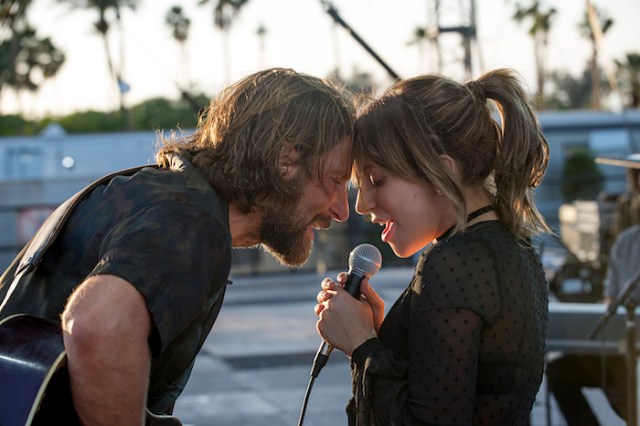
 It didn’t take much to make the latest iteration of A Star Is Born better than its immediate precedent, the Streisand-Kristofferson vehicle, which has become something of a camp classic while retaining its critical rep as a dog. Nevertheless, there are parallels worth exploring, the most obvious being the provenance of their four respective leads. In 1976, Kristofferson was probably better known to the general public as an actor than he was as the singer-songwriter that first brought him fame. Casting him as an arena rocker seemed predicated on his particular hirsute handsomeness, but his naturally gruff amateurism made the character, if not the performance, more sympathetic than it should have been. Streisand, on the other hand, was playing as furiously against type as her own immediate forebear, Judy Garland, had been in the 1954 remake: one of the hugest stars of the moment pretending to be an ingenue. This push-pull between her image and Kristofferson’s at the height of rock’s ascendance in pop culture was ridiculous to behold, despite a script by Joan Didion and John Gregory Dunne that turned the melodrama back on itself.
Lady Gaga is arguably on the same plane of career development that Streisand was at, but here she has the advantage of no acting experience. More to the point, her popular image as a chameleon whose appeal is at least partially credited to makeup and wardrobe and stage spectacle has been discarded for a disarming naturalism that makes her character, Ally, much more sympathetic than Streisand could ever be. Like Kristofferson, Bradley Cooper, as the country-rock star Jackson Maine, is going against his grain by singing and writing his own songs for the first time in a movie. In a sense, both Gaga and Cooper, who also directed, feel fresh, and that makes their romance on screen feel appropriate and believable.
But this sort of distinction only works for so long, especially in a movie whose story everyone knows pretty well. The differences are in the details—Maine first eyes Ally in a drag bar where he’s retired post-gig to nurse his alcohol jones, Ally is motherless but the apple of her limo driver dad’s eye (Andrew Dice Clay, being nice for once)—and the interesting addition of Maine’s older brother, Bobby (Sam Elliott), a failed musician who raised Jackson after their elderly father died and basically turned him into the musician he became. Though Bobby is the most blatant melodramatic device in the film, Cooper handles the dynamic with an eye on the development of the story as a tragedy that gives the overall contour of the plot more room to work its sad magic. Consequently, the chemistry between Gaga and Cooper is much more convincing than it was between Streisand and Kristofferson or, for that matter, between Garland and James Mason. The songs are also a hell of a lot better than the schlock in the 1976 version.
So why is that the movie felt flat in the end? Whatever my reservations about the miscasting of Kristofferson and Mason in roles that were out of their wheelhouses, they transcended their respective cliches by not trying too hard. Their tragedies were that their love was strong but their characters weak, and both actors recognized that once you are resigned to that truth, there’s only one resolution. Despite Bobby’s sage blandishments, Jackson never seemed to get this part—he might as well have been despairing over the tinnitus that threatened to stop his career. And Cooper underplays so skillfully that when he does the terrible deed you almost feel you’ve missed it. Ally’s grief is poignant without being particularly deep, and the big musical finish feels as gratuitously corny as it did when Streisand did it, except that Streisand is expected to be brassy and obvious. Gaga can’t be faulted for doing what she’s told, but she seemed strangely diminished.
Now playing in Tokyo at Toho Cinemas Nihonbashi (050-6868-5060), Toho Cinemas Hibiya (050-6868-5068), Marunouchi Picadilly (03-3201-2881), Shinjuku Wald 9 (03-5369-4955), Shinjuku Picadilly (050-6861-3011), Toho Cinemas Shinjuku (050-6868-5063), Human Trust Cinema Shibuya (03-5468-5551), Toho Cinemas Roppongi Hills (050-6868-5024).
A Star Is Born home page in Japanese.
photo (c) 2018 Warner Bros. Entertainment
 I’m probably not the first person to think that Ralph Wrecks the Internet would have been a better title for this sequel to the Disney hit Wreck-It Ralph, since it would have taken better advantage of familiarity with the original. However, these days people know more about a Disney-related film before it’s released than after, and having enjoyed Wreck-It Ralph without necessarily being invested in it—the digital video games it referenced had no traction on my life back in the day—the possibility that the main characters—the lamebrained, sentimental, muscle-bound title character (John C. Reilly) and the sweet-voiced, diminutive, super competitive race car driver Vanellope (Sarah Silverman)—would be moving out of the circumscribed universe of arcade games into the infinite possibilities of the Internet—a world, for better or worse, that I am invested it—was immediately intriguing.
 It seems, well, almost Grinch-like to complain about a new Christmas movie while we’re smack dab in the middle of the Christmas season, but, then again, The Grinch isn’t new. This is the third film iteration of the beloved Dr. Suess holiday story and people my age who grew up with the half-hour TV special will probably tell you that was good enough for them, especially when compared to the 2000 live-action feature film version starring Jim Carrey at his most scene-chewing obnoxiousness. Both that version and the latest one, a CGI animated creation by Illumination Studios, require a lot of padding to make a feature and Theodore Geisel had nothing to do with the script, so you sort of get what you might expect when Hollywood takes a classically idiosyncratic piece of art and tries to stretch it out.
 Here’s
  As a Canadian film acquaintance put it, Our Departures is a classic Shochiku release: sentimental, not too dramatic, and warmly funny in spots. It’s also about the importance of family, even if the family in question is unconventional, but, then, that seems to be the point. Jun Kunimura plays Setsuo, a veteran train driver in rural Kagoshima who is set to retire, much to the chagrin of his superiors, who, due to depopulation, don’t think they can find a replacement soon enough. Setsuo, a widower, lives alone in that kind of stoical self-sufficiency real men in Japanese films tend to manifest. One day, a young woman, Akira (Kasumi Arimura) and an elementary school-age boy, Shunya, show up on Setsuo’s doorstep. They turn out to be his estranged son’s second wife and son, who have come from Tokyo to inform Setsuo that his son died suddenly. Apparently, Akira tried to call many times but Setsuo has a habit of not listening to his old-fashioned message machine.
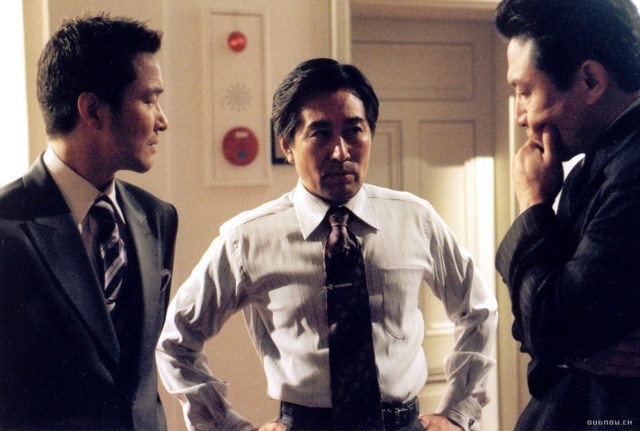 The following interview was conducted at the Pusan International Film Festival in October 2006. It originally appeared in The Japan Times.
 Israeli director Ofir Raul Graizer’s debut feature is a deceptively wicked take on romantic transference in that his strikingly unusual plot devices don’t seem that striking when they happen since they are so seamessly woven into the fabric of the story. Put bluntly, The Cakemaker is a love story between a young German man and not one, but two Israelis, a man and a woman, and while Germany as a country has done its best to reconcile with the Jewish people over its genocidal actions during World War II and is now a staunch supporter of Israel, the scenes where the German character interacts with Israelis on the latter’s home turf show how the relationship is still fraught with uneasiness. But it’s the second plot device, which connects directly to the first, that makes this movie more than a cross-cultural study. For those of us who know about Israel only through the news, it’s an eye-opening revelation, though to Israelis it’s everyday life.
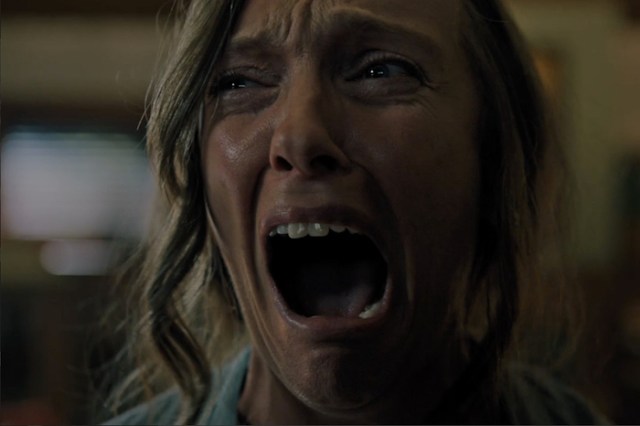 By far the most effective element in Ari Aster’s debut horror movie is Toni Collette’s face. Hereditary veers wildly and often incomprehensibly between domestic psychological drama and occult mystery, and the only thing holding it together is Collette’s command of her character’s mixture of incredulity and base terror. She plays Annie, a diorama artist grieving over her recently deceased mother, whom she never really liked but nonetheless felt connected to in a primal way she never understood. Her family—ineffectual psychiatrist husband Steve (Gabriel Byrne), 16-year-old pothead son Peter (Alex Wolff), slightly developmentally disabled 13-year-old daughter Charlie (Milly Shapiro)—empathize with her but mostly stay out of her way through the fitful funeral and its aftermath. When the mother’s grave is subsequently vandalized, Annie’s torment intensifies, and she joins a grief counseling group, where she meets Joan (Ann Dowd), who has a lot of peculiarly apt advice.
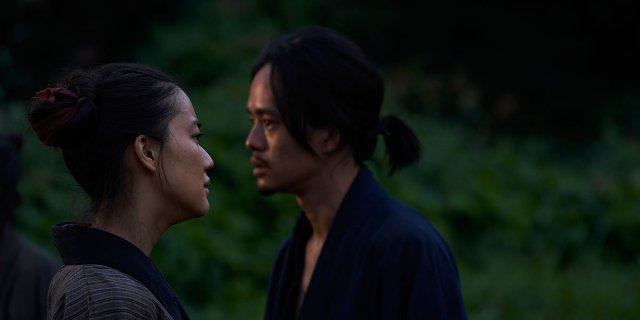 Director Shinya Tsukamoto wants people to come to his latest feature prepared for something different, which may sound like quasi-spoiler fodder given that it’s Tsukamoto’s first genuine genre film, namely a jidaigeki or, more familiarly, a samurai flick. But anyone familiar with Tsukamoto’s previous work will likely expect more than the usual gore, given the filmmaker’s penchant for grotesquerie. And, to a certain extent, there is a lot of blood, though not as much as there was in his World War II churner, Fires on the Plain. What’s different is his protagonist, Mokunoshin (Sosuke Ikematsu), a ronin who has decided he will have nothing to do with killing. Modern viewers will think of him as a pacifist, but the impulse is deeper, less philosophical. Mokunoshin is physically sickened by violence.
 philipbrasor.com