
 To anyone who filters the DC Comics cinematic universe through the overwhelming success of the brand’s rival, Marvel Studios, Aquaman the movie is best seen as a reply to the Thor series, which is where Marvel pointedly plays up the most ridiculous attributes of superhero blockbusters. Aquaman the character has always fit into a dodgy slot in the realm of comic fantasy as a guy who is half Atlantean-half American and talks to fish. And while there’s plenty to laugh at in the movie, its interminable length and earnest attempt to stuff as much “incident” into its two-and-a-half-hour running time leaches all the humor out of it.
The main difficulty faced by director James Wan is not so much the visual challenge of making underwater action scenes feel credible—for what it’s worth, they look perfectly OK—but rather squaring the epic prerogatives of an aquatic empire with the relatively real-world concerns of modern-day landlubbers. Aquaman/Arthur Curry (Jason Momoa) is the son of Queen Atlanna (Nicole Kidman), who has escaped the royal confines of her birthright, and the human lighthouse keeper Tom Curry (Temuera Morrison), who discovers her half-alive and washed up on the rocks below his keep. Atlanna eventually returns to Atlanta and Arthur grows up a bastard, but the main reason he’s bullied as a child is his affinity for fish and all things marine; and for most of its first 30 minutes the film makes for a compelling origin story. It’s when Arthur has to confront his fishier half that things become problematic plot-wise and thematically.
For one thing, the script relies too heavily on the viewer’s understanding of the mythology of Antlantis, which feels almost made up on the spot. Then there’s the surfeit of characters whose rationalization of good-vs.-bad becomes baffling very quickly. When Mera (Amber Heard) arrives at the lighthouse to beg him to claim his birthright from his evil half-brother, Orm (Patrick Wilson), the stakes seem clear, but then the writers throw in lots of complicated iconography, including a trench where exiles are punished, an extraneous super-villain named Black Manta (Yahya Abdul-Mateen II), a trusty royal advisor (Willem Dafoe), and a plot by Orm and his father, King Nereus (Dolph Lundgren) to make war on the human race. It’s this last bit of story that brings Aquaman into his own, but getting there proves to be a confusing, incoherent journey. The battles are vivid and ingeniously staged, but when things calm down the compositions feel overly stylized, like those tacky environmental paintings that were so popular in the 80s. Momoa, it should be pointed out, takes the ridiculousness of his character in stride, and the movie would have been funnier if it weren’t so damned busy.
Now playing in Tokyo at Toho Cinemas Nihonbashi (050-6868-5060), Toho Cinemas Hibiya (050-6868-5068), Marunouchi Picadilly (03-3201-2881), Shinjuku Wald 9 (03-5369-4955), Shinjuku Picadilly (050-6861-3011), Toho Cinemas Shinjuku (050-6868-5063), Shibuya Toei (03-5467-5773), Toho Cinemas Roppongi Hills (050-6868-5024).
Aquaman home page in Japanese.
photo (c) 2018 Warner Bros. Ent. and DC Comics
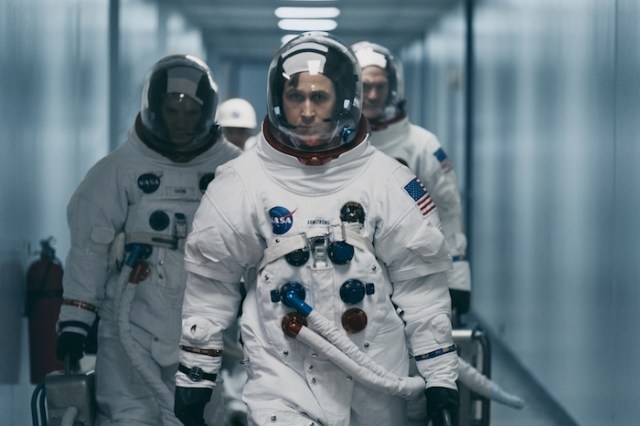 Damien Chazelle’s third feature is an oddly circumspect blockbuster. Though this biopic of Apollo 11 astronaut Neil Armstrong fits neatly into the big-budget hero stylings of The Right Stuff and Apollo 13, its focus on a character who was basically unknowable makes for a striking contrast in tone. The action set pieces are as good as space movies get, while the expository drama has a purposeful flatness that often feels inert. And while Ryan Gosling doesn’t look anything like Armstrong, his patented lack of affect sort of prepares you for the Enigma of Neil. In those rare instances where some sort of meaning peaks through the blank facade, the viewer feels they’ve learned something monumental.
 The decision to have Japan’s most famous amateur rock guitarist, Guitar Wolf, open for the Cramps at their Tokyo area shows is understandable, since both artists channel early American rock and stake their professional reputations on outrageous stage antics.
 Thematically and structurally similar to 45 Years, which also starred Charlotte Rampling as the wife of a man who undergoes a startling change in situation, Andrea Pallaoro’s heavily circumscribed character study is less emotionally involving but more evocative. Set in France, the movie keeps its focus on the title character, an unassuming and undemonstrative housewife whose husband (Andre Wilms), we gradually learn, is about to embark on a lengthy prison stay. The opening sequence, which finds Hannah dutifully packing a back for her spouse, is so devoid of dramatic signifiers that as the truth reveals itself the viewer may find himself questioning his eyes…though not his ears. There is virtually no dialogue for the first ten minutes or so.
 Before he became the most vital director of the Korean film renaissance, Lee Chang-dong was a successful novelist, and the most penetrating aspect of his movies is their unpredictable but nevertheless natural plot developments. In his two best films, Oasis (2002) and Poetry (2010), he sets up simple storylines that stress character interactions and then tests those interactions by setting off catastrophes that are both shocking and seemingly inevitable. Consequently, the melodrama that is so intrinsic to the Korean cinema sensibility feels neither sentimental nor contrived, making for the purest catharsis.
 Pardon me if I initially confused Gary Hart with John Edwards. Though the two presidential candidates’ respective career-destroying sex scandals happened almost two decades apart, they tend to blur together in my mind. All those WASPy Democrats look alike, I guess.
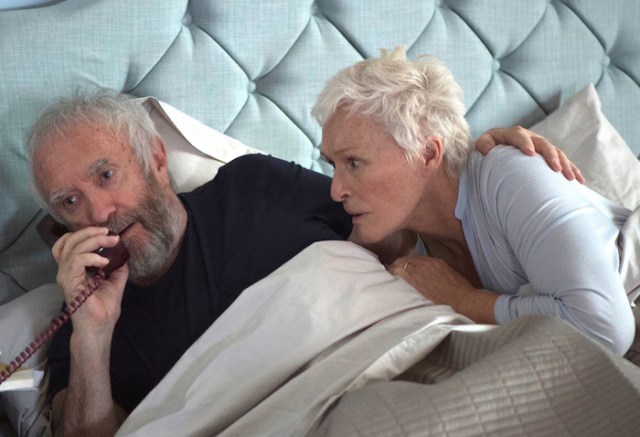 Glenn Close’s surprise Golden Globe win for Best Actress in a Drama already pegs Bjorn Runge’s film as a must-see mediocre movie, and, in truth, Close makes it worth your money. As the wife of blowhard writer Joe Castleman (Jonathan Pryce), who is being awarded the Nobel Prize for Literature, Close conveys her character’s mixture of horror and self-satisfaction with unusual delicacy. Why the wife of a man who is being feted for such an achievement has such polarized feelings is the question at the heart of the story’s conflict, and as high concept it’s a doozy, which is why the movie doesn’t live up to its star’s portrayal of the title character—Runge won’t leave well enough alone.
 Few genres have become as formulaic as horror movies, and one of the better things you can say about Luca Guadagnino’s reimagining of Dario Argento’s 1977 slasher classic is that it avoids the cliches you expect. Unfortunately, it replaces them with other cliches, mostly from opera and political thrillers. In fact, it’s probably best not to categorize this new version of Suspiria as a horror film, since it will mislead fans of the genre—there’s not a whole lot of suspense, and rather than gore the film charges its shocks with unsettlingly bizarre visuals—and repel those who usually eschew horror movies, though even this latter group might find it difficult to swallow.
 Though horrific in intent, this French film about a battalion of Kurdish women fighting against the Islamic State in Iraqi Kurdistan avoids scenes of overt violence and goes rather light on the gore. It’s both a relief and a cop-out, since what’s left of Eva Husson’s movie is mostly suffering for the sake of suffering.
