
I just watched Lauryn Hill’s performance at the Pitchfork Festival in Chicago online and marveled at how little her live show had changed in 20 years. Here’s my take on her first tour, which was published in the Japan Times but isn’t on the internet.
Lauryn Hill opened her Jan. 21 Budokan concert—the first date on her inaugural world tour—by singing the gospel standard, “His Eye is on the Sparrow.” With the hall lights down, Hill delivered the song offstage to only organ accompaniment, as if it were an invocation. “I sing because I’m happy,” goes the most memorable line, which rides on an ascending glissando that’s supposed to indicate a closer proximity to God through singing. Hill did without the glissando, and though it might have been a simple stylistic decision, it gave the line a more secular feel, setting the tone for what was to come.
God knows, Lauryn Hill has much to be happy about. Her debut solo album, The Miseducation of Lauryn Hill, has topped every entertainment-related publication’s best album list for 1998, and has sold more than three million copies in the U.S. alone. She is in constant demand as a writer and producer, having already worked on tracks for, among others, Aretha Franklin, Whitney Houston, and Cece Wynans. And she’s been nominated for every Grammy there is except microphone placement.
By themselves, these accomplishments and accolades don’t necessarily add up to anything more than flavor-of-the-year status, but Hill offers something that few 23-year-old superstar divas would even conceive of. More than simply aiming to be the baddest (male or female) M.C. or the richest (all connotations) soul singer on the block, Hill means to be the conscience of her community.
And when I say community, I’m talking borderless. The warmth in the ovation that greeted the singer as she took the stage with her huge complement of musicians, DJs, and singers was unmistakable. Tottering about on perilously stacked heels, and singing “Ex-Factor,” a song about the shock of suddenly realizing that the love you thought was permanent is not, there was something jarring about the juxtaposition of the desperation in the vocals with the outpouring of affection from the arena. “This is crazy,” she sang.
Hill attracts this kind of devotion because she situates everything she does in the realm of the personal. Her life is an open book. Hip-hop, of course, is dominated by the self-promoting confessional voice, which says if you don’t like how I’m living, it’s too bad. Hill’s candor is different, since it attempts to make sympathetic listeners out of everyone in earshot. On the standard rap boast “Superstar,” which she sang next, her targets are somewhere else. All of us in the house were made to feel we were in on the bitchy jokes (“if your rhymes sound like mine/I’m taking a percentage”), because the bad guys are too dumb to get it.
Consequently, her modified Fugees medley had a certain gleeful bite. Hill came of age in the group, and not just musically. The Fugees dared to fight the hip-hop status quo—there was a mission to their music—and when she broke with Wyclef Jean and Pras it was obviously more bitter than it would have been had the split been simply a creative one. In concert, she kicked “Fu-Gee-La” up into a faster, more danceable tempo and played with the tension throughout “Ready or Not,” wherein the band achieved a dub laxity that grooved irresistibly. The audience, again, was happy to be in on the rub. Continue reading

 Though more photographically distinctive than the Go Pro-recorded factory ship documentary, Leviathan, Rahul Jain’s meticulous study of a huge textile factory in Gujarat, India, is similarly obsessed with the process of labor and how mechanization complements human actions rather than supplements them. Jain’s purposes are more activist, some might say political, since there are also interviews with workers and management that clearly show the class dynamics at work. Rodrigo Trejo’s beautiful cinematography almost aestheticizes the grind, and in the end it may turn people away from the film’s most powerful implication, that mechanization both demeans human effort and destroys everything that comes into contact with it. A similarly themed movie shot in Europe or North American might convey a totally different message, but by showing in clear detail the garbage and heat and dim working conditions of this textile factory Machines goes the extra mile to tell us that the industrial world still has a long way to go toward recognizing the human dignity of manual labor.
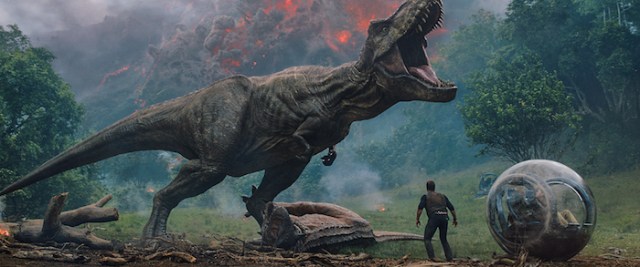 Though it wasn’t necessarily inevitable that the Jurassic Park franchise would get this far 25 years after it began, it was inevitable that if it did get this far the animals themselves would be portrayed as victims rather than whatever it is these days qualifies as the opposite of victims. When last we visited Isla Nubar, where the uber theme park Jurassic World imploded thanks to the double dealings of 0ne-percenters who saw money in cloning dinosaurs for nefarious purposes, it seemed obvious that humans and big lizards would never get along and so they were left to their own devices, so to speak. Now, it turns out, the island is undergoing volcanic activity that threatens a second extinction for the dinosaurs left there, so naturalist Claire Dearing (Bryce Dallace Howard) and her team of bleeding hearts once again enlist the help of dino wrangler Owen Grady (Chris Pratt) to help them evacuate the beasts to somewhere safer.
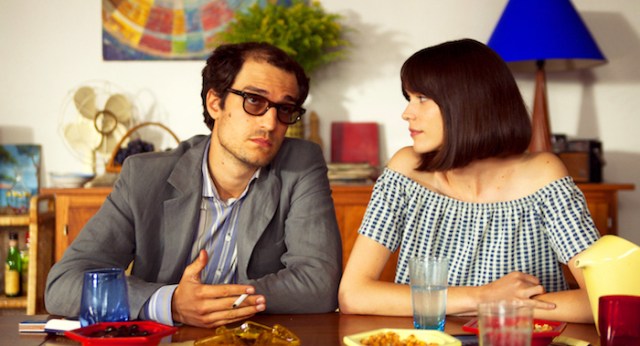 On the surface, Michel Hazanavicius’s decision to adapt a chapter in Jean-Luc Godard’s love life as a romantic comedy makes a certain amount of sense given the early New Wave crowd’s love of classic Hollywood screwball comedies, but Hazanavicius invariably falls into the trap that even modern American directors can’t avoid when tackling romantic comedey: the impulse to be cute. Though casting Louis Garrel, with fake receding hair and thick-rimmed glasses, as JLG was a minor stroke of genius, choosing Stacy Martin to play his first wife, Anne Wiazemsky, was a little too on the nose. There’s no doubt that this is a fictionalized version of their relationship, but the sight of JLG acting all super sophisticated and intellectual while Wiazemsky purrs and wrinkles her nose is only funny one time.
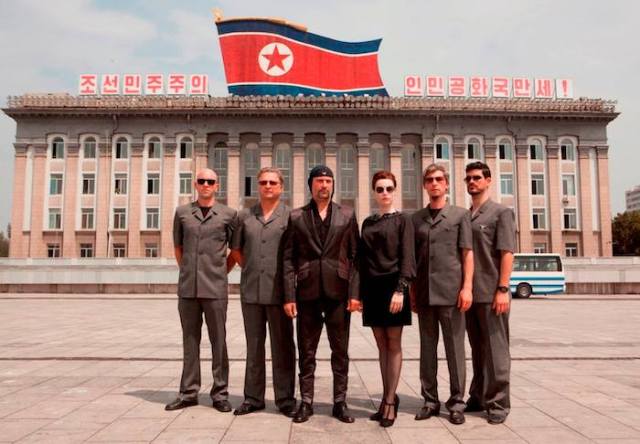 There are actually too many intriguing premises for this spiky documentary directed by two Scandinavians. The overall premise is compelling enough: a Slovenian art-rock band becomes the first foreign pop outfit to play a concert in Pyongyang that’s approved by the government. But even beyond that enticing possibility there are other questions that could very well form the basis of their own documentaries. The band, Laibach, for instance, is famous in Europe for being provocateurs in every conceivable way. They formed when Slovenia was still part of Yugoslavia and were an active thorn in the side of the government with their abrasive, industrial, strident, but no less melodic pop songs, many of which were ironic standards. For instance, they’ve played concerts that consisted of nothing but songs from The Sound of Music. They also appropriate Nazi imagery as a means of keeping everyone who sees them on their toes, because despite the martial frippery they seem opposed to both ends of the socioeconomic spectrum, as suspicious of communist ideals as they are of capitalist truisms.
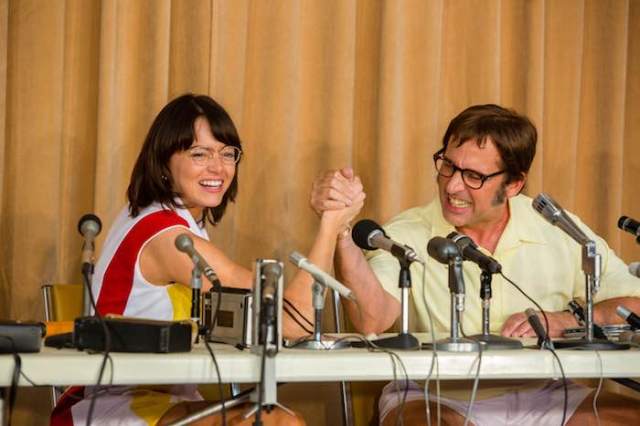 Movies that realistically depict the 1970s force those of us who remember the decade as firsthand observers to slog through several layers of subtext. Valerie Faris and Jonathan Dayton’s film covers one of the seminal “progressive” events of that time, the contest between former professional tennis player Bobby Riggs (Steve Carrell) and the current women’s tennis champion, Billy Jean King (Emma Stone)—the first woman to be named Athlete of the Year by Sports Illustrated—which became more about personal PR than women’s rights. The more immediate problem with Battle of the Sexes is that Faris and Dayton’s direction doesn’t quite do justice to Simon Beaufoy’s nuanced script. The directing couple seem to be taking their technical cues from David O. Russell, who tends to substitute genre and period signifiers for potent plot points that would actually advance a story. Consequently, the viewer fixates on the musical cues, the automobile models, the wallpaper, the cheesy fashion sense, and relate it all to the story, as if those things determined character and attitudes rather than the other way around. Carrell and Stone, two actors firmly identified with the most recent decade of Hollywood, only intensify this cognitive dissonance.
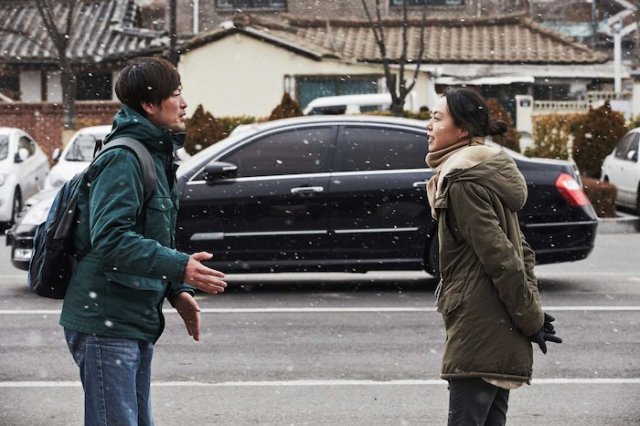 Hong Sang-soo’s Right Now, Wrong Then, released in South Korea in 2015, is finally opening in Japan, though it should be mentioned that Hong’s films are not temporally fixed. Current events or even trends have absolutely no purchase on his stories. Even the fashion sense is strictly generic. Right Now is one of Hong’s experiments in bifurcated narratives, and while it doesn’t really do anything different with the form, it does show incremental improvements in his command of it when compared to past experiments, like In Another Country.
 Here’s
 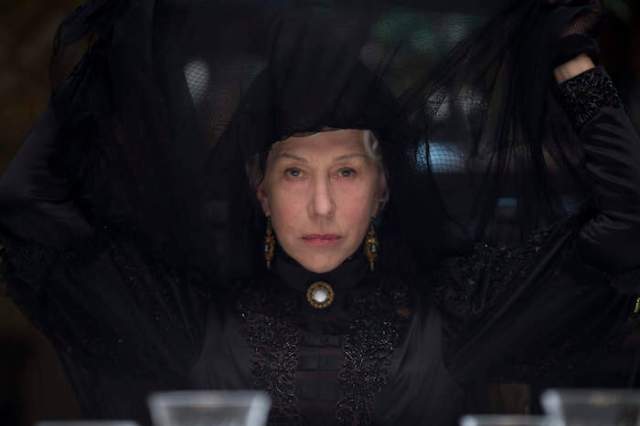 During the horror film’s formative heyday in the 80s, trashiness was next to godliness. Perhaps by necessity, the gory goings-on were delivered via hilariously ridiculous plots that were gentle on whatever degree of intelligence was brought to the proceedings. Even a fairly sophisticated shocker like Dressed to Kill was, at base, a comedy.
 philipbrasor.com