
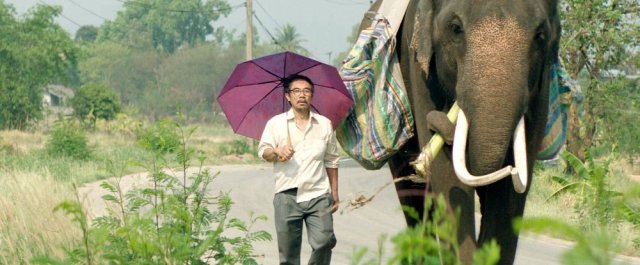
 The titular elephant in this Thai film is named after the iconic cartoon sailor, though I can’t really fathom the title’s unconventional spelling. In a way, the linguistic disconnect expands on the movie’s sometimes jarring juxtaposition of universal themes and local particulars. The hero is a successful architect, Thana (Thaneth Warakulnukroh), who is going through the usual mid-life crisis (failing marriage, loss of direction, etc.) and one day happens upon a man trying to move an elephant along a Bangkok street. Convinced the elephant is Popeye, his childhood pet when he lived in the deep countryside, he buys the animal off the man and sets out to “bring the elephant home” on foot. In other words, Pop Aye is a classic road movie of self-discovery except that we have no insight into the mindset of one of the members of the entourage.
Several times during the movie, the director, Kirsten Tan, suggests that the elephant isn’t what Thana thinks he is, but this subtext of self-delusion becomes inseparable from the general feeling of total incompetence. Thana may have once been a good architect, but he now seems lacking in basic motor skills and common sense. Through flashbacks, we learn that even at work he has become little more than a figurehead at his company. The young bucks are running things. Similarly, Thana’s relationship with his wife is thwarted more by his inability to communicate directly than by the usual breakdown of affections that accompany a longterm romantic partnership. Thana’s pathetic, but it’s difficult to feel sorry for him.
Consequently, the misadventures that characterize the road trip through hot and dusty countryside are difficult to comprehend from a dramatic standpoint. It’s obvious Thana is longing to recapture some of the simple joy that he remembers from his childhood, but nostalgia is a fickle mistress: she only reveals what her lover wants to see and hear. It’s thus a pleasant turn of events when Thana meets Jenny (Yukontorn Sukkijja), a transgender woman, in a roadside bar who seems to complete Thana in ways other characters, including his wife, do not. There is no sexual tension but, especially in a moving scene where they perform a karaoke duet, a shared feeling of being different and, in each other’s company, relaxed with that feeling. Encounters with other interlocutors—a suicidal drifter, Thana’s uncle who raised him, presumably in an indifferent manner—are much less consequential, though that may be an unintended result of Tan’s underwhelming directing style.
Through it all, the elephant (named Bong, who, interestingly, gets top billing) is mostly a cipher. Even animal lovers will have a hard time finding him cute or endearing. He’s a vehicle in more ways than one, a means for Thana to confront his own obsolescence as a man and member of society. Elephants get a pass in Thailand, apparently, and Popeye expresses no particular feelings toward Thana that we can discern. His presence is merely grounding and calming, as if Tan were afraid Thana by himself was too distressing a figure to focus on.
In Thai. Now playing in Tokyo at Euro Space Shibuya (03-3461-0211).
Pop Aye home page in Japanese.
photo (c) 2017 Giraffe Pictures Pte Ltd., E&W Films, and A Girl and a Gun.
 The Brothers Grimm story from which this French animated film has been adapted is not one of their more famous ones, but it has all the non-Disney hallmarks that have made the fairy tale-meisters the darlings of comparative lit majors. It’s fixated on graphic violence and sublimated sex, but it’s also about the human capacity for cruelty that goes beyond the kind of cartoon villainy we’ve come to expect from stories like this. The fundamental reason the story is so powerful and suggestive is the animation itself, which not only eschews CGI, but also the kind of cell-craft that most people are familiar with.
 Charlize Theron’s second feature with director Jason Reitman and writer Diablo Cody is more sentimental than Young Adult but every bit as irreverent, which may sound like a contradiction in terms. Theron plays Marlo, the pregnant mother of an autistic kindergarden-age son, Jonah (Asher Miles Fallica), and a nine-year-old daughter, Sarah (Lia Frankland). Her devotion to her children is unconditional and almost tragic in the contours of the difficulties she faces. Marlo knows that Jonah causes problems for the staff at the school he attends and is guiltily thankful they even accepted him—that is, until the principal brings up the possibility that he might be better served somewhere else. This early in the story you can see her slow meltdown begin, and though Cody cagily deflects our attention from the real issue a pattern is set that keeps the viewer off balance.
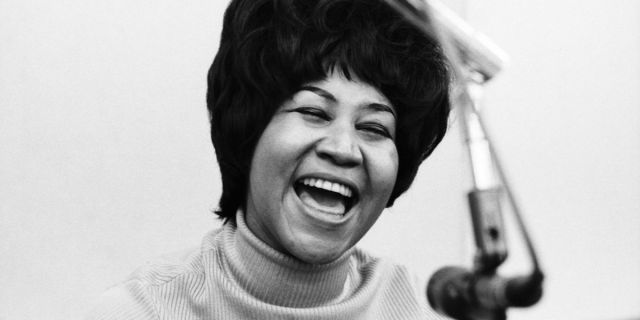 I first heard Aretha Franklin when I was 11 years old, listening clandestinely to my small transistor radio tuned to WABC (or was it WMCA?), which was tucked under my pillow as I was supposed to be sleeping. Like my mother I was an insomniac, though unlike my mother I would eventually outgrow it. We had strict bedtimes and it always took me several hours to fall asleep, so I would put my radio under the pillow and listen to music, or to Jean Shepherd tell stories on WOR.
 Given the casting of Hugh Bonneville in the role of Lord Louis “Dickie” Mountbatten, the last British viceroy of India before independence, it’s easy to guess that the producers wanted direct comparisons between this dramatic recreation of the summer of 1947 and Downton Abbey, though it more rightly resembles Upstairs/Downstairs in its contrast between the political machinations of the British overlords and the romantic goings-on among the servants in the titular establishment.
 Christopher McQuarrie returns to direct the sixth installment of Tom Cruise’s vanity project, which he has every right to be proud of, and not just because it continuously breaks box office records internationally. For what it’s worth, the Mission: Impossible franchise is the most seaworthy of action vessels, but that reliability is only partly due to its watertight premise based on the famous 1960s TV series about a secret organization that tackles cases too difficult for the usual U.S. government intelligence bodies. What generally keeps the series afloat is Cruise’s unflappable penchant for his own impossible stunts and scripts that are not built to be taken seriously by anyone.
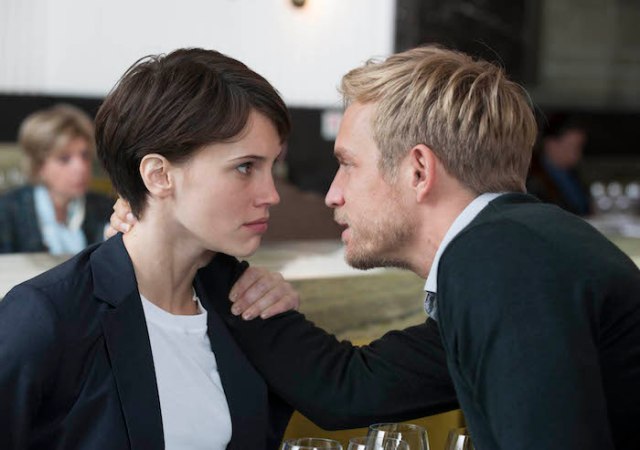 Though Francois Ozon has made an enviable reputation for himself by being both prolific and consistently engaging, his best movies are throwbacks to enduring styles that have never really benefited from being updated. Double Lover falls into this category. It’s the kind of psychological thriller that Hitchcock not only invented in cinematic terms but seemed to have perfected before anyone else tried to recreate it. Though relatively free of shock value and suspense, the movie nevertheless casts a queasy spell that lasts well after the lights go up.
 Here’s
 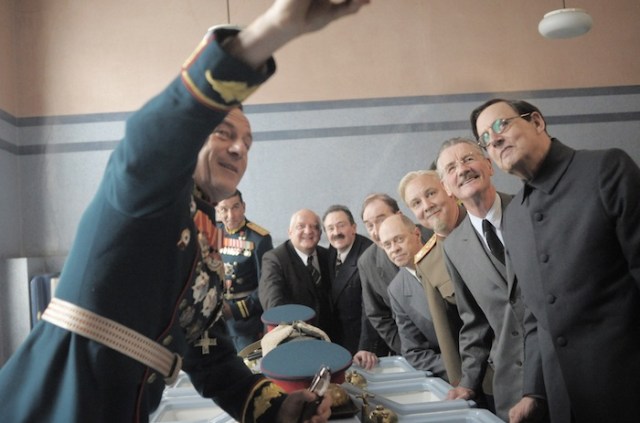 As he proved with the 2009 political satire, In the Loop, director Armando Iannucci is not afraid to delve deep into the curdled souls of ambitious men and women for comedy that smarts more than it entertains. He is the reason a wholly offensive TV show like Veep works as well as it does, and his reimagination of the inner-Kremlin machinations following the sudden death of Joseph Stalin in 1953 is funny for the same wincing reasons, but it offers something even more subversive: History you can use and laugh at at the same time.
 Though Pixar and Marvel are two separate production companies, both are distributed by Disney, a context that becomes problematic as the sequel to one of the best Pixar movies ever begins. The superhero Parr family battles a villain called the Underminer in Metroville and in the process destroys the city in order to save it. That is the same plot device that activated one of the Avengers movies, so you accept that fact as either a comment on Marvel or a shameless simulation of the studio style.
 philipbrasor.com