
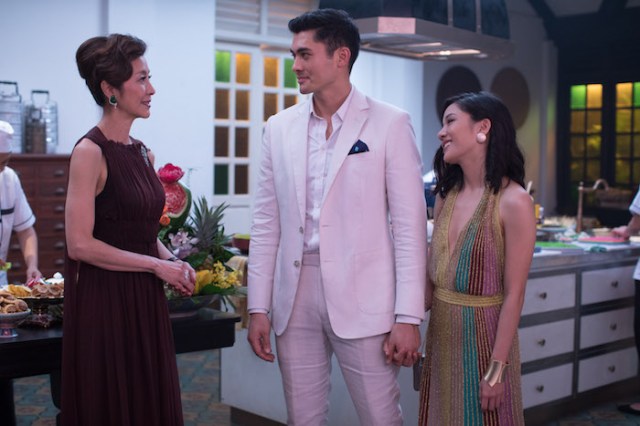
 As some of my colleagues have noted, the Japanese arm of Warner Bros. has dropped “Asians” from the title of this surprise box office hit, and while we can probably surmise the reason for the elision, the Japanese socio-historical relationship with its continental neighbors is so fraught with problematic baggage that any attempt to parse it would likely result in the inflation of bad stereotypes.
In any event, the movie is pure product, and we know what Tinsel Town has done to any Japanese subject matter. Here, the principals are Chinese-Americans and Singaporeans, none of whose economic circumstances place them below what used to pass for the upper middle class in New York City, where Rachel Chu (Constance Wu) grew up and where she met her future fiancee, Nick Young (Henry Golding), the scion of a wealthy Singaporean real estate dynasty, though Rachel doesn’t really know that until Nick flies her home for the ostensible purpose of attending the wedding of his equally privileged cousin, Colin (Chris Pang). The real reason for the long, expensive journey is to introduce Rachel to his domineering mother, Eleanor (Michelle Yeoh), who, predictably, doesn’t approve of Rachel, and not just because of the class and nationality differences. There’s a clear indication that Rachel’s brand of Chineseness is not acceptable to Eleanor, whose own relationship to her ethnic heritage is so narrow as to comprise a separate country.
But since this is a classic romantic comedy, these charged themes are played for laughs more often than not. The Youngs’ extravagance mirrors that of Katharine Hepburn’s family in The Philadelphia Story in that it’s easy to poke fun at from an average person’s standpoint, most of which is alluded to in the jokey exchanges that Rachel has with her college pal Peik Lin (Awkwafina), a native Singaporean who knows both sides of the divide only too well. Even more ridiculous is her father, who, as played by the already insufferable Ken Jeong, is as cartoonish as a Chinese character can be without being played by a white person.
Of course, the reason Crazy Rich Asians is a hit as a movie (I can’t comment on the novel, not having read it) is that it seems to say something to Chinese-Americans about their situation (maybe not so much to Chinese living in Asia) while giving them characters and actors who represent them wholeheartedly. Consequently, I got little to chew on from the scenes about mah jongg and moon cakes, though the slapstick and absurdist circumstances surrounding the actual wedding reception and ceremony rise above cultural signifiers. There’s actually nothing that’s really surprising about Crazy Rich Asians. It’s a standard rom-com-at-the-wedding storyline highlighted by dozens of extremely beautiful people occupying opulent sets and acting in character. It’s the most Hollywood movie I’ve seen in a long time.
Now playing in Tokyo at Shinjuku Picadilly (050-6861-3011), Marunouchi Picadilly (03-3201-2881), Toho Cinemas Nihonbashi (050-6868-5060), Human Trust Cinema Shibuya (03-5468-5551), Toho Cinemas Roppongi Hills (050-6868-5024).
Crazy Rich Asian home page in Japanese.
photo (c) 2018 Warner Bros. Entertainment Inc. and SK Global Entertainment
 It’s no scoop to say that the IMAX format dictates the production of certain movies, since it’s difficult to imagine a Hollywood conference call where, after a movie has been greenlighted and cast, someone thinks out loud, “Hey, maybe this would work on a towering screen!” The latest Dwayne Johnson vehicle, in which the former wrestling hulk shares top billing with a 4,000-foot CG Hong Kong office-and-residential building, was obviously made with the IMAX format in mind, and after you think carefully about it, Johnson is the only A-list actor at the moment who could have starred without wilting in the shadow of the titular edifice.
 Collaboration is more than just the theme of Agnes Varda’s latest curiosity. Teaming up with the tall-glass-of-water visual artist JR both on camera and behind it, the veteran nouvelle vague director expands her late career discussion of the French polity by engaging it in one of JR’s art projects, thus freeing herself up as more than just an enthusiastic observer of what is mostly rural life.
 Here’s
  I have yet to see Ryusuke Hamaguchi’s previous film, the internationally lauded 5-hour domestic drama Happy Hour, which, probably due to its length, hasn’t been picked up by WOWOW. But having read about its charms for almost a year I was intrigued to see his latest, which premiered in competition at this year’s Cannes. It’s much shorter and, based on a popular novel, apparently more manageable than Happy Hour. In fact, it’s pretty conventional in terms of plot and characterization. Hamaguchi’s strong point is his attention to personality detail. Despite the hackneyed dialogue and thin motivation that’s built into the story, he manages to make the people on screen seem familiar in a three-dimensional way, though, in the end, it isn’t enough to lift the narrative out of the pedestrian.
 It’s a good thing the second Ant-Man movie is above average, because it’s becoming quite a chore to fit all these Marvel superhero movies into the Marvel universe, at least as it applies to the Avengers movies, which seem to be the focus. Much of the plotting of Ant-Man and the Wasp is dependent on both the last Captain America movie and the last Avengers flick, though temporally they exist in different relative dimensions, and I found myself uselessly trying to recall the details of Avengers: Infinity War, which hasn’t taken place at this point, when I should have been concentrating on Captain America: Civil War, which is the reason our hero, Scott Lang (Paul Rudd), is under house arrest as the movie begins.
 Here’s
  Thanks to Japan’s complicated publicity machine, the sequel to the successful movie version of the very successful ABBA-inspired jukebox musical Mamma Mia! arrives well after most of the rest of the world has decided it’s a better movie than the original. The first thing that strikes me is pity for Meryl Streep, who basically saved the first movie from mawkish amateurism with her native ability as a stage performer and willingness to parlay her appreciation of the songs into a silly nostalgia romp. I don’t think I’m spoiling anything at this point by saying that Streep’s character is deceased in the sequel, a move that may have been production-oriented (Meryl may have simply thought once is enough) but was probably strategic, since the plot is divided into two parallel storylines taking place in different time periods. In the present, we have Donna’s (Streep) daughter, Sophie (Amanda Seyfried), preparing to reopen her mother’s Greek hotel, with or without the aid of her famously three fathers, Sam (Pierce Brosnan), Bill (Stellan Skarsgard), and Harry (Colin Firth). The other storyline depicts the early 20-ish Donna, played by the other young blonde go-to actress of the moment, Lily James, coming to the Greek island in question for the first time and meeting the three men who will seal her fate as not only a single mother of distinction, but a popular travel destination entrepreneur.
 philipbrasor.com