Review: The Death of Louis XIV

Recently, Christopher Nolan hailed Stanley Kubrick as the greatest director of all time, mainly for his ability to make nitrate film stock mimic the most sublime visual attributes of great paintings. Though he was thinking of 2001, Barry Lyndon is a better example of this attribute, and Barry Lyndon is the most obvious analog when discussing Catalan filmmaker Albert Serra’s The Death of Louis XIV. This is about as close as we’ll ever get to the richness of Rembrandt on film, and there are whole passages where all we have are closeups of faces that are doing nothing in particular but look like people from the 18th century.

The ostensible “plot” of the movie, based on memoirs of some of Louis XIV’s courtiers, is essentially the last month of the Sun King’s life. Having apparently injured his leg during a hunting expedition, the elderly monarch spends the entire movie succumbing to gangrene while in repose. We know we’re in Versailles not so much because of the extravagant wigs and costumes, but due to the obsequious behavior of the people who crowd around the soon-to-be deathbed, applauding every little gesture, even while the king is obviously in great pain. Played by Jean-Pierre Leaud, Louis is essentially a stoic facade occasionally wracked by coughs and horrible moans. Attempts to keep him in the pink through food and wine are met with impatient thrusts of the hand and withering smirks. In the only show of gallantry, he dons a stupid chapeau (the gesture bringing to mind Dylan’s immortal line of the “Leopard-Skin Pillbox Hat” balancing on the wearer’s head like a “mattress on a bottle of wine”) just in order to please the ladies in his midst. His reaction to their appreciation is the epitome of condescending disgust.

The film’s almost supernatural beauty confounds its theme of hubris in literal decay (the infected leg turns black in frightening degrees), so too much thematic analysis robs the viewer of the pleasure of not only Leaud’s nuanced performance, but the movie’s rightful status as moving painting rather than moving picture. Since the extended conversations among physicians as to the best course of treatment are basically pointless, they simply serve to provide tableaux that makes you wonder which Great Master Serra is ripping off at any given moment. The dialogue is inadvertently droll in that the only person in the room who sees the comic futility of much of the conversation is the dying king himself. Leaud’s face when someone remarks his “expression” has become more stimulating is horrifically priceless. The on-screen tone is solemn throughout, but you can imagine the actors cracking up at the implications of their work between takes.

In French. Now playing in Tokyo at Image Forum, Aoyama (03-5766-0114).

The Death of Louis XIV home page in Japanese

photo (c) Capricci Films, Rosa Filmes, and Ercraun Films, Bobi Lux 2016

Posted in Movies | Tagged , | Leave a comment

Review: Isle of Dogs

As a long-time resident of Japan whose interaction with the local culture is circumstantial, I don’t believe I have much to add to the conversation that has surrounded Wes Anderson’s latest entertainment and which mostly has to do with whether the director has exploited that culture without really understanding it. At first glance, I was more offended by the anti-cat bias of the storyline, but that, as they say, is just me. Narrative films rarely take the trouble to make whatever milieu they depict accurate in every sense since dramatic considerations usually come first. Generally speaking, if the dramatic elements work for me, I will appreciate, if not necessarily enjoy, the work on hand, and while I’ve had problems with Anderson in the past, I have come to like his movies the more I see them, which means he’s either getting better or I’ve just become used to his purposely quirky presentation.

That said, I prefer his previous stop-action animated film, Fantastic Mr. Fox, to Isle of Dogs, probably because I like Roald Dahl as a writer better than Wes Anderson as a scenarist. As usual, the plot of the new movie is busy to the point of delerium, an attribute that seems instilled by some sort of neurotic need to be challenged as a visual artist. Anderson is nothing if not an obsessive, and his intricately plotted stories are simply a means of testing his ability to achieve them filmically. This Japan exists only in his imagination because while he has openly admitted to the movie’s genesis as a homage to the Japanese films and directors he loves his characters have more in common with Anderson “types” and (thankfully) avoid traits that might be identifiable with national stereotypes. Consequently, the main speaking parts are given to dogs whose “barks” have been translated into English and spoken by famous actors, including Scarlett Johansson, Bill Murray, Edward Norton, Bryan Cranston, Tilda Swinton, and Jeff Goldblum. (This particular element, by the way, has been confounded by the local distributor, which has provided Japanese audiences with a dubbed option.) Linguistically, the movie is a mish-mash of two languages—English and Japanese—in all their filmic permutations, be it directly spoken, subtitled (or not), or simultaneously interpreted. That Anderson can pull it off is a measure of his skill but not his coherence.

Cognitive dissonance, in fact, is built into the premise. The fictional Japanese city of Megasaki scapegoats dogs because the mayor (Kunichi Nomura, who also helped conceive the story) prefers cats in accordance with some possibly made-up historical references to the shogunate. Consequently, Spots (Liev Schreiber), the canine pet of his orphaned nephew, Atari (Koyu Rankin), was shipped off to the island that serves as a municipal dump when he was young. Atari, as an adolescent, steals an airplane and flies to the island to find him, only to discover instead a whole society of dogs with whom he can’t communicate and who aren’t familiar with Spots, or, as they cryptically refer to him, “dog zero,” since the ostensible reason for the banishment of dogs is a disease called snout fever.

As with Moonrise Kingdom and The Grand Budapest Hotel, the complex back story is designed as bulidup to an elaborate action sequence that involves lots of Rube Goldberg contraptionality and each of the myriad characters fulfilling some kind of personal thematic transcendance. The main difference is that, as with almost any cartoon, the action can get distressingly violent without abandoning its comic tone, but the overall impression is that the plot elements in the second half, which include the intrigues of an American exchange student (Greta Gerwig) assisting Atari in his battle to save Spots and destroy his uncle, seem to have been devised in a vacuum. They’re in turn stimulating and cute, but only make sense in a stand-alone context. Anderson once again proves he’s a genius without necessarily producing a masterpiece.

In English and Japanese. Now playing at Toho Cinemas Chanter (050-6868-5001), Shinjuku Wald 9 (03-5369-4955), Shibuya Humax Cinema (03-3462-2539), Toho Cinemas Roppongi Hills (050-6868-5024), Ikebukuro Humax Cinemas (03-5979-1660.

Isle of Dogs home page in Japanese

photo (c) 2018 Twentieth Century Fox

Posted in Movies | Tagged , , , | 1 Comment

Review: Phantom Thread

In the rarefied setting that informs Paul Thomas Anderson’s latest luxury, the title “fashion designer” seems imprecise when describing the vocation of the protagonist, Reynolds Woodcock (Daniel Day-Lewis). He’s a dressmaker. All he makes is fine dresses for fine ladies. He is not, in fact, interested in fashion as an art form, though he obviously sees himself as something of an artist. More to the point, he’s an aesthete, a trait that Anderson emphasizes in the broadly conceived opening sequence, which shows Woodcock carrying out his morning ritual of dressing himself and then eating breakfast, preparations that are as vital to his vision of life as a series of beautiful choices as are his selection of fabric and filigree for his apparel.

Woodcock comes across as pompous and self-involved, but Anderson downplays these attributes to highlight his skills as a sketch artist and seamstress. The audience is never privy to his ideas with regard to what he’s making, but you get the idea through the details of the work. Woodcock’s dresses are, of course, an idealized function of the female form, but his dictatorial touch means that the women who wear them don’t have much say in their interpretation. So Anderson provides the master with two female foils, both represenatative of the 1950s London milieu in which the movie takes place. Woodcock’s sister, Cyril (Lesley Manville), is presented as the sensible business side of his undertaking, a woman whose practicality enrages her brother with her talk about the appeal of “chic” designers who may be drawing longtime clients away. Though elegant and poised as only an upper crust Brit can be, Cyril is essentially the vulgar side of the trade that Reynolds rejects as strongly as he would Frosted Flakes for breakfast.

And then there’s Alma (Vicky Krieps), a Francophone waitress whom Reynolds picks up while she’s on the job. He makes her his latest model, partly to get her into bed (apropos the Kubrickian rigor of the mise-en-scene, there are no sex scenes, however), but mainly to provide himself with the kind of inspiration that is fleeting in his line of work. Woodcock doesn’t require or even desire love, because he’s a narcissist, but he does demand attention and when Alma eventually asserts her own position within his sphere of importance, she becomes a bother.

If Phantom Thread lacks a compelling plot line, it makes up for it with shifting character developments that convey a specific time and a place with uncommon historical vividness. It is neither a love story nor a portrait of the artist as a stuck-up misogynist, but rather a study of a strange profession and the kind of man who is drawn to that profession because of his unique sensibility; which isn’t to downplay the women’s effect on that sensibility. Alma is one of the most interesting and complicated characters in all of Anderson’s movies. The fact that she isn’t the center of attention shows just how careful and dedicated an artist he is. He may have more in common with Woodcock than he’d care to admit.

Now playing in Tokyo at Cine Switch Ginza (03-3561-0707), Yebisu Garden Cinema (0570-783-715), and Shinjuku Musashinokan (03-3354-5670). From June 9 at Human Trust Cinema Shibuya (03-5468-5551).

Phantom Thread home page in Japanese

photo (c) 2017 Phantom Thread LLC

Posted in Movies | Tagged , , | Leave a comment

Media Mix, May 27, 2018

Here’s this week’s Media Mix, about the Government Monitor System, which was shut down several weeks ago after major media finally discovered it and realized that it contained a lot of comments that qualified as hate speech. The moral of the story, if you’re skeptical about politics as a rule, is that no one really cares about such “public access” sites except extremists who see an outlet for their radical and usually uninformed thoughts. However, as the discussion on No Hate TV indicated, Japan’s reactionary rabble, otherwise known as neto uyoku, is perhaps more mercenary than they are ideological in their methods. What separates this group from the more traditional right wing and conservative elements is their total lack of rigor and their dependence on cliches. They may actually hate resident Koreans and Chinese and foreigners in general, but they rely on other people to provide them with reasons for that hate, and in any case if they can make a yen or two in the process, who needs facts?

This attribute once again points to a difference between the right and the left that seems to be universal; not so much that the right’s cynicism overwhelms its claims to logic and analysis, but that right wing tactics are looser. The neto uyoku‘s highjacking of the GMS is similar in effect to the hacking that took place during the last U.S. presidential election, which many people believe was responsible for the Trump victory. Though ostensibly the hacking was carried out by nominally right wing elements, for the most part it was actually carried out by people for hire, or, even scarier, people who just thought they could do it, so why not? The conventional wisdom here says that liberals and the left should just appropriate these tactics and fight fire with fire, but the left seems repelled by the idea. No one is saying that liberals aren’t capable of dirty tricks, but there seems to be a limit to the range of their cynicism. No such limits apply to the right.

Posted in Media | Tagged , | Leave a comment

Review: All the Money in the World

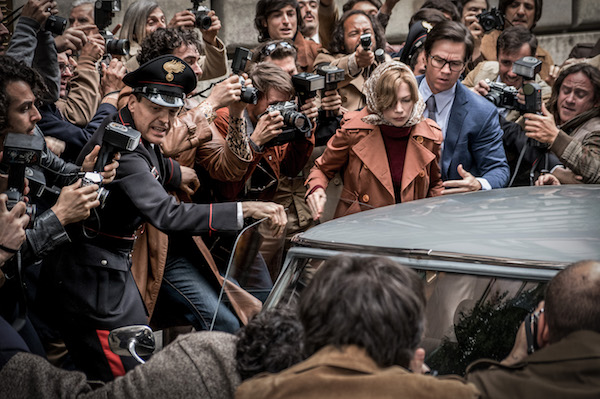
It’s a wonder that the incredible tale of the 1973 kidnapping of oil billionaire J. Paul Getty’s grandson hasn’t been dramatized before (for the record, there is presently a TV series covering the same ground), but as it stands this high-concept, low-ambition rendering by Ridley Scott has become more famous for its casting than for whatever insights it brings to the case, and for what it’s worth it’s difficult to believe that Kevin Spacey, unceremoniously dumped from the film after his scenes had been shot, would have captured the peculiar oily charm of Getty the way Christopher Plummer has.

Unfortunately, Plummer is more or less a sideshow to the intrigue, which relies on Michelle Williams as Getty’s daughter-in-law and Mark Wahlberg as his fixer (and ex-spy) to deal with the kidnapping itself. Williams generates enough heated anxiety to convince you she’s a worried mother, but Wahlberg’s performance is mainly about the wardrobe: without the serious eyewear and the tailored three-piece suits it would be difficult to believe he ever passed a civil service exam. Romain Duris as the warm-hearted leader of the kidnappers is practically unrecognizable, not because he’s playing an Italian, but because he exudes none of the usual mischievousness that made him a French screen star. But the real find here is Charlie Plummer (no relation to Christopher) as Getty III, whose blend of privileged innocence and acute terror points toward a movie that might have been more interesting than what Scott, who doesn’t seem to know if he wants to concentrate on the crime or Getty Sr.’s response to it, ends up with.

Which isn’t to say the movie isn’t entertaining, but rather that the disjointed narrative, which leaps freely from the picturesque Italian countryside to Getty’s palatial lair to the mother’s upscale Rome apartment—when it isn’t sidling into a flashback—fails to build a head of steam for what is played as a momentous climax. The final chase is almost ludicrous in its attempt to produce excitement where none is really needed. This story should rightfully sell itself.

Now playing in Tokyo at Toho Cinemas Hibiya (050-6868-5068), Toho Cinemas Nihonbashi (050-6868-5060), Toho Cinemas Shinjuku (050-6868-5063), Ikebukuro Cinema Rosa (03-3986-3713), Toho Cinemas Roppongi Hills (050-6868-5024), Aeon Cinema Itabashi (03-3937-1551).

All the Money in the World home page in Japanese

photo (c) 2017 All the Money US, LLC

Posted in Movies | Tagged , , , , | Leave a comment

Review: Oh, Lucy!

Atsuko Hirayanagi explores familiar screwball archetypes in her debut feature, and while most have been well presented by other Japanese directors, they’ve never attempted them in a cross-cultural setting. Setsuko (Shinobu Terajima) is an uptight, lonely single woman working a deadend OL job in Tokyo and living in a frightfully messy apartment. She seems this close to self-annihilating breakdown when her saucy niece (Shioli Kutsuna) talks her into signing up for English lessons with her teacher, an earnest American named John (Josh Hartnett). With a pedagogic style that uses hugs and wigs to fortify the role play endemic to Japanese language learning, John wins Setsuko over, and she becomes enamored of not only her new persona, Lucy, but John himself. When he suddenly leaves Japan with her niece in tow, she is eager to join her annoyed sister (Kaho Minami) on the California journey to find them. There, the movie opens up in startling ways and you appreciate not only Hirayanagi’s astute understanding of American differences, but also Terashima’s empathy with an inherently unlikable character. (95 min.)
In Japanese and English.
Now playing, Euro Space, Shibuya (03-3461-0211) May 17, 6:50 p.m. Euro Space screening will have English subtitles, Theatre Shinjuku (03-3352-1846). Photo (c) Oh Lucy LLC

home page: http://oh-lucy.com

Posted in Movies | Tagged , | Leave a comment

Media Mix, April 22, 2018

Kihei Maekawa

Here’s this week’s Media Mix about how and why the Finance Ministry protects its own in the face of scandal. Because the FM is considered the most powerful bureaucratic organ in the government, it has a kind of symbiotic relationship with the country’s best universities. Of the 52 men who have headed the ministry since the end of World War II, 48 are graduates of the Univ. of Tokyo law department. Naturally, this elite status results in predictable loyalties and attitudes, which were exemplified in the sexual harassment scandal that brought down Junichi Fukuda last week. (And which will be the subject of next week’s Media Mix.)

But sometimes these attitudes are informed by something else. During discussions of the two school-related scandals now dogging the Abe administration, several commentators have compared the fates of tax agency chief Nobuhisa Sagawa and former education ministry chief Kihei Maekawa. The education ministry is pretty low on the bureaucratic totem pole. Nevertheless, the media was surprised when last year Maekawa confirmed the existence of documents in his ministry that suggested the prime minister had pressured the government to approve a veterinary school operated by one of his friends. In a way, it shouldn’t have been a surprise because Maekawa had already been forced to quit to take responsibility for an “amakudari” scandal involving a ministry official who secured a post-retirement position at Waseda Univ. He no longer had anything to lose by revealing Abe’s involvement in the veterinary school approval, but as several commentators have pointed out, Maekawa had even less to lose because he’s from a wealthy family and didn’t really the need the job in the first place. Since leaving the ministry he’s worked more intently on issues that interest him, lecturing at schools about improving public education.

The commentators brought up Maekawa’s situation in contrast to that of Sagawa, previously a top FM official who may have lied to the Diet last year when he repeatedly testified that ministry documents related to the Moritomo elementary school scandal didn’t exist any more. Later, Sagawa was promoted to the head of the tax agency, which is considered one of the most powerful positions in government, and the media speculated that it was a reward for stonewalling the Moritomo investigation, which has since been resurrected with a vengeance. The difference between Sagawa and Maekawa is illustrative, some pundits have said. Sagawa is from a poor family and had to work really hard to get where he is. He will do anything to protect that position because he has nothing to fall back on, while Maekawa really didn’t need the education ministry job. He only took it because he actually cares about education. Sometimes the term “elite bureaucrat” has a complicated meaning.

Posted in Media | Tagged , | Leave a comment

Albums April 2018

Here are the album reviews I wrote for the April issue of EL Magazine, which was distributed in Tokyo on March 25.

Both Sides of the Sky
-Jimi Hendrix (Legacy/Sony)
Stone Cold Soul: The Complete Capitol Recordings
-Jackie DeShannon (MSI)
Jimi Hendrix’s legacy as a musician transcends his specific skills as a guitarist and singer. He was forward-thinking without necessarily trying to make something new. His approach to the blues, to contemporary rock, to folk, even to pop was reverent of whatever source material he covered, but in the spirit of the time he endeavored to make it his own, and because he was so prolific the high points were geniunely progressive. Nobody sounded like that at the time and no one would build on that sound for years to come. Since then the Experience Hendrix enterprise has released scads of studio ephemera and concert tapes, and while there is little in this mountain of material that adds significantly to the man’s legend, nothing detracts from it either. This latest collection has been hailed as perhaps the first integrated “album” released since the Rainbow Bridge recordings, mainly because some of the tracks were intended for an album that was jettisoned. But just as the idea that the genius of his official ouevre can be partly credited to what was left out, Both Sides of the Sky should be judged by the fact that it was abandoned. For the most part, the blues cuts—a funky “Mannish Boy,” a jumping “Things I Used to Do” with Johnny Winter—stand up surprisingly well, while the two Stephen Stills collaborations, including one of Joni Mitchell’s “Woodstock,” seem to feature Hendrix hardly at all. There’s a Lonnie Youngblood vocal that feels like a curiosity and a few cuts that are obviously edits of things that were never finished. The best thing here, a song that shows Hendrix stretching stylistically, is “Stepping Stone,” and the notes say it was destined to be a single but withdrawn at the last minute. Otherwise, the album sounds like an artifact of its time, which isn’t a bad thing, but it ain’t the future. A new collection by Jackie DeShannon, originally recorded around 1970-71, is also very much a product of its time. DeShannon, who wrote some of the best pop songs of the 60s, was scooped up by Capitol Records in 1970 and sent to Memphis, where she recorded with Chips Moman (Elvis, Dusty Springfield). The idea was for Jackie to reconnect with her Southern roots and it’s obvious Capitol was looking for something as authentic as what The Band was giving them at the time, but for some reason they never released the recordings. Instead they hauled her back to Los Angeles and had her cut R&B versions of Dylan, Van Morrison, Hoyt Axton, and some of her own songs. The album didn’t sell so they let her go. Now everything she recorded for Capitol has been released as Stone Cold Soul, and while it doesn’t rewrite the book on her career, it does make the case that Jackie was a better soul artist than people thought. It’s not the future, but it’s really good. Continue reading

Posted in Music | Tagged , , , , , , , | Leave a comment

Media Mix, April 8, 2018

Here’s this week’s Media Mix about a feud between the Tokyo Metropolitan Government and Adachi Ward over the latter’s implementation of a sex education course in one of its public junior high schools. As mentioned in the article, Adachi is one of Tokyo’s poorer wards in the sense that it has the highest percentage of students receiving public assistance of some kind. And since it’s generally acknowledged that teen pregnancy perpetuates the cycle of poverty, the school in question felt it was important to teach children as early as possible about intercourse and childbirth, not to mention contraception. Tokyo objected for the usual small-minded reasons, saying that such knowledge would encourage sexual activity, though, based on the kind of reactions that appeared in the media, objections to Adachi Ward’s program sounded mostly visceral–squeamishness at the prospect that children would be learning about sex at all.

The Adachi board of education’s reasoning goes deeper than simply trying to stall the cycle of poverty. In an article that appeared last year in the Mainichi Shimbun, the director of an organization of midwives who advise teens about sex pointed out that when girls become pregnant they usually already have “other problems,” such as domestic abuse, and thus pregnancy is a good indicator to schools of these other problems, which are usually associated with low income households. However, in most cases, schools prefer that the pregnant teen disappear, and so they encourage the girl to drop out. In the same article, a school nurse from Mie Prefecture despairs about the negligent attitude toward sex in public schools, saying that knowledge about contraception and having children is a human right in today’s society. If the purpose of public schools is to prepare young people for their futures as members of society, then sex education is integral to their development. What that means is that children should understand what they’re getting into when then have sexual relations, but if they do become pregnant then the school has an obligation to help them graduate with as little trouble as possible. If it’s proper for a school to make up for material want in the student’s home life by providing meals or other resources, then it’s also proper for the school to address students’ sexual activities, including pregnancy. In that regard, sex education is both a practical and a moral issue.

Posted in Media | Tagged , | Leave a comment

Movies April 2018

Here are the movie reviews I wrote for the April issue of EL Magazine, which was distributed in Tokyo last weekend (a little later than normal due to a printing error).

Black Panther
By now it’s difficult to separate the hype surrounding this extraordinary blockbuster from its qualities as a work of art, and while art may not necessarily have been what the filmmakers were after foremost, they certainly endeavored to make this latest entry in the expanding Marvel Comics universe more momentous than other recent superhero movies. But even within the preordained structural conditions that come with Marvel movies, Black Panther stands out, and not just because almost all the characters are black. Director Ryan Coogler has already proven, with Creed, that he can take a popular and beloved predigested film series and make it fresh by rejiggering its focus to appeal to black audiences. What distinguishes Black Panther is its attention not only to the action details all moviegoers demand these days, but to the particulars of the black experience in nuanced and refined ways. The quick, effective opener explains the fictional African country of Wakanda and its development as an advanced nation thanks to the auspicious arrival of a meteor eons ago carrying a vital metal called vibranium. The futuristic city built upon this element is kept mostly shielded from the world, but the tribes that thrive under its dominion continue to practice the ancient traditions, only with more responsibility because of their blessing. Wakanda is a utopia, and Coogler’s genius is in contrasting it with the lot of people of color throughout the world, in particular African-Americans. The requisite conflict, in fact, is precipated by one of Wakanda’s royalty, N’Jobu, exiling himself to California due to his objection to Wakanda’s self-imposed neutrality in the face of his race’s subjugation at the hands of “colonizers.” He is sought out by his brother, T’Chaka, who finds him in Oakland and brands him a traitor, killing him in the process, thus setting the stage for when N’Jobu’s son, Erik Killmonger (Michael B. Jordan), challenges T’Chaka’s son, T’Challa (Chadwick Boseman), for the throne of Wakanda. By this time, T’Challa is king, and thus assumes the identity of Black Panther, whose super powers are derived from vibranium, some of which is stolen by a white arms merchant (Andy Serkis) being chased by the CIA. This plot development makes for the only really uncomfortable bit in the movie, since T’Challa must work with the American government to get back his metal. It also means the CIA is instrumental in helping Wakanda fight off Killmonger’s scheme to bring Wakanda out of the shadows and on to the world stage as a righteous defender of the oppressed, and it’s hard not to argue with that, especially when it’s couched in Jordan’s street smart dialect. In fact, Killmonger’s mission, even as it runs up against the noble heroics of Black Panther, never feels compromised. You almost wish he’d wipe that stupid grin off the CIA’s face. (photo: Marvel Studios) Continue reading

Posted in Movies | Tagged , , , , , , , , , , , | Leave a comment