Here are the movie reviews I wrote for the December issue of EL Magazine, which was distributed in Tokyo on November 25.
 Art and Craft
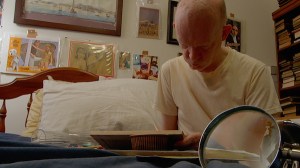
Certain documentaries are premised on stories or personalities so unusual that they practically direct themselves. The art forger Mark Landis has been covered extensively by the media in both his native U.S. and by the European press, but directors Sam Cullman and Jennifer Grausman (with help from Mark Becker) have painstakingly accessed these source materials and then augmented them with commentary from the subject himself, as well as the people he’s affected through his actions, thus giving us a kind of meta view of a story that doesn’t appear to be finished. Landis’s eccentricities go beyond his compulsion to forge artworks. He lives in a messy house in Mississippi that he inherited from his mother along with her money. Here he chain smokes, drinks, and does his paintings, drawings, and collages. His peculiar speech patterns and defeated posture indicate a mind and body that work differently from the norm, and he receives counseling for what might be a mental illness or autism (he spent time in a psychiatric institution as a teenager), but what he gets away with also indicates a sharp understanding of human nature and a ripe sense of humor. Landis gives his forgeries away to museums, convincing them they’re the real thing, and he’s done it so many times and for so long that he’s become famous. Since he receives no money for the works, he is committing no crime, but that doesn’t mean a lot to the people he’s fooled, and they are hard pressed to think of him as being innocent. One of them, in fact, a former gallery curator for the University of Cincinnati named Matthew Leininger, has made it his life’s work to expose Landis to the world, and he has become so obsessed with this work that he can’t hold down a job. Leininger’s frustration is palpable and best characterized by his young daughter’s complete knowledge of Landis’s sins. The problem is that it doesn’t seem to make any difference. Despite Leininger’s PR gambits and features about Landis in some of the biggest newspapers in the world, Landis continues to distribute his paintings to museums, usually in the guise of a priest whose church has somehow come into possession of these works, most of which are religious in nature. That Landis can produce such faithful reproductions in so many styles and media is impressive enough, but the subterfuge is so rich that Cullman and Grausman could have shot a supplemental doc just about the meaning of art in our world and made something just as entertaining. Because at the heart of Landis’s story is our own obsession with “authenticity.” It’s only when the museums find out these works are fake that they get upset, but what is the difference between the fake and the original as long as the original’s author is still considered the author? In his own sly, crooked way, Landis is a genius. (photo: Purple Parrot Films) Continue reading


 Music Complete