Media Mix, July 20, 2014

Katsuto Momii

Katsuto Momii

Here is this week’s Media Mix, mainly about Friday magazine’s “scoop” of what went down at NHK following an exclusive live interview with LDP Chief Cabinet Secretary Yoshihide Suga on “Closeup Gendai,” but also about the mainstream media’s tepid coverage of the government’s decision to make the Self-Defense Forces available for collective self-defense activities overseas. Though I watched the Suga interview on NHK and, unlike the LDP aide referred to in Friday, thought it was too polite by half, it did at least try to get Suga to address the problematic issues involved. I’m not saying the media has not addressed these issues themselves, only that they haven’t aggressively tried to get the administration to address them when they’ve had the chance, which makes me wonder if there’s more at stake than just “politics.”

But the NHK angle is still worth exploring in detail. A few days ago, after the column was filed, a group of former NHK employees submitted a petition to NHK saying that Chairman Katsuto Momii should step down because of comments he has made that imply NHK should follow the government line. Though I can understand the petitioners’ sentiments, what bothers me about their demand is the idea that Momii can so easily exert his will on an organization like NHK. As I mentioned in the column, NHK’s programming can be diverse in terms of viewpoint. NHK news tries to steer straight down the middle of the road, which can make it seem as if it’s on the side of the government but mostly it just translates as a very narrow take on whatever topic is reported. NHK’s m.o. is overly cautious, which is why its reporters aren’t allowed to talk off the tops of their heads the way experienced TV reporters in other countries are expected to do. But shows like “Closeup Gendai” and many of the broadcaster’s documentaries get pretty deep into their subjects and often challenge the powers that be in their own limited way. I don’t think Momii’s presence at the top will change this situation in any substantial way, but in any case there seems little that former NHK employees can do about it. It’s up to current employees to convey information as truthfully and completely as possible. In 2001, an NHK production team made a special about a mock tribunal of Emperor Showa that found him guilty of war crimes, and when the LDP found out about it it supposedly convinced higher ups in NHK to alter the content so as to soften the tribunal results as they were aired. The organizers of the tribunal, who worked with production team on the program, sued NHK for breach of trust. Certainly the government (Shinzo Abe was involved in the alleged intimidation) and NHK top brass were the cause of the problem in this case, but the production team and their immediate superiors should have resisted them more resolutely. Unless, of course, they agreed with the tenor of the interference, in which case there isn’t much the former NHK employees–and NHK viewers–can do.

Posted in Media | Tagged , , | Leave a comment

Media Mix, July 13, 2014

Dr. Tomohiko Murakami

Dr. Tomohiko Murakami

Here is this week’s Media Mix, which is about the government’s difficulties in cutting medical expenses. Before anyone starts citing the column as proof that universal health care doesn’t work, keep in mind that, strictly speaking, Japan’s national health insurance system isn’t universal. Yes, everyone has to participate, but everybody has to pay taxes, too, and the insurance system is set up more as a tax, meaning you pay into the system what you can afford to pay. And because people pay in this way, they think they should get as much out of the system as they can, meaning treatment for even the smallest infirmity. That’s why everyone goes to the doctor when they have a sniffle. The government has been trying to discourage this kind of situation, especially among old people who look upon the medical system as some kind of social club, but whenever they game the system to penalize people for using it indiscriminately the media takes the side of the public and says the government is trying to kill people. Doctors couldn’t be happier, because that’s how they make money.

In the column, I also mention that more conscientious doctors believe the health care system as it’s operated in Japan also discourages preventive care, since the focus is on treatment of existing ailments. In a way, this problem manifests itself in the inordinate number of old people who are bedridden. The media, strangely, has never questioned this phenomenon, and act as if it’s normal for people to spend their waking hours prone after they turn 75. Active people in their 80s are celebrated as being superhuman, which is even odder considering that Japan’s longevity rates are the envy of the world. This approach to illness as something that happens out of the blue undermines the efforts of health maintenance professionals who try to convince the public that they will be not only healthier but happier if they take care of themselves.

This media mindset was illustrated in an interesting way in Dr. Tomohiko Murakami’s book, which I mention in the column. Murakami was the head of the city hospital in Yubari, and became infamous in June 2010 when the national press blasted him for refusing an ambulance’s request to bring a man to his hospital. At the time, such stories were being reported all over Japan, the result of cutbacks and other fiscal difficulties, but the media treated them all the same: monolithic medical institutions couldn’t be bothered with treating some people, even when they required emergency help. The reports implied that the Yubari man died of cardiac failure because he wasn’t treated, but as Murakami explains in the book, the man, a suicide, was already dead. The ambulance simply needed a doctor to declare him deceased, but at the time Murakami had his hands full with living patients since he was the only doctor on duty.

Posted in Media | Tagged , | Leave a comment

July 2014 albums

Here are the album reviews I wrote for the July issue of EL Magazine, which was distributed in Tokyo last week.

jackwhite14blackkeys14Lazaretto
-Jack White (Third Man/Sony)
Turn Blue
-The Black Keys (Nonesuch/Warner)
It’s safe to say that classic guitar rock—blues-based, loudly melodic, often distorted—has survived the various challenges to its hegemony over the past three decades and is now more prevalent and vital than ever. If you want to credit Jack White with that development you won’t get an argument from me, though as with all pop music classifications guitar rock tends to withstand artistic pigeonholing. Since dissolving the White Stripes White has become more than a musical force. He’s a cultural lightning rod, the man who says what he means and has the talent and vision to make his pronouncements worthy of attention, regardless of how prickly or narrow-minded thay sound. His second solo album isn’t much different from his first one, only weirder, which makes it all the more interesting since blues rock exhausted most of its potential to surprise by the time Led Zeppelin recorded their fourth album. In fact, the record Lazaretto most resembles, as least tonally and thematically, is Zep’s third. The earnest folk touches are highlights rather than distracting filigree, and when things get bombastic the contrast is all the more thrilling. It’s also unabashedly accomplished. The chops on display revive the once derided image of the blues guitarist as virtuoso, but White makes sure that he’s showing off for a reason. The playful interaction between riffs and lyrics on “The Black Bat Licorice” is hilarious and scintillating. The complaint that the album is over-produced, with lots of incidental aural touches that White wouldn’t have countenanced on a White Stripes record, is off-base, since the whole point of White’s solo career is ambition, another hallmark of classic guitar rock and one everyone seems to have forgotten. But not the Black Keys. In fact, the main problem with the duo’s hotly anticipated followup to the best-selling El Camino is that Dan Auerbach seems to have run out of ideas on which to pin his ambition. This aspect of the group’s public image only serves to highlight their workmanlike approach to rock. Auerbach is no less talented than White, and may be a better singer, but his conception of blues rock sounds more like pastiche than White’s does, and while it was unfair of White to dis the Black Keys publicly for what he saw as them ripping off his style—Jimmy Page is too nice a guy to say the same about White—Auerbach does sound as if he’s still trying to get at something the White Stripes did ten years ago, which was to create an original voice in one of pop’s most overly exploited genres. The Keys do little more here than broaden their sound (“Weight of Love”) and goose their hooks (“Fever”). Auerbach also regresses into meathead male desperation. His obsessions about bad women are a leitmotif, and one that could be mistaken for editorializing rather than a tribute to the blues and soul shouters who once made such obsessions compelling. Continue reading

Posted in Music | Tagged , , , , , , , , , , , | Leave a comment

July 2014 movies

Here are the reviews I wrote for the July issue of EL Magazine, which was distributed in Tokyo last week.

beyondedgeBeyond the Edge
Given his status as New Zealand’s greatest 20th century hero, it seems unfortunate that the late Sir Edmund Hillary’s achievement is being memorialized with this pokey docudrama. Following several unsuccessful attempts to reach the summit of Mt. Everest by the Swiss and others, a British team lead by John Hunt decided to try in May of 1953 before the monsoons moved in. Hillary, a beekeeper by vocation, was a passionate mountaineer who made it onto the team but due to his nationality ended up low on the pecking order. The film does a good job of delineating events to show why it was Hillary and not one of the Brits who made it to the top, and sufficiently describes those qualities that distinguished him during the adventure. But the movie has no dramatic traction. Whether showing climbers gasping for oxygen and losing their bearings or depicting near fatal plunges down crevasses, all the scenes are pitched in the same flat tone, so even when Hilary and his guide, Tenzing Norgay, reach their goal, you feel little in the way of exhiliration. (photo: GFC (Everest) Ltd.) Continue reading

Posted in Movies | Tagged , , , , , , , , , , , , , | Leave a comment

Media Mix, June 29, 2014

Unknown

Shun Otokita

Here’s this week’s Media Mix, about the local coverage of the foreign coverage of the June 18 heckling incident in the Tokyo assembly. As the column indicates, even the Japanese press has admitted that it wouldn’t have been as interested as it was in the incident if outlets like the Wall Street Journal and the Huffington Post hadn’t found it so compelling, but, of course, the international media had to get the story from somewhere. Most think that the Asahi Shimbun broke it, and while that seems true up to a point, as media explainer Akira Ikegami pointed out in a recent column in that very paper, the Asahi’s initial coverage was only published in the Tokyo edition, thus betraying the editors’ feeling that it wasn’t a story worthy of national exposure. It was basically an “incident,” an isolated happening with no implications beyond the notion that Tokyo politicians could be mean. The Mainichi Shimbun was the only major media outlet to put the story in all its editions.

The Asahi’s parochial response is perhaps understandable if you consider the paper’s own likely source, the blog of Shun Otokita, who, like Ayaka Shiomura, is a Your Party member of the Tokyo assembly. What the Asahi missed or ignored in the post was Otokita’s outrage. His anger may be qualified by his loyalties, but his detailed description of the incident makes it clear that it was the sexist tone of the taunts that upset him and not so much the heckling itself. Some commentators have said that Shiomura was simply subjected to the same sort of trial-by-fire that all Tokyo legislators have to go through, and that if she isn’t up to it then she shouldn’t be a lawmaker. They take Akihiro Suzuki’s specific taunt, that Shiomura herself should get married as soon as possible, as a perhaps rude but nonetheless legitimate rejoinder to her assertion that Tokyo isn’t doing enough to help women have and raise children. There’s nothing sexist about it, they say. Otokita’s blog post destroys that already flimsy argument, since it describes an atmosphere in which a group of men verbally pile on an inexperienced member of the assembly by taking advantage of the fact that she’s a woman. In order to shake her up, they used language that made sport of her gender. The Asahi may or may not have picked up on this aspect of Otokita’s report, but in any case they didn’t think it was worth dispatching nationally. When it was published in the Japanese edition of the Huffington Post (a link is provided in the first paragraph of my column) the international press was exposed to it. I’m not saying that the foreign media is more responsible than the Japanese media is when it comes to gender issues, only that in this case the foreign press saw the heckling for what it really was. Had they not highlighted it the Japanese press would have likely just shrugged it off as, at best, business as usual or, at worst, the shenanigans of bored local politicians.

Posted in Media | Tagged , , | Leave a comment

June 2014 albums

Here are the album reviews I wrote for the June issue of EL Magazine, which was distributed in Tokyo last weekend.

61lilAgBabL51Jc3xqmCGLSheezus
-Lily Allen (Parlophone/Warner)
Shakira
(RCA/Sony)
You envy Lily Allen at your own peril. She’s one of the most interesting pop artists of the new millennium and her record sales match her talent and intelligence. However, these factors have also made her a target of people who dump on pop stars as a matter of course, and since she made her mark on the Internet she is forced to accept this unfortunate aspect as part of the price she pays for fame, which has become her leitmotif. Sheezus is only her third album, and her first since the brilliantly caustic, self-effacing It’s Not Me, It’s You. It isn’t half as self-effacing, but sounds preemptively defensive, both a comment on the emptiness of current pop culture and a kind of smart-alecky attempt to place herself in that context. The fact that the title sounds like the one Kanye gave to his last album will invite comparisons, thus adding another unnecessary burden to the album’s thematic load. If the opening, title track were as catchy as the rest of the collection, its strained overview of what divas have to put up with might resonate further than it does, but it feels more like an obligation than an observation. And while the domestic-life-is-bliss material can be hackneyed and predictable, it’s also charming and lively. Lily’s blessing-and-curse is her inability to step outside herself: there’s nothing here that’s not about her, and while her candor can be refreshing and witty, it can also scan as default solipsism, which gets exhausting over the course of a 70-minute album (the CD version has 5 bonus tracks and the Japanese version 2 more). Greg Kurstin’s co-writing credit guarantees pop rigor, but Lily’s incorporation of R&B forms would seem to indicate she feels she has to keep up with all those other divas. The peril is you don’t take Lily without the personality. You have to put up with it. Colombian hip-shaker Shakira has had a lot of time and experience to figure out her own place in the scheme of things, and while her new self-titled album seems like a reboot, it mainly substantializes a lot of the elements that have succeeded on her most recent English-language records, particularly a strong identification with classic rock. Even her duet with Rihanna, one of the artists Lily disses, has less to do with that singer’s patented style and more to do with Pink’s. And while another co-conspirator, Blake Shelton, is a country star, like most Nashville pretty boys these days “Medicine” shows that he worshipped at the alter of Eagles/Clapton. Even when Shakira offers up something acoustic, it has the hard-driving ring and shimmer of an MTV Unplugged segment with, say, R.E.M. The confidence is in the performance, in the snarl and Latin bite of her delivery. She sings what she means and means what she sings. If only Lily were this naturally confident in her abilities. Continue reading

Posted in Music | Tagged , , , , , , , , , , , , | Leave a comment

June 2014 movies

Here are the movie reviews I wrote for the June issue of EL Magazine, which was distributed in Tokyo last weekend.

GHB_6852 20130121.CR2The Grand Budapest Hotel
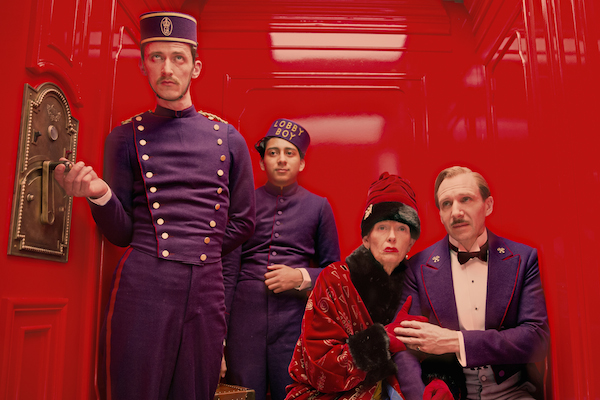
It’s telling of Wes Anderson’s curious ouevre that his best films are set in an idealized past that feels like a physical place, as if the present were too changeable to get a fix on. Of course, the past is changeable, too, open to shifting interpretations, but Anderson likes the idea that what really happened can’t be changed, and though his films are fictions he treats them with such unerring sureness of purpose that they feel less like memories and more like fossils. Judging by the way he circles around his main plot in The Grand Budapest Hotel, it’s obvious he misses the idea of the “old Europe,” which idealized civilized behavior. In a gambit that feels like a brilliant joke, he moves backwards from the present through not one, not two, but three layers of flashback to the titular institution, a fine hotel in the mountains of the made-up country of Zubrowka lorded over by the proud, effeminate concierge M. Gustave (Ralph Fiennes), who beds his elderly female customers (and probably a few of the male ones) as a show of hospitality that keeps them coming back for more, so to speak. Gustave’s management style is meticulous but fair, and he treats his new “lobby boy,” Zero (Tony Revolori), with respect rather than condescension because Zero must pass on the values of service that the hotel stands for. We already know from the second layer of flashback that Zero will grow up to be Mr. Moustafa (F. Murray Abraham), the owner of the hotel in its shabbier 1960s incarnation, and it is Mr. Moustafa’s warm narration that sets the tone of this remarkable tale, loosely based on the writings of Stefan Zweig but nevertheless wholly Andersonian in execution and feeling. On the eve of World War II, Zubrowka is under pressure from authoritarian forces that contradict the old European sensibility M. Gustave represents. The concierge is forced to act on his impulses after a crime occurs in his little empire that affects the fortunes of his most illustrious customer (Tilda Swinton). He becomes embroiled not only in the customer’s noble, in-fighting family, but in the intrigues that will soon plunge the region into war, and he dives into these adventures with all the facility and determination of a fop James Bond. The machinations get complicated, and if Anderson seems to make them that way just to utilize as many of his friends as possible (Bill Murray, Owen Wilson, Adrien Brody, Willem Dafoe, Edward Norton, Mathieu Amalric, Jason Schwartzman, Jeff Goldblum) he doesn’t shortchange the viewer. You follow as breathlessly as M. Gustave as he skis down the side of an Austrian Alp in pursuit of an art thief. The Grand Budapest Hotel has everything you want from a movie. (photo: Twentieth Century Fox) Continue reading

Posted in Movies | Tagged , , , , , , , , | Leave a comment

Media Mix, May 18, 2014

211513503571Here’s this week’s Media Mix, which is about the press reaction to a research group’s finding that a good many local governments may actually vanish by mid-century due to loss of population, specifically young females. The government has been talking about the low birthrate issue for at least two decades and hasn’t really done anything, but it’s perfectly right to wonder what they could possibly do about it anyway that wouldn’t interfere in some way with people’s lives. The choice to not have a child is, for better or worse, a common hallmark of developed countries. Before marriage became more open and birth control more available, having a child wasn’t thought to involve a “choice.” It was what happened to any woman who got married and to quite a few who didn’t.

When the cabinet-affiliated panel said that it needed to come up with a target birthrate before it could make recommendations, media eyebrows rose in unison because the comment smacked of social engineering. It was a year ago that the government’s plan to distribute handbooks to young women that would provide them with information about pregnancy was blasted by women’s groups as being narrow-minded and discriminatory, since the measure implied that the low birthrate was the fault of the nation’s females and thus they had to “solve” it. The proposal was quickly withdrawn. Similarly, after the panel made its remarks about targets, trade minister Akira Amari told reporters in what Asahi Shimbun described as carefully chosen words that the government is not forcing people to have children. He clarified that it is the government’s role to create an environment in which people would want to have children, though even that last phrase is perhaps putting words into his mouth. What he really said was something along the lines of an environment that would allow people to “demonstrate their will.”

This sort of tippy-toeing through the matter only goes to show that the government doesn’t really understand human nature. Though it’s obvious that people allowed to exercise their free will with regards to procreation will likely have fewer children on the whole, it doesn’t mean they don’t want to have any at all. In fact, most people want to get married and have children, with two being the optimum number, according to one government study. And since the government has said that the optimum number for maintaining the present population level is 2.07, then all the government has to do is make it possible for people to feel they can have children; i.e., that they can afford it.

But first these people have to get married, and that’s a bigger obstacle than it sounds, as proven by statistics that show both men and women are marrying at later ages. The problem with the marriage model in Japan is that for many years it was an engineered arrangement, as shown by the statistic that 95 percent of boomers are married, and most met their spouses at work. In those days, men got permanent employment at a company that also hired women as clerical help but mainly to provide spouses for those men, because those men couldn’t be expected to find mates on their own outside of work, to which they were expected to dedicate their lives. That employment model has become obsolete, but men still have difficulty finding mates outside of work, and now the government has finally come around to the idea of women working full-time in order to help support the economy. It doesn’t matter if, as so many media outlets claim, women would rather be full-time housewives. Men’s salaries and benefits no longer support that kind of family structure. So if the government really thinks it has an obligation to do something that will increase the birthrate, first it has to abandon its rigid concept of courtship and marriage.

Posted in Media | Tagged , | Leave a comment

May 2014 albums

Here are the album reviews I wrote for the May issue of EL Magazine, which was distributed in Tokyo last week.

boygeorgekylieThis Is What I Do
-Boy George (Very Me/Sony)
Kiss Me Once
-Kylie Minogue (Parlophone/Warner)
It’s a given that the older a pop star becomes the greater his or her desire to make music of substance, even if that simply means more substantial fluff. Both Boy George and Kylie Minogue have been around long enough to fall into this category, and the descent of that fall may be deeper for them owing to well-publicized personal challenges over the years. George Alan O’Dowd spent the better part of the last two decades not producing music but rather headlines due to his intemperate drug use and even more intemperate (and sometimes very true) public statements. This Is What I Do is one of those warts-and-all summings-up that doubles as a commercial comeback, and if a lot of people buy it as such it’s because they had something emotionally invested in the singer when he was setting soul music on its ear as the leader of Culture Club. As it stands, the voice is rougher but not unrecognizable, and the affection for 80s club styles and, especially, reggae is undiminished. More to the point, George’s uncompromising nature is advanced as the leitmotif, obvious in the song titles alone: “King of Everything,” “Bigger Than War,” “Live Your Life,” “My God.” The redemption theme is covered in gloriosity by a strident born-again approach that both derides fundamental Christians for daring to question his faith and asking the rest of us why we don’t believe in Him in the first place. His anti-war and pro-environmental stands are welcome if a bit simplistic, but that may just be a function of the music, which is bombastic in an unsettling way, as if George had decided to make up for the tight ensemble sound of his old band with the more flamboyant sonics characteristic of 80s Top 40. But there’s only one Elton John. Kylie’s problems were not of her own making—she’s a cancer survivor—but they were equally obsessed over by the media, and her new album splits the difference between the kind of light, effective dance pop that made her name and big-boned declarations of personal growth and worth. For those of us who always appreciated Kylie’s pop smarts without thinking the contrived cuteness was a necessary component, the show of maturity is welcome though contrived in its own way. The exception is Pharrell Williams’ “I Was Gonna Cancel,” a life-affirming song that, since it was written especially for her, takes into consideration her situation and was clearly composed by a fan who wants the best for her. In other words, it’s catchy and to the point, and a better song than “Get Lucky,” for what that’s worth. The dance numbers are more attractive than the ballads, but still rely on the robotic rhythms and processed vocals that have never hurt Kylie’s reputation as a diva. Craft was never her strong point, so why bother asserting talents she never possessed? Surviving has its own special appeal. Continue reading

Posted in Music | Tagged , , , , , , , , | Leave a comment

May 2014 movies

Here are the movie reviews I wrote for the May issue of EL Magazine, which was distributed in Tokyo last week.

906429 - The Amazing Spider-Man 2The Amazing Spider-Man 2
The only justification for making an entirely new franchise of the Spider-Man saga so soon after the first one ended, besides printing money, is that the Tobey Maguire series wasn’t true to the comic’s plot, which meant a lot to the coterie of kids who grew up with it. Peter Parker was the first angst-ridden superhero because he was a teenager with typical adolescent problems exacerbated by the responsibilities that come with special abilities. The biggest change the first series made was eliding Peter’s first girlfriend, Gwen Stacy, and going right to his eternal soulmate Mary Jane Watson. So the second installment is the real test, because it tests Peter’s convictions as a superhero against his love for Gwen. However, the screenplay, written by at least four guys, crams so much incident into its two-and-a-half hours that nothing feels consequential, not Peter’s employment as a news photographer (J. Jonah Jameson only figures as a by-line in an email), not his investigation into the reason for his parents’ disappearance, not the ghost of Gwen’s police chief father, not even the feeling of betrayal that causes Peter’s best friend, Harry Osborne (Dane DeHaan), to turn into the Green Goblin. Even the central standoff between Spidey and Electro (Jamie Foxx) feels as if it’s been shoehorned into the plot as a means of demonstrating how perilous Spider-Man’s public persona is, since Foxx’s character, a nebbish named Max Dillon, is enamored of the web-spinner as only a lonely nerd could be, and when he’s jolted with a huge surge of electricity, thus turning him into a human super conductor, the accompanying sense of power works on his eternally bruised ego, and he imagines Spider-Man as one of his tormentors, even though he once saved his life. But besides the blue glow that Electro gives off, there’s little that’s memorable about him as a super-villain. He’s basically a poor putz who’s going down for all the wrong reasons, whereas Harry, who’s enormously wealthy and powerful to begin with but dying of a genetic disease, is a more monumental bad guy, though Peter still thinks there’s something redeemable beneath the malice. The real subtext of The Amazing Spider-Man 2 isn’t teenage angst, but the nature of celebrity, which isn’t a bad theme but it’s been done to death in our age and neither the army of screenwriters nor director Marc Webb has the patience or the time to treat it with any nuance. Webb has his hands full anyway with all the special effects, which are so overbearing you wonder if any of the actors actually had to work in front of a green screen this time. No one and no thing looks natural here. Maybe it’s time for Marvel to get back to actual comic books, which are unnatural by definition. (photo: CTMG) Continue reading

Posted in Movies | Tagged , , , , , , , , | Leave a comment