Here are the movie reviews I wrote for the Jan. issue of EL Magazine. They cover films that were released in Tokyo between late Dec. and mid-Jan.
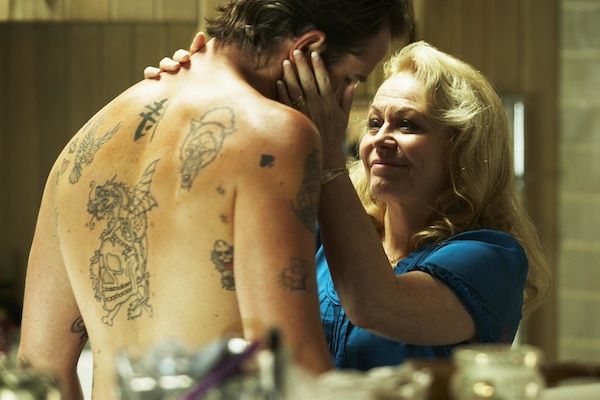 Animal Kingdom
The title of Australian director David Michod’s debut feature suggests an environment ruled by the laws of nature, but the world it describes is a small one and the game is actually rigged. The Cody family is a band of hardened criminals, and based on the attitude of the clan’s matriarch, Smurf (Jacki Weaver), it lays claim to some sort of pedigree. Her boys are bank robbers, a line of work as specialized as arc welding, but each brother has his own personal peccadillo that makes the work even more perilous. Around the time that Smurf’s teenage grandson, Joshua (James Frecheville), enters this volatile household, the Codys are under close surveillance by the local police, whose main object of desire is the eldest boy Pope (Ben Mendelsohn), who’s on the lam and off his medication. Josh’s mother, who had been estranged from Smurf since Josh was a little boy, has just OD’d on heroin in one of the most shockingly matter-of-fact scenes in the history of cinematic drug abuse. Shortly thereafter, a rogue band of cops offs a member of the Cody team, and the killing sets in motion a series of tit-for-tat reprisals that spirals out of control. Scorsese should probably sue for a royalty, but the defense would counter that Marty could never have countenanced Josh’s enervated voiceover. This is a kid whose damage goes way back and has rendered him a walking blank stare. The contrast between the adolescent’s open-mouthed incomprehension and his uncles’ macho bluster and drug-fueled desperation is so stark as to be antithetical. The contrast also gives Michod a plot device that brings out the worst in both sides of the battle. The brothers use their nephew’s passivity to their advantage, while the main cop (Guy Pearce) senses a hesitancy that he can tap once it becomes clear to Josh that his family isn’t looking out for his best interests. In the film’s most gratuitous display of depravity, Pope forces his survival prerogatives on Josh’s girlfriend, and you realize that the movie can’t go any lower, until Smurf, the very picture of a nurturing female, decides to sacrifice her grandson for the sake of her sons. After all, he’s not really a full-fledged member of the family. By over-reaching Michod squanders the viewer’s trust, since Josh is the only character with any recognizable moral perspective, and that includes Pearce’s detective, who understands what it means to lose your soul but doesn’t seem particularly troubled by the fact that he sold his long ago. Weaver got the Oscar nod mainly because of the character, but Pearce is the amazing one. At this point, his range seems boundless. (photo: Screen Australia, Screen NSW, Film Victoria, Premium Film Partnership, Animal Kingdom Holdings and Porchlight Films) Continue reading