Fuji Rock ’24: July 26, first half

Walked around the grounds this morning before the music started. The festival has definitely downsized since I was last here in 2019. The World Food Court is essentially gone. Field of Heaven only had six vendors, whereas five years ago there were more than a dozen. I was told that a Singapore company had bought up most of the property attached to the ski resort from Seibu, including the Prince Hotel. I can attest that the prices are pretty ridiculous at the hotel for the same old shitty rooms, but I wonder if they’re charging vendors more, too. That might explain the relative lack of retail options, but, then again, the festival has been slowly losing dedicated fans, so maybe the vendors aren’t convinced they can make as much money as they used to. 

Friday is always the least attended day of the fest, for obvious reasons. I’m not sure how the SZA cancellation at the end of May affected things, but I’ve seen a lot of Killer t-shirts today, so maybe they were able to get a few more people when they came on board. Still, when the fest opened on the Green Stage at 11 there was hardly anybody in front of it. The silver lining was that the usual insufferable rap that the two comics lay on the audience about what not to do at the festival (“Don’t feed the wild animals” was a new one, though) was briefer than normal. The weather forecast in the morning said it would start raining at 11 and continue through the afternoon, but by 3:30 there was not a drop; in fact, it’s been pretty hot, especially when the sun breaks through the clouds. The one nice thing about being in building 6 of the Prince is that it’s the closest to the festival grounds, so I’m able to duck back in for a quick shower, which makes all the difference, believe me. 

So far I haven’t heard anything that’s knocked my socks off, which is par for Fridays. Three of the Japanese acts I saw, indigo la End, Shintokyo, and Ruka (or Rushika? Not sure how she reads that kanji) trade in what an old college pal of mine derisively calls “limp dick jazz,” and though he used it to describe what by the 90s was called “yacht rock,” in this case it’s lite jazz with a bit of funk or, in the case of Ru(shi)ka, a kind of quiet, exotic Joni Mitchell vibe. Yellow Days, a British bloke with a serious hard-on for reverb, didn’t make much of an impression on the early afternoon crowd at the Red Marquee, probably because, try as he might, he could never get a groove going. I was curious about the Chicago duo Friko because I wanted to see how two people could make as much of a racket as they do on their debut album, and, of course, they aren’t a duo but a quartet. Their super dramatic distorto-guitar rock really connected with the people in the closed off section in front of the Green Stage, but most everyone else in the vicinity were sitting on their camp chairs checking their phones. I probably would have thought they were good if I had gotten up the energy to move closer to the stage. (Side note, the minute the set ended, Smash sent out a press release announcing the group’s tour of Japan in November.) The highlight of the first half for me was Erika De Casier, the Danish R&B artist whose soft-spoken approach is like catnip to a Japanese audience who probably didn’t know anything about her beforehand. Like Sade, she’s cool but intense with a melody, and her hip-hop bona fides are convincing. Moreover, her visuals are a crack-up. In one of her songs she’s putting it to her lover in no uncertain terms and behind her there was this collection of brothers refuting her testimony. Shit, girl, y’all are cold!

Posted in Uncategorized | Leave a comment

Fuji Rock Festival ’24: Prefest

This is my first time back at Fuji since 2019. It’s also the first time I’ve taken the train up to Naeba. I’d been to every edition that’s been held here since it started at Naeba in 1999, except for 2014, and I’ve either ridden the Smash staff bus or driven with a friend. The train is the best way, I found, which shouldn’t be surprising: faster, more relaxing, not particularly expensive. Even the shuttle bus from the station to the festival grounds was painless and quick.

The pre-festival party, which is free and open to anyone who happens to be here, starts at 7 pm the night before the festival proper, and features bon odori, a raffle, fireworks, magic shows, etc. It had rained in the area during the day, so the ground was wet, but there was no precipitation during the party. Nevertheless, the air was still pretty humid, so the fireworks weren’t as exciting as usual, being mostly blurred out by the mist. As usual, there was a sizable crowd making enough of a racket to give the impression that the fireworks were hot shit. 

Most of the grounds are closed during the prefest party; the only stage open is the Red Marquee, and a bunch of bands who agree to play for free do short sets to warm up the crowd for the weekend. Between sets DJ Mamezuka, who’s been playing this gig as long as i can remember, spins familiar tunes. He opened the night with Led Zep’s “Rock and Roll,” and while it was hardly an inspired selection it did draw people into the shed in large numbers. The first band was the Finnish blues garage outfit Us (“We’re Us,” they kept yelling, as if it needed to be pointed out), which was a good choice since they were raunchy, fast, and as eager as a golden retriever. The crowd ate it up despite their tendency to flag halfway through a song. They only played a half hour, but seemed worn out about 15 minutes into the set. Or was it me? I’m not as indefatigable as I used to be. 

As always, Koichi Hanafusa, the head of Fujirockers.org, got the evening rolling with a photo of the people in the Red Marquee. He also briefly mentioned John Mayall in passing, mainly because Mayall’s son, Jason, works for Smash UK and is a fixture at Fuji Rock. For that matter, so is his brother, Gaz, who leads the ska revival band The Trojans. Both are here for the festival doing several DJ stints, which would seem to mean they are not mourning their father’s passing in the traditional way, by laying low. I think that makes sense. John Mayall would probably want to be remembered with music. As it happened, after the Us set, I strolled over to the Blue Galaxy DJ tent and Jason happened to be holding forth in front of an adoring, heavily dancing crowd. Sporting his typical painted straw hat and facial hair I’d never seen before, he was burning through his collection of vintage R&B 45s that emphasized the funk, and everybody was feeling fine. If his Dad was looking down, I’m sure he approved.

Posted in Music | Tagged , | Leave a comment

Review: Blind Willow, Sleeping Woman

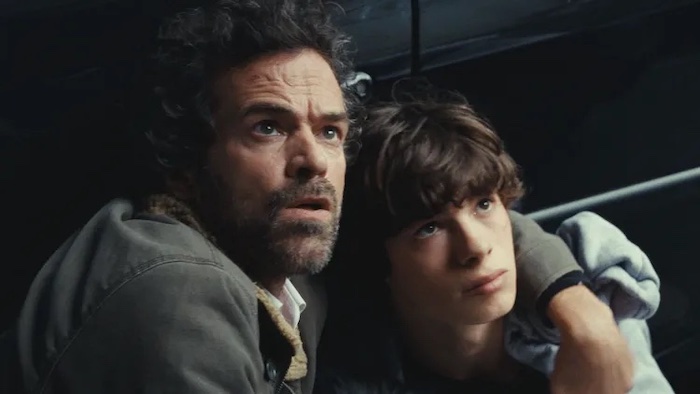
Having only read a handful of short stories by Haruki Murakami, I don’t feel I’m in a position to make informed pronouncements about how faithfully filmmakers have adapted his work. I liked Lee Chang-dong’s Burning and Ryusuke Hamaguchi’s Drive My Car, but from what I understand they mostly used basic plot points from their source material and liberally extrapolated on the themes. I also liked Jun Ichikawa’s Tony Takitani and had read the original short story in the New Yorker. It was quite faithful, but I liked the short story and the film for completely different reasons. Director Pierre Foldes’ take on six Murakami stories exists on a whole other level, and not just because it is animated. I’ve only read one of the stories adapted, but it seems more purposefully faithful to the original tone and meaning of the source material. What sets it apart as an adaptation is that Foldes has carefully and, for the most part, successfully combined the stories in such away as to create an integrated feature film rather than the collection of shorts that such an undertaking would normally produce. And by doing so, he more readily abides by Murakami’s appeal as a storyteller. Of course, the problem with such an approach is that it may only appeal to those who are already taken by Murakami’s peculiar literary traits. The rest of us might not be so disposed toward them.

There are two overarching plots in the film. In one, an indecisive, preternaturally uninteresting young man named Komura is taken aback when his wife, Kyoko, leaves their Tokyo home following the Great East Japan Earthquake of 2011, saying she will never return. In the bluntest terms, she adds she has no desire to live with Komura any more, since she finds him to be nothing more than “a chunk of air.” Though Komura is depressed by this development, he basically proves her right by going about his business, interpreting his abandonment as more of an inconvenience than anything else. As the story progresses, we learn how he and Kyoko met and came together as a couple under circumstances that seem hardly ideal, which to me is a hallmark of Murakami’s stories, especially those concerning romantic love. At one point, the POV turns to Kyoko herself as she relates a story to a friend (much of the development is presented as characters telling stories to other characters) that, at first, seems to have nothing to do with Komura but, in the end, actually does. The second plotline focuses on another loser, Katagiri, who might be Komura twenty years on. In fact, they work for the same bank. Katagiri is a loan officer in charge of an account with a company that is behind in its payments and may have associations with underworld figures. As his boss is putting the screws on him to get the company to pay up, Katagiri is visited by a giant talking frog in his messy apartment. The frog says that Tokyo will be hit by a massive earthquake on a certain day and it will be caused by a giant worm. The frog plans to fight the worm and requires Katagiri’s assistance. Murakami’s naturalist style here translates as magic realist comedy, since Katagiri has no idea why a zhlub like him would be chosen to assist in what comes down in movie terms as saving the world, and it’s difficult to get a handle on whether this is an allegory for something deeper. In any case, it’s more affecting the Komura tale in that Katagiri at least is given a chance to rise above his miserable station.

Foldes reproduces Murakami’s pointedly banal dialogue effectively, matching it to a flat drawing style that makes the characters look disembodied from their surroundings. The mood is downbeat throughout, a quality that emphasizes Murakami’s sometimes off-putting approach to women’s bodies and sexual attraction. When Komura ends up sleeping with a woman he just met on an inadvertent trip to Sapporo, the encounter feels all the more surreal because Komura is such a nonentity as a fictional presence. It’s as if Murakami, and Foldes, just wanted to give the guy a break by offering him sex without the emotional work sex usually requires. Maybe that’s what Kyoko was talking about.

In English dialogue and Japanese dialogue versions. Opens July 26 in Tokyo at Euro Space Shibuya (03-3461-0211), Cinema Qualite Shinjuku (03-3352-5645), Kadokawa Cinema Yurakucho (03-6268-0015).

Blind Willow, Sleeping Woman home page in Japanese

photo (c) 2022 Cinema DeFacto-Miyu Productions-Doghouse Films-9402-9238 Quebec Inc. (micro scope Productions l’unite centrale)-An Origami Pictures-Studio Ma-Arte France Cinema-Auvergne-Rhone-Alpes Cinema

Posted in Movies | Tagged | Leave a comment

Review: The Royal Hotel

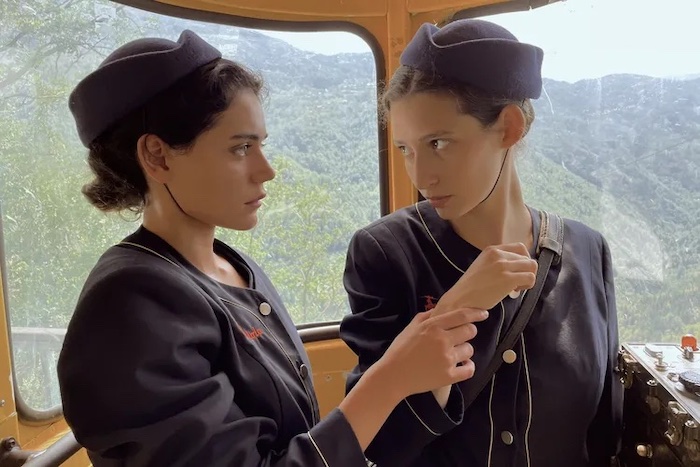
The last time director Kitty Green and actor Julia Garner entertained us, it was with a clammy study of malevolent male power in the entertainment industry. In The Assistant, Garner played the titular factotum to a faceless Weinsteinian indie producer whose proclivity for ingenues wasn’t very secret. Garner’s assistant wasn’t subjected to her boss’s attentions, but the guilt she felt being a party to his debauched appetites undermined everything about her relationship to a job she once thought was a godsend. In Green’s latest film, Garner plays Hannah, a young Canadian woman vacationing in Australia with her BF Liv (Jessica Henwick). When they run out of money, seemingly unexpectedly, they are partying as heartily as the trio of girls in the similarly-themed How to Have Sex, and one gets the impression that Hannah and Liv are just having too good a time to pay enough attention to their credit limit. They are reduced to applying for jobs with the holiday work exchange program and are assigned to an Outback hotel where the same kind of male-dominant assholery prevails as it did in the NYC office of The Assistant, only that nobody at the Royal Hotel keeps their assholery a secret.

Though the idea is just to make enough money to get back to Sydney and resume partying, circumstances, not to mention the debased clientele of the Royal, conspire to make it difficult for the two women to get out, and as in a classic horror film, the development focuses on an ever-burgeoning dread of violence that each protagonist faces differently. Liv seems to be the kind of employee who takes her work at face value, and since most of this work involves serving drinks to lower caste laborers whose attitude is that the customer is always right, she has to put up with a lot of coarse sexual innuendo and unmediated drunken behavior. Hannah, on the other hand, won’t have any of it, and while she’s fairly good at keeping her head, she won’t hesitate to tell off a gob who suggests that what she really needs is a good shag. Though the pair were warned even by their work consultant about the behavior in this stretch of desert, they really don’t understand the extent of the depravity until they arrive and find one of the English women they’re replacing being done doggystyle in their bedroom by a patron. They laugh at the sight but it’s clear they have been warned what they’re in for.

Green is thorough enough to show us why the guys act the way they do, and while the socioeconomic exploitation of these uneducated slobs is handled as boilerplate conflict-creation by the director, she gets sufficient emotional mileage out of the contrasts she sets up, especially with Matty (Toby Wallace), a customer whose attraction to Hannah is reciprocated with halting sympathy; Dolly (Daniel Henshall), a true menace whose sense of grievous resentment of his bosses and betters translates as misogyny of the purest kind; and Billy (Hugo Weaving), the alcoholic owner of the hotel who hates that he has something temperamentally in common with the men he serves. As terrible as these and other men can be in the movie, they, as well as the few women on the scene, don’t necessarily deserve the fate to which Hannah and Liv subject them in the end. They can always go back to Canada. These poor sods are lifers. 

Opens July 26 in Tokyo at Human Trust Cinema Yurakucho (03-6259-8608), Shinjuku Musashinokan (03-3354-5670).

The Royal Hotel home page in Japanese

photo (c) 2022 Hannah & Liv Holdings Pty., Ltd., Screen Australia, and Create NSW

Posted in Movies | Tagged , | Leave a comment

Media watch: Korean and Japanese groups set to excavate disaster site with or without the government’s permission

Remains of pier for the Chosei coal mine (Choshu Shimbun)

In February 2022, we posted a piece about the 1942 Chosei coal mine disaster in Ube, Yamaguchi Prefecture, which killed 183 workers, 136 of them Koreans who had been brought to Japan. A local group was formed in 1991 and have been holding annual memorial services for the dead ever since. A parallel group in South Korea was established the following year and the two groups have worked together and separately to lobby the Korean and Japanese governments to undertake an excavation of the disaster site in order to recover the remains of the victims. Since the mine collapsed during the war, the Japanese government did not have the available resources to recover the bodies, and after the war subsequent governments have claimed that the logistics of the proposed recovery operation would be too difficult, because the mine was located under the seabed off the coast of Ube. However, certain independent media have said that another reason the Japanese government has ignored the groups’ entreaties is that the Koreans who died in the accident were laborers brought to Japan against their will, an assertion the government has always refuted, and thus opening the Chosei mine would in turn open a can of worms. One aspect of the dispute that the government sidesteps is that during the colonial period, land, including farmland, on the peninsula was appropriated by the Imperial authorities without compensating the owners, thus forcing the owners and others who made their living off the land to secure work elsewhere, and in many cases the only work they could find was in Japan laboring for the war effort.

Apparently, the two memorial groups have decided they are no longer going to try to get any government involved in the project and will just carry out the excavation themselves. According the Choshu Shimbun, during the February 2024 memorial service, the groups declared that they would “open the hatch” by the end of the year, “the hatch” being the ingress point into the tunnel that connects to the collapsed mine. On July 15, the groups organized a meeting attended by 107 Japanese people and 30 Koreans that officially launched the recovery effort. Since the groups cannot count on the Japanese government for help, they are also launching a crowdfunding page to raise money on their own to finance the excavation. A Korean lawyer who has been instrumental in the negotiations with both governments since 2005 told the group during the meeting that without recovering the remains of the victims of the Chosei mine disaster, “we cannot solve any serious human rights issues [between our two countries], and therefore cannot even talk about Japan-Korea friendship.” If there is a will to recover the remains of the victims, then the groups should just go ahead and do it on their own, he added. 

Apparently, the groups were spurred to action in April, when one lawmaker in the Japanese Diet asked welfare minister Keizo Takemi why the government has “never tried to open the hatch.” Takemi answered that the site of the disaster is underwater, “so we don’t know where the remains are or how deep [the site] is.” The memorial groups responsed by saying that of course Takemi would say such a thing because the government has never even tried to carry out a field survey of the disaster site to determine the feasability of a recovery effort, so they realized that if the work was going to be done, they would have to do it themselves. Through crowdfunding, the groups plan to raise ¥8 million with the intention of starting the excavation work this fall. 

They know what they are up against. Even the location of the hatch is not known, so the first action on the agenda is to find it, and in recent weeks, volunteers have been cleaning the suspected area of vegetation. They don’t even know who owns the land they are searching, but are nevertheless undeterred. They have not sought permission for the ecavation work from either the central government of the relevant local government, but will simply go ahead and face such an issue only after someone in authority complains. But that doesn’t mean they will stop. 

For crowdfunding site (in Japanese) click here.

Posted in Media | Tagged , , | Leave a comment

Review: Despicable Me 4 and Fly Me to the Moon

The Despicable Me franchise just became the most successful animation series ever, box office-wise, which is only believable given inflation and the fact that I assume the franchise includes the Minions-focused films. In any case, resistance is futile, and the fourth installment has several moments of inspired lunacy that should appeal across the age spectrum, even if it’s very young children who are essentially keeping the series at the top of the heap. By now I would think the idea of a dedicated villain being turned around to become a villain-fighting hero would have outstayed its welcome, but there’s no accounting for thematic success when it comes to the financial calculations of Hollywood. In this one, the dagger-nosed Gru (Steve Carell) is beset by a former classmate at the school for villains, Lycée Pas Bon, he attended as a child, a literally cartoon Frenchman named Maxime Le Mal (Will Ferrell) who has invented something that turns him into a big bug commanding the cockroach hoards to do his bidding. After Le Mal is thrown in jail and escapes with the aid of his six-legged army, vowing revenge against his fellow alumnus, the deep state villain-fighting agency that employs Gru puts him into witness protection in an upscale suburban neighborhood with his wife, Lucy (Kristen Wiig), his three adopted daughters, and his new infant son, Gru Jr., who doesn’t seem to like him. However, the adolescent girl next door, Poppy (Joey King), recognizes the ex-baddie and blackmails him into helping her pull off a heist that Gru reluctantly, but ably, carries out.

That is essentially the plot, but the script by Ken Daurio and Mike White serves the humor, which has privilege over anything smacking of continuity or structure, so, of course, there’s a substantial Minion subplot that has several of the yellow pill-heads transforming into “mega-superheroes” who can’t quite get their super powers to work for them they way they should. Since most of the Minions’ staying comedic power is of the extreme slapstick variety, they don’t need verbal jokes and thus director Chris Renaud has a free hand to crank up the pratfalls and humiliations that kids love to see. 

When this stuff works, at least for me, it’s because of what’s made fun of. Gru’s bumbling attempt to be an all-American suburban dad (who sells solar panels for a living), especially with that Boris Badunov accent, is a pretty good antidote to current MAGA culture, especially when Gru and Lucy are contrasted with Poppy’s snooty country club-attending parents, who are a hoot-and-a-half but that’s only because I don’t have to live next door to them. Most of the rest of the attempts at levity had me checking my watch.

Speaking of watches, the big budget Fly Me to the Moon clocks in at 132 minutes, which is way too long for a romantic comedy, though selling it as a romantic comedy may be false advertising. All the elements are there—the monumental meet-cute, the initial enmity between the two romantic leads, the subset of supporting players who provide most of the comedy—but the framing story is flimsily constructed, and since that story is based on a real historical event, the Apollo 11 moon landing, the wobbly plot is even less engaging despite its breezy ridiculousness.

The leads seem to have been born to play these roles. Scarlett Johansson is Kelly Jones, the go-getting freelance advertising agent whose forceful personality in a world of Mad Men attracts the attention of the shadowy intelligence operative Moe Berkus (Woody Harrelson), who knows that Kelly is a professional con artist and blackmails her into doing PR strategy for NASA so that the project won’t have its funding pulled and the U.S. can get to the moon by the end of 1969, just as JFK promised. Though Berkus’s stated reason is beating the Soviets, the story positions him as an independent operator with a God complex. Kelly’s chief obstacle in getting the astronauts and various NASA honchos on board with product endorsements and CMs is Cole Davis (Channing Tatum), the mission director whose impressive upper body and collection of vintage crew-neck shirts make him the perfect foil for Kelly’s curve-enhancing outfits and very red lipstick. 

Conflict blooms when Berkus insists on there being a backup plan, because the U.S. cannot afford to blow the mission. He gets Kelly to rig a fake moon landing on a soundstage that will be used in case the real one fails, and while, at first, with its fey, Kubrick-jealous director and team of loutish actors, the secret project brims with comic potential, in the end it can’t help but come across as ludicrous in a completely unintended way—how could anybody, even within the fantasy milieu concocted for the movie, think that they would ever be able to pull this scheme off while the actual mission was taking place? And in a way, I think the filmmakers figured this out, too, but way too late. Like Berkus’s stupid notion, they just had to go through with it once they started, and the whole process drains the ending of both romance and comedy. 

Despicable Me 4, in subtitled and dubbed versions, now playing in Tokyo at Toho Cinemas Nihonbashi (050-6868-5060), Toho Cinemas Hibiya (050-6868-5068), 109 Cinemas Premium Shinjuku (0570-060-109), Shinjuku Wald 9 (03-5369-4955), Shinjuku Piccadilly (050-6861-3011), Toho Cinemas Shinjuku (050-6868-5063), Kino Cinema Shinjuku (03-5315-0978), Toho Cinemas Shibuya (050-6868-5002), Toho Cinemas Roppongi Hills (050-6868-5024).

Fly Me to the Moon now playing in Tokyo at Toho Cinemas Nihonbashi (050-6868-5060), Toho Cinemas Hibiya (050-6868-5068), 109 Cinemas Premium Shinjuku (0570-060-109), Shinjuku Wald 9 (03-5369-4955), Shinjuku Piccadilly (050-6861-3011), Toho Cinemas Shinjuku (050-6868-5063), Shibuya Cine Quinto (03-3477-5905), Toho Cinemas Roppongi Hills (050-6868-5024).

Despicable Me 4 home page in Japanese

Fly Me to the Moon home page in Japanese

Despicable Me 4 photo (c) Illumination Entertainment and Universal Studios

Posted in Movies | Tagged , , , , | 1 Comment

Review: How to Have Sex

The provocative title could be taken two ways, as either a manual or a philosophical contemplation, but the purport of Molly Manning Walker’s script suggests neither. Despite the manic energy displayed by the three British teens as they arrive at a cheap resort in Crete for a holiday that promises 24/7 partying, the cinematic mood is ominous, forcing the viewer to wonder: Do I have automatic prejudices against this situation, or is Manning Walker manipulating my feelings? As the women giggle and start pumping as much alcohol into their systems as they can get their hands on, the prejudices seem well-founded, and then, once they check into their room and announce that whoever gets laid gets the master bedroom, you sort of know where the movie is headed.

And you wouldn’t be wrong, but you’d be right in ways you won’t expect. The dynamic among the three BFFs is seasoned by their carefully wrought personalities, which are informed as much by their appearance as they are by their respective temperaments. Tara (Mia McKenna-Bruce), the nominal protagonist of the film, is small and bubbly, “cute” in a classic way and, most significantly, an admitted virgin who means to get past that presumed humiliation while on this vacation. Skye (Lara Peake) acts all experienced and everything, but it’s mostly a function of assertiveness. Em (Enva Lewis) seems the most level-headed by standards that parents would appreciate, and while she can’t hold her liquor very well she tests her limits often enough to make you believe her relative temperance isn’t worth a whole lot in a clinch. In essence, while the three pledge to have one another’s backs, they aren’t much good at looking out for themselves. They start hanging out with the trio next door: a guy called Badger with dyed highlights (Shaun Thomas) who isn’t as dumb or feral as his first impression might suggest; Paddy (Samuel Bottomley), a more subtle joker who turns out to be plenty feral; and their female pal, Paige (Laura Ambler), whom Manning Walker mostly ignores because, being a lesbian, she doesn’t pose a danger to anyone. 

Though there isn’t much of a story, there is a continuum of reckoning on Tara’s part. It’s not enough to say that her sexual awakening is a disappointment—it almost always is in the movies—but Manning Walker’s cautionary impulses vivify her rapid descent into disillusionment. Even before she’s taken advantage of, she burns out on the constant interaction with strangers that this kind of party atmosphere demands. The public drinking and debauchery is depicted in documentary detail—when the kids are hungover their nausea is contagious. Manning Walker, who got her start as a cinematographer, knows what it takes to isolate emotional states on a crowded screen. Her movie taught me nothing about how to have sex, but quite a bit about how difficult it is to feed your appetites without losing your soul. 

Opens July 19 in Tokyo at Human Trust Cinema Shibuya (03-5468-5551), Cinemart Shinjuku (03-5369-2831). 

How to Have Sex home page in Japanese

photo (c) Balloonheaven, Channel Four Television Corporation, The British Film Institute 2023

Posted in Movies | Leave a comment

Review: La Chimera

Josh O’Connor’s most characteristic facial expression is the sheepish grin, a look he made his own when he played the young Prince of Wales in the third season of The Crown, which is odd because Charles in real life never came across as anything but self-confident and O’Connor seemed to be implying that he was grievously intimidated by the even younger Diana Spencer, a reading of the situation that probably changed a lot of people’s thinking about that relationship. Whether it was based on anything other than O’Connor’s peculiar acting style, the expression has also been dominant in subsequent roles with characters who don’t always seem as shy as O’Connor interprets them. In Alice Rohrwacher’s quite original quasi-fantasy, he plays a lapsed archaeologist with a huge chip on his shoulder slumming it in a rural Italian town as the mystic-leader of a ragtag band of tomb-robbers, or tambaroli, in the local parlance. His British expat, Arthur, is dour to the point of surliness, but can still eke out a shy smile when he needs to charm the audience—though never, it would seem, his on-screen interlocutors. I like O’Connor, but I wish he’d cut it out.

The reason for Arthur’s chronic glumness and dishevelment is never explicitly explained, though it probably has something to do with the absence of the love of his life, Beniamina (Yile Vianello), who is only shown in what I assume are memories that flit through Arthur’s brain when prompted by some outside stimulus. Though the viewer eventually gleans that the girl is dead, she is never declared as such by Arthur, at least not in front of her mother, Flora (Isabella Rossellini), a wheelchair-bound singing instructor living in a broken-down villa who stares down her gaggle of daughters and grand-daughters, all of whom do think Beniamina is dead and want Flora to move into a nursing home. Just as Rohrwacher never lets on what it was that led to Arthur’s rupture with the academic discipline he once pursued, there’s no mention of how Beniamina came into his life, and at various junctures there are hints that everything is a figment of his imagination. The exception is the milieu, which is not the usual sun-kissed, leafy tourist paradise we expect from movies set in the Italian countryside, but basically a despoiled landscape filled with crumbling shacks, unkempt forests, and toxic industrial wastelands. Here, Arthur and his merry troupe look for underground grave cavities containing Etruscan pottery and sculptures, which Arthur locates using a dowsing rod until he becomes sick to his stomach, thus indicating that the dead dwell just below his feet. The group then clandestinely sells the contraband—all relics in Italy belong to the state, and the police are constantly on the lookout for poachers—to a mysterious rich person named Spartico (Alba Rohrwacher), but Arthur is not interested in money. He’s still hung up on beauty, which is why his impulses tend to run opposite to the aims of his accomplices. The only person who seems to understand him is Italia (Carol Duarte), Flora’s tone-deaf student and reluctant servant, who objects to the raiding of the deceased, no matter how many centuries they’ve been gone. It’s perhaps this doctrinaire moral stance that attracts Arthur, but he’s such a cipher that it becomes a chore just trying to make sense of his behavior. 

The same goes for Rohrwacher’s magical realist-style direction, which flips the camera every which way in order to keep the viewer off balance and jumbles the development into a collage of often counteractive intentions. Which isn’t to say La Chimera is frustrating or annoying. It works well as a comedy of errors with its colorful, intriguing characters, including Arthur, whose sourness never tips so far over as to fall into despair. Whatever the purpose of that enigmatic grin, it helps alleviate the movie’s latent sense of misery. 

In Italian and English. Opens July 19 in Tokyo at Bunkamura Le Cinema Shibuya Miyashita (050-675-5280), Cine Switch Ginza (03-3561-0707).

La Chimera home page in Japanese

photo (c) 2023 tempestra srl, Ad Vitam Production, Amka Films Productions, Arte France Cinema

Posted in Movies | Tagged | Leave a comment

Media watch: Ministry throws cold water on local government’s registration of same sex couple

In May, a same sex couple made news when the city of Omura in Nagasaki Prefecture allowed them to be indicated as the equivalent of a common law couple in their resident certificate, or juminhyo. It is the first time a same sex couple has received the indication in a juminhyo. Since then, at least two other cities, Kanuma in Tochigi Prefecture and Mitoyo in Kagawa Prefecture, as well as Setagaya Ward in Tokyo, have said they are considering making the same indications if a same sex couple want to do so on their juminhyo. 

But not so fast, said the central government. According to the Asahi Shimbun, the Minister of Internal Affairs and Communications (MIC), Takeaki Matsumoto, held a press conference on July 9 saying that there is a “possibility” that such an indication would cause “practical problems.” Apparently, the ministry had already contacted the mayor of Omura, Hiroshi Sonoda, in writing, telling him that juminhyo are official documents under national law, which Omura “did not follow” when it made the indication for the unnamed same sex couple in their household juminhyo. Sonoda replied that he had no intention of changing the indication and requested that the ministry clarify what it meant by “practical problems.” It is the mayor’s understanding that local governments administer resident certificates at their own discretion, since juminhyo are necessary for managing social security and social welfare matters at the local level. By extension, they can also be used to grant power of attorney. However, in many cases, such matters involve the central government, as well, so the MIC feels it has some say on how resident certificates should be administered. The MIC’s thinking is that if same sex couples are treated the same as common law couples in the document, social welfare officials will have a difficult time judging if an applicant is eligible for certain social services, even though an official at Omura City Hall told Asahi that the office received a call from an MIC official on July 8 who admitted that the indication in the juminhyo “should be decided by the local government.”

But the MIC didn’t stop there. A later Asahi article said that on July 9, the ministry sent notifications to all prefectures saying pretty much what Matsumoto said at the press conference. While Matsumoto’s statement about the matter was vague, its intention seemed to be to tell local governments that they can’t make such indications in the juminhyo, though, as Sonoda pointed out, it isn’t clear if the ministry can force the issue.

Omura’s move was inevitable. In recent years, some local governments have passed ordinances that recognize same sex couples as couples, but these ordinances do not give same sex couples the same rights as legally married couples. However, in March the Supreme Court decided that someone in a same sex relationship is eligible for compensation provided by the government to victims of crimes or victims’ families if that person’s same sex partner was the victim of a crime. The court’s rationale was that since common law heterosexual couples qualified for such compensation, same sex couples should as well.

In the Asahi article, a Nihon University professor disputed the MIC’s position, saying that the administration of resident certificates is not work that has been “entrusted” to local governments by the central government, so it is, indeed, completely up to the local government how they carry out the process. In addition, he doesn’t see how there would be a “problem” in indicating a same sex couple on the juminhyo, since on the document there are boxes for gender and relationships, so, as in the case of the Omura couple, one partner would be the head of household (setainushi, a problematic word for many since it literally means “owner of the household”) and the other would be indicated by their relationship to the head of household (HOH), in this case “husband,” and since both partners would have the “male” gender box checked, it would be easy to tell that this was a same sex couple. The professor says that Omura recognized, in accordance with the Supreme Court decision, that allowing heterosexual common law couples to register as partnerships without allowing same sex couples the same thing is discrimination. 

Continue reading
Posted in Media | Tagged , , , , | Leave a comment

Review: May December

Todd Haynes’ latest study of the undercurrents of American notoriety is his most willfully complicated work. It’s based on the 90s scandal involving the late Mary Kay Letourneau, an elementary school teacher who at the age of 34 had sex with one of her students and went to jail, where she gave birth to the boy’s child. Upon release, she married the boy and they raised a family before separating some 15 years later. Haynes and his screenwriter, Samy Burch, have changed the particulars of the case and added a fictional character who means to probe the relationship for personal profit. Though the themes are not particularly difficult to grasp, the plot tries to answer every possible question an observer might ask themself about what such a relationship entails, and, for the most part, the two filmmakers succeed. In fact, they answer a few questions we may not even have thought of.

Gracie (Julianne Moore) and Joe (Charles Melton) Yoo live in a fine home in upscale Savannah, Georgia, where both have lived all their lives, meaning they remain in the town where the scandal unfolded, among the people they scandalized most directly, including Gracie’s first husband and their children. In addition to the daughter, Honor (Piper Curda), that Gracie bore in prison and who is now in college, the couple have twins, Mary (Elizabeth Yu) and Charlie (Gabriel Chung), who are about to graduate high school. Joe is only 36. Into this fertile milieu comes Elizabeth (Natalie Portman), a famous TV actress trying for some much desired prestige by playing Gracie in an independent film directed by a hot shot veteran with whom she is having an affair. Gracie has granted Elizabeth a few weeks of her time so that the actress can do research on the part, a task that Gracie obviously doesn’t like but, as she says, if they’re going to make such a movie any influence on her part is better than nothing. At first, Elizabeth tries to be the consummate professional, promising Gracie that the movie will be a “complex and human story,” an explanation that doesn’t exactly put Gracie at ease, but the die has already been cast, and as Elizabeth spends her days in the finely appointed household she, and we, observe Gracie’s domineering passive-aggressive relationship with Joe, a medical technician whose hobby is raising butterflies. As Elizabeth gets closer to a conception of Gracie that she can use, she inserts herself into the life of the family and the community in such a way that, purposely or not, she undermines the various relationships she encounters by reflecting them back on the principals. Moreover, by interviewing the peripheral personalities, such as Gracie’s ex-husband, Tom (D.W. Moffett), and their emotionally wayward son, Georgie (Cory Michael Smith), she manifests an array of self-doubts and recriminations that have been simmering for years. Joe, in particular, finally admits to himself that, as much as he loves his children, he resents Gracie for forcing him onto a path he was too young to navigate with a clear mind. 

Fundamentally, the story is about sex and maturity, and in that regard Haynes can’t resist making it into a broad entertainment—a mystery and a comedy, often at the same time. The dramatic thrust of the scandal is that Gracie impulsively stepped over a line and refuses to regret it, which means Elizabeth feels she has the license to do the same, and while the actions on screen are bound to shock certain sensibilities, they do so in the spirit of how tragically ridiculous the whole enterprise is. In the film’s most hilariously cringe-inducing scene, Elizabeth takes questions from a high school theater class whose main interest is how she handles sex scenes, for which she is famous. As with almost every encounter in the movie, Elizabeth plays it like a pro, meaning she not only gets in the last word, but keeps her interlocutors wanting more. In that regard, she’s Gracie’s worst nightmare. 

Now playing in Tokyo at Toho Cinemas Nihonbashi (050-6868-5060), Toho Cinemas Hibiya (050-6868-5068), Toho Cinemas Shinjuku (050-6868-5063), Toho Cinemas Roppongi Hills (050-6868-5024).

May December home page in Japanese

photo (c) 2023. May December 2022 Investors LLC

Posted in Movies | Tagged , , | Leave a comment