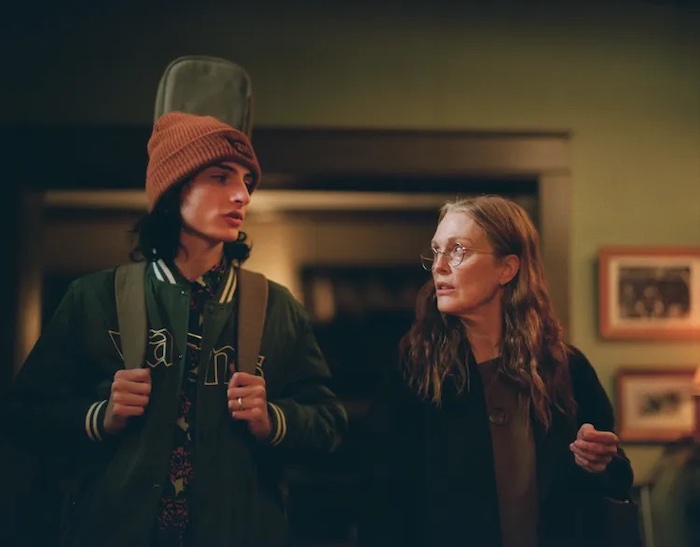
Review: When You Finish Saving the World

As an actor, Jesse Eisenberg occupies a clear thematic space in many moviegoers’ minds that is most readily filled by his nervous portrayal of Mark Zuckerberg in The Social Network; which is a shame, since Eisenberg is capable of a much wider range of interpretation. Nevertheless, his directorial debut, based on an audiobook he made in 2020, plays up that image by focusing on two narcissistic liberal types whose crusading activities more or less hide deep wells of insecurity. It’s as if Eisenberg is making fun of the prototype character that essentially gave him his career.

The two principal assholes are a woman and her teenage son. Evelyn (Julianne Moore) runs a women’s shelter somewhere in Indiana. She is a veteran adherent of second-wave feminism and has been a social welfare firebrand her whole life, but privately she’s a mess. Her marriage to a university administrator (Jay O. Sanders) achieved zero inertia years ago and their time together is mostly spent talking past each other. Moreover, middle age has prompted her to question the point of her life, as she no longer derives satisfaction from work that requires a constant need to compromise. It just takes too much energy. So when a woman (Eleonore Hendricks) enters the shelter to escape her abusive husband with her own teenage son, Kyle (Billy Bryk), in tow, Evelyn latches on to Kyle as a project, since he conveys native intelligence and wherewithal despite being from what she perceives as an “underprivileged” background. It’s clear to the viewer that she’s using this boy to make up for her neglect of her own son, Ziggy (Finn Wolfhard), a total failure in terms of the kind of social skills needed to survive American public schools, a failure he addresses by boosting himself as a sensitive singer-songwriter with a social media presence visited and subsidized by lonely adolescents in foreign lands. Ziggy’s own project, to make a truly socially invested female classmate (Alisha Boe) interested in him, is the most overtly wince-inducing element of this so-called comedy, since it’s so obvious that Ziggy has no conception of how he comes across with his earnest attempts at appearing smart and in-the-know, when, in fact, he has no genuine interest in the world. Even Evelyn, who reads and keeps up on current affairs, can’t seem to use her knowledge to navigate everyday existence, and her cultivation of Kyle manifests as a kind of grooming that puts others off when they actually stop and look at it. 

Eisenberg’s short New Yorker pieces prove he has a sharp wit, but When You Finish is over-extended. The characters never make an impression outside of their cringe characteristics, and in the end it’s impossible to empathize with them. Eisenberg doesn’t seem to realize that when you laugh at characters because of their cluelessness, you at least need to connect with their situation in order to maintain any interest in where they are going. I was tired of Evelyn and Ziggy after 30 minutes. 

Now playing in Tokyo at Toho Cinemas Nihonbashi (050-6868-5060), Toho Cinemas Chanter Hibiya (050-6868-5001), Kino Cinema Shinjuku (03-5315-0978).

When You Finish Saving the World home page in Japanese

photo (c) 2022 Saving the World LLC

Posted in Movies | Tagged , | Leave a comment

Review: Rifkin’s Festival

A common complaint about Woody Allen’s films ever since they moved from overt comedy to more cerebral fare is that the dialogue didn’t change accordingly. It still had that stilted, artificial quality that sounded more appropriate coming off a stage during a standup routine, but wasn’t necessarily supposed to be funny. Because of Allen’s prodigious output over the years, most of us became used to this style and adjusted as long as the characters and stories made sense, but the director’s most recent work has mostly been a reshuffling of already covered themes and the dialogue problem has thus become more pronounced. Though there are certainly extraneous reasons why his latest English-language comedy (I’ve heard he’s finished a more recent French language film) has failed to enjoy the kind of wide distribution he used to take for granted, the neglect may simply be due to the fact that the movie itself feels so inconsequential: Another Woody Allen movie that in a year or so no one will be able to distinguish from dozens of other movies he’s made.

Allen’s avatar here is Mort Rifkin, who, as played by Wallace Shawn, only makes the stereotypical Woodyisms that much less tolerable. Though Shawn can be amusing and even affecting within his own acting wheelhouse, he seems to have been shoehorned into the role of a retired film studies professor who accompanies his younger wife, Sue (Gina Gershon), to San Sebastian for the film festival, where she has a job as a publicist for a hot young French director played by Louis Garrell. Though Shawn is 8 years younger than Allen, it feels as if the director decided that if he went with a stand-in with his own distinctive screen persona he could make viewers forget about the various disparities incumbent in the film’s main connubial dynamic, but it isn’t possible, especially given Shawn’s patented schlubby screen appeal contrasted with Gershon’s well-seasoned sexual panache. The pair’s scenes together, compounded by the aforementioned stilted dialogue, are almost unwatchable since these differences aren’t alluded to at all. When Sue predictably starts sleeping with her client, Mort reacts not as someone who, by dint of his age and appearance, should have seen something like this coming, but as someone who blames it all on the over-familiarity bred of a long relationship, which makes little sense in this context. But it does provide the justification for Mort, after experiencing some slight chest discomfort, to seek out the services of a young female cardiologist (Elena Anaya) whose intellectual interests make more of an impression on him than her physical attributes. Not that Mort thinks he’s going to get to first base with her, a development that might have provided some queasy but actionable comic potential. Instead, Rifkin’s Festival is just another story about an older man’s need to have his worth acknowledged as a man.

Even Allen’s penchant for skewering intellectual pretentiousness falls flat. Whatever pushback Mort gets at the festival for his doctrinnaire approach to the old European cinema masters feels tired and trite. At least Garrell, playing a new shining light who endeavors to inject more Hollywood glitz into his art, provides some self-conscious rakishness; and Christoph Waltz’s cameo as a chess-playing foil pulls off the kind of non sequitur joke that Allen used to be so good at. Though I almost hate to say it, what Rifkin’s Festival really needs is Woody Allen the comic actor, but at 88 he’s obviously past all that now. He’s just running on whatever fumes fuel his old typewriter.

In English and Spanish. Now playing in Tokyo at Toho Cinemas Hibiya (050-6868-5068), Shinjuku Piccadilly (050-6861-3011).

Rifkin’s Festival home page in Japanese

photo (c) 2020 Mediaproduccion S.L.U., Gravier Productions, Inc. & Wildside S.r.L.

Posted in Movies | Tagged , , , | 1 Comment

Review: Green Night

Chinese director Han Shuai’s first movie, 2020’s coming-of-age story, Summer Blur, was such a big worldwide festival hit that programmers and distributors have been maneuvering ever since to be advantageously positioned when the followup finally dropped. In that regard, Green Night is certainly a surprise. A surreal gangster tale set in Korea, the movie’s entire vibe implies that Han was determined to not repeat herself. The casting alone would seem to reward the anticipation: Chinese star Fan Bingbing makes her own long-awaited return to the screen as an Incheon Port security guard married to a violent Korean man of faith, and rising Korean actor Lee Joo-young plays a punky drug mule who seems to have the hots for Fan’s character. 

Han sets the movie in the seedier environs of Seoul and its suburbs, a gambit that highlights the contrasting sensibilities of the core relationship. Fan’s Jin Xia is a Chinese woman trying to get out of her disastrous marriage-for-convenience and secure a resident visa, while Lee’s unnamed, green-haired retrobate seems to function as more or less a monkey wrench thrown into Jin Xia’s plans. There’s not a lot of coherence to the sequence of events that follow their first meeting at the security checkpoint in the port when Jin Xia attempts to scan a Korean woman for contraband and she responds by coming on to her. When Jin Xia tries to report this scofflaw to her boss, he doesn’t seem to care, thus indicating some kind of under-the-table quid pro quo. Jin Xia’s humiliation is exacerbated when she finds herself being stalked by the Korean woman, who readily admits she’s carrying drugs into the country for some Chinese concern. Without reason, Jin Xia succumbs to green-hair’s charms and allows her to crash at the crappy apartment she rents away from her husband, who pesters her with calls begging her to come back when he isn’t dropping in to give her another beating in the name of the Lord. Green-hair tries to return the favor by involving Jin Xia in a big drug deal, which will make her enough money to get a visa, albeit illicitly. The rest of the movie supplies plenty of transgressive potential, including copious violence, harrowing medical emergencies, and nasty language, but Han never gets a purchase on the underlying motivations and settles instead for a kind of artsy narrative ambience, which just comes across as being coy.

Even the promise of a cross-cultural romance fails to play out convincingly, though affection born of desperation does manage to develop between the two mismatched women. The structure, which is episodic to the point of distraction, fails to support the whole, even as a genre exercise. If you want to convey grit, you have to offer more than just the trappings of reality. 

In Korean and Mandarin. Opens Jan. 19 in Tokyo at Human Trust Cinema Yurakucho (03-6259-8608), Shinjuku Musashinokan (03-3354-5670), Shibuya Cine Quinto (03-3477-5905).

Green Night home page in Japanese

photo (c) 2023 DEMEI Holdings Limited (Hong Kong)

Posted in Movies | Tagged , , | Leave a comment

Media watch: Osaka Expo’s fate remains uncertain three months prior to vital deadline

On Jan. 5, three of Japan’s top business lobbies held a joint New Year’s press conference and one of the topics discussed was the disaster in Ishikawa Prefecture, in particular how it might affect the 2025 Osaka-Kansai Expo, whose progress has been plagued by delays. Despite flagging public support for the Expo, the business community continues to back it, saying it must be carried out at all costs. However, a slight chink in this facade of confidence was exposed when Takeshi Niinami, the president of Suntory Holdings and current chairman of the Japan Association of Corporate Executives (Keizai Doyukai), expressed hesitation about prioritizing the Expo while people in the area stricken by the quake were still suffering. 

According to Tokyo Shimbun, Niinami stressed that the Expo, slated to start in April 2025, should go ahead as planned, but also said that he has heard from associates in the affected area that the “scale of damage” is “extraordinary,” adding that the shortage of construction labor in Japan, which is one of the main problems affecting the Expo, “shouldn’t hamper reconstruction in the disaster area.”

Since the quake on New Year’s Day, some people in the media have said that helping the victims return to some normal semblance of life should be Japan’s priority, which means resources now being used to build pavilions and other infrastructure for the Expo should be transferred to Ishikawa. If that happened, the Expo could be doomed, because there is no way all the structures planned for the event would be completed in time. 

The other two representatives in attendance, Masakazu Tokura of the Japan Business Federation (Keidanren) and chairman of the Expo committee, and Ken Kobayashi, chairman of the Japan Chamber of Commerce, were unwavering in their continuing support for the Expo. Tokura said, in essence, that the two matters are not in conflict with each other. “We must address the disaster as soon as possible,” he said, “but we also have to keep the meaning of the Expo in mind.” Kobayashi remarked that the quake was an act of God and thus shouldn’t have any effect on the Expo, which will “demonstrate” Japan’s power to the world.

Continue reading
Posted in Uncategorized | Leave a comment

Review: Beyond Utopia

Madeleine Gavin’s movie about North Korean defectors, which has been shortlisted for this year’s Documentary Feature Oscar, is custom-made for controversy. Though many Western critics have praised its verité take on the defection process and unflinching depiction of NK regime atrocities, documentarians who regularly cover the Korean peninsula have questioned what they see as an unbalanced view of the North-South standoff and expressed concern as to the filmmakers’ effect on the action presented. These issues were explicated in a recent letter some of these documentarians sent to PBS prior to its airing of Beyond Utopia, saying that the historical record laid out in the film is incomplete and the film’s wholesale demonization of North Korea dangerously misleading. Though almost no one thinks the dynastic communist Kim regime constitutes a legitimate government, or that the country’s human rights record is anything but horrible, the U.S. has had a hand in maintaining the brutality of the regime through ever-intensifying military pressure and sanctions that mainly harm the North Korean people. Such aspects only opens the film up to charges of being ideologically driven.

Just as likely, these decisions seem to have been made for the purpose of generating dramatic tension. The movie covers two parallel stories, the more exciting of which is a step-by-step visual record of one family’s escape from North Korea into China, which takes them all the way to Thailand, mostly on foot. In order to make this possible, the filmmakers work closely with the South Korean Christian pastor, Kim Seungeun, who has helped hundreds of other defectors make the same trip in the past. Working with teams of brokers who are in it for the money, Pastor Kim knows all the pitfalls of such a journey and is the perfect guide for the viewer, especially since he, at one point, physically joins the Roh family (which includes two children and an 80-year-old woman) after they enter Vietnam. There is no denying the visceral character of these sequences, though the viewer may wonder how much of what they are seeing is in service to the documentary project. (At one point, the pastor instructs family members on how to use the cameras) The structure of the film also raises questions, as the suspense of the Rohs’ ordeal is interrupted—and thus heightened—every so often for another example of North Korean perniciousness as explained by a group of experts, including journalist Barbara Demick and defector/activist/author Lee Hyeonseo. In contrast, the second story, which follows defector Lee Soyeon as she tries to extricate her teenage son from North Korea, can’t help but feel less momentous since it all takes place on the phone as she, already settled in the South, negotiates with brokers and people with connections in the North. 

It’s perhaps the utter professionalism and high quality of the finished product that may cause the viewer to wonder, because all the elements seem geared toward maximum emotional involvement. Beyond Utopia bills itself as a unique look into a country that’s shrouded in dread and mystery, but it has the effect of being draining in much the same way a disaster movie is draining. Most of the film’s objectivity is concentrated on the Roh family’s difficulties in coming to terms with the despicable character of the North Korean government since they are so conditioned by propaganda—even as they flee the country for their own survival. It’s a paradox that Gavin plays up, especially at the end, but it also implies that if the viewer is truly interested in a complete picture of the plight of North Koreans, they should additionally seek out other, less fraught materials. 

In Korean and English. Now playing in Tokyo at Toho Cinemas Chanter Hibiya (050-6868-5001). 

Beyond Utopia home page in Japanese

photo (c) TGW7N, LLC 2023

Posted in Movies | Tagged | Leave a comment

Review: A Light Never Goes Out

Nostalgia, as in the longing for something lost, takes on a double meaning in Anastasia Tsang’s debut feature. On the surface, the thing lost is the craft of neon sign-making, which the film’s protagonist, Heung, played by veteran Hong Kong actor Sylvia Chang, attempts to maintain after the death of her husband, Bill (Simon Yam), who was a master of the art. In another sense, it is the loss of Hong Kong itself, which once boasted a brilliant night glimmer thanks to its neon-lit boulevards, now garishly illuminated by LEDs and fluorescent lights. Of course, Hong Kong has lost much more in recent years, but Tsang thinks that the end of that neon glow is enough to represent it all.

Her movie is a strictly sentimental affair. Heung was always skeptical of Bill’s calling, especially as the years passed and fewer and fewer businesses availed themselves of his wares, but after his death she begins to appreciate his contribution, visiting locations where his works once made their mark indelibly, and she meets others who miss the neon, including Leo (Henock Chou), a young man of no particular distinction who claims he was Bill’s “apprentice” and continues to squat in Bill’s old workshop. Leo and Heung eventually try to extend Bill’s legacy against all odds. Then there’s Heung’s daughter, Prism (Cecilia Choi), who fortifies the allegory. Like many of her compatriots, she sees no future in her beloved city, and is planning to move with her fiancee to Australia. 

Tsang seems to be saying that the whole economic rationale behind the elimination of neon points to a future that disdains creativity for the sake of convenience. In Bill’s workshop, Heung and Leo endeavor to recreate his most indelible creations for the enjoyment of people who have nothing else to hold onto as they approach the end of their lives. In interviews, Tsang has acknowledged that her film was difficult to produce in today’s environment because of its “literary flavor,” and while the script has no overt political message, its piquant nostalgia says more than the characters themselves let on.

In Cantonese. Opens Jan. 12 in Tokyo at Bunkamura Le Cinema Miyashita Shibuya (050-6875-5280), Cinemart Shinjuku (03-5369-2831).

A Light Never Goes Out home page in Japanese

photo (c) A Light Never Goes Out Limited

Posted in Movies | Tagged | Leave a comment

Media watch: Some fast food operators handle price increases better than others

Gyoza no Osho

Most businesses that survived the pandemic are now doing well owing to something called “revenge” spending, which is essentially a reflexive action by consumers after they’ve been liberated from reduced spending due to restrictions, whether mandated or market-driven. At the same time, many of these businesses have increased prices due to a number of factors, and in that regard some are doing better than others.

One who is not doing better is McDonald’s Japan, which has lost customers in the past year. According to a Dec. 20 report in Gendai Business, the Japan arm of the world’s most famous fast food company posted a 5.3 percent decrease in patrons last June compared to June 2022. Like all retail businesses McDonald’s lost a lot of customers starting in March 2020 when COVID took hold, and a year later those customers started to return. The numbers improved steadily thereafter until last January, when the trend reversed. 

Gendai asked an analyst why this was happening, and he gave several reasons, the main one being price increases on McDonald’s part. The first was implemented in March 2022, but seemed to have little effect. The second came about in Sept. 2022 and affected 60 percent of the menu items with increases ranging from ¥10 to ¥30. Then in Jan. 2023 there was another price hike on 80 percent of the menu items that resulted in a maximum increase of ¥150. To put this into perspective, a regular hamburger went from ¥100 to ¥130 in March 2022; from ¥130 to ¥150 in Sept. 2022; and from ¥150 to ¥170 in Jan. 2023. The price increase for a Big Mac was even more pronounced in Tokyo (Tokyo prices tend to be higher than in other regions): ¥390 to ¥450. A small order of fries increased from ¥150 to ¥190. The expert gave various reasons for the hike: higher cost of ingredients, exchange rate fluctuations (McDonald’s imports almost all its ingredients), and higher wages. The latter reason especially affected McDonald’s, which tends to hire almost exclusively part-time staff, and in order to ensure full crews at all times they have to offer higher pay than what part-timers usually earn.

The analyst theorizes, however, that it wasn’t just the higher prices that discouraged some customers, but rather the fact that there was no attendant increase in cost effectiveness. He points out that, in fact, McDonald’s was more expensive in the past. A hamburger was ¥210 in 1985, when the exchange rate was almost ¥200 to the dollar. In 1990, a Big Mac was ¥380, meaning the price had barely gone up in 30 years. He observed on social media that many consumers knew about these price differences over the years. While increasing prices, McDonald’s Japan also eliminated or curtailed some of its more popular campaigns, thus effectively driving up the price even more in the minds of regular customers. They cut back on the distribution of coupons, which save customers money on certain items like coffee and side orders. The set menus were changed. In the past, hamburger sets included a drink and a side order, but now they no longer include the side order; whereas the Big Mac set used to include only a drink for ¥400, but now the set also includes a side order and is ¥750, which most customers will think is too expensive if the drink-only set option is unavailable.

McDonald’s is doing away with bargain options because it wants to get more money out of each customer visit. But as the analyst points out, if this strategy was implemented to address declining patronage, it will only make the matter worse, meaning McDonald’s would theoretically have to keep increasing prices to bring in the same amount of revenue, and that would be self-defeating.

Continue reading
Posted in Media, Money | Tagged , , | Leave a comment

Review: 20,000 Species of Bees

The topicality of the Spanish film 20,000 Species of Bees is its main selling point, but focusing on its LGBTQ themes does it a disservice. Set in the Basque Country during the summer, the story centers on 8-year-old Aitor (Sofía Otero), whose struggles with identity issues have come to a boil as he leaves his home in southern France with his mother, Ane (Patricia López Arnaiz), and two siblings for Ane’s childhood home in northern Spain. It’s clear from the fraught opening scene that some minor scandal has occurred between Aitor and a female classmate, and also that Ane’s relationship with her husband, Gorka (Martxelo Rubio), is going through a bad patch. (Gorka elects to join his family later for reasons not explained) Aitor’s sullen demeanor waxes and wanes after he arrives at his grandmother Lita’s (Itziar Lazkano) house, where all his relatives comment on his long hair and sudden insistence that he be called Cocó rather than Aitor. This fluid attitude toward names will continue, as Cocó decides to adopt the more resolutely feminine moniker Lucia after he hears the story of St. Lucia, the patron saint of poor people. 

But Aitor’s gender confusion is embedded in a larger tale about transformation as a normal part of life. As Aitor addresses that confusion, maintained by the acceptance of his choices by his great-aunt Lourdes (Ane Gabarain), a beekeeper who encourages him to talk about his feelings and says he can be anything he wants (“What do you want to be called,” he asks Aitor, who replies, “Nothing.”), and the rejection of those choices by Lita, who blames Ane’s constant state of distraction for Aitor’s situation, we also see Ane rekindle her student love of art, as she attempts to commandeer her late sculptor father’s workshop in order to re-enter a field she gave up when she became a wife and mother. Her own transformation is met with similar resistance, though of a more passive-aggressive type, and the two conflicts come to a head in the final reel. Writer-director Estibaliz Urresola Solaguren, whose first feature this is, adds just enough backstory to clarify Ane’s choices as a means of explaining her seeming ambivalence toward Aitor’s. Though she is willing to allow her child to follow his own impulses until it feels right, she thinks she needs the approval of others in order to fulfill her own needs. Lourdes recognizes this ambivalence and chides Ane for it, saying that it is her lack of attention to Aitor’s dilemma that exacerbates Aitor’s stuggle, but to Ane it’s a lose-lose situation. 

Aitor sees no way out of this struggle—which is more about not wanting to be a boy than wanting to be a girl—except transformation, though he is too young to understand exactly what that entails. After Lourdes explains a local custom of striking a beehive several times with a stick when someone is born, Aitor asks her if it would be easier for him to just be “reborn” as a girl. Lourdes answers that there is “no need to die” in order to become a girl, which is probably the first statement from an adult regarding his struggle that Aitor can work with. 20,000 Species of Bees is one of those rare movies that actually offers a resolution to the specific personal conflict depicted, even if it isn’t necessarily a resolution to the more general conflict the story symbolizes. It has a lesson for everyone. 

In Spanish, Basque and French. Now playing in Tokyo at Shinjuku Musashinokan (03-3354-5670), Human Trust Cinema Shibuya (03-5468-5551).

20,000 Species of Bees home page in Japanese

photo (c) 2023 Gariza Films Inicia Films Sirimiri Films Especies de Abejas AIE

Posted in Movies | Leave a comment

Review: Concrete Utopia

Um Tae-hwa’s disaster movie was South Korea’s official submission for this year’s International Oscar. It didn’t make the shortlist, and it’s easy to see why. Concrete Utopia plays like a genre movie, which normally don’t rate with Academy members. So why did the Korean Film Council, which had a ton of very good movies to choose from last year, pick Concrete? Probably because the movie’s genre conceits served a critique of modern Korean society, thus making it similar in purpose to Parasite, which, of course, won not only an Oscar for best International Feature, but one for Best Picture. However, the similarities end abruptly there. Though Concrete is at heart a black comedy about how ownership turns people against one another during times of extreme hardship, it’s also an entertainment filled with extreme special effects, disturbing violence that you would more likely find in a horror movie, and plot points that revolve around mysteries the characters have to solve. It’s not just a genre film, it’s a multi-genre film, and all the aspects designed to pull us into the story overwhelm its sociological themes.

The horrific earthquake that destroys Seoul and provides the backdrop for the action takes place before the opening titles. The Hwang Gung apartment complex comprises the only structures still standing for what looks like many kilometers, so naturally outside survivors flock to it for food and shelter from the cold, much to the consternation of the homeowners who live there. At first, they take pity on the refugees and allow them into the building. Some, like the meek civil servant Min-sung (Park Seo-jun) and his wife, nurse Myung-hwa (Park Bo-young), even allow several to camp out in their apartments, but after multiple incidents involving visitors getting into fights or making demands that strain the good will of their hosts, the residents council votes to kick them all out, and elect the brooding Yeong-tak (Lee Byung-hun) to carry out the effort. He proves to be effective, and after a violent struggle the “cockroaches” are banished and Yeong-tak becomes a dictator whose credo is that the strength of the collective is defined by the integrity of the home; meaning only owners have rights in such a situation. This way of thinking infects the complex and turns it into an authoritarian oasis: selfishness becomes the justifiable default mode of all activities. Bands of residents venture out into the fallen city to loot businesses and abandoned apartments for food and supplies, while a bureaucratic system takes hold within the complex that supposedly guarantees equal treatment, but certain residents demand a heirarchy based on presumed “contributions” to the whole. 

However clever the humor (fortified by the martial music on the soundtrack) or the mystery sub-plot of Yeong-tak’s shady provenance as a resident, the viewer knows exactly where the story is headed and all Um can really do to add variety is ratchet up the ensuing violence and intensify the bad behavior. Had Um stuck with his opening gambit of showing how Korea’s predatory real estate boom has made the country less secure, he might have created something more provocative. Concrete Utopia is a well-made film, but it rarely transcends its urge to appall the viewer with atrocious behavior. A better Korean movie of this ilk is 2022’s Dream Palace, about a new condo resident who fights against the collective for what she believes are her own specific rights as a homeowner. That movie doesn’t require a catastrophe to show how self-interest can corrupt, and stars the invaluable Kim Sun-young, who plays the head of the residents’ council in Concrete Utopia. In fact, some of the council members say they recently moved to the Hwang Gung apartments from a nearby condo called Dream Palace, which is obviously inferior in status—after all, it collapsed. As with apartments, it’s impossible not to compare movies that cover the same ground. 

In Korean. Opens Jan. 5 in Tokyo at Marunouchi Piccadilly (050-6875-0075), Shinjuku Wald 9 (03-5369-4955).

Concrete Utopia home page in Japanese

photo (c) 2023 Lotte Entertainment & Climax Studio, Inc.

Posted in Movies | Tagged , , | Leave a comment

Media watch: Korean actor criticized for knowing about history

Han So-hee

If you’re into K-dramas, you’re probably aware that on Dec. 22 a new one called Gyeongseong Creature premiered on Netflix. Like the titular monster it’s a hybrid: part sci-fi horror mystery, part historical melodrama. Set in the spring of 1945 in Gyeongseong, the old name for Seoul, the story centers on a man and a woman who learn about horrible human experiments being carried out by the Japanese Imperial Army, first in northeast China and then in Gyeongseong. The idea was inspired by real experiments the Japanese military conducted on Chinese prisoners during World War II. The creatures under development in the drama are designed to be weapons. 

To announce the launch of the series, actor Han So-hee, one of the stars, posted a brief poetic description of its theme on her Instagram account accompanied by 8 photos, one of which depicted the Korean independence activist Ahn Jung-geun. The comments thread for the post quickly filled up with reactions, many of them angry, not at the post itself but at the photo. Ahn was the man who assassinated Hirobumi Ito, Japan’s first prime minister who later became resident-general of Japan’s occupation of the Korean peninsula, in the Chinese city of Harbin in 1909. Ahn was against Western influence in Asia and welcomed Japan’s victory in its war with Russia, but was disappointed when it became obvious that Japan was bent on colonizing Joseon (the old name for Korea), which it would do the following year through annexation. According to the late Japan scholar Donald Keene, Ahn always felt an affinity for Japan since he believed the two countries shared many values and traditions. He was put to death by the Japanese military.

Nowadays, Ahn is a national hero to Koreans and a terrorist to many Japanese. By posting Ahn’s photo, Han offended her Japanese followers, who thought she was making a political statement at their expense. Han did not mention Ahn in the text of her post, but by attaching his photo she appeared to be connecting the idea of Korean independence to the drama series, which takes place during the last year of Japan’s colonial rule, Korea’s “darkest time,” according to the show’s catch copy. None of the complaints let on that Japan officially governed Korea from 1910 to 1945 (and unofficially for some years prior to 1910), and during that time endeavored to turn Koreans into subjects of the Japanese emperor by force. The authors didn’t seem to make the connection. They took Han’s gesture as an affront without even thinking about the context, if, in fact, they even knew about it. 

Continue reading
Posted in Media | Tagged , | Leave a comment