Though I no longer earn income writing music criticism (I still earn a bit covering the biz), I find that the annual task of compiling this list has become more and more time consuming, so, in a way, it’s good that I’m semi-retired since it gives me that much more time to waste on it. Then again, once you have time to waste, you end up taking your time, so maybe my notion of cause-and-effect is backwards. In any case, once I did get down to it, I tumbled down the rabbit hole of African electronica, specifically the South African genre called amapiano, which has actually been around for a number of years. I just didn’t know that particular species of house music had a name, but once I did it became like a drug and in mid-November I stopped listening to the stuff I had been listening to regularly all year and dove into it head first, seeking out other writers who knew more about it than I did (thanks, Frank Kogan) and scouring the internet for related artists. Consequently, by mid-December my shortlist was top heavy with African DJs and I wondered if—to beat these metaphors to death—I hadn’t gone overboard. So I’ve spent almost every waking minute of the last three weeks going through all the stuff I’ve liked even glancingly during the past 11 months to make sure I wasn’t overlooking anything, and, as you can probably guess, I found a lot of things I liked that I didn’t expect to. In the end, three amapiano artists remained on the list, and two (DJ Black Low, DJ Finale) were removed, so for once I added a Best Songs list in order to give them—and some other artists I jettisoned—the recognition they deserve.
Owing to Japanese distributors’ habit of taking their time to promote overseas releases, foreign films often don’t show up in theaters here until well after they’ve shown up elsewhere. This trend was exacerbated by COVID and thus I figure more than half the features on my best of 2023 list might seem like ancient history to moviegoers from outside Japan. Sometimes, as with Oppenheimer, the reason for the delay is different, but despite the local controversy I always knew Christopher Nolan’s blockbuster would eventually get a theatrical release here, and the tentative date is this spring, hopefully (for the distributor) before the Oscar show. Still, sometimes a filmmaker has a built-in audience in Japan that means the distributor can do away with extensive promotion, which is why the Aki Kaurismaki movie is on my list. In that regard, the biggest surprise is the Kelly Reichardt feature, which came out in the US this year. Reichardt has been making critically acclaimed movies since the early 90s and Showing Up is her first standard theatrical release in Japan—well, simultaneously with her 2019 movie, First Cow—which means somebody finally caught on (local streaming service U-Next, to be precise). Of course, I can’t use the promotional delay excuse to explain the absence of Japanese fiction features, something I’ve talked about in the past and which I won’t discuss here, but suffice to say that I saw the Hirokazu Kore-eda film and liked the story but not the characters; and didn’t go out of my way to see the Hayao Miyazaki movie because I’m not a big fan of anime. I did, however, see Ryusuke Hamaguchi’s latest, Evil Does Not Exist, and would have put it high on this list but it won’t come out in Japan until next year, so even Japanese films can be subject to the promotional delay. And if you’re wondering why Killers of the Flower Moon isn’t here even though it did receive a limited theatrical release in Japan, well, actually, I did see it, and, in fact, enjoyed it—or, at least, the parts I remember. There was something about the rambling quality of the nearly four hour film that left me afterwards with gaping holes in my recall of the story. I’d blame it on encroaching old age, but I remember almost every minute of Wang Bing’s documentary Youth (Spring), which I saw at Busan, and that was three-and-a-half hours. It just depends on what makes an impression in the moment, I guess.
Last Wednesday, the Fukuoka High Court ordered Okinawa Governor Denny Tamaki to “approve” the modified plan for landfill work ordered by the central government for relocating the US Marine Corps Air Station Futenma to the Henoko area of Nago on the east coast of the prefecture. Tamaki had rejected the revised plan, saying that further research was needed into the soft seabed discovered at the reclamation site. The court found that Tamaki’s action had harmed “the public interest,” despite the fact that Tamaki’s stated reasons for rejecting the plan was that his constituents opposed the base construction project and wanted Futenma to be moved out of the prefecture altogether.
If Tamaki refuses to approve the revision, the land minister can circumvent his authority and approve it himself, which means that the governor of Okinawa has no real authority over the prefecture he was elected to govern because the central government can do whatever it pleases. The courts in this case simply have a rubber stamp function for anything the government wants. After all, it was the central government that sued Tamaki for not approving the plan, a rare move in the first place. He can still appeal the ruling to the Supreme Court, but it doesn’t take a legal expert or fortune teller to figure out they’ll decide the same thing.
The Henoko construction project is already a fiasco. Futenma, built by the US in 1945 after the Battle of Okinawa, is located in the densely populated city of Ginowan, which has complained for decades about the danger of US military aircraft flying above it, not to mention attendant noise and air pollution issues. In 1996, the central government reached an agreement with the US. to relocate the base. Camp Schwab in the Henoko coastal area of Nago was chosen in 1999. Local residents and other Okinawans have opposed the relocation ever since, saying construction will destroy the area’s marine ecology and, besides, the prefecture shoulders too much of the burden of hosting the US military. However, the Americans insisted that the Marine air base is essential to its task of policing the Pacific, which includes protecting Japan, and Okinawa is the optimum location for such a base. The landfill work was originally approved in 2013 by the governor at the time, but his successor revoked the approval two years later. Then the Supreme Court ruled that the retraction was illegal and landfill work began in earnest in 2018, when Tamaki was first elected. In 2020, it was discovered that a major portion of the seabed where the reclamation work is being carried out is much softer than initially thought, and so more work and money would be needed to reinforce it. Tamaki rejected the revised plan and work was paused. In the meantime, protests against the construction by local activist groups intensified.
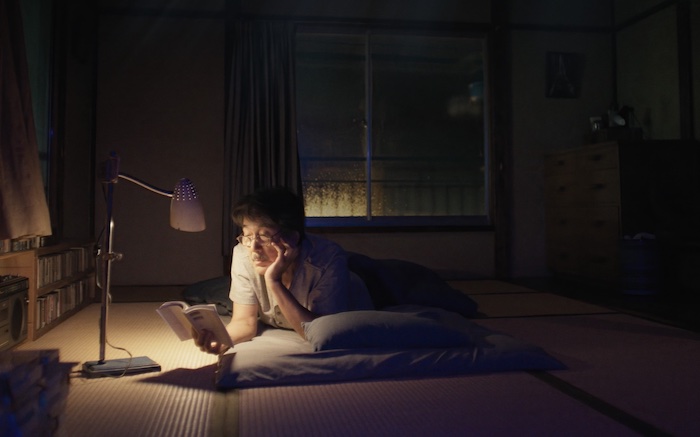
Wim Wenders’ ode to everyday wonder works best when its protagonist (Koji Yakusho), who could have been named Analog Man without raising anyone’s eyebrow rather than Hirayama, is simply going about his business, whether its cleaning the very stylish public toilets in Shibuya Ward, taking photos of tree canopies with his film-loaded camera, reading bunko paperbacks of classic novels in his 6-tatami room in Kameido, or puttering around the streets and expressways of Tokyo in his kei truck listening to cassettes of classic rock. These scenes are as immaculate as Hirayama’s morning toilet and ascetic digs, and convey a personality that feels natural and realistic, even if Wenders’ efforts to romanticize his life can sometimes feel precious. (An early scene is set to the Animals’ “House of the Rising Sun” as the actual morning sun appears over the Tokyo skyline.) Hirayama is a man who seems to have found peace with simple pleasures, meaning he’s most alive in his loneliness. It’s when Wenders injects other people into the proceedings that the movie becomes hard to accept. You understand the impulse. Hirayama is no misanthrope, but he’s obviously averse to the trappings of the social media age and would prefer keeping to his routine. If, as the saying goes, hell is other people, it’s because they demand attention from somebody who rejects it constitutionally.
Wenders injects these interactions into the film as a means of trying to explain Hirayama’s isolation, which is not only unnecessary, but offensive. His younger toilet-cleaning colleague, Takashi (Tokio Emoto), drags Hirayama against his will to a used record shop because he thinks the older man can make some good cash selling his vintage cassettes. The scene does nothing except expose Takashi as an asshole, something that Hirayama, in his Wenders-granted purity, would prefer not to be made aware of. Later, after a fairly idyllic sequence of a day spent with Hirayama’s teenage niece (Arisa Nakano), who shows up on his doorstep unannounced, Hirayama’s sister (Yumi Aso) drops by in a chauffeur-driven sedan to take her home. So he’s from that kind of family! That explains everything! In fact, it explains too much. Can’t Hirayama remain a mystery? Now that we suspect he’s a dropout, he becomes more of a cliché. If we are meant to admire him for eschewing the digital life and appreciating the work he does, and seems to love, because it benefits society in a direct way, why does it have to be qualified by his rejection of his past? We never see him drink or smoke (his preferred beverages are canned coffee, milk, and ice water), but when he accidentally happens upon the mama-san (enka star Sayuri Ishikawa, who does her own version of “House of the Rising Sun”) of the little bar he visits once a week in the arms of a stranger, he bolts to the banks of the Sumida River with three cans of highballs, as if he’d just fallen off the wagon. Moreover, the stranger (Tomokazu Miura) inexplicably finds and confronts him in order to set things straight. Who asked him to?
It’s hard not to suspect that the choices made by Wenders and his co-scenarist, Takuma Takasaki, are designed to make the movie more conventionally story-driven; but in actuality they make it that much less cinematic. There’s more drama and feeling in Hirayama attacking a urinal with his brush and sponge than in any of his close encounters with humans, all of whom are caricatures. Wenders named the movie after one of Lou Reed’s greatest songs, a meditation on quotidian ecstasy that itself is perfect in its simplicity. Wenders should have left well enough alone.
In Japanese. Now playing in Tokyo at Toho Cinemas Chanter Hibiya (050-6868-5001), Toho Cinemas Nihonbashi (050-6868-5060), Toho Cinemas Shinjuku (050-6868-5063), Kino Cinema Shinjuku (03-5315-0978), Toho Cinemas Roppongi Hills (050-6868-5024), Toho Cinemas Shibuya (050-6868-5002).
As a series, the Hunger Games movie tetralogy had one thing going for it that made it impossible to dismiss: The unrelenting cruelty of the whole concept of the titular games. And while I wasn’t completely convinced that the Armageddon-like climax in the fourth installment was the best way to end it, what led up to it made my argument less than airtight. So I rolled my eyes when I learned that Lions Gate was adapting Suzanne Collins’ prequel to the series, which shows how the Hunger Games showrunner, Coriolanus Snow, played by Donald Sutherland in the tetralogy, came to power as a young man. I was heartened, however, when I learned that Francis Lawrence was returning to direct it, so at least it would be consistent.
The Hunger Games, created by the overlords of Panem to defuse the resentments of the lower class residents of the deprived districts by pitting one district against another in a winner-take-all contest to the death centered on “tribute” child warriors, have been up and running for nine years, but ratings for the broadcast, which is presented as a sporting event duded up as an emcee-run game show, have been dropping steadily. The rulers from the Capitol know they need to make it more exciting or else the natives will get restless. Thus they charge the elite students of Panem’s most prestigious prep school with mentoring individual contestants in order to goose the Games’ PR value. Snow (Tom Blyth) is one of these students and already a seething mass of ambition owing to his own family’s loss of economic station. The showrunner is Volumnia Gaul (Viola Davis), a sociopath of limitless cunning whose enthusiasm for seeing children kill one another seems to be the driving force in her life. Throughout this very long film, Snow and Gaul will match wits in ways that belie the YA tenets of the source material and recall something more along the lines of Orwell crossed with Jerzy Kosinski. When Snow is assigned the popular District 12 folk singer Lucy Gray (Rachel Zegler), the story moves in the direction of a tragic romance, and its the development of this relationship that keeps the viewer involved because it keeps shifting as Snow’s ambitions are checked repeatedly by superiors who question his wherewithal. And that’s not to mention Gray’s own machinations, whose ends are never quite clear.
Songbirds and Snakes also has grittier action sequences. The more camera-ready forest setting of the Games in the original series, with its clever contraptions and video-game logic of gaining and losing weapons, has yet to be developed (by Snow?). Here the competition is more primal and takes place in a derelict arena where none of the tributes can hide. Every kill is direct, brutal, and final. It’s much more effective as an exercise in barbarity than anything in the original series. Even Jason Schwartzman’s emcee is cruder than his descendants in the job as he is basically a weatherman moonlighting. In fact, the cynicism on display is so overwhelming that you wonder if it could possibly qualify as YA material. If the overlords of the original series were basically civilized monsters, here they are bona fide human beings driven to blood-thirsty madness.
Opens Dec. 22 in Tokyo at Toho Cinemas Nihonbashi (050-6868-5060), Toho Cinemas Hibiya (050-6868-5068), Toho Cinemas Shinjuku (050-668-5063), Toho Cinemas Roppongi Hills (050-6868-5024).
The Hunger Games: The Ballad of Songbirds & Snakes home page in Japanese
Though Kelly Reichardt‘s films have been screened for special programs and festivals in Japan and are available online through streaming service U-Next, none have ever received a proper theatrical release until now, when we get her two most recent features on the same day. First Cow, originally released in 2019, is a period film she wrote with Jonathan Raymond, who also wrote the novel on which it was based. Its plot is as disarmingly simple as its title, though it describes the peculiar free market ethos that made America what it is in a rather complicated way. Set in the Oregon territory in the 1820s, the story centers on a friendship between two men, a white cook who hopes to make a new life on the west coast and a Chinese immigrant who has traveled the world but sees America as a place where he can “take history on my own terms.” It’s obvious from the start that both men are naive in their approach to the challenge of the frontier, but their relationship is so good-natured and encouraging that you want them to succeed at any cost.
The white man, Cookie (John Magaro), has made it this far providing meals for a rough crew of fur trappers who treat him like shit, while the Chinese man, King-Lu (Orion Lee), is first seen fleeing from some Russians who want to kill him. Recognizing what they have in common vis-a-vis the other outcasts that have come to this lawless land, they hookup at a trading outpost and start living together in King-Lu’s rustic shack, almost as if they were a married couple. King-Lu means to make it to San Francisco to start a business and hits on Cookie’s skills as a baker to realize his dream, but their experiment in retail is fraught with danger. In order to raise capital, Cookie makes sweet biscuits that they sell at the outpost, but the biscuits require milk, which they steal from the only cow within a week’s ride and it belongs to the post’s Chief Factor (Toby Jones), a stuck-up Englishman who thinks nothing of beating or even killing employees if it will keep other employees in line. The genius of the plot is that the biscuits are a huge hit, especially with the Chief Factor, which means the pair are under pressure to produce more and thus have to continue milking the sole cow for all she’s worth.
What ensues is predictable and to a certain extent anti-climactic, as Reichardt’s chosen storytelling aesthetic eschews surprises for the sake of surprise. If anything, she relies too much on atmosphere and setting to give her themes substance, decisions that undermine First Cow‘s basic appeal as a black comedy. Most of the points she wants to make about the socioeconomic unfairness inherent in the American experiment are sideshows to the main action, which is only thrilling in very short instances. There’s something missing here that’s difficult to pinpoint, but she and Raymond might have been better off allowing the story to follow her two protagonists to the Bay Area. Though it would have been a completely different movie, it also would have been more interesting.
Reichart’s latest film, Showing Up, is more compelling—funnier, sadder, even more enraging in its indictment of the way Americans take for granted their own selfishness. Michelle Williams, who could be called Reichardt’s muse, plays Lizzie, a sculptor who can’t quite juggle the everyday exigencies of life with the requirements that produce good art. And while struggle is the default theme of any story about an artist, here the focus on matters like paying rent, feeding one’s cat, and fulfilling the responsibilities of a drag job tend to take up more screen time simply because they take up most of Lizzie’s time. All the various conflicts in the story stem from Lizzie’s desperate rush to complete the work for an upcoming exhibition, which is treated as being less of a big deal than the upcoming exhibitions of her haughty landlord, Jo (Hong Chau), also an artist who seems to have far better representation. This difference in access to patrons and even an audience is exacerbated by Jo’s cavalier attitude toward her tenants. Lizzie can’t seem to get Jo to take her pleas to fix her water heater seriously (forcing her to shower at the university where she works as an office factotum) and also ends up taking care of a wounded pigeon that Jo fobs off on her as if Lizzie were her personal assistant. On top of that, she has to address family issues that seem trivial on the surface but point to long-simmering difficulties that have always threatened to boil over into something more serious, like her layabout brother (Magaro again) who appears to have a bipolar condition, and parents (Judd Hirsch, Maryann Plunkett) whose long-time separation has turned Lizzie into a frazzled go-between. Even Lizzie’s mischievous orange tabby demands too much of her emotional capital.
Though lighter in tone and effect than First Cow, Showing Up has more important things to say about what we prioritize. It’s set in the here and now, which makes it easier for audiences to enter its rarefied world, but its deceptively loose structure also renders the circumstances it presents more dramatic. Similarly, the scenes that show Lizzie at work vivify a notion of the creative life that makes it appealing and admirable in new ways. Sculptors may not have more fun, but I would love to have a friend like Lizzie.
Both films open Dec. 22 in Tokyo; First Cow at Human Trust Cinema Yurakucho (03-6259-8608), Shinjuku Musashinokan (03-3354-5670), Human Trust Cinema Shibuya (03-5468-5551); Showing Up at Human Trust Cinema Yurakucho (03-6259-8608), Human Trust Cinema Shibuya (03-5468-5551).
Pardon me if I think the title of this British movie is a terrible idea. The first thing that will occur to many people is that Tina Turner song, and they will thus assume it’s about domestic violence. When they then learn it’s actually about arranged marriages they will probably think, “Bingo!” Actually, domestic violence isn’t brought up at all, and the concept of arranged marriages—at least in the beginning—is presented in a positive light, a gambit that turns out to be disingenuous. Given that this is what mainstream British producers think of as a romantic comedy, potential viewers should know that they have to take the comedy with a pinch of tough romance. The studio behind it all is Working Title, which gave us such classics of the subgenre as Notting Hill and Love Actually. Another tip-off is Emma Thompson as the almost elderly woman who still insists on acting like a teenager, a comic relief character that’s required for these kinds of romantic stories. The fact that she seems to be enjoying herself immensely doesn’t make the spectacle any easier to watch.
The principals are Zoe (Lily James), an award-winning documentary filmmaker, and Kazim (Shazad Latif), a physician, who grew up next door to each other in a leafy suburb of London and shared a treehouse that straddled their properties. They are lifelong besties, and when Kazim informs Zoe that he is entering into an “assisted marriage” (different from an arranged one in that the chosen partners are allowed to get to know each other before the wedding) with someone in Pakistan selected by his tradition-minded parents, Zoe is taken aback, because she is not only a modern Western woman but one who tends to have a negative view of marriage in the first place. She copes with the shock by suggesting she make Kazim’s wedding the subject of her next documentary, and during the recording he can state his case for the superiority of his culture’s take on matrimony as compared to a so-called love marriage. As already pointed out, the first half is mostly a comedy of manners, with funny Muslims trying their best to act more British than the white characters (They LOVE Harry Potter!) and the white characters (cue Thompson, who plays Zoe’s single mom as an ethnically appareled dervish) showing how down they are with the subcontinent. Even Zoe’s occupation and failed love life are plumped for skewering, decisions that would seem to contradict the movie’s progressive spirit since they only go to show how uncomfortable she is in her self-celebrated independence. The other shoe drops in the second half as Zoe confronts the loneliness of a feminist and Kazim realizes that Maymouna (Sajal Ali), the law student from Lahore he’s been set up with, may not be as tolerant of the assisted marriage thing as he is, and for good reason.
The fact that the director, Shekhar Kapur, and the scenarist, Jemima Khan, have more direct insight into Pakistani culture doesn’t prevent them from giving the audience what they want in terms of sticking it to traditional cultures that look upon love as being overrated. I don’t think the movie needs to idealize arranged marriages, but certain stereotypes can’t help but be reinforced when that other old tradition—the cinematic inevitability of love conquering all—turns out to be the dominant theme. You know where this thing is going because it always ends up there in these kinds of movies.
In English, Urdu and Arabic. Now playing in Tokyo at Human Trust Cinema Yurakucho (03-6259-8608), Kino Cinema Shinjuku (03-5315-0978)Yebisu Garden Cinema (0570-783-715).
What’s Love Got to Do With It? home page in Japanese
Tonally and thematically, there isn’t much difference between Aki Kaurismäki’s newest film and his previous ones. The production design is still impeccably nondescript, the dialogue strictly utilitarian, the attention to quotidian detail limited to a lower class socioeconomic field. If there is anything distinctive about Fallen Leaves it’s how the director makes all these factors serve a conventional love story so as to make it as pure a love story as possible. The movie offers little in the way of surprise. If anything, its dramatic arc feels etched in granite; but the particulars of the romance on display are depicted with the kind of passion that Kaurismäki has rarely exhibited before. He still locates the humor in all his tableaux because he can’t seem to avoid it, but now there’s an underlying layer of pathos that feels more organic than it did in his more overtly melodramatic films, like The Match Factory Girl. It’s pathos that anyone can identify with.
Much of this sadness is related to work. Holappa (Jussi Vatanen) toils in a metal factory as a sand-blaster, but his drinking on the job eventually gets him fired. Ansa (Alma Pöysti) is first shown as a grocery store employee who herself is fired after she tries to take some merchandise home that has been thrown out because its sell-by date has passed. Through the course of the film, these occupational troubles will plague both characters in their own respective ways—Holappa’s by his own volition, meaning his alcoholism, and Ansa through the basic cruelty and bureaucratic indifference of the capitalist system. Though the use of these themes is as schematic as it always is in Kaurismäki’s films, the focus on character rather than circumstance makes them more emotionally effective. These two principals meet cute in a karaoke bar where they’ve been dragged by respective friends. In Holappa’s case, it’s his work buddy Huotari (Janne Hyytiäinen), who during the visit tries to pick up Ansa’s friend, Liisa (Nuusa Koivu), thus causing our protagonists to notice each other. It’s clear from their awkward glances that interest is sparked, a connection the actors achieve with the sparest of movement. From here, the relationship develops at a pace that, for Kaurismäki at least, could be considered light speed, and so the bumps along the way are even more startling for how monumental they feel when juxtaposed against the backdrop of Helsinki’s drabber environs. In a typical rom-com touch, Holappa loses Ansa’s phone number, and is forced to repeatedly revisit the movie theater where they had their first date (to watch a Jim Jarmusch film, naturally) in hopes she will stop there, too. Later, when they wonder if they should go to the next level, Ansa has misgivings about Holappa’s drinking, which turns out to be much worse than she originally thought, and delivers an ultimatum in a quiet but decisive manner that derails Holappa’s masculine self-possession. The break feels all the more tragic for its utter familiarity.
Though Kaurismäki continues to mine the cliches of romantic drama for the rest of the movie, he never loses sight of what it is about these two people that appeals to the viewer, namely their belief that love can make this unfeeling world tolerable; which isn’t to say that Fallen Leaves is an exercise in wretchedness. Even if Ansa and Holappa are bruised in mind and body, they hold on to a hope that’s affecting in its credibility and good nature. It’s an ending that more than earns its right to the word “happy,” even if it’s typically low-key in the Kaurismäki style.
In Finnish. Now playing in Tokyo at Kadokawa Cinema Yurakucho (03-6268-0015), Shinjuku Cinema Qualite (03-3352-5645), Euro Space Shibuya (03-3461-0211).
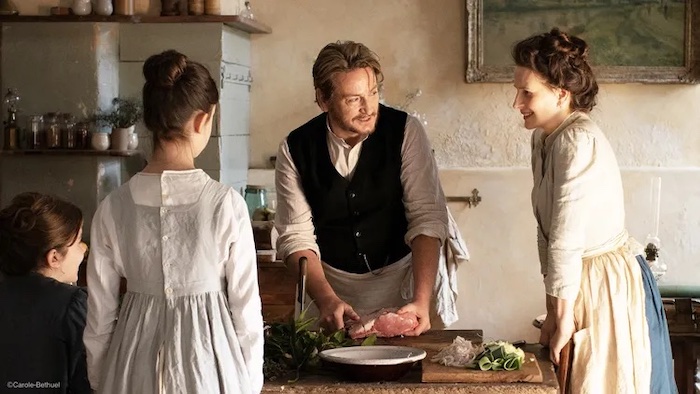
This Belle Epoque-set adaptation of Marcel Rouff’s 1924 novel about a well-to-do French epicure may be the most indulgently gorgeous entry into that sub-genre called food porn cinema. In the hands of director Tran Anh Hung, who used his sumptuous talents to the same effect in his Vietnam-set debut feature, The Scent of Green Papaya, the preparation of elaborate meals using ingredients that are grown or raised or caught by the people who construct them is so devotedly depicted that you may not be able to stand it. And the operative word here is “prepared,” because while there are some scenes showing people (almost always men as wealthy as their host) devouring the food and effusively singing its praises afterwards, the idea is to imbue the craft of meal preparation with the kind of mystery one would more readily attribute to the performing or musical arts. One can only look on and gape in wonder.
That said, The Taste of Things doesn’t have much of a plot. The epicure is Dodin (Benoît Magimel), whose source of wealth is never revealed. He certainly seems to have no other vocation but growing produce and raising fowl for his table. And while he does participate in the elaborate preparations, they are mainly the handiwork of his full-time cook Eugénie (Juliette Binoche), who, at the time the story takes place, has been in Dodin’s employ for some 20 years. In fact, they come across as a married couple in that they often share a bed as well as a kitchen, but for reasons not fully explained, Eugénie has never accepted Dodin’s proposals, and at this point he doesn’t seem bothered by what appears to be a determination to maintain her freedom, a stance that’s all the more admirable when we understand the circumstances of the girls who come to work at Dodin’s provincial household in lesser stations. It’s clear that Eugénie herself once filled such positions, and now that she’s proved her worth she means to make the most of it to the point where she is treated as a peer by Dodin’s landed gentry pals, who practically beg to be invited to his table. So it feels almost grautitous when Eugénie starts presenting with signs of chronic illness—fainting spells and bouts of nausea that the local physician can’t quite fathom, but it’s not really a mystery. One of Tran’s better choices is to have his principals look their age, which would appear to be mid-50s. As Eugénie fades and Dodin despairs, the two necessarily trade places, with the latter becoming the chef he always aspired to be and she turning into the pampered, if dying, celebrity of the estate.
If that isn’t enough to make The Taste of Things as memorable as it thinks it is, it probably has more to do with the viewer than with the film, which achieves its aims with startling precision. There’s an inevitability to the whole aesthetic that feels over-determined, which is Tran’s stock-in-trade as a filmmaker. He doesn’t need a vivid story or colorful characters to fulfill his expressive needs. He simply requires a minimum of essential ingredients to satisfy appetites. He couldn’t have found a better property.
In French. Opens Dec. 15 in Tokyo at Bunkamura Le Cinema Shibuya Miyashita (050-6875-5280), Cine Switch Ginza (03-3561-0707), Shinjuku Musashinokan (03-3354-5670).
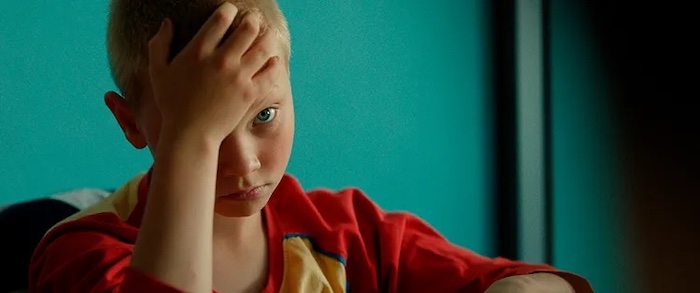
Right from the start, Lise Akoka’s and Romane Gueret’s fiction feature about an indie film crew making a fiction feature about disadvantaged kids in a suburban French town seems to be skewering the methodology of the Dardenne brothers. The director of the film-within-the-film, a bearded gentleman named Gabriel (Johan Heldenbergh), is almost immediately identified as being Belgian, though he tends to get more specific later in the movie by calling himself Flemish. There’s also an early scene that feels lifted wholesale from the Dardennes’ The Kid With a Bike. If this is parody it might have worked if the film-within-the-film were better, but it’s stuffed with cliches about the poor and, unlike with the Dardennes, Gabriel’s poetic tendencies dominate his approach to the material. In that sense, The Worst Ones—the title is an observation by one of the kid actors about how the filmmakers are only auditioning children with miserable backgrounds—should more accurately be described as a farce about the hypocrisy surrounding liberal good intentions, but its humor is curdled by a sour attitude toward all the participants, including the youngsters who are nominally being exploited for art and commerce.
The best thing about the movie is the interactions between the young actors and their response to being in the spotlight. The youngest, Ryan (Timéo Mahaut), has the most complicated relationships. A towheaded troublemaker whose ADHD is like an open wound, Ryan lives with his well-meaning and responsible older sister because social workers have decided his mother’s mental health problems make her unfit to be a guardian, though she insists she can cope. Ryan thus has a certain native understanding of his character, a boy like him being raised by a drug-addicted grandmother, but can’t command the self-possession necessary to take Gabriel’s direction, which is not only too specific for Ryan to comprehend but clueless in its determination to wring “realism” out of someone who is ignorant of artifice. In one scene Gabriel flies into a rage because Ryan keeps smiling at tormentors who are about the beat the shit out of him, which seems like a much more realistic reaction to the scenario than what Gabriel wants. Silmilarly, teenage Lily (Mallory Wanecque), already branded as the high school slut, is cast as a pregnant 15-year-old with trauma to spare, a role she internalizes easily because she’s still mourning the death of her little brother from cancer. In the simulated sex scene between Lily and Jessy (Loïc Pech), it is Lily—still a virgin, despite her image—who makes the most of her homemade method acting, while Jessy, a juvie sexual blowhard in real life, explodes in a homophobic fit of frustration at the AD because he can’t transcend his self-consciousness. Lily sees her makeshift professionalism as placing her above her sneering peers’ immaturity. She’s determined to see this acting gig through to a career, but she lacks the life experience necessary to leave the job on the set and ends up developing a serious crush on the older sound technician, following a path of misread signals to a broken heart. Lily’s opposite number is Maylis (Melina Vanderplancke), a freckle-faced, sexually fluid adolescent who quits halfway through the production because she has caught on that the whole thing is a scam, a decision that immediately makes her the most interesting character in the movie, but she doesn’t appear again. What a waste.
It wasn’t until after I watched the movie that I learned all the kid actors were themselves amateurs, and thus wished I could read French in order to sample local reviews to see if anyone accused Akoka and Gueret of the kind of exploitation they were implying Gabriel was guilty of. That, of course, is a value judgement, but despite a few missteps I think the Dardennes on the whole make good, important movies about subjects that deserve more attention. By the same token, The Worst Ones also deserves attention. I just wish it were more deserving of appreciation.
In French. Now playing in Tokyo at Theater Image Forum Aoyama (03-5766-0114).








 philipbrasor.com