Review: Blacklight

Though they have absolutely nothing in common in terms of approach to craft or onscreen image, Liam Neeson has become the Nic Cage of late boomer movie stars, an actor who seems to take any part offered him regardless of the quality of the film attached. The main difference is that Cage is offered a wide variety of projects, from dumb actioners to out-there provocations to relatively thoughtful but misguided dramas, while Neeson is wanted for only one thing: retaliation stories. And though he’s proven his worth by remaining in-demand—thus implying, at least, that his movies make money—the returns in terms of thrills and surprises have been diminishing for years. When he was still doing the Taken series, his explosive obsession with killing the people who wronged him was exciting because of Leeson’s quietly coiled performance style, but that trademark character distinction requires a considerable measure of suspension of disbelief—and not just because of his age—to make it work, and the movies he’s been doing recently don’t provide that.

Blacklight contains all the Neesom trademarks: He plays a super-skilled federal operative who’s either retired or nearing retirement, with a loved one or two in mortal danger. Director Mark Williams and co-scenarist Nick May try to engage the viewer immediately by juicing the action with proof that they read their news feeds. A nominally left-wing member of congress is murdered in a hit-and-run while Neeson’s Travis Block is charged with extracting an undercover FBI agent from the clutches of a white supremacist organization that may have caught on to who he really is. These two seemingly unrelated events are, of course, shown later to be related when Block is told to convince a rogue agent to come in from the cold, but, of course, the agent’s reasons for bolting, as Block learns, are legitimate, thus placing Block in a difficult situation vis-a-vis his superior, a fellow Vietnam-era veteran named Gabe (Aidan Quinn) who has floated to the top of the organization while Block is still mostly a contract operator (the best to guarantee deniability), but one who, apparently, doesn’t have the option to quit. 

The Neesomism that’s invariably tapped is Block’s main reason for retiring, which is to spend more time with his very young granddaughter, and so he doesn’t really whip himself into a righteous frenzy until he discovers a secret assassination team within the bureau that threatens his family to keep him in line. Though this story is serviceable as far as it goes—it provides Block with the necessary justification for killing at will—it has no substance in terms of realistic motivation. The political ramifications are completely elided and the characters so poorly drawn as to make them interchangeable as bodies to be perforated by bullet or blade. For a Neesom vehicle, it’s pretty boring.

Now playing in Tokyo at Shinjuku Wald 9 (03-5369-4955).

Blacklight home page in Japanese

photo (c) 2021 BL Productions LLC; Allplay Legend Corporation
Posted in Movies | Tagged | Leave a comment

Review: The Fabelmans

It’s interesting to ponder what kind of film Steven Spielberg’s semi-autobiographical The Fabelmans would have been had he made it earlier in his life. Film critics have broadly divided his output between two schools, the entertainments and the nominally serious movies, and I would assume that had Spielberg made The Fabelmans 20 years ago he would have approached it as a serious topic, since it takes into consideration such “adult” themes as connubial satisfaction, racism, and the pursuit of artistic vision. Well into his 70s, however, the director has subjected his story to an inventive scrutiny that transcends its various themes, making it by far his most entertaining work in years. The “seriousness,” if that’s what you want to call it, is all in what you take away from it.

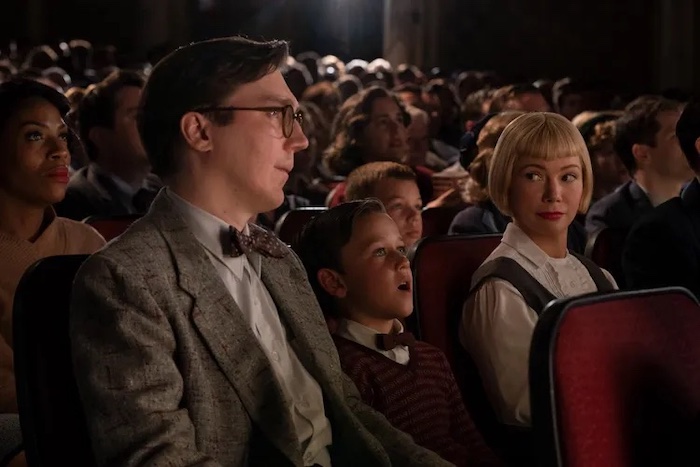
Told through a script by Spielberg and frequent collaborator Tony Kushner, the movie’s story is strictly linear without any tricky sidelines or flashbacks or flash-forwards. Spielberg’s stand-in, Sam Fabelman (Mateo Zoryon Francis-DeFord), is first turned on to the magic of movies while watching The Greatest Show on Earth in Cinerama, paying particularly close attention to the famous train crash sequence, which would inform so much of his visual attitude. Though the scene is meant to instill horror, Sam is filled with awe and the instatiable drive of the autodidact to recreate it, an urge encouraged by his mother, Mitzi (Michelle Williams), a discouraged concert pianist. His engineer father, Burt (Paul Dano), gets into the spirit of things by buying Sam a model train set. Thus the two poles of the Spielberg creative mentality—the poetic and the technical—are established.

As Sam grows older (and is subsequently played by Gabriel LaBelle) his obsession with Super 8 filmmaking only intensifies while his home life gradually erodes. The family moves from New Jersey to Arizona in the early 60s when Burt leaves IBM to take more lucrative and challenging work. The move involves not only the Fabelman family, but Burt’s best friend, Bennie (Seth Rogen), who also has an uncomfortably close relationship with Mitzi, whose insecurities become more acute after she settles in the Southwest. The script does an admirable job of informing Sam’s artistic development with the traumatic aspects of his living arrangement, and as his parents’ marriage slowly unravels and his father becomes less tolerant of his “hobby,” the movie’s serious side comes into its own without making a big deal of it. It is when the family moves again, to Northern California, that the various dramatic lines converge in a stunningly executed sequence wherein Sam reacts to his high school’s overt anti-semitism with a piece of personal filmmaking that captures all of the boy’s conflicting feelings about the life’s path he’s chosen and the material world—with all its prejudices and injustices— he has to navigate to walk that path. It’s the perfect depiction of how Spielberg’s first impulse as an artist is to please an audience. 

But even beyond the writing itself and the usual Spielberg visual magic, it’s the characters that make The Fabelmans the ultimate autobiographical film study. For once, the period setting is honored to a T: there’s no accidental verbal anachronisms (or, at least, none that I caught—and I’m pretty sensitive to films set in the 60s) or strange intrusions of a post-millennial sensibility. Dano and Williams are so vivid as to be heartbreaking in their characters’ lack of compatibility, but two smaller parts really stand out: Judd Hirsch as Sam’s Uncle Boris, whose soliloquy about his stint as a lion tamer is the spot performance of the year; and David Lynch’s cameo comic turn as John Ford, who gives young Sam the kind of advice only Ford could. Everything else is history.

Now playing in Tokyo at Toho Cinemas Nihonbashi (050-6868-5060), Toho Cinemas Hibiya (050-6868-5068), Shinjuku Wald 9 (03-5369-4955), Shinjuku Piccadilly (050-6861-3011), Toho Cinemas Shinjuku (050-6868-5063), Toho Cinemas Shibuya (050-6868-5002), Toho Cinemas Roppongi Hills (050-6868-5024).

The Fabelmans home page in Japanese

photo (c) Storyteller Distribution Co., LLC

Posted in Movies | Tagged , , | Leave a comment

Review: Everything Everywhere All at Once

I know responsible film critics see movies twice, but life is too short, and the reviews you read here are, for the most part, based on single viewings. With this surprise Oscar contender, however, I made a point of returning for a second glance because the first time I couldn’t wrap my head around enough of the details to appreciate fully what the two writer-directors, Daniel Kwan and Daniel Scheinert, were trying to tell me. It was just too exhausting. But on second viewing, the story fell into place, and the details, most of which are just childish jokes, hit their targets without a lot of fuss. More to the point, the emotional contours pulled me in, and while the plot was still too contrived to qualify as something I could identify with on a personal level, I cared a lot for the characters and their situation.

The situation is quotidian to a fault. Our hero, in all senses of the word, Evelyn Wang (Michelle Yeoh), owns and operates a laundromat in what looks like Southern California with her timid husband Waymond (Ke Huy Quan). After they married, the Wangs emigrated to the U.S. against the wishes of Evelyn’s old world father, Gong Gong (James Hong), and eventually had a daughter, Joy (Stephanie Hsu), who, as we join the action, has turned into a college-age adult with a girlfriend, Becky (Tallie Medel), whom Evelyn doesn’t know how to deal with, especially at this particular moment with her ailing father visiting them for his birthday. As it stands, Joy can barely speak Cantonese, so what is Gong Gong going to think when he is introduced to Becky? Added to these anxieties, Waymond is suddenly asking for a divorce and Evelyn is scheduled to undergo an IRS audit for which she is ill-prepared, especially given the woman assigned to her case: Dierdre Beaubeirdre (Jamie Lee Curtis), a dyed-in-the-wool numbers cruncher who sees her job as a righteous calling.

Despite the movie’s overlong running time and ensuing frenzy, the one thing Daniels do very well is pacing. Just as Evelyn is reaching the end of her rope in front of the auditor, the multiverse comes crashing into her consciousness as Waymond switches from his nerdy persona into that of an avenging space jumper with sick martial arts skills. He informs Evelyn that she has been identified as the only person who can save the multiverse from an evil force named Jobu Tupaki. And as Evelyn attempts to carry out, at first reluctantly, the mission she’s been charged with, she realizes that the multiverse is made up of all the situations that would have developed had the various decisions she faced in her life were addressed differently. In other words, she sees her life, and the lives of her loved ones, as a gestalt that contains multitudes. Unlike The Matrix, however, Everything treats the concept as a laff-riot, and Daniels come up with the most ridiculous outcomes, binding them all together by means of a dream logic that actually makes perfect sense. 

My mistake while watching it the first time was blinking, because you miss a lot if you do, in particular the brilliance of the action set pieces and the weirdness of the interstitial shenanigans, which follow physical laws that could have only been thought up by the Marx Brothers. Jumping from one universe to another, for instance, invariably involves a preternaturally silly action, like saying “I love you” to someone you very definitely don’t love (still, I could have done without the paper cut gimmick). But in the end, the innumerable strands, no matter how far out they dangle, get woven together into a tapestry of interpersonal empathy that transcends the movie’s knockabout purposes. Families matter–and antimatter, too.

In English, Cantonese and Mandarin. Opens March 3 in Tokyo at Toho Cinemas Hibiya (050-6868-5068), Toho Cinemas Shinjuku (050-6868-5063), Shinjuku Wald 9 (03-5369-4955), Toho Cinemas Shibuya (050-6868-5002), Toho Cinemas Nihonbashi (050-6868-5060), Toho Cinemas Roppongi Hills (050-6868-5024).

Everything Everywhere All at Once home page in Japanese

photo (c) 2021 A24 Distribution LLC

Posted in Movies | Tagged | Leave a comment

Media watch: Korean tourists celebrate uprising anniversary by patronizing former oppressors

Yahoo News

Today is the 103rd anniversary of the March 1 Independence Movement in South Korea, a national holiday. On March 1, 1919, anti-colonial elements in Korea assembled at various locations to denounce Japanese rule, thus leading to a movement involving 2 million Koreans comprising 1,500 demonstrations over the next month or so. Korean records claim that more than 7,000 people were killed in retaliation by Japanese soldiers and police, with more than 46,000 arrested. Japanese records claim 553 died.

March 1 is obviously a day that Koreans are keen to celebrate and Japanese people are just as keen to ignore, which isn’t to say that the legacy of that day impinges directly on the two countries’ relationship. For sure, Seoul and Tokyo maintain a steadily antagonistic tension based on differing views of their shared history, but that tension doesn’t necessarily apply to commerce. 

A Feb. 27 story by the Yonhap news agency reports that the number of Koreans visiting Japan today will likely set a new record. The three low-cost carriers that operate between South Korea and Japan are reporting near sold out flights from Feb. 25 to March 1, the same scale of traffic you normally would see during the peak summer vacation months. In fact, the rush of Korean tourists to Japan has been extraordinary ever since Japan relaxed its COVID travel curbs in October. During that month alone, 123,000 Koreans visited Japan. The number increased to 315,000 in November and 456,000 in December. In January, the number exceeded half a million, or 37.7 percent of all the foreign visitors to Japan that month. And it just continues to grow.

Continue reading
Posted in Media | Tagged , , | Leave a comment

Media watch: Feminist icon outed as…a wife

Chizuko Ueno (Toyo Keizai)

The March 2 issue of the weekly magazine Bunshun contained a bombshell scoop of a sort. One of the articles is about Chizuko Ueno, a University of Tokyo sociology professor (graduate of Kyoto University) whose specialty is feminist theory, in particular how patriarchal societies like Japan’s systematically discriminate against women and limit their choices. One of her constant themes is that the institution of marriage as it’s conventionally defined in Japan  is “the root of all evil,” so Bunshun’s scoop was noteworthy since it reported that Ueno was married.

The past tense is important here because Ueno’s purported husband died in September 2021 at the age of 96. Ueno is 74 right now. Her husband was Daikichi Irokawa, a renowned historian who chronicled the lives of ordinary Japanese people in the context of “freedom and human rights.” He was also an activist whose experience during World War II prompted him to study how the state wielded control over the Japanese populace. 

Though Bunshun doesn’t actually produce a marriage certificate or family register, the reporter uses other documentary evidence to show how the two scholars were wed, though it’s not clear exactly how long they were wed. Irokawa’s first wife died in 2017, and last June an application to transfer property he owned in Yamanashi Prefecture was carried out. Further investigation revealed that the registration for the land was passed on to Ueno on the date of Irokawa’s death the year before. According to a legal expert interviewed by Bunshun, such a property transfer could not be carried out had the recipient not been related to the deceased, because only an “heir” can receive an “inheritance,” which is how the application was processed. Had Ueno and Irokawa not been married, she would have only been able to receive the property as a “gift” through a will. So that means Ueno was either legally married to Irokawa or had been adopted by him. As the expert put it, being in the same family register as the deceased makes the process of liquidating property very easy. Otherwise, a lot of paperwork would be required, and that doesn’t seem to be the case in this instance. 

Irokawa’s son told Bunshun that he is not concerned about Ueno’s image, only his father’s memory. But the article implies that Irokawa’s previous wife knew about his relationship with Ueno. As for Ueno’s legal name, had she been either Irokawa’s legal wife or legally adopted heir, she would have to have the same name, and there is no indication that Irokawa changed his name to Ueno. However, there is also no evidence of her changing her name since, following a spouse’s or adopted guardian’s death, a person can easily reclaim their previous name. 

Ueno has not commented on the article so far, and certain elements on the internet who find her pronouncements objectionable have been quick to label her a hypocrite by keeping her wedded status a secret even as she rails against the sexist aspects of traditional marriage. But while one could probably make a case that keeping that relationship a secret detracts from Ueno’s reputation as a self-sufficient single person, it by no means detracts from her work, which is centered on the inherent dignity and rights of the individual. In recent years, a subtheme of her writing has been aging and dying alone, whether the individual is a man or a woman, and as it turns out, this was also one of Irokawa’s activist interests in his twilight years. Living in the home he bequeathed to Ueno, Irokawa formed a neighborhood group called Neko no Te Club whose members took care of one another as they grew older, regardless of whether they had family. In the end, it’s nobody’s business but hers if Ueno was married, but from all appearances she practiced in that marriage what she preached in public. 

Posted in Media | Tagged , | Leave a comment

Review: Paper City

One of the salient points that Edward Seidensticker made in his history of Tokyo was that, in the Shitamachi area of the capital—the “low city” where the hoi polloi lived—the carpenters’ guild was congruent with the fire brigade; meaning that the people who built all those wooden structures were the same people who had to put out the fires when they burned, which they did in a big way every decade or so. This cycle of construction-destruction evolved into Tokyo’s infamous scrap-and-build urban development policy, and though Seidensticker doesn’t mention it, it also likely had something to do with Gen. Curtis Lemay’s decision to firebomb the Shitamachi area during World War II, since he knew it contained densely arranged wooden dwellings that would light up like matchsticks, despite the fact that it contained few facilities that were strategically important. The whole point was to create casualties that would “disrupt production.” During the night bombing raid that started just after midnight on March 10, 1945, American B-52s dropped more than 1,500 tons of bombs, destroying one-fourth of the city. About 100,000 civilians died, with another 125,000 wounded. Lemay considered it a great success.

Australian filmmaker Adrian Francis’s documentary, Paper City, is less about the raid itself than about how it has been memorialized. For the most part, only those persons with a direct link to the terrible event have kept its memory alive. As one elderly witness explains, young Japanese today don’t even know that the U.S. was Japan’s enemy during World War II, much less that Americans massacred tens of thousands of men, women, and children indiscriminately in the course of one night. Francis focuses on three people who survived the firebombing and subsequently worked to get the Japanese government to set up a permanent memorial to those who died, though, in truth, what they are after is to get the government simply to acknowledge officially that it happened. Most of the footage was filmed between the 70th anniversary of the raid in 2015, when the memorial association submitted a 300,000-signature petition to the ruling Liberal Democratic Party demanding they create a permanent memorial, and the following year, when the government effectively killed the petition by ignoring it. 

Consequently, the memorial activists have had to set up their own memorials piecemeal, raising money privately to pay for them. As they go about this business, the three principal subjects relate the horrors of that night: How the Sumida River filled with dead bodies and, as children, they were forced by soldiers to pull the bodies out of the water; how all the public parks “from Asakusa to Oshiage” contained “mountains” of charred, unidentifiable corpses; how the residents couldn’t do a thing since the volume of incendiaries was so great it caused firestorms that blew flames through the streets with hurricane force, and yet these residents were prohibited from leaving the area by the military authorities because they were supposed to put the fires out somehow. 

At one point, Francis films a demonstration outside government offices and a sound truck from a rightist organization drives by and scolds the demonstrators for “begging the government for money” when they should be picketing outside the U.S. embassy. In a sense, they are right—the U.S. has never apologized for the wholesale carnage, the same way it has never recognized Hiroshima and Nagasaki as being inherently genocidal military actions—but as one association member puts it, the “pre-war establishment still controls Japan,” which means the government will never acknowledge its own part in the destruction caused by the firebombing until that faction is removed somehow. Getting them to at least recognize the horrors of March 10, 1945, is the only way to begin that process, which, at the moment, is more vital than ever as these establishment forces prepare the country to accept a larger and more offense-oriented military. 

Addendum: A reader has pointed out that Lemay received the First Class Order of Merit of the Grand Cordon of the Rising Sun, one of Japan’s highest honors, in 1964, which only adds insult to injury and further explains why the current government would rather not talk about the Tokyo firebombing.

In Japanese and English with English and Japanese subtitles. Now playing in Tokyo at Theater Image Forum Aoyama (03-5766-0114).

Paper City home page in Japanese and English

photo (c) 2023 Feather Films Pty Ltd.

Posted in Movies | Tagged | Leave a comment

Review: Worth

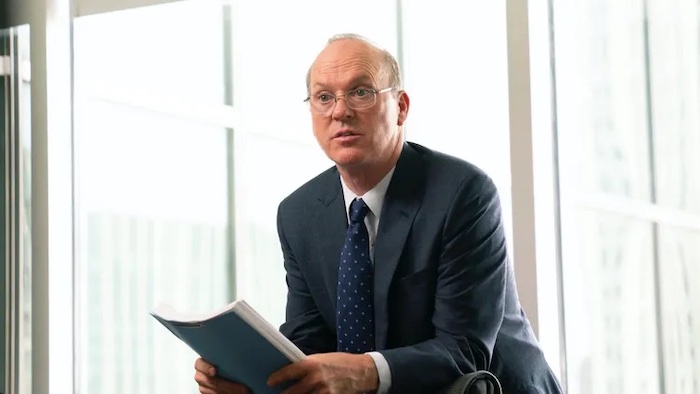
Worth is solidly in the cinematic tradition of lawyer-as-Sisyphus real-life dramas, of which Todd Hayne’s Dark Waters is probably the most pertinent of recent examples. If Worth doesn’t quite match up to the slow burn frustration of Dark Waters it has less to do with the presentation than with the underlying legal questions. Dark Waters was a standard little-guys-vs-big corporation tale that kept the technical matters in focus without allowing them to overtake the dramatic elements. The frustration was visceral because what made the case frustrating—Dow Chemical’s avoidance of its responsibility in poisoning the drinking water of an entire West Virginia town—was clearly and intelligently explained. The legal particulars of Worth are not so clear, since they pivot on questions that are almost philosophical in nature. How much, exactly, is a human life worth, especially in relative terms, which is what the case was all about?

The lives in this instance were those lost in the 911 attacks. The U.S. government has decided to compensate the families of the victims so as to preempt the certain likelihood of huge lawsuits being filed against the airlines involved and sinking the economy in the process. The problem is how much to pay, and that job is assigned to private attorney Kenneth Feinberg (Michael Keaton, dusting off his trusty Boston accent), who happens to witness the Twin Towers collapse while commuting into the city and listening to opera on his CD Walkman. Though Feinberg knows that “no one wants this job,” which is to crunch the numbers and figure out who gets how much, he lobbies for it anyway, because “I’m good at this.” And for the most part, Keaton and director Sara Colangelo show off Feinberg’s juridical and bookkeeping acumen to excellent effect. The purpose, however, is to elucidate what an impossible task he has taken on, and while most of the emotional heavy lifting is handled by Feinberg’s colleague, Camille Biros (Amy Ryan), who deals directly with the families, it’s the bureaucratic niceties of the case that claim center stage. In that regard, it is Stanley Tucci’s Charles Wolf who provides the foil to all the well-meaning common sense that Feinberg endeavors to wield. Wolf is the spouse of one of the victims and the leader of a movement to “fix the fund” in order to make sure that dead CEOs don’t receive a hundred times more in compensation than the people who mopped the floors or, for that matter, the first responders who lost their lives while saving those of others. 

Inevitably, Feinberg’s insistence on “objectivity” is defeated by the realization that there is no perfect solution to his problem, since it forces him to place a monetary value on something that is, by definition, priceless. Hayne had it much easier. Dark Waters ended not with a clear legal victory against the bad guys, but with a moral victory in that there was an understanding the lawyers for the plaintiffs would continue being an effective thorn in the side of Big Chemical for years to come, thus making sure laws would change for the better. Worth tries to make a similar claim but fails to be as convincing, because while it doesn’t scan as a typical feel-good Hollywood legal drama, it does try to fit the Sept. 11 Victim Compensation Fund into a pat narrative that can’t possibly contain it.

Now playing in Tokyo at Toho Cinemas Nihonbashi (050-6868-5060), Toho Cinemas Chanter Hibiya (050-6868-5001), Toho Cinemas Shinjuku (050-6868-5063), Euro Space Shibuya (03-3461-0211).

Worth home page in Japanese

photo (c) 2020 WILW Holdings LLC

Posted in Movies | Tagged , | Leave a comment

Review: Triangle of Sadness

The main problem with movies that try to be up-to-the-minute is that they invariably feel dated by the time they are actually released, even if “dated” is a problematic construct. The main two characters in Swedish director Ruben Ostlund’s second Palme d’Or winner are internet influencers, a concept that seems tired since it’s a vocation that’s already been endlessly sent up in popular culture. Nevertheless, Ostlund gets a lot of comic mileage out of the idea at the outset. Carl (Harris Dickinson) is a model who, despite being young and buff, already appears to be past his sell-by date according to a casting director who recommends he have some Botox work done on the titular real estate between his eyebrows. Actually, it is Carl’s significant other, Yaya (Charlbi Dean), a former model, it would seem, who is the influencer, and as such makes more money than Carl does, a situation that results in one of the most poignantly hilarious precoital transactions ever recorded for the screen. If Ostlund’s purpose is to deride post-millennial capitalism as the ultimate sex game, then he could have just stopped filming after the couple’s charged conversation in their expensive hotel room following dinner in an equally expensive restaurant where the two argue over which of them will pick up the tab.

The rest of the movie is all anti-climax, and while it maintains Ostlund’s cynical outlook with a wry attention to detail it never reaches the same kind of insight. Yaya and Carl join a cruise on a big yacht for free as influencers with a horde of rich older folk from various countries and professions. The dynamics are provided by the interface between these assholes and the below-deck crew, who represent various developing countries but mainly the Philippines. Yaya and Carl are somewhere in the middle—arrivistes in the old concept of the word but with a winking knowledge of class tension, since they most likely grew up under less than middle class circumstances. The scenes on the ship basically comprise black comic sketches predicated on certain national stereotypes: wealthy Russians are stupid, British retirees are good-naturedly racist, Americans don’t give a shit about anything except their own passions. And while some of these episodes achieve a level of jokey discomfort that would be the envy of Ricky Gervais, they don’t amount to anything beyond their own gross pedantry. But Ostlund knows how to make each of them bigger in emotional impact than the last one, and by the time we get to the now infamous seasick scene he’s more than made his point.

Unfortunately, that isn’t the end of the movie, because Ostlund’s opinion about all uses of power is made literal and explicit in the final chapter, which reorchestrates the one-on-one premise of Swept Away into a symphony of survival kitsch. The image I have of the well-dressed elite at Cannes laughing their asses off at all this is funnier than anything in the movie. 

In English, Russian, Filipino, German, French and some other languages I didn’t catch. Now playing in Tokyo at Toho Cinemas Hibiya (050-6868-5068), Bunkamura Le Cinema Shibuya (03-3477-9264), Toho Cinemas Shinjuku (050-6868-5063).

Triangle of Sadness home page in Japanese

photo (c) 2022 Platform Produktion AB, Film i Vast AB, Sveriges Television AB, Essential Filmproduktion GmbH, Coproduction Office Ltd., Societe Parisienne de Production SARL, Coproduction Office ApS, British Broadcasting Corporation, The British Film Institute, Arte france Cinema

Posted in Movies | Tagged | Leave a comment

Review: Empire of Light

Having worked in a movie theater shortly before those years in which Empire of Light is set, I can attest to the accuracy of its depiction of how films were presented to paying customers at the time, not to mention the peculiar aspects of the work environment. And while this recognition sparked a gratifying feeling of nostalgia that I hadn’t expected, it didn’t necessarily intensify my appreciation for the movie as a movie, probably because the matters it was most concerned with had little to do with movies, or movie theaters. The setting was just that—a setting. It could have just as easily told the same story had it taken place in a Denny’s. 

Except, of course, this is England, the coastal resort town of Margate, to be exact, and the year is 1980, when punk had given way to two-tone ska and National Front goons were asserting their right to make trouble for anyone who wasn’t white, working class, and incoherent like them. Within this fraught social environment, the Empire theater, a former movie palace that can’t seem to decide if it wants to be a multiplex, stands for certain old-fashioned values that are reflected in the somewhat defeated air of the place. Olivia Colman plays the middle aged manager, Hilary, who personifies this mood: outwardly genteel, fair but firm with both staff and customers, but eminently distracted. Eventually, we come to understand that Hilary is in what can only be described as a one-sided sexual affair with her married boss, Mr. Ellis (Colin Firth), meaning he summons her to his office when he feels like it and has his way with her. And yet, while Hilary obviously dislikes these trysts, they don’t seem to be the central source of her melancholy. Enter Stephen (Micheal Ward), a new employee who himself seems unmoored, though more in a material fashion. Stephen aspires to be an architect, but hasn’t made enough of an effort. Then again, Stephen is Black, which means he has to make more of an effort when it comes to material gain.

Enticed by his youth and relative nonchalance, Hilary takes to Stephen and brightens up a bit. Stephen, in turn, is attracted to Hilary’s candor and kindness, which fail to mask a mental illness that eventually manifests in an outburst of recrimination that leads to her institutionalization, and not, we learn, for the first time. If this sounds like a spoiler, there’s much more to come, and Mendes, who wrote the script, meticulously weaves Hilary’s and Stephen’s respective situations into the historical tapestry of that very specific time and place. Thanks to Roger Deakins’ evocative cinematography and the careful production design, the story Mendes wants to tell feels completely of a piece with this milieu, even if his conception of the characters never takes hold. It isn’t until the last scene that we learn Hilary has never even watched a movie in the place where she works, and as she sits down to take in a new feature called Being There, you think to yourself: This is where the story should have begun.

Opens Feb. 23 in Tokyo at Toho Cinemas Nihonbashi (050-6868-5060), Toho Cinemas Hibiya (050-6868-5068), Shibuya Wald 9 (03-5369-4955), Toho Cinemas Shinjuku (050-6868-5063), Shibuya Parco White Cine Quinto (03-6712-7225), Toho Cinemas Roppongi Hills (050-6868-5024).

Empire of Light home page in Japanese

photo (c) 2022 20th Century Studios

Posted in Movies | Tagged , | Leave a comment

Review: Three Thousand Years of Longing

George Miller may be our prime cinematic fantasist if only because his fantasies cover such a wide range of subject matter. Known mainly for the Mad Max series, he’s also responsible for the two Babe movies and the animated penguin romp Happy Feet. But while he’s noted for indulging his inner child, his movies always have an adult component that most people under the age of 18 probably wouldn’t appreciate. It’s this peculiarly adult yearning for something ideal that motivates his latest film, based on a novella by A.S. Byatt, that reimagines the Arabian Nights as a conversation between two brainy people with way too much time on their hands.

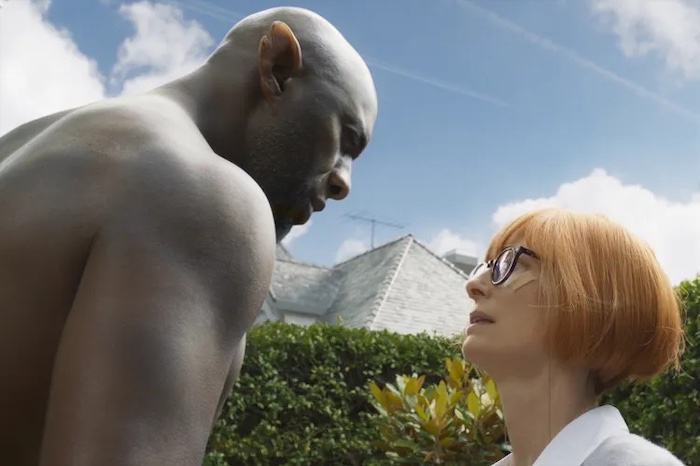
Tilda Swinton plays Alithia Binney, a dyed-in-the-wool academic whose field of study, narratology, seems so arcane that you wonder how she can possibly make a living, but she seems quite comfortable, jetsetting around the world, attending literary conferences and visiting museums and bazaars for stories. In Istanbul, she buys an old glass container in a market and when she gets back to her beautifully appointed hotel room discovers that it contains a djinn (Idris Elba), who, naturally, offers to grant her three wishes. But before he does that he has to tell her his story, because he’s been cooped up in the container for 3,000 years and is just dying to have a nice, long chat. This should be right up Alithia’s alley, but all through these rangey episodes about kings and harems and doomed betrothals Alithia maintains the attitude of an informed skeptic, which isn’t to say she doesn’t believe him, but that she’s heard enough stories in her life to take every pronouncement, regardless of how passionately it’s presented, with several grains of salt. But the greatest insult to the djinn’s self-esteem is her total indifference to coming up with three wishes. She wants for nothing, which explains the picture perfect but highly improbable production design.

Despite Swinton’s and Elba’s intense, idiosyncratic performances, these conversations never quite get on a track that would keep the movie on a steady course. Every tale the djinn tells is vividly recreated but thematically and emotionally inert; there’s no through-line for the two interlocutors to grab onto, no overarching narrative. So what you get is an intelligent colloquy about the meaning of love and how power, whether granted by magic or lineage, is inherently corruptible. And while there is a certain romantic frisson between the two principals, Miller doesn’t really know what to do with it. It’s essentially a children’s movie that would put most children to sleep.

In English, Greek, Turkish, German and French. Opens Feb. 23 in Tokyo at Toho Cinemas Nihonbashi (050-6868-5060), Toho Cinemas Hibiya (050-6868-5068), Toho Cinemas Shinjuku (050-6868-5063), Shibuya Cine Quinto (03-3477-5905), Toho Cinemas Roppongi Hills (050-6868-5024).

Three Thousand Years of Longing home page in Japanese

photo (c) 2022 Kennedy Miller Mitchell TTYOL Pty Ltd.

Posted in Movies | Tagged , , | Leave a comment