Media watch: Availability of abortion pill beset by obstacles

On Jan. 27, the health ministry approved public sale of the so-called abortion pill in Japan. As pointed out by Asashi Shimbun in its coverage of the news, Japan is one of the last developed countries to approve what is usually referred to as “medication abortion.” The U.S., for example, approved the pills in 2000. In France and China, they’ve been available since 1988. Nevertheless, there will still be many obstacles for people who wish to use the abortion pill in Japan.

Asahi reports that 126,000 abortion procedures were carried out in Japan in 2021. Of these, between 80,000 and 90,000 cases could have been treated with abortion pills, since the procedures were performed up to the ninth week of pregnancy, which is the deadline for prescribing the drugs. In actuality the abortion pill is two pills. One is mifepristone, which halts the pregnancy. The second pill, taken up to 48 hours after the first one, is misoprostal, which initiates bleeding to empty the womb within 8 hours after ingestion. In 90 percent of cases, the proper use of the two pills will lead to the end of the pregnancy. The amount of bleeding that results is said to be greater than the amount of bleeding that accompanies a surgical abortion, but the other possible side effects that attend a procedure, such as those related to anesthesia, are greatly mitigated with the abortion pills. Individuals who do not completely abort the pregnancy will have to undergo the procedure. 

In this regard, one of the possible obstacles for obtaining abortion pills will be the places where it is distributed. Most early term abotions take place at clinics that do not have hospitalization facilities in case of emergency medical situations. According to the health ministry, the second pill should be taken in the morning of a weekday so that the bleeding occurs in the afternoon, when clinics are still open, so if a procedure is needed the patient can have it done right away. However, if the reaction to the pills is more serious, the clinic must have a system in place to respond to such reactions, such as an affiliation with a hospital, so the Japan Society of Obstetrics and Gynecology is recommending that at least for the first six months after the abortion pills become availalbe, their use should be limited to hospitals or clinics that have access to hospital services.

Continue reading
Posted in Media | Leave a comment

Review: Benedetta

Though it may seem too obvious, I’m still surprised Paul Verhoeven has never made a women’s prison movie given the potential for steamy clinches under pressure of violence. With Benedetta he does what I would assume to be the next best thing—a story set in a convent, and in the 17th century, no less. When we first meet the title character she is a pre-adolescent who is all excited about “taking the veil” because she already has an understanding with her future husband, Jesus Christ, and demonstrates that connection to a bunch of scurvy rogues who encounter her and her rich family on their way to the symbolic betrothal. These punks are about to have their way with the entourage and then she performs what seems like a miracle. The Verhoeven touch here is that instead of going prostrate, the rogues laugh and say that’s a good one and leave them alone.

Based somewhat on a book about lesbian antics in a Renaissance Italy convent, Benedetta essentially tells the story of how this little girl grows up to be a formidable power shifter (now played by Virginie Efira), using her zealotry to outmaneuver the convent’s reverend mother, Felicita (Charlotte Rampling), whose main motivations are not spiritual but capitalistic, thus making her vulnerable. Cultivated to believe that “your body is your worst enemy,” Benedetta’s visions eventually take on a lurid quality that manifest as stigmata. Felicita, as well as the audience, can’t help but think, “Does she or doesn’t she?”, but Benedetta ends up convincing the powers that be—at least those in the small fortified town where they live—that she deserves to run the joint, and Felicita high tails it to Florence where she inveigles the local nuncio (Lambert Wilson) to investigate her usurper. Meanwhile, Benedetta is free to ramp up her sexual affair with fellow nun Bartolomea (Daphne Patakia), who “knows” this stuff because she sought protection in the convent after being raped by her father and brothers. The shenanigans don’t disappoint, and involve religious icons whittled into dildos and every position imaginable.

Though Verhoeven does a good job of sending up Catholic dogma and showing how men have used it to subjugate women, his main purpose is to present a rip-roaring tale about sexual abandon, and if he succeeds too well it has less to do with his cinematic skills than with his utter disregard for finer sensibilities. It’s not as rip-roaring as Showgirls, but anyone who appreciated that classic for whatever reasons, including the “wrong” ones, will find a lot to like here, and get a fairly insightful history lesson in the bargain.

In French. Now playing in Tokyo at Human Trust Cinema Yurakucho (03-6259-8608), Shinjuku Musashinokan (03-3354-5670), Human Trust Cinema Shibuya (03-5468-5551).

Benedetta home page in Japanese

photo (c) 2020 SBS Productions-Pathe Films-France 2 Cinema-France 3 Cinema

Posted in Movies | Tagged , | Leave a comment

Review: Ant-Man and the Wasp: Quantumania

One of the saving graces of the Marvel Cinematic Universe is that neither the characters nor the filmmakers take it all that seriously. The Ant-Man series is probably the least serious of the various franchises, owing mainly to the casting of Paul Rudd, Hollywood’s favorite everydude, as the titular superhero who can shrink to the size of a raisin without losing his strength. However, the third installment takes place entirely in a sub-atomic corner of the multiverse, which has come to dominate recent Marvel scripts, and there isn’t much of the real world to react humorously against and so, despite a surprising extended cameo by Bill Murray, Corey Stall as a big head, and some throwaway lines, the overall production feels heavy-handed and over-extended dramatically. Maybe that’s because the whole purpose of Quantumania is to introduce a new villain, Kang (Jonathan Majors), to the MCU. As such, the movie is more about brand-bulding than storytelling.

Again, family ties is the theme that holds it all together, with Michelle Pfeiffer reprising her role as Janet, the mother of Ant-Man’s romantic partner, Hope, alias the Wasp (Evangeline Lilly). Janet spent some 30 years in this pipsqueak universe and is sucked back into it along with Ant-Man, the Wasp, Ant-Man’s daughter (Kathryn Newton), and the inventor of the shrinking suits that the two superheros wear, Hank Pym (Michael Douglas), who is also Hope’s father, after another of Pym’s inventions goes on the fritz. Why they’re there isn’t entirely clear, but I assume it’s to give Pfeiffer another role worthy of her heritage. However, once they are there, the generic sci-fi character of the landscape and the “creatures” that inhabit it just compound the viewer’s confusion since there’s nothing recognizable on which to hang your relative understanding and provide Ant-Man with tools to ride and wield as weapons. True to the PR spirit of the production, Kang is the most important screen presence, and while he does little more than act threatening and speak in stentorian tones, the movie only captures your attention when he’s on hand. But the seriousness of Majors’ performance also acts as a huge drag on the story, which itself is so poorly extrapolated that I couldn’t find it among the loud, busy action set pieces. Something about “destroying timelines”?

Which isn’t to say that Ant-Man and the Wasp: Quantumania is not my kind of movie—in fact, it isn’t, but I enjoyed the earlier two more than I usually enjoy MCU films. Also, I wasn’t necessarily disappointed, which just goes to show how low my expectations were. Mostly, I just felt perplexed, because you know the next one will have something to do with saving humanity and I will be lost as to motivation, so low expectations are called for again.

Now playing in Tokyo at Toho Cinemas Nihonbashi (050-6868-5060), Toho Cinemas Hibiya (050-6868-5068), Marunouchi Piccadilly (050-6875-0075), Shinjuku Wald 9 (03-5369-4955), Shinjuku Piccadilly (050-6861-3011), Toho Cinemas Shinjuku (050-6868-5063), Toho Cinemas Shibuya (050-6868-5002), Toho Cinemas Roppongi Hills (050-6868-5024).

Ant-Man and the Wasp: Quantumania home page in Japanese

photo (c) Marvel Studios 2023

Posted in Movies | Tagged , , , | Leave a comment

Review: Decision to Leave

Though it feels timeless, the narrative concept of the femme fatale seems peculiarly suited for the movies, and many film enthusiasts will probably locate its peak utilization during the heyday of Hollywood in the 40s and 50s in works like Double Indemnity and Vertigo, crime thrillers that almost doubled as Greek tragedies. Nowadays, the idea of the femme fatale, the woman who brings down a good-but-flawed man, may seem dated and perhaps sexist to some, and yet the dramatic appeal remains inescapable as evidenced by Park Chan-wook’s delirously enticing Decision to Leave. Park and his co-scenarist, Jeong Seo-kyeong, have created a pair of would-be lovers to rival any in cinematic history. Kim Hae-joon (Park Hae-il) is the ultimate obsessive police detective, the kind of guy who can’t function properly unless he has a murder to solve, approaching his often grisly task as a kind of ecstatic vocation. Seo-rae (Tang Wei) is the ultimate seductive murder suspect, cooperative but cold initially, yielding but opaque eventually. 

The two are brought together by the death of Seo-rae’s husband (Yoo Seung-mok), who fell off a cliff while doing what he loves best, climbing mountains by himself. Was it an accident? A suicide? To Hae-joon’s younger, clumsier partner, it was murder, and Seo-rae is almost immediately the likely killer in his eyes, since she demonstrates no sense of grief over her husband’s death. Because he is analytical by nature, Hae-joon is less certain. Seo-rae is much younger than her husband, a retired immigration official whom she married after she was caught trying to enter South Korea illegally from China. A vital theme is Seo-rae’s incomplete command of Korean, which gives her a certain dispensation for verbal slips that Park exploits fully to advance the mystery component: Hae-joon’s initial attraction to Seo-rae is compounded by his biased conclusions regarding her innocence. This motivation is deepened by a rich array of contextual elements, including Hae-joon’s precarious marital situation (for her job his wife lives in a different town that he visits only on the weekends), a parallel murder case whose romantic underpinnings echo his feelings, and his chronic insomnia, which is aggravated by stress brought on by too much self-doubt. But the femme fatale aspects of the movie really come into their own in the second, more convoluted half of the story, when it is Seo-rae’s motivations that are examined, turning everything on its head.

As with the best noirs, Decision to Leave reserves the right to keep the viewer in the dark, even at the end, and Park’s mastery of visual indirection and comic sidelining makes it impossible to guess where the story is going while at the same time intensifying the viewer’s investment in the characters. Femme fatales are characterized as being initially devious for selfish purposes and ultimately tragic when their machinations inadvertently lead them to love. Park’s reinvention of this formula is a mutual romantic obsession that literally can’t survive outside the police-suspect dynamic. These are two people who can never be satisfied without the push-pull of suspicion and betrayal. It’s about being “wanted” in all idiomatic iterations of the word.

In Korean and Mandarin. Opens Feb. 17 in Tokyo at Toho Cinemas Nihonbashi (050-6868-5060), Toho Cinemas Hibiya (050-6868-5068), Toho Cinemas Shinjuku (050-6868-5063), Bunkamura Le Cinema Shibuya (03-3477-9264), Toho Cinema Roppongi Hills (050-6868-5024).

Decision to Leave home page in Japanese

photo (c) 2022 CJ ENM Co., Ltd., Moho Film

Posted in Movies | Tagged | Leave a comment

A stretch of Pavement

Pavement are in Japan at the moment. I will not attend any of their shows, though I did the last several times there were in these parts and have dug out a concert review I wrote for the Japan Times in August 1999. It’s on the website, but behind a paywall. Enjoy.

The opening act at Akasaka Blitz on Aug. 24 was an earnest Danish group called Thau, who offer a thumping and searing sound reminiscent of the Meat Puppets. The audience awarded their 20-minute set with a warm and noisy ovation, prompting effusive gratitude from the band’s drummer, who mentioned what an honor it was “to play in front of the mighty Pavement.”

Pavement is a fine band, but “mighty”? It sounds like something a 70s promoter would yell while introducing Emerson Lake & Palmer. I can imagine the members of Pavement, if in fact they were listening at all, tittering derisively at the compliment.

Having convinced major labels not to call any more, Pavement are now comfortably ensconced in a snug indie cocoon that they inhabit all by themselves. At one time hailed as the next big thing, the group has turned into something less dramatic but much more interesting: an eternal underground band whose influence has been immediate and pervasive–especially, at the moment, in England.

There have been other such bands, and like Pavement, not all of them traded up to the “Major Leagues.” (No band, underground or major, obsesses as much about the biz in their songs as Pavement does.) But no other ostensible indie group has ever sustained such an impeccable oeuvre over time. To paraphrase Randy Newman, each Pavement album is just like their last album, only better.

“Mighty” isn’t the adjective I’d use to describe the band’s appearance, either. Dressed for either the playground or the science fair, the five members didn’t resemble a tight ensemble, which is understandable since their songs’ appeal lies in the juxtaposition of jerry-rigged structures and intense musical acuity. Each musician goes about his task with considerable focus, though they don’t always appear to be paying attention to what anybody else is doing. The fact that they always get where they’re going makes each song sound like a small miracle of intuition.

Stephen Malkmus, who is understood to be the main songwriter (there are no songwriting credits on the albums), is a much better singer in person. This, of course, can be attributed to the famous shower effect wherein anyone who sings loud in an echoey environment sounds like Caruso. In the beginning at least, Pavement were dedicated lo-fi purists, and Malkmus’s flat, thin delivery was untweaked. His attempts at holding notes he couldn’t find and then screaming like a headbanger when the songs hit overdrive left a lot of people thinking he was a wiseass, even though for the most part he was sincere. Nobody believes you can sound that dorky unless it’s on purpose.

Positioned stage left, Malkmus, who stands out because he’s tall and lanky as opposed to the other guys who are soft and pudgy, put lots of body English behind his guitar playing and singing, pulling his long, thin frame up onto the tips of his toes as he reached for those high notes with his frail voice. The emotional high points were those junctures where Malkmus’s offhanded delivery suddenly ratchets up into a rant. I’d always thought, as much as I enjoyed those moments, that they were also the most calculated. But one look at Malkmus possessed by a squawk and you could tell that the boy can’t help it. During “Cream of Gold,” a rangy mid-tempo song with a lot of keyboard echo, he repeated the chorus (“I bleed in beige/why’d you leave me so far”) and at the same time shook his guitar to produce a tremolo effect that worked itself up his arm, into his head, and then out of his mouth.

Then there’s keyboard-percussionist Bob Nastanovich, who shakes a tambourine like one of those little windup dolls you see perched at the entrances of cheesy toy stores, only much faster. Nastanovich’s purposes on record are never clear (they use little keyboard, and I only hear one drum set), but he’s the most motile person on stage and projects a rocker sensibility that his everyguy wardrobe and features wouldn’t normally warrant.

In “Stereo,” one of Malkmus’s three-minute patchwork pop masterpieces, Nastanovich inserts lines into the meandering lyrics that Malkmus delivers in a musing tone of voice. The singer wonders, “What about the voice of Geddy Lee/How did it get so high/I wonder if he speaks like an ordinary guy,” and then Nastanovich, without missing a beat, offers, “I know him, and he does.” “Thanks,” Malkmus replies, without changing tone, “you’re my fact-checking cuz.” Though I’ve laughed at the line while listening to it “on the stereo,” I practically bust a gut watching these two pull it off live.

Very entertaining but not “mightily” so, and not particularly danceable, since the band tends to switch randomly from one melodic or rhythmic mode to another, and try as the appreciative audience would, they never got a mosh pit going. Structurally, Pavement’s songs (or, at least, the ones sung by Malkmus; those sung by the other guitarist, Scott Kannberg, are more conventionally “alternative,” i.e., lots of slightly discordant strumming within a traditional verse-chorus configuration) rarely build or create tension since they fall apart several times before they fall apart for good at the end.

But they are songs, ones that you hum to yourself as you wash the dishes or walk to 7-11 for a liter of milk. Over the course of an hour and fifteen minutes, they played twenty of them, and except for the nursery rhyme-tempoed “Billie” and the countryish “Folk Jam,” at the end of which Malkmus tore off a beautiful crescendoing single-note solo, nothing clocked in at over four minutes. If you figure that the average Pavement song contains at least one distinct melody for every minute of music, that works out to something like 80 different melodies during the evening. Many pros will think, “What a waste,” while the rest of us just sit in our seats shaking our heads, wondering, “Where did that come from?”

As a bonus, here’s a link to an interview I did with Bob Nastanovich in 2010.

photo (c) Tarina Westlund

Posted in Music | Tagged , , | 1 Comment

Review: Mass

One of the classic challenges for filmmakers is to take a story that was written for the stage and “open it up” for the screen. There are a variety of ways to do this, but it mostly involves creating a visual complement to the dialogue while providing at least an excuse for watching it on a screen. Probably the most famously successful example is Amadeus, but A Streetcar Named Desire was no less successful because Elia Kazan didn’t “open it up,” and that was because the acting was organically connected to the writing, and the direction—the camera placement, the lighting, the blocking—honored that connection. 

Perhaps because he’s an actor first, Fran Kranz’s debut as a writer-director for films is focused on the words and how they’re expressed. He inverts the classic challenge in Mass, producing a script that seems better suited for the stage and actually filming it that way. The bulk of the movie takes place in a conference room in a rural church. All four characters sit around a table and talk. That’s pretty much it, and yet Mass doesn’t feel like a filmed play. The opening scenes contain hints of a mystery. Employees and volunteers at the church set up the room where the action will take place, making small talk and church gossip and only lightly touching on the purpose of the preparation. A woman shows up to inspect the preparation and carefully but sternly makes instructions that indicate the people who will be using the room need everything to be a certain way, even if they don’t know it.

The four people who show up comprise two couples—Gail and Jay (Martha Plimpton, Jason Isaacs), and Linda and Richard (Ann Dowd, Reed Birney)—who, it turns out, have never met in person, though their lives have been linked in misery for more than a decade, when the latter couple’s son brought a gun to school and murdered some students, including the former couple’s son, before killing himself. The trials and media circuses are in the past, and thought it isn’t completely clear, it appears that Gail and Jay have been wanting this meeting for years, because they demand to know why it happened and believe talking to Linda and Richard will help in that process. Naturally, the ensuing discussion is fraught with pain, resentment, and a desperate hope that some sort of “closure” can be achieved. 

Surprisingly, what Kranz’s script gets right is the clinical stuff—the legal details, the ancillary controversies involving guns and male rage, the failure of the usual psychology tropes—all of which the quartet discusses as if recalling an extremely exhausting graduate school program. Kranz is less effective with the emotional component, how nothing that Linda can say about her love for a mass murderer will ever assuage Gail’s depression and anger, or how Richard’s taking responsibility for his son’s pathology because he worked too much is, at bottom, even more of a cop out than not taking responsibility. But, as with something like Streetcar, the actors understand what’s expected of them and they bring real gravity to the dialogue and their characters. It’s powerful because they know it has to be, and make it work by showing how the purpose of the meeting can never be achieved. It can only be stated and made clear to all the participants, who leave the encounter with more questions but perhaps new insights into how to answer them.

Now playing in Tokyo at Toho Cinemas Chanter Hibiya (050-6868-5001), Cinemart Shinjuku (03-5369-2831).

Mass home page in Japanese

photo (c) 2020 7 Eccles Street LLC

Posted in Movies | Tagged , , , | Leave a comment

Review: Compartment No. 6

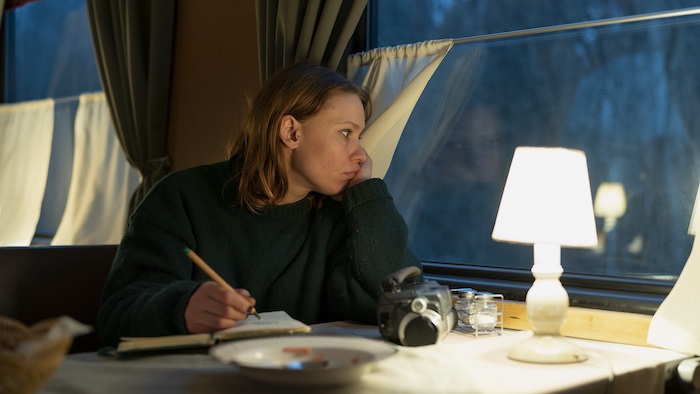
I’m embarrassed to admit that it wasn’t until about 30 minutes into Juho Kuosmanen’s film about a Finnish student traveling by train from Moscow to the Arctic Circle—which won the Grand Prix at Cannes in 2021—that I realized it was set in 1994. I should have been immediately clued in by the total absence of cell phones, but I apparently have an inbred prejudice about Russia that sees it as basically still looking as shabby as it did during the Soviet era, even though it’s been more than thirty years. In that regard, Kuosmanen’s biggest achievement may be the integrity of his production design and how it expresses the hopes and dreams—or lack thereof—of post-Soviet Russians.

The student, Laura (Seidi Haarla), is presented as being somewhat lazy in her academic endeavors. She’s in Moscow to study the language but mostly she stays because of her romantic relationship with Irina (Dinara Drukarova), a relationship that we quickly realize is on the rocks, since Irina hangs with a more intellectual crowd that doesn’t countenance her Finnish girlfriend’s linguistic limitations. Laura and Irina had planned a joint trip to Murmansk to observe the petroglyphs, ancient inscriptions on rocks that line the shore of the Arctic Sea, but at the last minute Irina pulls out without much explanation, obviously hoping that Laura will take the hint. Heartbroken but determined to make the trip anyway, Laura sets off by herself and ends up sharing a train compartment with Ljoha (Yuriy Borisov), a crude example of Soviet manhood cast adrift by the loss of central planning. He’s on his way north to take a seasonal job in construction. Laura is at once put off by Ljoha’s drunkenness and attempts at some kind of rapport—he tries to teach her some dirty Russian words and wonders if she’s a sex worker going to the same place he is—and she bolts the compartment to seek another one. The conductor has no sympathy whatsoever.

So they’re stuck with each other and, as you can probably guess, they do establish a rapport based on their respective insecurities. Laura’s aren’t that difficult to pin down. At every stop she seeks out a pay phone and calls Irina in the hopes that there’s still some spark left. Ljoha’s are more difficult to identify, but they seem inextricably linked to his inability to make a life of meaning in such a chaotic social milieu, but, of course, he can’t quite articulate this feeling. The ice between the two finally cracks when, during an overnight layover, Ljoha invites Laura to an elderly female acquaintance’s house for a meal, and in the interaction between the two Russians (the old woman’s relationship to Ljoha is not clear) she sees his basic humanity. Later, after meeting a fellow Finnish traveler who tags along and then steals Laura’s camera, she recognizes in Ljoha something of her own restlessness and disappointment: “All humans should be killed,” he says, only half-jokingly, when he learns of the theft. Though the two do not develop any kind of romantic feelings, Ljoha shows flashes of jealousy for reasons that aren’t explained, but, in the end, he becomes the trusted road companion she needs, and a much stronger link to the Russia she has yet to understand. 

In Russian and Finnish. Now playing in Tokyo at Shinjuku Cinema Qualite (03-3352-5645).

Compartment No. 6 home page in Japanese

photo by Sami Kuokkanen (c) 2021 Aamu Film Company, Achtung Panda!, Amrion Production, CTB Film Production

Posted in Movies | Leave a comment

Review: Egoist

Serendipity can come in various forms. Daishi Matsunaga’s new movie about a homosexual relationship arrives in theaters a week after Japan’s ruling party embarrassed itself by saying the public (read: the ruling party) isn’t ready for same sex marriage, and then stepped even further backward when it was revealed that an aide to the prime minister admitted to reporters that he couldn’t countenance LGBTQ couples. Some might say that this is the kind of publicity Matsunaga’s movie doesn’t need, while others will counter that there’s no such thing as bad publicity.

Egoist, of course, isn’t the first Japanese feature film to address the subject, but in many ways it’s the boldest and most self-consciously responsible, which isn’t always a good thing if it draws attention to the fact. Ryosuke Hashiguchi’s 2015 integrated omnibus, Lovers, took a subtler approach to gay love by presenting it in an almost banal fashion, though the overall effect was anything but conventional. Matsunaga gets fairly explicit with the sex because he obviously feels that the viewer needs to understand how these two people connect, and as he explicates the respective living situations of the two principals, Kosuke (Ryohei Suzuki) and Ryuta (Hio Miyazawa), he focuses on those aspects that speak to their marginal status as sexual minorities in a social milieu where they still have to be careful about exposing that aspect of themselves. In most Japanese movies that deal with sexual minorities, this approach can be reductive, but Matsunaga, adapting a semi-autobiographical novel by Makoto Takayama, has enough confidence in the story to trust that the audience will take the relationship depicted both seriously and to heart. 

The story is simple yet vivid. Kosuke, whose mother died when he was young, escaped his sheltered life in the suburbs for the big city, where he flourishes as a fashion editor and cultivates friendships in Tokyo’s gay community that have enriched his life without actually filling the emotional hole his mother left. (His father, played by Akira Emoto, is not only oblivious to his son’s sexual proclivities but seems oblivious to anything not within a meter of his nose.) He hooks up with Ryuta, a personal trainer whose material circumstances require him to take side jobs, which include occasional sex work, a detail that eventually gets in the way of the relationship once it becomes more serious. Kosuke offers to support Ryuta because his feelings for him are real, but these feelings become more complicated when he meets Ryuta’s mother (Sawako Agawa), who raised him by herself and is the reason Ryuta needs the extra money. 

So what on first blush feels like a tale about forbidden love turns on the question of how such a relationship is strained by differences in economic capability. Kosuke is self-made and well-off. In that regard, Matsunaga necessarily plays up the stereotype of gay extravagance (that apartment!), but he uses it to interrogate Kosuke’s feelings in such a way that we come to understand what it is he really longs for, and while the answer isn’t surprising, it is surprisingly moving. Being a literalist, I would have appreciated more background on Ryuta and his mother, since their straitened situation sometimes felt like a plot device, but as a protagonist, Kosuke is entirely convincing.

In Japanese. Opens Feb. 10 in Tokyo at Toho Cinemas Nihonbashi (050-6868-5060), Toho Cinemas Hibiya (050-6868-5068), Theatre Shinjuku (03-3352-1846), Human Trust Cinema Shibuya (03-5468-5551), Toho Cinemas Roppongi Hills (050-6868-5024).

Egoist home page in Japanese

photo (c) 2023 Takayama Makoto, Shogakkan/Egoist Seisaku Iinkai

Posted in Movies | Leave a comment

Review: Babylon

In a very short time Damien Chazelle has staked his claim as Hollywood’s primary exemplar of entertainment-themed entertainment. That Neil Armstrong bio-fantasy was the exception that proved the rule, since it didn’t make as much of an impression as his other films, and in that sense Babylon could be viewed as his magnum opus in terms of length (3 hours) and scope (the history of Hollywood from the silent age to 1952), though given how overwrought it is dramatically it may have been conceived as some kind of opening salvo in a degraded Time/Life chronicle of 20th century show business. 

Since it’s already been deemed a box office flop we can assume that isn’t going to happen, but the excess on display was always meant to be the movie’s main appeal. Opening with a wild and wildly designed 1926 party in the desert where everyone in Hollywood does actual mountains of cocaine and participates in copious orgies, Babylon immediately takes its title way too literally, and while annals of the age attest to the debauchery that’s depicted, Chazelle fails to make it feel historically credible. Perhaps because Brad Pitt and Margot Robbie essentially play versions of their most publicly popular personalities (Pitt falls back on his cool, self-deprecating shtick), it’s difficult to get a sense of what is different about the 1920s compared to the 2020s except that there are no cell phones. For sure, the cars aren’t really any bigger. The movie is episodic in structure as it charts the course of the studio system through the late silent years, over the speed bump of the advent of talkies, and on into the era of increasing moral exhaustion and media overkill. Our tour guide is Manny Torres (Diego Calva), a Mexican kid who starts at the bottom as a go-getting gofer and gradually works his way up in the system to become a producer of some success. In his rise to the top he helps the ambitious ingenue Nellie LaRoy (Robbie) achieve her dreams of stardom at the going price, while the leading man of the silents, Jack Conrad (Pitt), sees his own fortunes plummet once he’s forced to speak for himself. 

Some of these episodes are impressive in the way they’re juxtaposed with what’s actually going on outside the show biz bubble, but too many rely on what can only be called the shock of the old: Were they really that depraved back then? In the film’s most bizarre sequence, Manny has to placate a gangster-cum-executive-producer played improbably by Tobey Maguire whose drug-induced psychopathy manifests as a chain reaction of violence that just goes on and on. Though it comes near the end of the movie it is in no way an apotheosis, just merely the biggest bang in Chazelle’s array of gaudy fireworks. The climax, in fact, is so corny that you will rightly wonder if Chazelle wasn’t taking the piss the whole time. Certainly, he can’t be serious, I said to myself, neglecting the fact that seriousness of purpose does not guarantee coherent creative statements.

Opens Feb. 10 in Tokyo at Toho Cinemas Nihonbashi (050-6868-5060), Toho Cinemas Hibiya (050-6868-5068), Shinjuku Wald 9 (03-5369-4955), Shinjuku Piccadilly (050-6861-3011), Toho Cinemas Shinjuku (050-6868-5063), Toho Cinemas Shibuya (050-6868-5002), Toho Cinemas Roppongi Hills (050-6868-5024).

Babylon home page in Japanese

photo (c) 2022 Paramount Pictures

Posted in Movies | Tagged , , | Leave a comment

Review: Fall

High concept cinema, meaning movies premised on a single, simple, vivid idea, is really all about the setup, since the concept itself isn’t going to work unless the viewer is given some reason to care about it. In Scott Mann’s meditation on the dumber aspects of x-treme sports, the concept is two young women stuck at the top of a defunct 600-meter radio tower in the middle of the desert, which is a pretty weird place to be stuck, so Mann’s biggest challenge is getting the two women up there. 

He does it through emotional manipulation, which is sort of a cheat. At the start of the film, Becky (Grace Caroline Currey) is almost a year into mourning her boyfriend, who died while the two of them were climbing the sheer rock face of a mountain. Becky’s best friend, Hunter (Virginia Gardner), also a free climber, tries to get Becky out of her funk in a decidedly extreme way, by compelling her to “kick fear in the dick” and scale something a bit more manageable—an abandoned radio tower—the idea being that the exhiliration of accomplishment will make her glad that she’s alive. It will also give them a chance to do something meaningful for her boyfriend, which is to spread his ashes when they get to the top. Becky eventually gives in to this odd idea and the two break into the empty compound where the tower is located and start to climb its ladderlike attachment—without, for some reason, noticing that the whole thing is weathered and rusty. Mann, of course, makes sure the viewer notices by occasionally flashing closeups of bolts coming loose during the ascent. At about the time they reach the top, the whole apparatus crumbles in a shower of metal parts and the two are trapped on a narrow platform where, naturally, the cell phone coverage is zilch. 

The rest of the film shows how the pair struggles to survive without much food or water as they try to figure out a way to contact services on the ground with a fading battery while resisting high winds, vultures, and other affronts to their derring-do. Granted, Mann knows how to induce chills through skin-of-the-teeth acrobatics and shrewd editing—and his talent for narrative misdirection is formidable. I admit I was impressed by how he resolved the whole thing, but not enough to make me believe that anyone with the kind of native skills necessary to rock climb was going to be stupid enough to try this stunt. 

Now playing in Tokyo at Shinjuku Wald 9 (03-5369-4955), Shibuya Cine Quinto (03-3477-5905).

Fall home page in Japanese

photo (c) 2022 Fall Movie Productions, Inc.

Posted in Movies | Leave a comment