Review: Happening

The Japan distributors of Audrey Diwan’s 2021 Venice Golden Lion winner are probably patting themselves on the back for having waited so long to release Happening in Japan, since Annie Ernaux, the author of the novel on which it’s based, won the most recent Nobel Prize for Literature. That’s the kind of PR boost you can only pray for, but I hope that viewers intrigued by the pedigree of the film understand what they’re in for. Ernaux’s story, presumably autobiographical to a certain extent, since almost all her work is, is about a young woman’s quest to undergo an abortion in 1963, when the procedure was illegal in France. Even talking about it could land you in trouble with the authorities. Ernaux and Diwan make this aspect the main thrust of their story, which is both painfully personal and sociologically relevant, even to our own age. 

Anne (Anamaria Vartolomei) is studying literature at a university in a conservative town in southwestern France, aiming to advance to a graduate program, when she discovers that she is pregnant. Understanding that being a single mother would effectively end any of her career ambitions, she is desperate to be rid of the embryo, but has nowhere to turn. Bolder than her fellow female students, who seem resigned to following the usual domestic track after graduation, she is curtly told by a much older doctor to get lost when she indirectly brings up her wish. And while the doctor who previously told her of her pregnancy sympathizes with her plight he refuses to even discuss her options lest he not only lose his license but go to jail. Anne, of course, cannot possibly talk about it to her parents, tavern owners who are proud of their daughter for being the first person in their family to attend university. And when she finally reveals her condition to her two best friends in the dorm, one of them immediately cuts her off, as if she were a leper trying to touch her. 

Diwan does not reveal the father of the child until well into the film, and while this man feels an obligation at first he conveniently uses Anne’s pugnacious attitude to justify his failure to find a solution. In a sense, Anne’s downward spiraling circumstances—Diward marks each successive week of pregnancy with a title card—come to feel as if they comprise a societal conspiracy against her, and for the first half, at least, the dialogue has an over-determined quality that seems designed to explain everything in unmistakable terms. Moreover, while the boys are predictably mercenary in their behavior—once rumors spread, Anne’s male classmates all hit on her—the narrative takes surprising turns, as when one potential boyfriend, Jean (Kacey Mottet Klein), after also unsuccessfully trying to get into Anne’s pants becomes something of a savior by hooking her up with an underground abortionist. It’s then when the horrors really begin, and Diwan is unflinching in her depiction of the process, which seems interminable. More than anything, Happening underscores the contradictory attitudes that even the most liberal-minded person can have about pregnancy and abortion. Anne is not only cruelly isolated by her situation, but made to pay an unbearable price for it. 

In French. Opens Dec. 2 in Tokyo at Bunkamura Le Cinema Shibuya (03-3477-9264), Shinjuku Piccadilly (050-6861-3011), Marunouchi Toei (03-3535-4741).

Happening home page in Japanese

photo (c) 2021 Rectangle Productions – France 3 Cinema – Wild Bunch – Srab Film
Posted in Movies | Tagged | Leave a comment

Review: The Electrical Life of Louis Wain

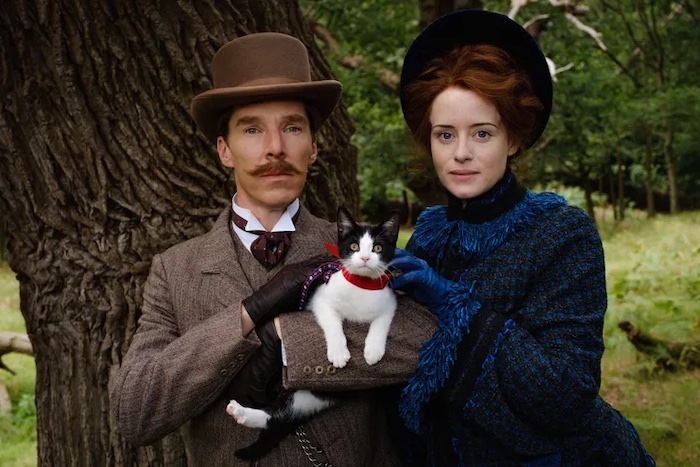
History mainly views Louis Wain as the Englishman who made the world safe for cat pictures. He didn’t photograph them. He drew them, initially with great verisimilitude and then in a more whimsical, anthropomorphic style, but when his feline illustrations first appeared at the end of the 19th century they were novel because cats were not really considered pet material. They caught mice and other vermin and were mostly despised by people of good station, which should have included Louis Wain, since he was born to a noble family, and that, essentially, is the gist of this muddled biopic starring a very animated Benedict Cumberbatch as Wain.

These days, a personality’s like Wain would probably be described as being on the spectrum (he was posthumously diagnosed as schizophrenic), but in Victorian England he was considered an eccentric by those who knew him and irresponsible by his family, which had somehow lost most of their fortune and relies on his talents as a freelance illustrator to get by. This was especially trying for him since his fatherless household comprised his mother and five sisters, and his polymath interests extended to composing operas and inventions based on electricity. Nevertheless, the family tries to keep up appearances, and after they hire a governess, Emily (Claire Foy), to attend to the younger sisters and Louis falls in love with her, the eldest sister, Caroline (Andrea Riseborough), is scandalized because of the class difference. But Louis, whose particular psychologigal constitution makes it difficult to change his mind with arguments based on propriety, marries Emily anyway, and their shared appreciation for things that most people aren’t interested in is most clearly represented by their adoption of a stray kitten, which they name Peter. When Emily falls ill and leaves the story, Louis cannot cope with the loss and turns to drawing cat pictures, because it’s the only way he can keep his memory of Emily alive.

The remainder of the movie explores Wain’s artistic gifts as the man himself falls victim to a larger constellation of nervous disorders, which eventually land him in an institution. Meanwhile, his cat drawings are an international sensation that he can’t quite enjoy because he neglects to copyright them, and while he accumulates friends along the way who try to advise him to his benefit, Wain’s manic predilections come to dominate not only his behavior but the mood of the movie. That said, Will Sharpe’s direction is for the most part light-hearted, and some viewers may find the tonal shifts jarring if not offensive given how they reflect on the subject of mental illness. Cat lovers may appreciate the movie as an historical document without necessarily loving the movie itself. Actual cats don’t get much screen time, only their graphic representations. 

Opens Dec. 1 in Tokyo at Toho Cinemas Chanter Hibiya (050-6868-5001), Toho Cinemas Shinjuku (050-6868-5063), Shibuya Parco White Cine Quinto (03-6712-7225), Toho Cinemas Roppongi Hills (050-6868-5024).

The Electrical Life of Louis Wain home page in Japanese

photo (c) 2021 Studiocanal SAS – Channel Four Television Corporation

Posted in Movies | Tagged , , | Leave a comment

Media watch: Is Japan ready for uterus transplants?

According to an article published by Asahi Shimbun on Nov. 25, Keio University has applied to the health ministry for permission to carry out uterus transplants. If permission is granted, the ministry will start screening applicants for the procedure early next year, after which clinical trials will be launched. Last July, the Japan Medical Association studied the prospects for uterus transplants and agreed to permit clinical trials, which would be the first step toward actual transplant operations. The JMA’s summary stated that the transplants would be for women in their 20s and 30s diagnosed as being unable to bear children, women who were born without uteruses, and women who had undergone hysterectomies due to benign tumors. (Women who had had hysterectomies because of malignant tumors are not eligible.) As with donated eggs, transplanted uteruses can only be from blood relatives of the recipient, typically an older, pre-menopausal woman like a mother or an aunt. Anti-rejection medication is administered following the transplant procedure and menstruation is monitored for at least 6 months to determine the viability of the transplanted organ. The recipients retain their ovaries, from which eggs are harvested and fertilized. The resulting embryo is then implanted in the transplanted womb. Any baby that is subsequently brought to term is delivered via caesarian section. Since the mother must continue taking anti-rejection drugs, she is allowed a maximum of two babies. Eventually, the transplanted uterus is removed. The cost of the operation alone is estimated at ¥25 million, but as the article points out there are still many issues to be resolved before any transplant can be performed.

The first uterus transplant took place in Saudi Arabia in 2000 on a 26-year-old woman, but the uterus turned out to be not viable. After more testing on animals was carried out over the years, the first child born to a woman via a transplanted uterus was in Sweden in 2014. As of October, there have been 98 uterus transplants worldwide that produced 52 babies. The procedure to remove the uterus from the donor takes 8-10 hours and the implant operation takes about 5, so it is a large-scale surgical matter. According to an assistant professor at Keio who talked to Asahi, uterus transplants differ significantly from other transplant operations in that they are not performed to save or otherwise extend the lives of their recipients. The purpose is simply to provide women who are not able to conceive or deliver children with another option to give birth. Viable uteruses can be transplanted from either living donors or deceased donors, but initially in Japan only living donors will be allowed, though, according to the assistant professor, deceased donors are more appropriate due to any surgical complications when operating on a live donor. But because of existing Japanese transplant guidelines and laws, the JMA will need to discuss the related ethics first, and they plan to do so next year along with the Japan Gynecological Academy. 

Continue reading
Posted in Media | Tagged | Leave a comment

Review: Shades of the Heart

Kim Jong-kwan’s 2020 Korean adaptation of Josee, the Tiger and the Fish, titled simply Josee, was a minor hit in Japan, owing most likely to its source material, Seiko Tanabe’s 1984 short story, which has been adapted in Japan for the screen in both live action and anime versions that were major hits here. A local distributor is now releasing Kim’s earlier film, Shades of the Heart, which is a much different animal, and not just because it’s based on an original script by Kim himself. Shades is one of those exercises in creative self-indulgence that can often try the viewer’s patience, and has little of the overt heart-tugging appeal of Josee. It’s a movie whose storyline charts the interactions of a novelist protagonist with a series of people, and it becomes something of a game to determine if these interactions are real, dreams, or sketches for a literary work in progress. 

The first interaction is the most intriguing. A young woman (Lee Ji-eun, better known as the pop singer IU) dozes in a coffee shop and awakes to see a stranger sitting across the table from her. The stranger is our protagonist, Chang-seok (Yeon Woo-jin), who claims he had a pre-arranged rendezvous with the woman. Their conversation is cryptic and lacking in the kind of small talk that usually arises when two people meet for the first time. Chang-seok explains himself in vague terms, that he recently returned to Seoul from living abroad, that his marriage failed and he’s a writer. The upshot is that the encounter is filtered through the woman’s confusion, and, in fact, she’s Chang-seok’s mother, dizzy from onset dementia, imagining her first meeting with Chang-seok’s father.

The remaining encounters provide diminishing returns in terms of invention, but Kim has adroitly prepared the viewer to expect the unexpected and question the validity of these encounters as events happening in the material world. Chang-seok meets with an old colleague (Yoon Hye-ri) who now works for the company that is publishing his latest book, and the conversation is mostly about her, her failed relationship with a foreign student, and her abortion. In another encounter, Chang-seok happens upon another former acquaintance, a middle aged photographer (Kim Sang-ho), in another coffee shop. He tells Chang-seok that his wife is dying of cancer and that he plans to kill himself after she’s gone. While the photographer takes a phone call, Chang-seok swipes his vial of cyanide. The last encounter takes place in a deserted bar where the bartender (Lee Ju-young) confesses she suffered amnesia after a traffic accident and ever since has picked customers’ brains for their memories, because she has none of her own. 

Due to the episodic, conversation-driven structure, Shades of the Heart often seems in danger of tipping over into Hong Sang-soo territory, but the prosaic banality of Hong’s dialogue was the point, whereas in Kim’s case the words have a scripted quality that make it seem as if we are reading a book rather than seeing a movie. However, the film gains in narrative substance as it gives up more information about Chang-seok’s past and his obvious sense of despair, which he can only express in writing. Kim places too much stock in carefully placed visual and auditory symbols that tend to distract from rather than enrich his themes and story, but Shades of the Heart is nonetheless a noble, often fascinating miscalculation.

In Korean. Now playing in Tokyo at Cinemart Shinjuku (03-5369-2831), Shibuya White Cine Quinto (03-6712-7225).

Shades of the Heart home page in Japanese

photo (c) 2019 Vol Media Co., Ltd.

Posted in Movies | Leave a comment

Review: The Green Knight

Given the way he has decided to adapt the epic 14th century poem “Sir Gawain and the Green Knight” for the screen, director David Lowery might seem to be putting himself out there to helm an MCU or DC comics blockbuster, though I have a feeling the kind of people who find superhero movies the epitome of cinematic expression would leave The Green Knight impressed but baffled. The story is simple enough. Gawain (Dev Patel) naively accepts the challenge of the titular demon (Ralph Ineson) in the court of his uncle, King Arthur (Sean Harris), but after he cuts the demon’s head off, the demon just pops it back on then compels Gawain to complete the challenge—the young knight must come to the Green Knight in a year’s time and submit himself for slaughter. Most of the movie involves Gawain’s journey to the Green Knight’s lair, a chapel. Lowery presents this long odyssey as if it were a fever dream filled with magical animals and monsters. Gawain is understandably uneasy about the fate that awaits him at the end of his journey, and while much of the action that takes place before he arrives gives off the feeling that he’s in no hurry and would prefer seeing the sights, even if they tend to be scary and soul-sapping, Gawain is chivalrous to a fault and understands he must show up, even if he seriously misunderstood the purport of the original challenge.

And while the movie’s visual component, especially Lowery’s use of color, is sumptuous and stimulating, the story isn’t conventionally coherent. Based on the title and the opening gambit, the viewer might believe that there will be fighting along the way, but most of Gawain’s struggles are with his conscience and sensibility. Before Gawain took the demon’s challenge, he was plagued by indecision and callow waywardness, and his journey to oblivion is essentially the cost he has to pay for privilege he didn’t earn. But so much of this content is framed as metaphor and allegory, probably because that’s how it was presented in the poem, so Lowery seems determined to give something more to literary scholars than to the usual superhero fans, which is quite a mission, if you think about it. I enjoyed The Green Knight even though I have never read the poem, but, then again, I’m not sure I completely understood what it was trying to say. I also tend to walk out of Avengers movies scratching my head. 

Now playing in Tokyo at Toho Cinemas Chanter Hibiya (050-6868-5001), Toho Cinemas Shinjuku (050-6868-5063), Toho Cinemas Roppongi Hills (050-6868-5024).

The Green Knight home page in Japanese

photo (c) 2021 Green Knight Productions LLC

Posted in Movies | Tagged , | Leave a comment

Review: Sister

Not even 20 years ago, most prominent films from China, whether officially approved or not, could expect a release in Japan, but not any more. It has less to do with content or even popularity than with lack of local distributors (not to mention venues) that are interested in—or that even understand—Chinese cinema. I imagine this family melodrama, which looks as if it were shot on a shoestring budget, wouldn’t have merited a Japan release if it hadn’t actually been a box office hit in China, which, due to its sensitive theme and fairly restrained dramatic presentation, was probably not predicted even in China. 

The story isn’t particularly original. Ran (Zhang Zifeng) is a nursing intern at a hospital in the city of Chengdu who hopes to advance to a graduate program in Beijing. Her career path is interrupted by the deaths of her mother and father in an automobile accident. Though she has been estranged from her parents for a number of years, she is called back to her home by relatives who expect her to take care of her 6-year-old brother, Ziheng (Kim Darren Yowon), whom she doesn’t know at all since she entered nursing school around the time he was born. Eventually, we learn through flashbacks that Ran’s father compelled her to pretend to be disabled so that they could apply to the authorities for permission to have another child. This was when China enforced its one-child policy, and Ran’s father desperately wanted a son. Ran resented the subterfuge, which is one of the reasons she left home, so she feels no particular responsibility to her parents’ memory or her brother himself, which causes much friction with her various relatives, who not only want her to take Ziheng but also demand she give them a piece of her parents’ property, which is now legally in her name. 

Zhang plays Ran as pugnacious and aggrieved, and the performance lifts the movie out of whatever sentimental mire it’s in danger of being stuck in. In fact, Zhang, a former child actor, has become a certified star due to the relative success of Sister. She also helps sell director Yin Ruoxin’s social criticism regarding Chinese society’s lingering gender discrimination. Ran is up against a lot to achieve her dream of becoming a medical professional. In addition to her relatives’ restrictive expectations, her boyfriend, another intern, doesn’t seem to be fully behind her determination to move to Beijing. Even her hospital colleagues disappoint her as professionals when they cave to a man who insists his wife bring her pregnancy to term even though it will likely end in miscarriage and possible death for the mother. 

That’s why the predictable outcome of the film may dishearten many viewers. Ziheng is a terror in the beginning who, having not been told his parents actually died, resists Ran’s halfhearted attempts to take care of him while she looks for adoptive parents and endeavors to sell the family home. Over time, her resistance is eroded by Ziheng’s fundamental neediness, and while the development of their relationship is affecting and natural, its direction is towards a conclusion that feels determined by forces outside the scope of the nuanced and thoughtful script. It’s difficult to avoid the feeling that, regardless of how pointedly she has addressed her social themes, in the end Yin felt she had to acquiesce at least partially to traditional sensibilities. 

In Mandarin. Opens Nov. 25 in Tokyo at Shinjuku Piccadilly (050-6861-3011), Human Trust Cinema Yurakucho (03-6259-8608).

Sister home page in Japanese

photo (c) 2021 Shanghai Lian Ray Pictures Co., Ltd.

Posted in Movies | Leave a comment

Media watch: Japanese actor gets grief for apologizing to Korean press

Japanese actor Yoko Maki is the target of online vitriol for comments she recently made in South Korea. According to a Nov. 18 post on the website Shukan Josei Prime, Maki was interviewed by the Korean “media company” OSEN and talked about her experience portraying zainichi (Japan-resident) Koreans in two movies—Pacchigi! (2005) and Yakiniku Dragon (2018). Maki herself is not zainichi Korean and prior to the first job she says that while she was aware of the “existence” of zainichi Koreans in Japan she did not know any personally. Consequently, she thought they “had nothing to do with me.” However, because she had been hired to play a zainichi Korean character, she endeavored to find out more about their background and took out some history books from the library. After reading them she realized that the history of Japan she had learned in school included nothing about the zainichi experience. She then offered an apology for Japan’s past treatment of Koreans, presumably both Koreans who lived under Japanese colonial rule prior to the end of World War II and zainichi Koreans who are born and live in Japan and are often the target of hate speech. She goes on to say that as a member of the “younger generation of Japanese” (she is 40), she feels “embarrassed.”

Shukan Josei Prime, the web site of the weekly women’s magazine Shukan Josei, commented that Maki offered her opinion on a topic she is obviously “naive” about. The article goes on to say that it is only natural that she has caused an uproar on social media and is being criticized roundly. For instance, Tsuneyasu Takeda, a TV personality and so-called political pundit whose main claim to fame is that he is a descendant of Emperor Meiji, expressed displeasure that Maki would say she felt “ashamed” of being Japanese and that she should learn the “true history” of Japan-Korea relations. This is the view of certain people in Japan who think that Koreans have nothing to complain about with regard to their relationship to Japan during and since the war. They believe that Japan liberated Korea from Chinese control and lifted it out of the darkness; and deny any and all evidence indicating Japan’s oppressive rule and atrocities against Koreans. As for the treatment of zainichi Koreans, they tend to dismiss the matter by claiming that Koreans who live in Japan are basically parasites and should become Japanese nationals and give up their heritage, thus effectively proving the disgruntled zainichi Koreans’ complaint, which is that they are subject to discrimination.

Continue reading
Posted in Media | Tagged , | Leave a comment

Review: Silent Night

This apocalpytic satire, the debut feature of Camille Griffin, seems stuck somewhere between existential melodrama and biting social commentary, mainly because the unidentified crisis that determines the actions on screen isn’t explicated enough to make the viewer really care. As the title suggests, it’s Christmas season and a well-to-do couple, Nell and Simon (Keira Knightley, Matthew Goode), are entertaining other well-to-do friends at Nell’s mother’s spacious English country estate. Everybody brings their families, which means there are lots of children on hand to join in the…well, not celebration, though everyone tries their best to enjoy the seasonal spirit. At first, the film’s purposely artificial cheery mood, undermined by a current of dread, draws the viewer into the hackneyed holiday movie mood, and one almost expects Chevy Chase-level hijinks to ensue in pursuit of laughs at the expense of this mood. 

But the dread slowly creeps to the fore, even as the revellers continue to try and act normal, playing Scrabble, singing songs, getting drunk, and digging into their meal with forced gusto. The exceptions are some of the children, especially the hosts’ young son, Art (Roman Griffin Davis), who surveys the party with an air of increasing frustration and, eventually, anger. There’s also a pregnant guest who gives the game away by defending her decision to not abort her child even though there is no future for it. It seems that the adults—or, at least, most of them—are resigned to an ugly fate simply because the authorities have convinced them of this fate, but the particulars of the coming crisis are only sketched out in the most rudimentary ways, and I, for one, couldn’t understand why anyone would possibly go along with it unless the director had some pointed political agenda in mind. Even with that it’s difficult to decide just how much she distrusts any government control over the collective factors that affect our lives. Is climate change beyond anyone’s reach, or does following protocols dictated from on high to check a deadly pandemic make one less human? 

It’s obvious that, as the party winds down and everything turns solemn and desperate, these people are being led into a scenario that doesn’t have to happen and that the only reason they are going into it is because they have no free will, which is a ridiculous premise, especially when you realize the only characters resisting it are the children. I can understand the innocent wisdom of babes, but this whole situation takes way too much for granted. Adults, even rich, selfish ones, aren’t this uniformly stupid. 

Now playing in Tokyo at Cinemart Shinjuku (03-5369-2831), Human Trust Cinema Shibuya (03-5468-5551).

Silent Night home page in Japanese

photo (c) 2020 SN Movie Holdings Ltd

Posted in Movies | Tagged | Leave a comment

Review: Mrs. Harris Goes to Paris

Had Anthony Fabian’s comedy been produced when its source material was published in 1958 it would probably be cited today as an earnest, heartwarming example of postwar British cinema. It might even have been considered a classic. But it’s hard to view it nowadays within its temporal context, since its entire basis for being entertainment is nostalgia for a time when the notion of a woman breaching the bonds of class and gender was a quaint one at best. The titular cleaning lady (Lesley Manville) is a war widow who still talks to her dead husband from a bridge overlooking the Thames and knows her station. Fabian pokes fun at Mrs. Harris’s clients, who range from a stuffy upper-class couple to a desperate, scatter-brained show biz ingenue, while showing how those in Mrs. Harris’s own class are closer to the truth of life, even if they don’t have the material means to enjoy it fully. Then, through a string of improbable good—and bad—fortune, Mrs. Harris finds herself in the possession of a little money and decides she’s going to blow it on a Christian Dior dress, which necessitates a trip to Paris.

Most reviewers who’ve had a positive take on Mrs. Harris Goes to Paris characterize it as a fairy tale, meaning it’s a feel good story that could never actually happen, but for an instance I thought the movie might be heading toward something more thematically substantial. When Mrs. Harris arrives in the City of Light, she’s met with a garbage strike, a somewhat pointed comic comment on the French penchant for working class solidarity, and the sight of piles of rubbish outside the House of Dior seemed as meaningful as Mrs. Harris’s own quixotic mission to buy a haute couture “frock” with bundles of banknotes. There’s also the matter that Dior is having its own cash flow problems, which means the haughty manager, Claudine (Isabelle Huppert), has to swallow her pride and let the frumpy, Cockney-accented housekeeper sit among the rich old dames who watch the latest season of new ensembles, even if it is at the behest of a nobleman (Lambert Wilson) who takes pity on Mrs. Harris and vouches for her. But Fabian does nothing to build on the comically and historically significant elements presented by this tableau and simply milks it for its sentimental value, even when, later on in the story, Mrs. Harris instigates a work stoppage by the seamstresses who actually produce the wares. 

What kept me from cringing to death was Manville, an actor whose subtle skills I have always taken for granted. She gives Fabian exactly what he wants, a character whose selflessness and good humor masks her general disappointment with how her life has turned out, and thus is more than grateful when her luck changes for the better. What Manville brings to this professional obligation is a total immersion in character that somehow transcends the stickiness of the film’s premise, which is that Mrs. Harris will never herself transcend her position and thus we shouldn’t expect her to try, expensive dress or no expensive dress. She’s a joy to watch, especially as you compare this to her current turn as Princess Margaret in The Crown. The two performances are literally a world apart, and extremely satisfying; even, you might say, edifying. 

Now playing in Tokyo at Toho Cinemas Nihonbashi (050-6868-5060), Toho Cinemas Chanter Hibiya (050-6868-5001), Toho Cinemas Shinjuku (050-6868-5063), Shibuya Parco White Cine Quinto (03-6712-7225), Toho Cinemas Roppongi Hills (050-6868-5024).

Mrs. Harris Goes to Paris home page in Japanese

photo (c) 2022 Universal Studios

Posted in Movies | Tagged , | Leave a comment

Review: The Menu

So-called haute cuisine is mercilessly derided in Mark Mylod’s attractively staged satire, which takes place in a restaurant on an island that can only be reached by boat. Rich patrons partake of the artfully prepared meals of master chef Julian Slowik (Ralph Fiennes), who serves up disdainful philosophical tidbits with each course. His customers, who pay more than $1,000 each for a meal, love the fascist mindset as much as the cooking, even when the disdain is directed squarely at them, because they know they are getting a unique experience. On the night in question, they get even more since many of them have been specially selected for this particular menu, which promises to be even more daring than usual. 

Screenwriters Seth Reiss and Will Tracy offer up a cross section of arrogant 1 percenters, including a haughty food critic (Janet McTeer), a spoiled movie star (John Leguizamo), and a bunch of young, pointedly offensive businessmen, each designed to be a target of the viewer’s enmity in their own special way. In contrast, the wide-eyed foodie, Tyler (Nicholas Hoult), seems almost woefully naive about his obsession and is thus the main object of ridicule, but the venom injected into his scenes is diluted by his date, Margot (Anya Taylor-Joy), who is the only person on the receiving end of Slowik’s wares who sees things for what they are, simply because she’s not rich and is here by accident, or so it seems. In fact, when Slowik finds out about her provenance it seems to upset his carefully laid plans, since he has something dastardly in store for this evening’s guests and she doesn’t fit in. 

The dark humor is mostly situated in Fiennes’ performance, which is as dry as overcooked pot roast, and for what it’s worth the comedic elements not only dampen much of the film’s horror potential but also its pointed social criticism involving the destruction of nature and the perpetual grinding down of the serving classes. As each course presents new challenges to the assembled palates the viewer may quickly tire of the cleverness, the way a genuinely hungry person would want to get to the main course and be done with all the trivial hors d’ouevres. To belabor the metaphor further, too many layered subtexts make for a movie that ends up being thin gruel. 

Opens Nov. 18 in Tokyo at Toho Cinemas Nihonbashi (050-6868-5060), Toho Cinemas Hibiya (050-6868-5068), Shinjuku Wald 9 (03-5369-4955), Toho Cinemas Shinjuku (050-6868-5063), Shibuya Cine Quinto (03-3477-5905), Toho Cinemas Roppongi Hills (050-6868-5024).

The Menu home page in Japanese

photo (c) 2022 20th Century Studios

Posted in Movies | Tagged | Leave a comment