Review: Sinkhole

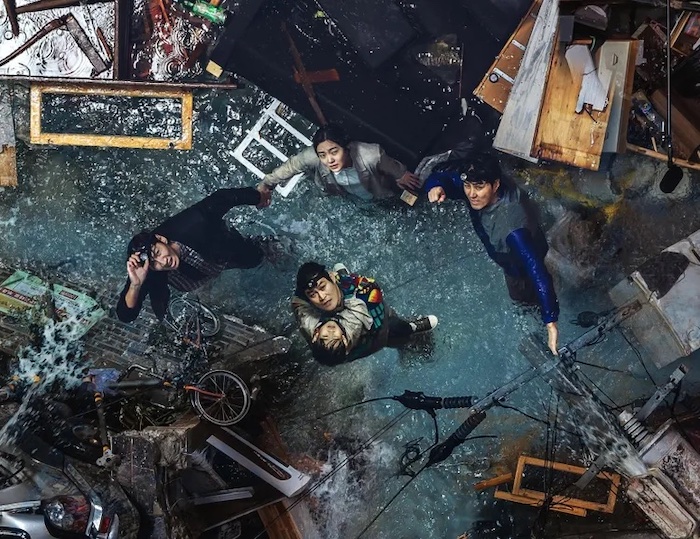
Though nominally a disaster movie, Sinkhole fits neatly into a subcategory of Korean films that address the current housing finance crisis. As it stands, young people in Korea are putting off marriage and other life goals because they are getting into debt to buy property, and sometimes the debt overwhelms them. The protagonist of Kim Ji-hoon’s movie is an average salaried employee of a small company who has put everything he’s got into buying a new condominium on the outskirts of Seoul, and at first the various difficulties he faces—friction with new neighbors, jealousy from colleagues—are played for laughs. Even when Dong-won (Kim Sung-kyun) starts suspecting that the quality of his new apartment may not be up to snuff, there’s a kind of slapstick quality to his disappointment and anger. His young son, for instance, finds it entertaining that marbles move across the floor by themselves. This subtext deepens when Dong-won invites his subordinates to his new digs for a housewarming party and they talk about their own housing-related woes, but just as the script starts exploring the theme in detail the bottom literally drops out of the movie, and Dong-won’s apartment building is swallowed by a sinkhole.

This disaster scenario lays out another subtext: South Korea’s unfortunate history of man-made disasters that are usually caused by poor construction practices and civil engineering. Of course, in order for the movie to pack as much drama and tension into the ordeals that the building’s residents now face just trying to survive, the disaster itself is exaggerated—the building sinks about 300 meters into the earth. Interestingly, Kim maintains the slapstick mood for a while, even as loved ones go missing and bad weather threatens to shift the ground even more. But Dong-won and his neighbors, including the ne’er-do-well single father, Man-su (Cha Seung-won), who has been a thorn in Dong-won’s side ever since he moved in, work together to make sure everyone gets out alive. Kim does some fine work in the requisite white-knuckle moments, and the patented Korean sentimentality doesn’t grate as much as it usually does. As a disaster movie, Sinkhole is efficient and entertaining (despite some cheesy special effects), but moreover its sly depiction of how generations of working people in Korea are being pushed into economic ruin by the conventional need to buy property not only holds its own against the action prerogatives but makes a more lasting and forceful impression.

In Korean. Now playing in Tokyo at Toho Cinemas Hibiya (050-6868-5068), Toho Cinemas Shinjuku (050-6868-5063).

Sinkhole home page in Japanese

photo (c) 2021 Showbox and the Tower Pictures, Inc.

Posted in Movies | Leave a comment

Review: Don’t Worry Darling

If Olivia Wilde’s sophomore effort as a director were better, I might lament the distracting pre-release gossip surrounding the movie’s reported on-set squabbles and romantic intrigues, which mostly dominated its big premiere at Cannes, but as they say there’s no such thing as bad publicity and if the tabloid intelligence does anything it actually deepens Don’t Worry Darling‘s shallow subtext. Though I would recommend approaching the film as a thriller rather than as social criticism, Wilde and her scenarist, Katie Silberman, give away the game at such a furious pace that, depending on the viewer’s patience, they may not derive any sense of suspense.

We know, for example, that the California desert community of Victory is something of a dodge right from the get-go. It’s the 1950s (or 60s, depending on which oldie is playing on the soundtrack) and the action is set on a cul de sac where perfectly made-up women stay at home cleaning house and making perfect meals that their husbands can enjoy when they get home from work. They offer their better halfs lots of sex and spend their copious leisure time shopping, drinking, and working on their figures. Because Wilde incorporates all the most hackneyed stereotypes of American postwar connubial culture into the story, the viewer immediately gets hip to the notion that Victory is not a real place, a feeling reinforced by our protagonist Alice’s (Florence Pugh) occasional hallucinations and brief out-of-body experiences. That means the viewer’s job is to figure out just what it is that’s wrong with Victory.

Alice’s distress only increases as her husband, Jack (Harry Styles), is promoted within the shadowy Victory Project, the only employer in town, which is busy working on some top-secret engineering endeavor the wives are not privy to. Once Alice starts speaking up about her unease, prompted by the attempted suicide of a neighbor that’s been hushed up, the movie becomes more interesting but keeps stalling, thus effectively damping the story’s tension. What’s more, the particulars of the plot confound what would initially seem to be the film’s overarching theme about the tenacious appeal of patriarchal systems. Except for Alice and the woman who attempts to kill herself (and who is Black, though even that aspect isn’t explored in context), none of the women question their secondary status, but even Alice seems to have larger issues (her very survival) than parity with her partner. All this mysterious business is explained with perfect precision in the end, but by then you’ve already concluded that Don’t Worry Darling is merely a rehash of ideas that have been done to death before, and with better results. 

Opens Nov. 11 in Tokyo at Human Trust Cinema Yurakucho (03-6259-8608), Shinjuku Piccadilly (050-6861-3011), Shibuya Parco White Cine Quinto (03-6712-7225), Toho Cinemas Roppongi Hills (050-6868-5024).

Don’t Worry Darling home page in Japanese

photo (c) 2022 Warner Bros. Entertainment Inc.

Posted in Movies | Tagged , , | Leave a comment

Tokyo International Film Festival 2022

Here are the posts I wrote for the TIFF 2022 home page.

Competition Jury Press Conference

A Light Never Goes Out Q&A session

Kaymak Q&A session

The Cord of Life Q&A session

Butterflies Live Only One Day Q&A session

This Is What I Remember Q&A session

1976 Q&A session

Ashkal Q&A session

Life Q&A session

World War III Q&A session

Mountain Woman Q&A session

Opium Q&A session

Posted in Movies | Leave a comment

Review: The Roundup

The top-grossing film so far in South Korea this year, Lee Sang-yong’s followup to the 2017 crime thriller The Outlaws does not, as the saying goes, mess with the formula, which in this case focuses on what the producers call the “beast cop,” Ma Seok-do, a burly, unworldly, intuitive police detective whose effectiveness is all in his fists. This a guy who invariably gets into fights with the criminals he tries to arrest and always beats the shit out of them—a cinematic m.o. that logic should tell us would be a dead end, since we know the outcome of every bloody battle. Then again, we almost always know the outcome in these sorts of conventional crime films, regardless of which country they’re from. It’s just that Korean cop movies are less hesitant about exploiting those expectations. Moreover, in Ma Dong-seok (or Don Lee, if you prefer his Hollywood moniker), the franchise has charisma to burn, even if the character he plays would seem to represent the worst qualities of the South Korean police force.

This aspect becomes all the more apparent when Detective Ma, along with his somewhat hapless superior, Capt. Jeon Il-man (Choi Gwi-hwa), are sent to Vietnam to escort a Korean fugitive back home after he mysteriously gives himself up to the South Korean embassy. I’m not sure if the Vietnamese authorities appreciate that Ma (who wrote the story for the film) and Lee make the country look like a lawless frontier teeming with foreign gangsters, but, then again, I wonder if the South Korean police appreciate how the cops in this movie treat every suspect like a punching bag. In any case, Ma can’t quite fathom why this relatively low-level crook is practically begging to be arrested and returned to jail in Seoul and eventually strongarms the truth out of him—a rival gangster who preys on Korean tourists has threatened his life. Once Ma extrajudiciously hunts down this bad guy, Kang Hae-sang (Son Sukku), who has kidnapped the son of a rich loan company executive for ransom, he sets off a chain reaction of brutal retributive violence that reaches back to Korea.

The violence, in fact, gets to be a bit too much, but that is the movie’s selling point. What keeps it from falling into the realm of the totally absurd is the integrity of the script, where the smallest plot detail is reasoned and justified and even the requisite car chase has a logical flow that makes complete sense within the context of the story. Ma, of course, sells himself wholesale with his often clueless grasp of social niceties set against a clear understanding of the moral stakes, and it’s obvious the movie wouldn’t have been half as entertaining with someone else in the lead. Ma the actor really is an international goldmine. 

In Korean and English. Now playing in Tokyo at Toho Cinemas Nihonbashi (050-6868-5060), Toho Cinemas Hibiya (050-6868-5068), Toho Cinemas Shinjuku (050-6868-5063), Toho Cinemas Roppongi Hills (050-6868-5024).

The Roundup home page in Japanese

photo (c) ABO Entertainment Co., Ltd & Bigpunch Pictures & Hong Film  & B.A. Entertainment Corp.

Posted in Movies | Tagged , | Leave a comment

Media watch: The administration’s very unoriginal solution to rising energy prices

Environmental minister Akihiro Nishimura (Asahi)

Last week, Prime Minister Fumio Kishida announced a ¥29 trillion economic package to fight inflation, centered mainly on the energy sector, that will supposedly save every household in Japan about ¥5,000 a month on their utility and gasoline bills. As part of this plan, the government said it would expand its existing subsidies to gasoline wholesalers and others in order to check the price at the pump, thus effectively placing the administration’s carbon neutral policy on hold, though, according to an Oct. 30 article in the Nihon Keizai Shimbun, no one has actually come out and said this, including bureaucrats in the Ministry of the Environment and most mainstream media outlets. 

As the Nikkei reporter, Junya Iwai, points out in the article, inflation aligns with the ministry’s fundamental carbon neutrality policy, since higher prices for gasoline would compel consumers to shift away from internal combustion engines to electric vehicles and other forms of transportation that don’t use fossil fuels. However, the current administration is worried about falling support rates and thus believes it has to be seen as doing something about inflation, especially given that imported oil is subject to exchange rate fluctuations and the yen’s value has been historically low in recent months. The subsidies are meant to reduce retail gasoline prices and thus bolster consumer confidence, and since the Cabinet as a whole has promoted these measures, the environmental ministry has to go along with them, even if they go against their own fundamental policy. The new environmental minister, Akihiro Nishimura, has said virtually nothing about the matter. 

The gasoline subsidy plan, in fact, was supposed to end last March, but it has subsequently been extended several times. As a result, fossil fuel consumption has increased, thus confounding the environmental ministry’s aims. Iwai says that there are bureaucrats within the ministry who are very critical of the government’s continued use of gasoline subsidies to increase public support for the administration, since they think the longer the subsidies last, the longer it will take for Japan to reach its carbon-neutral goals. Iwai himself comments that subsidies like the one being used to bring gasoline prices down usually are only implemented on a temporary basis because the end game is predictable. However, as the subsidies continue to be renewed and even expanded, there’s a danger they will become “normalized.” As it stands, the budget for the gasoline subsidies has already reached ¥3 trillion. In contrast, the environmental ministry’s budget for subsidizing carbon neutral policies at the local level is only ¥20 billion on an annual basis. Moreover, the ministry’s request for money to fund home insulation improvement and further energy conservation measures has hit a wall of passive resistance in the government. 

Continue reading
Posted in Uncategorized | Leave a comment

Review: Parallel Mothers/The Human Voice

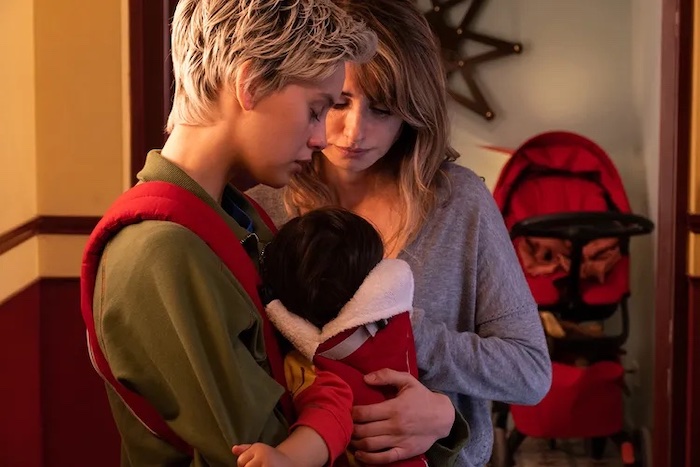
Though Pedro Almodovar is rightly lauded for his sense of style and control of visual tone, he doesn’t really get enough credit as a storyteller, probably because many of his films seem to be heavily indebted to older films by other directors. In Parallel Mothers, he weaves a melodramatic tale of two women who’ve had motherhood thrust upon them into a meditation on national memory—or, more correctly, the erasure of national memory when it comes to the Spanish Civil War, a subject that is still very sensitive in Spain. A fashion photographer named Janis (Penelope Cruz) meets a forensic anthropologist, Arturo (Israel Elejalde), through her work, and she asks him about his own work, which involves digging up bodies from unmarked burial grounds throughout Spain. Janis and her family have always wanted to exhume the remains of her grandfather, who was murdered by Franco’s troops during the civil war, but didn’t know how to go about it. Arturo offers to help her seek approval and carry out the exhumation. But before that, as fitting an Almodovar story, they sleep together.

Janis, who is the daughter and granddaughter of single mothers (she was named after Janis Joplin), doesn’t insist that Arturo take responsibility for raising the daughter she eventually bears, since he is already married. While preparing to give birth in the hospital, she befriends another expectant mother, a teenager named Ana (Milena Smit), who has her daughter the same day Janis has hers. At this point, the original story about the hidden graves is subsumed by the fraught tale of Janis and Ana’s friendship, which involves the awful story of how Ana became pregnant, Ana’s problematic relationship with her neglectful actor mother (Aitana Sanchez-Gijon), and Janis’s prickly feminism, which sometimes rubs Ana the wrong way despite the fact that Janis is twice her age. 

What’s conspicuously missing from much of the story is men. Though Arturo comes and goes throughout the film’s two-hour running time, his value to the story is utilitarian in more ways than one. As the title suggests, it’s the two women’s parallel experiences as first-time mothers that provide the dramatic impetus for a story that, per Almodovar’s m.o., isn’t surprising but nevertheless more deeply affecting than his usual tales of heartbreak. As Janis and Ana move in and out of each other’s emotional orbit, their lives change in consequential and provocative ways. But what makes the movie so moving is Almodovar’s sympathies for everyone involved. Janis is probably the most appealingly realistic character he’s ever created, and even Ana’s mother, who first comes off as a selfish careerist, is revealed to be about much more than her conservative values. So in the end, when the film comes full circle to address the tragic legacy of the Spanish Civil War, it does so with (female) characters who expand on the film’s central theme of being honest not only with oneself and others, but with history as well.

Being released simultaneously is Almodovar’s first English language film, The Human Voice, a “free” adaptation of Jean Cocteau’s play. It’s basically a one-woman-and-a-dog-show featuring Tilda Swinton as an aging model waiting in a stew of rage and despair in her apartment for her ex-lover to come and pick up their things. Filmed on a characteristically colorful sound stage set, this efficient, monologue-driven production is pretty much Swinton’s gig, as her character swings wildly between suicidal longing, violent anger, and contemplative resignation. Her telephone conversation is one-sided in that we don’t hear the lover at all, so Swinton has her work cut out for her. She makes it work, but the film’s success may also be due to its 30-minute run time. Anything longer and the viewer might end up as emotionally exhausted as Swinton’s character. 

Parallel Mothers in Spanish and The Human Voice in English (separate admission). Now playing in Tokyo at Human Trust Cinema Yurakucho (03-6259-8608), Shinjuku Cinema Qualite (03-3352-5645), Bunkamura Le Cinema Shibuya (03-3477-9264).

Parallel Mothers/The Human Voice home page in Japanese

photo (c) Remotamente Films AIE & El Deseo DASLU

Posted in Movies | Tagged , , | Leave a comment

Review: Ticket to Paradise

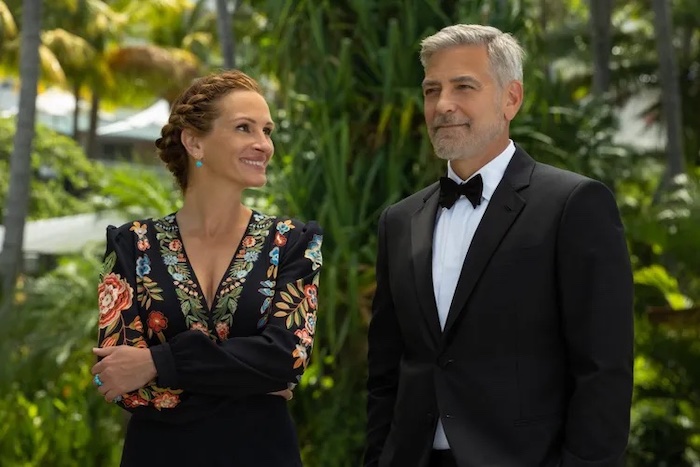
There’s a certain species of Hollywood movie that seems designed to please those who work on it more than those who will eventually watch it. I’m not talking about movies where the stars are simply guaranteed huge amounts of money, but rather projects they can get through with the minimum amount of effort, have fun in the process, and make huge amounts of money. This middling romcom’s only reason to exist is to bring George Clooney and Julia Roberts together again to laugh at each other and their situations, and viewers susceptible to that kind of come-on will likely find the experience of sitting through it painless, maybe even enjoyable. But does that really mean it has a reason to exist?

The two stars play a long-divorced couple, David and Georgia, who conspire to wreck the wedding of the only thing their brief marriage produced that still means anything, their daughter, Lily (Kaitlyn Dever), who has apparently decided to toss her law degree and impulsively wed the local seaweed farmer, Gede (Maxime Bouttier), she met on vacation in Bali following her graduation. David and Georgia, who, naturally, each have high-powered, high-paying careers, decide to bury the hatchet for the time being in order to prevent their daughter from rushing into a marriage she will later regret, just like they once did. Avid romcom fans will be predisposed to react positively to the various comic and sentimental devices used throughout the script: the carefully timed bickering interludes between the two stars, Lily and Gede’s demonstration that true love is a greater power than career ambition (thus confounding her parents’ own life choices), and the various funny bits contributed by supporting players, including Lily’s requisite best friend (Wren Butler). 

It’s not saying much that Clooney and Roberts create “chemistry” while Dever and Bouttier don’t. In fact, I would guess that this dynamic was built into the production, because the only thing that seems to be more vital to the filmmakers than making sure the two stars are happy and loving every minute of their time together on (and off) screen is presenting Bali as the perfect post-COVID travel destination. Clooney and Roberts, in addition to the big paychecks, get actual free tickets to paradise for what amounts to a working vacation.

Opens Nov. 3 in Tokyo at Toho Cinemas Nihonbashi (050-6868-5060), Toho Cinemas Hibiya (050-6868-5068), Toho Cinemas Shinjuku (050-6868-5063), Toho Cinemas Shibuya (050-6868-5002), Toho Cinemas Roppongi Hills (050-6868-5024).

Ticket to Paradise home page in Japanese

photo (c) 2022 Universal Studios

Posted in Movies | Tagged , | 2 Comments

Review: Recalled

An acquaintance who is very much into Korean TV dramas thinks that every single one has to contain either an amnesiac or incest. This twisted mystery sort of has both, but even if you go into it knowing that it’s still quite surprising. A woman named Soo-jin (Seo Yea-ji) is involved in a serious accident and when she wakes up in the hospital her husband, Ji-hoon (Kim Kang-woo) is there beside her; or, at least, he says he’s her husband. She can’t remember much of anything before the accident, but in any case Ji-hoon is preternaturally devoted and over time his efforts to help her recover seem almost superhuman. However, Soo-jin keeps having hallucinations of what seem to be future events, and the viewer is led to believe that she now possesses some kind of psychic power, but what’s actually happening is even stranger.

As usual, it takes a police detective to bring certain matters to light that point to the truth behind the hallucinations, and the script is structured in such a way that these truths are revealed in layers so as to project what seemed to be future events into the past, and, of course, the first casualty of these revelations is Ji-hoon, who Soo-jin soon suspects is not really her husband. Certainly, the cleverest idea has to do with where Soo-jin actually lives, since it plays into current news stories about overpriced, undersold condominiums in Korea. But it also involves migrating to Canada, adoptive parents, patricide, and domestic violence. Director Seo Yu-min has to maintain an iron grip on the story. One slip and the whole premise, which is constructed not so much as a puzzle box but rather like a house of cards, will come tumbling down. It’s a cute trick, but considering the build-up some may find the payoff a little disappointing.

In Korean. Now playing in Tokyo at Cinemart Shinjuku (03-5369-2831).

Recalled home page in Japanese

photo (c) 2021 CJ ENM

Posted in Movies | Leave a comment

Review: Songs For Drella

The skinny on this concert document is that it was lost shortly after it was recorded and broadcast in 1990 and then found in the director’s attic while Todd Haynes was putting together his Velvet Underground documentary. Lou Reed and John Cale, the men who created the Velvet Underground and then parted ways after the group’s second album, reconvene to honor their patron, Andy Warhol, in the wake of his death with a bunch of songs that directly address Warhol’s effect on the New York downtown scene, which launched their own respective careers as professional musicians. Though I have owned the album for almost three decades, I’ve never thought of it as being so emblematic of the two men’s art as I now think it is, having seen them perform the songs live.

Though the music is stark—Reed on guitars, Cale on keyboards and viola—it’s also more expressive than a lot of the music that each man produces on his own. It’s obvious who wrote what by who sings what, and Reed’s songs are more incisive about the kind of man Warhol was. They’re prosaic and direct. He talks about Pittsburgh and gets into personal particulars about Andy’s peccadillos, especially with regard to money and the well-documented obsession with his self-image, something Reed found off-putting. Though there’s a measure of sentimentality in his recitations, there’s also that certain species of New York bitterness, which only sounds half-kidding (about would-be Warhol assassin, Valerie Solanas: “I would have pulled the switch on her myself”). Cale’s songs are more impressionistic and ironic—riffs on the images that Reed treats clinically—but they are also more musically affecting. And, surprisingly, given the two men’s fraught relationship, Cale has the last word. 

Though production notes say that this was performed for an audience, no audience sounds can be heard, thus lending the whole affair a sad finality, as if the songs had been composed for a wake and were never meant to be played again. Director Edward Lachman keeps things simple, honoring the songs as songs rather than performances, and the back projections that illustrate some of the ideas put forth in the lyrics are redundant but not distracting. In any case, I’ll definitely be listening to the album more from now on. 

Now playing in Tokyo at Human Trust Cinema Shibuya (03-5468-5551).

Songs For Drella home page in Japanese

photo (c) 1990 Initial Film and Television/Lou Reed & John Cale

Posted in Movies | Tagged , , , | Leave a comment

Review: The Policeman’s Lineage

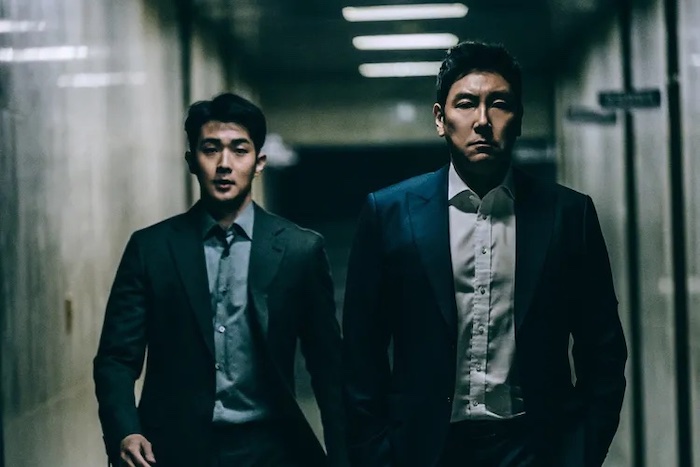
Ever since Serpico, the idea of a cop betraying colleagues who have broken the law themselves has always been catnip for filmmakers, since the whole premise is fraught with conflicting notions about the meaning of loyalty and integrity. This South Korean police procedural, adapted from a Japanese novel that took place just after World War II, opens by maintaining the so-called integrity of its protagonist, Min-jae (Choi Wooshik), a rookie who testifies against an older partner who used illegal means to capture a criminal and is quickly blackballed by other cops as a result. Just as quickly he’s summoned by Internal Affairs, who then ask him to go undercover to nail another veteran cop whom IA thinks is taking bribes from a prominent underworld figure. The setup is almost too pat—Min-jae is the son of a famous cop who died on the job, and thus has a certain reputation to maintain. At first, he isn’t interested in the assignment, until he learns that the target of the investigation may have killed another cop in the service of the underworld figure. In addition, IA says that if he successfully brings down the targeted cop, they will let him see the sealed report of the investigation into who killed his father.

What makes The Policeman’s Lineage more interesting than your average crooked cop movie is the way this particular police organization works. Basically, Kang-yoon (Cho Jin-woong), the police supervisor under suspicion, is in charge of his own team, which carries out investigations separate from other police stations and also has to raise money for expenses on their own. This arrangement sounds outlandish given how easy it would be for the members of the team to compromise their own integrity, but the historical context, involving insufficient budgets during South Korea’s pre-democracy era, makes it all the more fascinating and credible. In any case, once Min-jae has inserted himself into Kang-yoon’s team as a key member, he notices that the chief lives the high life—expensive suits, a penthouse condo, BMWs for squad cars. Moreover, Kang-yoon’s obsession is a young drug dealer from a well-to-do family whose rival seems to be Kang-yoon’s main “sponsor,” which is what IA is concerned about, but soon Min-jae also learns that IA itself may be compromised. 

It’s not revealing anything to say that Kang-yoon is under the sway of gangsters, but, as is often the case in this kind of action thriller, things are never that simple, and Min-jae’s loyalties are in a constant state of flux. Much less interesting is the action prerogatives which are doled out at such an even pace you can set your watch with each fistfight. I don’t normally come out of a cop thriller having learned something new and intriguing, so The Policeman’s Lineage at least has that to distinguish it from the rest of the lot. 

In Korean. Opens Oct. 28 in Tokyo at Shinjuku Wald 9 (03-5369-4955).

The Policeman’s Lineage home page in Japanese

photo (c) 2022 Acemaker Movieworks & Leeyang Film

Posted in Movies | Leave a comment