Review: Wanda

American actress Barbara Loden’s directoral feature debut was released in 1970 to a handful of theaters and disappeared quickly, but over the years it has retained an odd notoriety for its frank depiction of a poor woman’s lot in middle America. There’s absolutely nothing sentimental about this depiction, but Wanda also doesn’t qualify as what we now conveniently categorize as docudrama. It’s a solidly conventional social drama, with an easy-to-follow line of development that accrues a certain measure of neo-realist cred along the way. Some have compared it to what Cassavetes was creating at the time, but Loden avoids those touches that telegrammed Cassavetes intentions as an artist. Loden has a story to tell, and she doesn’t want anything to get in the way.

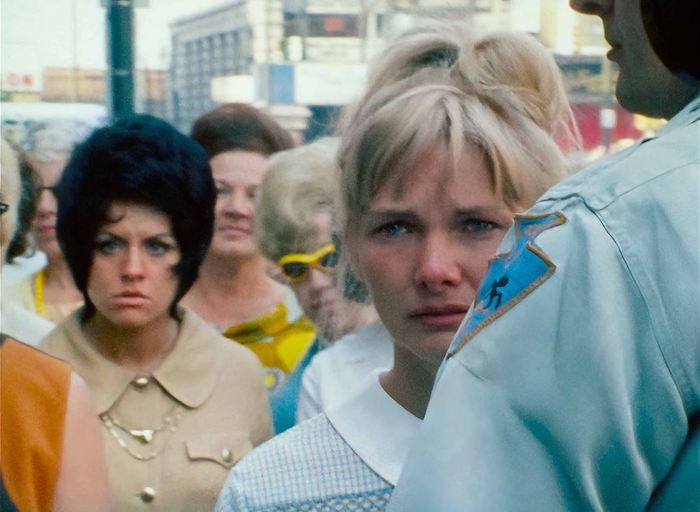
The titular character is first seen sleeping on the couch in her married sister’s ramshackle house in Pennsylvania’s coal country. In fact, there are side loaders transferring coal right outside the window. Wanda (Loden) is obviously not welcome here, as evidenced by her brother-in-law’s angry, quick departure for work. A subsequent scene in a courtroom, where Wanda’s soon-to-be-divorced husband is asking for full custody of their two young children, shows just how unmoored she is. She puts up no fight, saying the kids “would be better off with him,” and leaves the courtroom in a fog of depression. She then shows up at a textile factory where she used to work, demanding back pay and asking for her former job. The back pay is mostly consumed by taxes and the foreman refuses to hire her again, saying she’s “too slow.” Wanda is, for all intents and purposes, not just rudderless but homeless.

Though not technically a prostitute, Wanda gets by the only way she knows how. She goes to familiar bars and hangs around until she’s picked up by some philandering bald guy in a seedy suit and goes to bed with him. The guy invariably leaves before she wakes up. Though the situation smacks of cliche, Loden invests these scenes with a melancholic tone that points up the desperation of everyone involved, as well as the listless atmosphere of the entire milieu in which they take place. More significantly for someone watching this film today, the sexual transactions are purely materialistic. As a woman from a semi-rural region in 1970, Wanda does not necessarily possess the wherewithal to react to her exploitation at the hands of men—Loden herself grew up in Appalachia—but she surely recognizes her position and can’t help but resent it. It’s there in her voice when she tries to make her one-night stands feel more comfortable, and even more pronounced the next morning in her defeated demeanor. 

Eventually, one hookup changes the stakes. Stopping into a bar after it’s closed to use the toilet, Wanda stumbles upon a robbery, and the thief, whom she calls Mr. Dennis (Michael Higgins, appropriately stiff in his own seedy suit, masking spectacles, and sad mustache), takes her on as his accomplice after spending the night together. Though the movie’s storyline begins to take on the trappings of a lover-outlaws on the lam tale, Loden concentrates on the relationship rather than the bank heist Mr. Dennis is planning. He brings her to Korvettes to buy a dress because it won’t do for her to wear slacks, a ruefully sexist touch that’s couched as a professional practicality, since she’s going to act as a diversion when he takes a bank officer’s family hostage. But the thriller aspects are lacking in thrills, perhaps intentionally, and Loden didn’t sufficiently think through the plausability of Mr. Dennis’s scheme. However, for a short stretch Wanda seems to have purpose, even if it’s at the service of a deluded criminal. 

What’s appealing about Wanda is that while it looks squarely at a woman who can no longer play by the rules of civil society, it isn’t a depressing slog. There’s a liveliness to the direction that’s not only stimulating, but unique. Loden, who, for what it’s worth, was married for a while to Elia Kazan, died about 10 years later in her late 40s and never made another feature, which is a shame. Even Cassavetes could have learned a thing or two. 

Now playing in Tokyo at Theater Image Forum Aoyama (03-5766-0114).

Wanda home page in Japanese

photo (c) 1970 Foundation for Filmmakers
Posted in Movies | Tagged | Leave a comment

Review: The Alpinist/The Summit of the Gods

The Alpinist

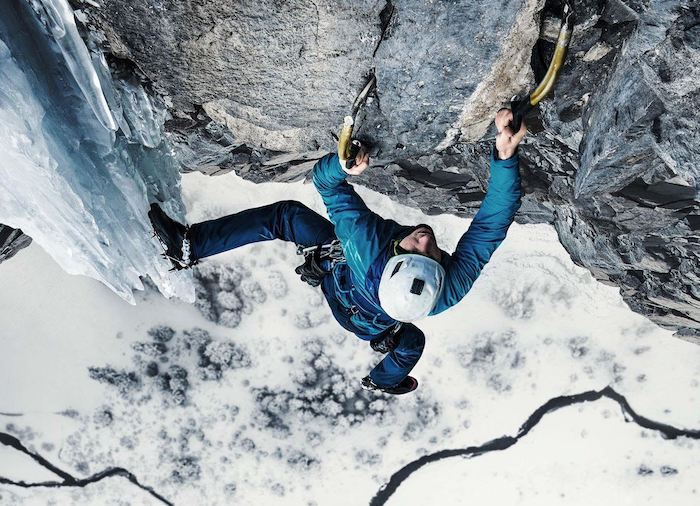
The appeal of mountain climbing, even to those who have absolutely no interest in partaking themselves, is special. The old colloquy of why one would want to scale a peak and then the intended interlocutor coming back with “because it’s there” both accentuates and disregards the mystery behind the climber’s obsession. In recent years there has been a sudden surfeit of climbing movies, both fiction features and documentaries, and the reason they’ve become so ubiquitous is twofold: climbers themselves have become skilled at the art of filmmaking; and drones. This combination definitely comes into its own with The Alpinist. The directors, Peter Mortimer and Nick Rosen, are both seasoned alpinists and they take as their subject a figure that, until the pair decided to make a movie about him, would have likely remained just another legend within a cognoscenti delineated by a fixation on a rare and infamously dangerous sport. Canadian Marc-Andre Leclerc was considered the best of the best, and not just because his rock and ice climbing skills were next to superhuman. Like all great artists he shunned anything that fell outside his specific art. When he climbed, he climbed solo and didn’t tell anyone about it, so his greatest feats were known only to him. Nevertheless, he did have friends, invariably part of the climbing community, and word got out. Mortimer and Rosen finally approached him about making a movie when he was barely into his 20s and he agreed as long as they didn’t get in his way. The Alpinist is suitably, fascinatingly wonky, because the directors are pleasing themselves first, but this attention to detail is what makes The Alpinist superior to the Oscar-winning documentary Free Solo, which was also directed by a pair of climbers, and is intrinsically linked to Leclerc’s m.o. of being tight-lipped and unflappable, whereas the subject of Free Solo, climber Alex Honnold, was more of a raconteur-philosopher, and thus a less naturally charismatic focus for a movie about an athlete, which should be about the doing, not the explaining.

What Mortimer (who also narrates) and Rosen provide in addition to the thrills and awe-inspiring visuals expected of mountaineering movies is a portrait of a loner that transcends the usual cliches about loners. Leclerc, who reportedly had ADHD, left high school at a young age simply to pursue mountain climbing and fell into the drug and alcohol scene that tends to materialize around people who live on the edge. The directors never let you forget that half of leading solo climbers die while pursuing their dream, but that Leclerc’s almost bizarre sense of self-containment while climbing (“filming him was terrifying, but he always seemed so relaxed”) was what made the production so irresistible. It also makes for drama that’s almost inexplicable. Leclerc was the son of working class parents who spent most of his youth just walking through the forests of British Columbia. That he eventually fell in love and spent time with a permanent girlfriend, also a climber, is seen as something of an anomaly since he wasn’t just a loner by temperament. He was preternaturally unconnected. The purpose of The Alpinist is to film him doing something he didn’t care about anyone else knowing—a climb up an impossible rock or ice face that Honnold would have likely trumpeted to the media because he needed the exposure for fund-raising. One of the uninvestigated mysteries of The Alpinist was how Leclerc supported himself. He was, in essence, a bum who lived day-to-day in order to climb. In one of the most poignant scenes, after a successful, treacherous climb in South America, he has to negotiate with a cab driver—in fluent Spanish—to get him to the airport because he’s broke. 

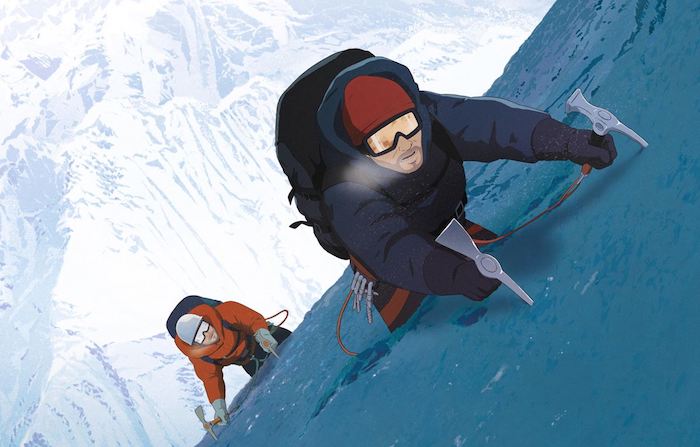
Patrick Imbert’s The Summit of the Gods is a more conventional mountain climbing movie since it’s based on a work of fiction written almost 30 years ago, the award-winning manga by Jiro Taniguchi and Baku Yumemakura. Imbert, a French animator, adapted the manga as a French-language ode to classic anime, but local distributors have wisely redubbed it with Japanese dialogue, since all the characters are Japanese. The basic plot is a detective story. After covering an unsuccessful climb of Mt. Everest by a Japanese mountaineering club in the 1980s, photographer Makoto Fukamachi is approached by a local in a Katmandu bar offering to sell him the small camera that was supposedly lost by British climber George Mallory in 1924. Mallory didn’t make it back and his body not found until 1999, well before the action of Summit, so it was never clear if he actually made it to the peak. Fukamachi brushes off the local and then, outside the bar in an alley, he sees the local being shaken down by a man with a missing finger. Later, he suspects that the man was Joji Habu, who, like Leclerc, was a legend within local mountaineering circles for his daring solo climbs, but after he takes on an apprentice who dies during an ascent, Habu disappeared. 

The Summit of the Gods

Unfortunately, the movie never really gets back on track with the Mallory mystery and wastes a lot of narrative time speculating about what happened to the British climber. Mostly, it follows Fukamachi’s pursuit of Habu, who in the meantime has been laying low in Nepal attempting his own solo ascent of the world’s highest mountain and, again like Leclerc, is not interested in anybody knowing about it. Fame isn’t in it. It’s all about the doing, and in that regard the platitudes come fast and thick and bog down the story, but Imbert’s animation is as stunning as the footage that Mortimer and Rosen achieved in The Alpinist, and because he can more readily manipulate these images, Imbert works them for maximum dramatic effect. Though I’m not a big fan of anime, what Imbert accomplishes here is stunning. To lay persons like me, the idea of climbing a mountain under the conditions depicted in The Alpinist and The Summit of the Gods is akin to fantasy of the most extraordinary type, and Imbert captures that quality perfectly.

The Alpinist is now playing in Tokyo at Toho Cinemas Chanter Hibiya (050-6868-5001), Cinemart Shinjuku (03-5369-2831), Shibuya Cine Quinto (03-3477-5905).

The Alpinist home page in Japanese

The Alpinist photo (c) 2021 Red Bull Media House

The Summit of the Gods in Japanese now playing in Tokyo at Human Trust Cinema Yurakucho (03-6259-8608), Shinjuku Piccadilly (050-6861-3011), Shibuya Cine Quinto (03-3477-5905).

The Summit of the Gods home page in Japanese

The Summit of the Gods photo (c) Le Some des Dieux – 2021/Julianne Films/Folivari/Melusine Productions/France 3 Cinema/Aura Cinema

Posted in Movies | Leave a comment

Media watch: Former idol candidates face the music

Akiko Ikuina

It’s common for show biz celebrities to run for public office in many countries, and in Japan they usually run under the ruling Liberal Democratic Party banner, for whatever reason. In this weekend’s Upper House race there are two candidates aiming for seats with the LDP who were idol singers in their youth—38-year-old Eriko Imai, who is set to retain her proportional seat and who used to belong to the female idol group Speed, and 54-year-old Akiko Ikuina, a first-timer gunning for a Tokyo constituency seat who long ago belonged to the first Japanese female idol collective Onyanko Club. 

On July 6, tabloid Nikkan Gendai reported that four music industry associations—the Japan Association of Music Enterprises, the Federation of Music Producers Japan,  the Japan Concert Promoters Association, and the Music Publishers Association of Japan—were throwing their combined weight behind the two candidates, pledging to “organize gatherings” to show their support. According to Gendai, representatives of the four groups visited LDP headquarters on June 30 to talk about their support. The chairman of JAME released a statement saying that Japan’s entertainment sector needs to gain more “political power,” and hopes that Imai and Ikuina can act as “conduits” between the music business and Nagatacho.

The news caused an immediate uproar among other music-related people in Japan, who said that the four associations do not represent their views. On July 2 the hashtag website #SaveOurSpace, which was originally organized to help concert halls and clubs survive during the COVID pandemic, released a letter of protest stating that “many kinds of people work in the music industry who hold differing viewpoints” and that these people are free to endorse whomever they wish. The fact that these four music industry associations, which are “very influential” in the music business, have banded together to publicly support two candidates without receiving consent from musicians and other music-related workers is “exceptional,” and they are demanding answers. As of July 4, more than 2,000 music-related people had affixed their names to the letter. Gendai noted that on July 2, even Keiichi Suzuki, the 70-year-old leader of the veteran group the Moonlighters tweeted that he in no way supported the four associations’ actions, adding that Suzuki had never talked about politics in the past. His tweet received 37,000 likes.

One music critic told Gendai that no one in the music business had any idea this was going to happen, and that the announcement caught everybody by surprise. It was beyond the pale that these associations didn’t survey members to find out what they thought of the endorsement. They just went ahead and made the decision on their own. Gendai sent an email to JAME asking for an explanation but had received no response by the time the article went to press. 

For what it’s worth Ikuina belongs to Ogi Productions while Imai is represented by Rising Productions, both heavyweight talent management production companies in JAME.

Posted in Media | Leave a comment

Review: X

The idea of blending porn and slasher pic has surely been thought of before, but as far as I know it hadn’t been realized as a feature film, and director Ti West deserves credit for thinking through the concept with more care than others might have. First of all, he sets it in the late 70s, when porn had finally reached commercial viability and slasher films were coming into their own in a big way. He’s also quite technical about the making of the film within the film, a quickie stroker called The Farmer’s Daughter, showing how these things are actually put together, and grounds the various characters motivations in behavior that feels of and about its time. The producer, Wayne (Martin Henderson), knows his small crew well, but West makes sure his sexism shows through, even if he thinks he’s not a sexist. His girlfriend and business partner, Maxine (Mia Goth), seems to have more together as a filmmaker than he does, but, of course, she’s relegated to lesser billing both in the credits and on the set. The cameraman, RJ (Own Campbell), pretends toward being an artist, while his girlfriend, Lorraine (Jenna Ortega), who is also the sound engineer, is the only person on hand who seems to have a clear head about things in general, and at one point she asks to appear in the film performing sex, mainly to bug RJ, who clearly isn’t into it. 

The setting is the key. Wayne finds an old boarding house attached to a farm on a backroad in Texas where he plans to make the movie. The couple who own the farm are old and know nothing about the purpose of the crew’s visit, and while they’re a strange pair they don’t seem that interested in finding out at first. But when the wife, Pearl (also Goth, heavily made up), who is clearly not well, stumbles on the set and sees the actors getting it on something is triggered in her—at one point she starts moaning about how her husband can’t get it up—and she starts stalking the crew members with various farm implements. There’s also an alligator involved.

All the action takes place during one long night, but once the killings start the film loses whatever distinction it had initially offered through the porn connection. The suspense is rote and the bloodletting conventional. Even the subtext that sex can provoke murderous impulses—something that undergirds probably 90 percent of the slasher genre—seems pretty weak here, which seems like a missed opportunity. Maybe West should have just made a regular movie about creating quickie porn in the late 70s. It certainly would have been more interesting that what he ended up with. 

Opens July 8 in Tokyo at Toho Cinemas Nihonbashi (050-6868-5060), Toho Cinemas Hibiya (050-6868-5068), Toho Cinemas Shinjuku (050-6868-5063), Shibuya Parco White Cine Quinto (03-6712-7225), Toho Cinemas Roppongi Hills (050-6868-5024).

X home page in Japanese

photo (c) 2022 Over the Hill Pictures LLC

Posted in Movies | Leave a comment

Media watch: How do Japan’s and Korea’s economies compare?

Shopping in Seoul

Japan’s diplomatic relations with South Korea are probably the worst they’ve ever been, a situation that invariably affects press coverage of what goes on between the two countries. For the most part, these difficulties are grounded in different perspectives on their historical relationship, but, in any case, one has to take Japanese coverage of anything related to South Korea with a grain of salt—and vice versa. The most obvious disconnect in this regard is the way K-pop is covered. Japan is by far the foreign country where K-pop has made the most money over the years, and yet the Japanese media only gives it perfunctory coverage and almost never goes into detail about how K-pop bands routinely sell out arenas and stadiums here, while in Korea the press trumpets the success of K-pop in Japan, even more so than in Western countries where the penetration could be considered more culturally and economically significant.

Lately, however, another disconnect has become a topic of conversation among certain experts: South Korea’s overtaking Japan as a world economic force. In the June 20 evening edition of the Asahi Shimbun, reporter Takashi Kamiya wrote about his leaving South Korea after three years as the newspaper’s Seoul correspondent. Before departing he made the rounds of his regular sources in Seoul and told them he was being reassigned to Fukuoka in Kyushu, which has a special relationship with Korea because of its good reputation as a tourist destination. Everybody congratulated him and said they always enjoyed going to Fukuoka before the pandemic made it impossible. When he arrived in Fukuoka and told people he had been in Seoul for three years, he was expecting them to say something similar—that Korea was a nice country to visit and South Korean tourists were always welcome, or something like that. But instead all they talked about was how South Korea was beating Japan in almost every sector, including the economy. And they seemed seriously concerned by this development.

Continue reading
Posted in Media | 1 Comment

Media watch: “Education and Nationalism”

Here is the link to our column for the July issue of the Number 1 Shimbun, which is about how the government’s textbook approval system has affected education in general.

Posted in Media | Leave a comment

Review: The Protege

Though it’s obviously conceived as an action vehicle for Maggie Q, this freelance assassin thriller sports enough of a pedigree to give publicists an easy time with the name recognition: directed by Bond veteran Martin Campbell, written by Equalizer/Expendables scribe Richard Wenk, and co-starring two reliably popular male geezers, Michael Keaton and Samuel L. Jackson. Fortunately for Maggie Q’s resume and reputation she deports herself exceptionally well in the stunt department. The countless gun- and fistfights take advantage of her cool economy of movement, thus fortifying her character’s superhuman professional attributes as a contract killer. But by this stage in human civilization, there is no more hackneyed genre than hitman movies, and The Protege struggles mightily to give you any reason for why you would need to see it other than its featuring a lone woman killing dozens of burly dudes in the course of a few minutes. Jaded isn’t the half of it.

Even the double revenge premise of the plot fails to engage. Q’s Anna was rescued as a child when Jackson’s international contracter Moody found her cowering in a closet with a gun in Da Nang after a job. He raised her as an apprentice and even bought her a bookshop in London to act as her cover while she took over his business, and when he’s murdered, seemingly for that job in Da Nang 30 years ago, she goes after the people who called in the hit, which takes her all over the world but also eventually back to Vietnam. Along the way she is pursued by a guy with the unlikely name of Rembrandt (Keaton) who seems to be a factotum for one of the Mr. Bigs she thinks is responsible for Moody’s death. He’s typically intrigued by her skills and smarts and even when she’s being tortured by thugs nominally employed by the same organization he works for he helps her get her shit together enough to escape, mainly because there’s still an hour left in the running time and there are so many bodies left to plug and stab. Plus, they need to fall into bed at least once before they actually try to kill each other. Gross.

I don’t expect my underworld thrillers to edify, but the total lack of interest in Anna’s inner life or any proof that she even likes books that much just shows how lazy the whole production is. Personally, I hate pedigree.

Now playing in Tokyo at Toho Cinemas Hibiya (050-6868-5068), Toho Cinemas Roppongi Hills (050-6868-5024).

The Protege home page in Japanese

photo (c) 2021 Makac Productions Inc. 

Posted in Movies | Tagged , , | Leave a comment

Review: Escape From Mogadishu

Action movies the world over usually require at least one elaborate chase scene, and no one does it better than Korean filmmakers, regardless of whether the pursuit is vehicular or on foot (you’ve gotta be pretty skilled to navigate those narrow Seoul alleyways). One of the greatest South Korean crime movies ever made is actually called The Chaser, about a dishonest cop on the trail of a serial killer. The cop was played by Kim Yoon-seok, who stars as the South Korean ambassador to Somalia in Ryoo Seung-wan’s ambitious retelling of an incident that took place in the titular capital in 1991, and, yes, the movie ends with one of the best chase scenes you will ever see. 

Up until that point, however, there’s a lot of business to sift through. The historical background is certainly compelling. In 1987, just as the country was about to emerge from its dictatorship, South Korea endeavored to gain membership in the UN, and since the bulk of UN members were in Africa they needed those countries’ votes to make it a reality. That is Ambassador Han Shin-sung’s (Kim) job, which is very important to him since this is his first diplomatic posting and if he fails he can’t hope to climb up the foreign ministry heirarchy. Unfortunately, he’s confounded at almost every step by the North Korean delegation, which is determined to make sure South Korea remains isolated by the rest of the world. One of the ways they do this is by selling arms to Somalia’s rebels and militias and then use those factions to gum of the South Koreans’ plans. When Han tries to explain all this to a high level Somalian functionary he’s mostly ignored, and instead hit on for some substantial bribes. Han’s task is further complicated by government authorities threatening his mission on an almost daily basis. 

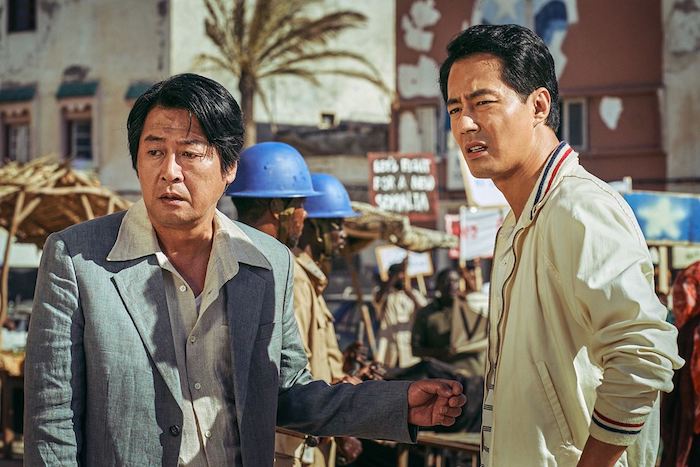
Ryoo seems to have a fairly good grasp of the politics involved but he’s not the kind of writer who can present it in a way that always makes sense to the viewer. Escape From Mogadishu is mainly a series of thrilling, expertly executed action set pieces taped together with barely coherent exposition. It’s easy to see his endgame, which is to throw the South and North Korean delegations together against their will once the city is overrun by bloodthirsty rebel forces. When diplomatic immunity means nothing, it’s every embassy for itself—even the North Koreans, who, despite their earlier arming of the rebels can no longer count on being in their good graces when total chaos ensues. While trying to make it to the Chinese embassy through the blood-soaked streets after their compound is destroyed, the North Korean ambassador, Rim Young-su (Huh Joon-ho), and his mission are pinned down outside of the South Korean embassy, which at the moment still has government protection, and beg to be let in. Out of cultural solidarity, Han opens the gate.

As sworn enemies, the conflicts between these two sides write themselves and reach a pitch of ridiculousness in a scene where the KCIA attache Kang (Zo In-sung) and his North Korean counterpart get into a long kung fu dustup after the latter learns that Kang plans to hand the NK delegation over to his bosses as “defectors.” Most of the second half of the film involves the making of a kind of truce between the two sides, which is vital to their mutual survival as the situation in Mogadishu quickly deteriorates. By the time the climactic chase scene occurs, with both delegations driving hellbent through the streets toward sanctuary at the Italian embassy while being pursued by government soldiers, an understanding has been reached, mainly negotiated by Han, who knows his career is probably over for making overtures to the North Koreans, but he’s a humanist first.

As with many Korean films that utilize an international milieu, Escape From Mogadishu suffers from a less-than-earnest attempt at inter-cultural credibility. The Somalis are two-dimensional, and the scenes where English is the form of communication are mostly incomprehensible. But that chase scene…

In Korean and English. Now playing in Tokyo at Shinjuku Piccadilly (050-6861-3011).

Escape From Mogadishu home page in Japanese

photo (c) 2021 Lotte Entertainment & Dexter Studios & Filmmakers R&K

Posted in Movies | Tagged , | Leave a comment

Review: The Worst Person in the World

These days it seems almost counter-intuitive when a male storyteller presumes to make something that takes the purview of a female protagonist. Of course, it wasn’t always that way and shouldn’t be. Some great male artists have given us vivid, credible female characters whose stories were enlightening and edifying. Scandinavians, Bergman and Ibsen immediately come to mind, seem to be better at this sort of thing, so Joachim Trier, a Danish-Norwegian director whose films have covered a wide range of genres and themes, seems at least constitutionally prepared to take on the tale of a young woman who attempts to interrupt her aimless drift in life by anchoring herself to a male partner. The pitfalls are obvious in such a narrative undertaking, and Trier, to his credit, understands this.

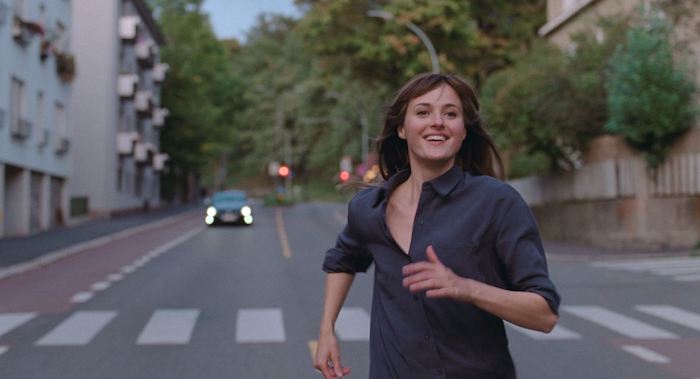
In a glib opening montage narrated by a third person, we learn how Julie (Renate Reinsve) has, in the course of her post-secondary school education, moved from pre-med to psychology to photography without really getting much of a handle on any of them, and ends up working in a book shop, which presumably keeps her stimulated intellectually but is really just a port of call while she figures out what she wants. When she hooks up at a party with the older (by about 15 years) Aksel (Anders Danielsen Lie), a former underground comics star famous for his anthropomorphic animal characters’ sexism and crudeness, she endeavors to move in with him, though it seems like yet another way of testing her tolerance of convention. During a weekend spent with Aksel at his parents’ house with friends, all of whom are married with kids, the subject of a long-term relationship comes up amidst the usual connubial dustups, and Julie expresses her disinclination to being a mother, a view informed by her uneasy ties with her divorced parents and which Aksel deems premature, since, as a man with “less time” than her he thinks he has to start a family before it’s too late. This conversation, carefully structured for its evocation of each character’s position, sets the tone for the film in a way that Trier may not have anticipated. From now on, the viewer will evaluate Julie’s choices from her standpoint on the possibility of becoming a mother, and while that is a concern many if not most women have to address, it feels limiting given Julie’s ongoing quest for self-awareness. When she publishes online a provocative essay about sexuality, she’s applauded, especially by Aksel and other male peers, for her frankness and stylistic skills, and you can sense some slight resentment on her part at their patronizing tone.

Inevitably, given her restless temperament, Julie drifts out of her relationship with Aksel, who, by dint of being older seemed resigned to living his life with her, children or no children. She takes up with Eivid (Herbert Nordrum), a barista her own age who is also unmoored—he doesn’t want children either—and coming out of a long-term relationship, but unlike Julie he feels extremely guilty about leaving his former mate. In fact, it is in another glib third-person narrated montage about this process where the titular phrase is evoked (“cheating on her felt like cheating on the planet”). But even if Eivid is very different from Aksel, the quality of Julie’s dissatisfaction with the state of her existence remains unchanged. 

Many have called The Worst Person in the World a romantic comedy, which both shortchanges its peculiar comic charms and underestimates its dramatic thrust. Trier is especially fond of narrative non sequiturs, but the sequences where Julie stops time to rendezvous with Eivid or trips on mushrooms add little cinematic color to the story. And the somewhat maudlin, typical ending indicates that certain ideas about women’s options haven’t changed much since Paul Mazursky allowed Jill Clayburgh to choose bohemian uncertainty over middle class security in An Unmarried Woman. This isn’t to say that Julie’s story should have been told by a woman. She is Trier’s creation and can only be accepted on his terms. 

In Norwegian. Now playing in Tokyo at Bunkamura Le Cinema Shibuya (03-3477-9264), Human Trust Cinema Yurakucho (03-6259-8608), Shinjuku Cinema Qualite (03- 3352-5645)

The Worst Person in the World home page in Japanese

photo (c) 2021 Oslo Pictures-MK Productions-Film I Vast-Snowglobe-B-Reel-Arte France Cinema

Posted in Movies | Leave a comment

Review: Licorice Pizza

The best movies about Los Angeles—Chinatown, The Long Goodbye, Shampoo—were made in the 1970s, even if the times they depicted may have been those of another decade. (And while The Long Goodbye was set in the year it was made, 1973, its hero, Philip Marlowe, was clearly beamed in directly from the 1940s-50s.) Add to this trio Paul Thomas Anderson’s ode to his youth, Licorice Pizza, even though it was made recently. Set in the mid-1970s, mostly in the San Fernando Valley that was the de facto middle class bedroom community of L.A., it has been configured to look as if it was actually made in the 1970s, and is even more meticulous in its period production design than Anderson’s previous 70s Valley jaunt, Boogie Nights. However, the obsessive attention to detail is not a function of Anderson’s nostalgia, but rather an attempt to actually remake that milieu into an idealized version of what he remembers. Genre-wise, Licorice Pizza is a coming-of-age story in which a boy’s crush on an older woman is told the way the viewer would have hoped it turned out. It’s certainly Anderson’s most optimistic work, a pure fantasy that nonetheless feels as if it could have very well happened to someone.

An alternate title could have been A Portrait of the Artist as a Young Con Man. Gary Valentine (Cooper Hoffman) is a soft-bodied 15-year-old high school student living with his single mother (Mary Elizabeth Ellis), who gets him juvenile acting jobs in TV shows and commercials. Gary’s confidence is boundless, but not in the usual annoying way. He knows what he wants, and as the film opens what he wants is Alana Kane (Alana Haim), the 25-year-old assistant to the photographer who has come to Gary’s school to take yearbook photos. For Gary it’s love at first sight. For Alana it’s a flattering acknowledgment of her appeal at a time when she’s still struggling to make sense out of life. The movie charts their relationship, which is passionate in its own way but not physical, over the next year or so, but while Anderson also shows their development away from each other, the complementary frisson is so acute that you can’t imagine them apart. 

The movie is sustained not so much by plot, but by the spirit of adventure that infuses both personalities and which is inseparable from its 70s Valley milieu. Gary, even before he is old enough to graduate high school, moves from one scam to another with the help of his minor celebrity as a kid actor, and Anderson isn’t shy about incorporating real, albeit dead, people in the stories, including unflattering (but hilarious) portraits of Lucille Ball (Christine Ebersole) and Jon Peters (Bradley Cooper, in his most unhinged performance ever). He also includes stand-alone episodes featuring Sean Penn as a drunken, exploitive movie actor-producer and Tom Waits as a lingering, decrepit embodiment of old Hollywood deal-making. Anderson saw the Valley as the proving ground for future movie industry movers and shakers, and while he himself is now part of that community he understands that the modes of self-improvement have not changed substantially since then, but his main vehicle for explaining this is Alana, not Gary, whose ambitions are almost cartoonish. Alana, whose personality and life trajectory is based on that of the woman who plays her, Alana Haim of the rock group Haim, is the self-conscious cognate to Gary’s hustler. While Gary slides slimily from one get-rich-quick scheme to another, Alana, who has to make a living to survive, goes from waitressing to political activism without any ulterior motives. It says something that Anderson uses Haim’s real parents and sisters to play her parents and sisters in the movie. He wasn’t after artifice but rather the recreation of a dynamic that resulted in something admirable. 

Licorice Pizza is certainly Anderson’s loosest, most purely entertaining film, though some viewers may find it a bit too rangey. For sure, he doesn’t gloss over the sexism and racism inherent in the scene he depicts, and some of the characters’ worst impulses are presented as merely funny foibles. But as a love story, it feels exactly right and, yes, nostalgic for anyone who grew up in that era, when social interactions were still dependent on actual personal contact. 

Opens July 1 in Tokyo at Toho Cinemas Chanter Hibiya (050-6868-5001), Toho Cinemas Shinjuku (050-6868-5063), Toho Cinemas Nihonbashi (050-6868-5060), Toho Cinemas Roppongi Hills (050-6868-5024), Shibuya Cine Quinto (03-3477-5905).

Licorice Pizza home page in Japanese

photo (c) 2021 Metro-Goldwyn-Mayer Pictures Inc.

Posted in Movies | Tagged | Leave a comment