
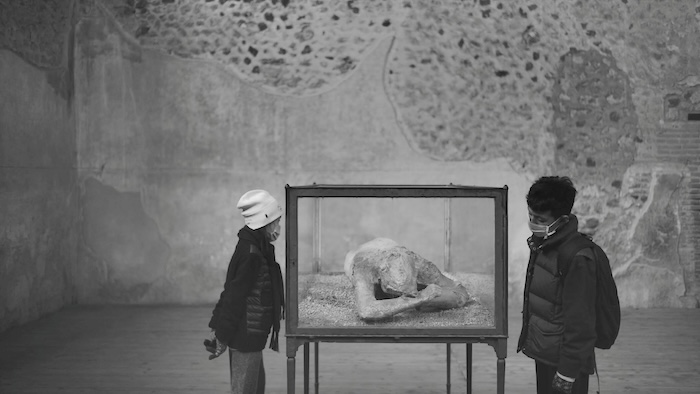
Documentary filmmaker Gianfranco Rosi struck paydirt when he found a middle-aged female archaeologist to comment on her work in a storehouse for artifacts unearthed during digs of the legendary city of Pompei, which was buried under lava and ash after Mount Vesuvius erupted in A.D. 79. The woman speaks of the sculptures and fragments in her charge with the air of a poet (“they were all wrenched from their contexts”), thus reinforcing the airy tone of the epigram by Jean Cocteau that opens the movie: “Vesuvius makes all the clouds of the world.”
Pompei: Below the Clouds is mostly about Naples, the port city adjacent to Pompei, which remains under threat, not only from Vesuvius (which last blew its top in 1944) but also the Phlegraean Fields, a volcanic caldera located west of the city. Every so often Rosi inserts a shot of lava and steam arising from some huge vent in the field. Juxtaposing scenes of Pompei’s ruins and their ongoing painstaking excavation—much of it being done by University of Tokyo archaeologists and their students—with scenes of everyday life in Naples, Rosi attempts to forge a continuum of mortality, life in the stark shadow of death; which may be why he chooses to shoot in black-and-white. One of his favorite locations is the local fire department’s emergency response room, where employees field calls from citizens who report rumblings under the earth as much as fires, petty crimes, and domestic incidents (the most fraught scene in the film is a fireman talking to a woman being beaten by her drunken husband). When the poetic archaeologist talks about the life of Pompei, she uses the present tense, as if the lives of the people represented by these artifacts were simply interrupted by the eruption. In Rosi’s depiction of a homey cram school filled with books, he conveys the extension of lives and the knowledge they hold into the future, while a pair of Syrian sailors discuss the huge hold of grain they are delivering from Ukraine to the world via Naples, and their fears of going back to Odessa for more, since the city is being bombed. Though these disparate episodes feel disconnected from one another, they are stories about Naples and thus connect subterraneanly to its history as a city, adding to its reputation as a region of global consequence.
Another leitmotif is tomb robbers, who have plagued the area for centuries, a reminder of the value of the past in a more material form. We see law enforcement officials inspecting age-old tunnels built by raiders who somehow made a living from stealing old frescoes and art works without getting caught. The more recent past is represented by old films, including Rodolfi’s silent The Last Days of Pompei and Rossellini’s Journey to Italy, which are shown being screened in a derelict Neopolitan movie palace. Rosi’s film is a fitting companion to these attempts to come to terms with the past, and, in a sense, may strike the viewer as a requiem.
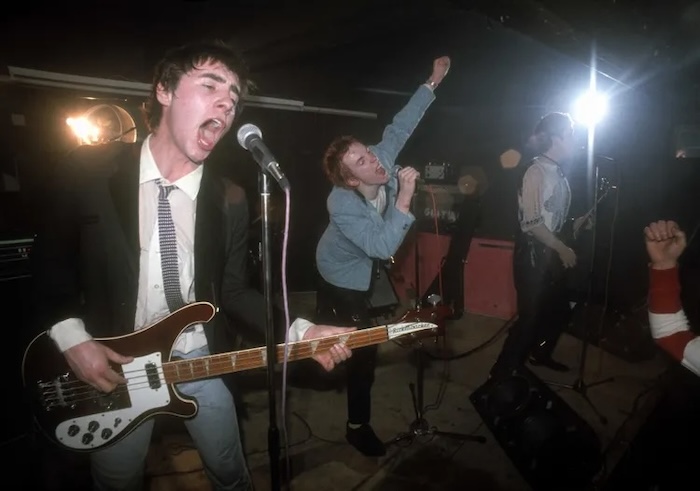
Archaeology of a very different stripe is attempted by the rock doc I Was a Teenage Sex Pistol. The “I” in the title is the legendary punk band’s original bassist, Glen Matlock, who was unceremoniously kicked out of the group just after they released their one-and-only album and replaced with lead singer Johnny Rotten’s severely dissipated childhood mate Sid Vicious. Matlock proves he knows the right attitude as a rock’n roll raconteur. “I’ve told this story a million times,” he says before he starts, and I think I’ve heard this story a million times, but it’s mainly been from Rotten’s POV, meaning it’s steeped in resentment-in-hindsight vitriol, because Rotten’s voice was the only one that filmmakers thought was important. Matlock doesn’t possess nearly the command of words that John Lydon does, but his rendering of this oft-told tale has angles and contours that make it a bit more believable.
And lighter, too. One thing that Matlock puts across quite handily is what a blast he had as a Sex Pistol. With candid comments also being offered by bandmates Steve Jones and Paul Cook and none from Lydon, we get a more rounded picture of a bunch of gormless juvenile delinquents who happen to love old time R&B trying to do something with that love before life itself destroys them. We already know about the mercenary designs of Malcolm McLaren, the fashion retailer who put the Pistols together and introduced them to Lydon/Rotten, but previously we never really heard much about the mechanics of the band, how they wrote their songs, and what sorts of stylistic limitations they had to overcome in order to become one of the most original sounding groups England ever produced. As the main interpreter of the story, Matlock predictably toots his own horn, explaining how he invented the band’s rhythmic signature, not to mention the way he channeled his love of mainstream pop (Rotten reportedly got rid of him because of his affection for the Beatles, but Abba seems to have been a more direct influence) into the chord structures he worked out with Jones. Even more vital is his descriptions of the recording sessions, which were not the chaos casseroles you might expect but workmanlike efforts to get a sound that was in his head down on tape.
The usual parade of big-name contemporaries lend their opinions of the impact of the band, and while it’s all quite sincere it’s hardly something we need to hear again. More vital to the story is Matlock’s overview, from a distance, of what his firing did to the band in the end. Right after Never Mind the Bollocks, Here’s the Sex Pistols was released, the group embarked on several ill-fated tours that ended with them dissolving in a puddle of disgust at Winterland. Matlock, of course, can’t help but feel vindicated, and the movie gives him the last laugh by showing how he went on to a steady career as a rock’n roll lifer, including an extended stint with Blondie. I’m not sure I don’t detect a bit of “what-could-have-been” in his confident septuagenarian swagger, but he deserves to tell his story just as much as we deserve to hear it.
Pompei: Below the Clouds, in Italian, Neopolitan, Japanese, English, Arabic, now playing in Tokyo at Bunkamura Le Cinema Shibuya Miyashita (050-6875-5280), Human Trust Cinema Yurakucho (03-6259-8608).
I Was a Teenage Sex Pistol now playing in Tokyo at Cinemart Shinjuku (03-5369-2831), Shinjuku Musashinokan (03-3354-5670).
Pompei: Below the Clouds home page in Japanese
I Was a Teenage Sex Pistol home page in Japanese
Pompei: Below the Clouds photo (c) 21 Uno Film SRL/Stemal Entertainment SRL 2025
I Was a Teenage Sex Pistol photo (c) 2025, I Was a Teenage Sex Pistol Productions, LLC

