
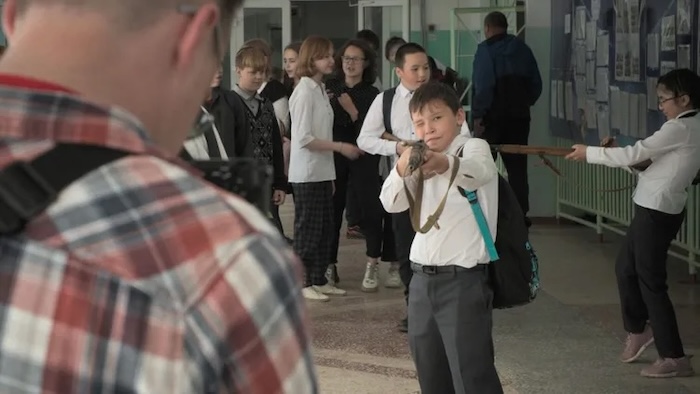
There is a subgenre of documentaries that interrogates the act of filming so-called truth while ostensibly presenting something true. This Oscar-winning film is centrally about Vladimir Putin’s propaganda push to support his war against Ukraine as it is carried out by the authorities’ in a public school in the Ural Mountains, but its premise is much more interesting and involving. The co-director, main cinematographer, and narrator is a young teacher at the school named Pavel Talankin, who goes by the playful nickname of Pasha. He grew up in the town of Karabash, celebrated as one of the most toxic municipalities on earth due to its copper mine and smelting plant, and works at the school he attended as a child and where his mother is still the librarian. He is beloved by his students and maintains his office as a kind of sanctuary where they can go to chill and talk candidly among themselves about whatever is on their minds. He recognizes immediately what the authorities are trying to do at his school and he means to expose it, but, of course, the very nature of the government’s brainwashing blitz means he cannot do so overtly. As it happens, Pasha is an AV nerd and thus the school’s de facto videographer, so it’s actually his job to record the propaganda efforts so that the government can know the school is doing what it’s being told to do. Meanwhile, Pasha’s post-dubbed narration explains what is really going on and, in the end, he has to escape Russia with the video data to Europe, where a professional director named David Borenstein puts it together to make the documentary we are seeing.
Though often scary and suspenseful due to the danger that Pasha is putting himself through to assemble his images, the film is relentlessly entertaining because of the kind of person Pasha is. Much of the humor in the voiceover is in the typical self-deprecating Russian style, but Pasha himself is an immediately appealing host with his colorful outfits, floppy hair, and chubby physique, not to mention his way of framing subjects both visually and descriptively in ways that bring out their true character. Pasha’s most stirring concern is how the demands of the propaganda-making machine, which are basically meant to condition these young people for a long war and the boys especially for a glorious death on the battlefield, replace anything that resembles proper education. Reading and writing are sublimated into one-sided history lessons that equate the Ukrainian “military operation” with the Great Patriotic War (World War II), and subjects like math and science are simply thrown by the wayside. Pasha showers special attention on one history teacher named Abdulanov who is completely down with the program, showing how this stiffly proper pedant is a throwback to the ideal Soviet Man (In a guerilla interview he says that he can’t decide which of Stalin’s henchmen is his favorite “historical figure” because their respective bloodthirsty jobs were equally “interesting”), and keeps his camcorder running as a bunch of elementary school students struggle to remember their lines when attempting to “act” as if they are ad libbing patriotic boilerplate.
Needless to say, Mr. Nobody Against Putin is effective in revealing the insidiousness inherent in making children bend to one’s will without their actually believing in what that will represents. Pasha’s tragedy, as he so movingly explains, is that he knows that what he’s doing means he will have to leave Karabash forever, a place he adores while acknowledging how dirty and ugly it is. And while the tense escape plan he has worked out with his nameless female go-between on the phone has a thrilling air of intrigue, it feels secondary to the huge loss that this delightfully uncompromising man will obviously suffer when he leaves the people he loves so dearly. This realization is much more powerfully felt than the intentions of exposing Putin’s horrifying designs.
In Russian. Now playing in Tokyo at Theater Image Forum Aoyama (03-5766-0114).
Mr. Nobody Against Putin home page in Japanese
photo (c) 2025 made in copenhagen Aps, Pink Productions s.r.o.

