
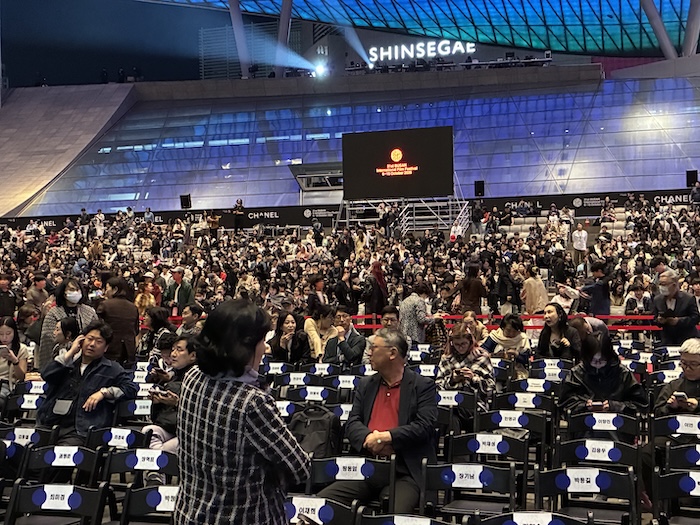
Since I arrived at the festival on its opening day, Tuesday, the weather in Busan has been great. Warm and sunny in the daytime and cool and dry at night. Nevertheless, my flight from Narita was slightly delayed and by the time I arrived at the Busan Cinema Center it was after 3 p.m. and I couldn’t pick up my badge and materials because they close the desk early for security reasons—the badge desk is in the same building as the opening ceremony, which started at 6 p.m. So I had to hunt down a foreign press person to get my invitations to the opening ceremony and reception.
This year the festival put me up in a hotel quite close to the Cinema Center, which is where everything happens. Usually, they give me a room in Haeundae, the resort area on the beach. Though it’s only 3 subway stops away, obviously being nearer the Cinema Center is better, except that most of the night action, meaning festival related parties and such, happen at Haeundae, and the subways stop at around 11:30 p.m. For instance the opening reception was at a hotel on the beach, so I had to take a taxi back to my hotel, though I seriously thought of walking the whole way since the night was so nice.
Because I’m a “guest” of the festival I get access to the guest ticketing system, which allows me four tickets a day to public screenings for free. However, the number of guest tickets is limited and they tend to sell out fast. In order to get them, you have to go online at 8:30 a.m. the day before the actual screening and register for them, but, of course, all the guests are online promptly at 8:30. Last year, when they introduced this system, I had no trouble getting seats for the movies I wanted, but so far this year it’s been difficult. On Tuesday, I was in a station waiting for the train to Narita Airport at 8:30 and had to get tickets for Wednesday using my phone. I was able to get a seat for the Korean monster movie Hope but nothing else. The same thing happened yesterday morning—I couldn’t get tickets for the movies I mainly want to see. It’s quite frustrating.
The opening ceremony was as long and boring as it usually is. Kim Min-ha, the actor from Pachinko was the MC by herself, which is unusual. In the past it was always one male and one female, so I suppose Kim has enough star power to handle the job herself. Or maybe it’s because she’s in the Opening Film, The Table: Day and Night, which was a very odd choice. As everyone knows, in the past year BIFF has had its rating as an international film festival boosted to the highest level, putting it on par with only a handful of other festivals, including Cannes and Venice. So this year’s edition is a big one for BIFF and may explain why I’m having trouble getting tickets on the guest ticketing system: there are just too many guests. Nevertheless, the last two years, as BIFF was gunning for its ranking to be boosted, it chose blockbusters for the Opening Film. The Table is more like a return to BIFF’s traditional mode of promoting smaller Korean films for the Opening Film, a tradition I approve of, though in this case it was something of a disaster. The Table, a kind of omnibus narrative set in a coffee shop, is ridiculously pretentious and shallow. I stayed until the end, but I would guess that a third of the audience walked out while it was on.
Being boosted to the top level also means that BIFF now has to have a Competition Section, the winner of which automatically gets submitted to the Academy for consideration for an Oscar. A lot of filmmakers I’ve talked to over the years actually admired BIFF for not having a competition section (instead they had the New Currents competition, only for up-and-coming Asian filmmakers), which is only put in place for publicity purposes. But at least the Competition Films at BIFF are limited to those from Asian countries.
Michelle Yeoh is this year’s Asian Filmmaker of the Year, and she gave the best of the speeches at the ceremony, thanking those Chinese directors who have helped her over the years. She said nothing about Hollywood, which I found refreshing. One thing about BIFF is that it very rarely screens Hollywood movies, though it does have a World Cinema section where such movies could be screened.
Come to think of it, Hope almost qualifies as a Hollywood production in terms of scale and professional savvy. It was the first movie I saw on Wednesday, in the CGV Multiplex’s IMAX theater. It was pretty breathtaking. The first hour or so is just nonstop action as the inhabitants of a coastal town near the North Korean border (there are signs everywhere alerting locals to stay vigilant) contend with a monster that seems to kill everything in its path. Director Na Hong-jin wisely keeps the monster off screen to increase the tension. However, once the monster is revealed as well as its provenance the movie loses a lot of its mojo even though the action itself becomes more intense (Na is a master of chase scenes, be they on foot or by vehicle). It seems like it’s gearing up for a sequel.
Na showed up for the post-screening Q&A, which was completely in Korean without English interpretation or one of those little huddles near the corner of the theater where an English interpreter whispers what’s being said to a clutch of foreigners. What’s really frustrating is that they even made an announcement IN ENGLISH that there would be a post-screening Q&A and that everyone should remain afterwards to participate. This has long been a problem at BIFF, and seems to be getting worse. If BIFF really wants to be a world class festival equal to its newly earned status, it has to do more to connect to non-Korean speakers.
I saw three other movies yesterday, none of which I had originally planned to see, having hoped I could get tickets to other films I really wanted to see. In the video room I watched a documentary called Birds of War, about a female BBC-Arabic reporter based in London who falls in love over the phone with one her sources in Aleppo during the Syrian civil war, a male photographer who was also an activist. She’s Christian Lebanese and he’s Muslim Syrian, but they manage to connect intimately as he constantly moves around to escape the attention of Assad’s military and eventually escapes to Turkey, where she finally meets him. They marry, but their professional and moral obligations keep them apart. It’s a stirring doc, but I needed more details about those professional obligations, especially the BBC reporter’s involvement with the situation in Lebanon after the Israeli invasion.
The best movie I saw yesterday was 9 Temples to Heaven, a Thai film by the longtime assistant director to Apichatpong Weerasethakul, whose name I am too tired to spell out here. It’s basically a comedy about Buddhist superstition, but only hints glancingly at the kind of spiritual enigmas that Weerasethakul is famous for. A businessman is told by his boss that he had a dream about the busineesman’s mother’s funeral and recommends he and his family, along with the mother, do a pilgrimage of 9 temples in order to extend her life. The extended family makes the trip in two vans and, predictably, sparks fly emotionally, though no one gets carried away. It’s all kept under the surface. Also predictably, the mother for whose benefit this trip is being taken rejects it all and demands to go home, perhaps thinking it’s not worth it to live long if I have to put up with this. The movie is long and slow, but the family dynamic is not only believable, but rather affecting in ways that I can’t describe, and I’m sure that was the director’s intention.
At night I took in a press screening for Hirokazu Koreeda’s Look Back, a film I didn’t intend to see initially. The movie is already in general release in Japan and I missed the press screenings there because I was so disappointed with the other movie Koreeda made this year, Sheep in a Box. Look Back is better. It’s about two girls who bond during six grade over their love of manga, and they work together to form a team that becomes quite successful even before they’ve graduated from junior high school. Eventually interpersonal tensions drive them apart and tragedy strikes. Most critics have compared it to the animated version of the same story that preceded it, a movie I didn’t see, so everything was fresh and, for me, rather unstimulating. My main problem, however, wasn’t with the story, which was boilerplate melodrama, but with the girls themselves and how they were portrayed, especially the elementary school versions (there are two sets of actors). I just couldn’t believe how they behaved and what they said. This is particularly disappointing since Koreeda is one of the best directors of children in Japan, as shown by Nobody Knows and Monster (where it was the adults whose behavior and dialogue were unbelievable). What happened here?

