
 I’ll give hot horror director Ari Aster this much: He really knows how to set the stage for his twisty mischief. Like his earlier potboiler, Hereditary, Midsommar opens with a deceptively bleak slice of melodrama. Dani (Frances Pugh), a grad student, has to cope with the tragedy of a bipolar sister in a set piece that would have made an exceptionally interesting film by itself. The trauma eats away at her already disintegrating relationship with her boyfriend, Christian (Jack Reynor), who seems more beholden to his chums, a toxic crew of privileged maleness. The one exception is Swedish softie Pelle, (Vilhelm Blomgren), an exchange student who invites Christian and his pals to his home village in Scandanavia, a kind of primitive hippie commune. Since two in this crew are studying anthropology, they are eager to go to experience the village midsummer festival. Dani’s part in this is not really clear, though Christian seems to want to patch up their relationship, and she really could use a change of scene.
As with Hereditary, from a certain point Midsommar winds itself so tight that the plot can seem impenetrable, but in any case, the village isn’t quite what these Americans envisioned. The first thing they do when they arrive is consume herbal hallucinogenics, a move that freaks Dani out given her already delicate psychological condition. The guys dig it, however, and not just because of their scholarly curiosity. The commune seems to practice its own form of free sex, though the newcomers may have to wait to participate. Predictably, the warm hospitality masks something much more sinister, and while it becomes obvious early on that our travelers are trapped—the commune is very far from what you would call civilization—it’s Dani, of course, who gets hip to the ways things are done around here before her pals do; and that plot point is central to what Aster has under his hat.
The scares are rather mild compared to Hereditary, and the gimmick is that everything happens in either broad daylight or during extremely well lit nighttime activities. It’s the movie’s suggestions that are meant to be upsetting, and while the feminist subtext is acutely felt, it doesn’t feel particularly original. Dani is the only character the viewer will likely care about, so one’s emotional investment is paid back without much in the way of dividends. In fact, the Swedes are so blankly uniform in manner and appearance, it’s surprising Aster hasn’t been accused of stereotyping.
In English and Swedish. Now playing in Tokyo at Toho Cinemas Nihonbashi (050-6868-5060), Toho Cinemas Hibiya (050-6868-5068), Toho Cinemas Shinjuku (050-6868-5063), Human Trust Cinema Shibuya (03-5468-5551), Toho Cinemas Roppongi Hills (050-6868-5024).
Midsommar home page in Japanese.
photo (c) 2019 A24 Films LLC
 What’s immediately striking about Terrence Malick’s newest movie is that its premise does most of the work for him. Malick is known for imprinting a characteristic visual style and spiritual tone on all his stories, regardless of their provenance or theme, thus creating his own theme, which usually centers on the nexus between the natural world and God. A Hidden Life is about the Austrian farmer Franz Jagerstatter (August Diehl), who refused to fight for Adolf Hitler because of his religious beliefs. The first half of the film takes place high in the Austrian Alps, a milieu where nature is king and God’s work is taken for granted. Jagerstatter’s life is so simple that he doesn’t even need the Catholic Church to guide his spirituality (“the Church tells you so…”), and he comes off as something of an oddity in the community, a man of deep faith without need for dogma to explain how to channel that faith. He sees God in the trees and the fields and the animals and in his love for his wife, Franzi (Valerie Pachner), who gives him three children. As with many such passages in Malick’s films, this idyll is sometimes overwrought, an excess of beautiful scenes beautifully staged and shot. Some will no doubt find it tiring, but it makes Jagerstatter’s idealism whole and uncomplicated, and that’s important because it determines the choices he makes, ones that very few of us ever even contemplate.
 Justin Kelly’s cinematic retelling of the J.T. LeRoy scandal is the second film I’ve watched in a span of 24 hours about a true-life literary hoax. The day before I watched Marielle Heller’s Can You Ever Forgive Me?, which was about biographer Lee Israel’s two-year project to defraud literary memorabilia collectors by forging letters by famous dead authors. The Heller film is superior to Kelly’s, but mainly for technical reasons. Heller understands how to shoot and edit for maximum emotional resonance and how cinematic time differs from real time. Kelly’s film, which depicts a longer time period, is often confusing in that incidents almost seem to happen on top of one another. And the use of title cards and voiceovers just add to the mess of developmental tricks that are obviously used to paper over lapses in imagination.
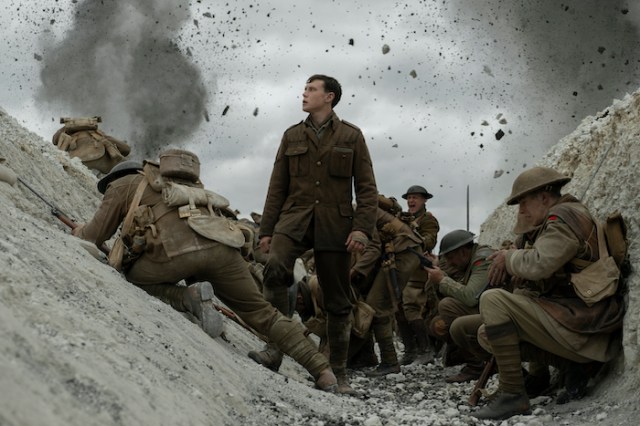 Most bets were on Sam Mendes’s World War I epic to take the Best Picture Oscar at last week’s Academy Awards ceremony, but no one seems to be griping that he was robbed. I guess that most people who saw all of the nominated films probably think that the best one won, but it’s still worth discussing why 1917 was favored in the first place. The thinking is that movies about heavy-duty themes (war) that are also technically challenging (the famous “one take” gambit) have an advantage with Academy voters. Within those narrow parameters, 1917 is quite good and exerts its intended power as you watch it. Afterwards, however, it fails to linger, a function of its gimmick rather than its theme.
 The first thing that needs to be said about The Good Liar for those who look to reviews for recommendations is that it’s essentially a straightforward adaptation of what sounds like a trashy thriller novel made respectable by the casting of two of Britain’s finest veteran actors. That description alone should be enough to let you know whether you want to see it, and if it isn’t then probably you shouldn’t, because, as directed by supreme hack Bill Condon, it offers little in the way of surprises or deep thought.
 The post-2007 recession will continue to supply movies and TV dramas with endless examples of capitalist venality and the resulting suffering of the masses, but so far there’s been what seems like an even divide between comedy (The Big Short, etc.) and melodrama (99 Homes, etc.). Hustlers, which is based on a true story, is stuck somewhere in the middle in terms of entertainment value. Essentially a feature-long revenge fantasy against the moneyed assholes who caused the meltdown—not to mention moneyed horndogs—the story’s real-life particulars have obviously been ginned up, and for once it’s a good thing.
 At this late date there’s little originality to be squeezed from the rind of the classic drawing room murder mystery epitomized by the work of Agatha Christie. Personally, I’ve always found the genre, with its strictly structured setups, carefully dropped red herrings, and over-determined reveals, unsatisfying since with each new story there are necessarily diminishing returns in terms of excitement. More to the point, the structures and sentiments required by the genre leech the stories of anything identifiable. The murder and subsequent investigation might as well be happening in Middle Earth.
 When you look at the life of French novelist Romain Gary, there are a lot of incidental notes that could make for fascinating sidetrips by themselves. One is that he is the only French writer to have ever won the Goncourt Prize twice under two different names, which, as it happens, is the only way you can win the Goncourt twice since French law prohibits the same writer winning it more than once. The other incidental I want to know more about is the story behind Gary cowriting the script for The Longest Day, an English language movie that, until Saving Private Ryan, was the most memorable film ever made about D-Day. Gary’s take on the war is especially valuable if you take his memoir, Promise at Dawn, for what it says it is. Personally, I have my doubts, since so much of what happens in the story is almost beyond belief, but maybe that’s just a function of director Eric Barbier’s style of storytelling.
 philipbrasor.com