
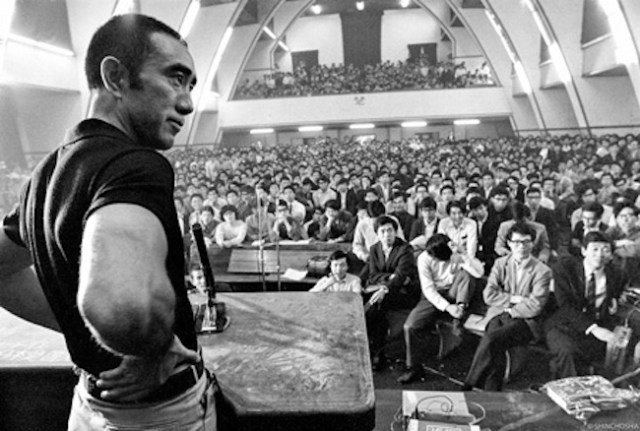
 Almost 50 years after he committed ritual suicide at the self-defense agency headquarters in Tokyo at the age of 45, Yukio Mishima wedges his way back into Japan’s consciousness in the form of a documentary based on “lost footage” of a public debate he had with a left-wing student organization at the Komaba campus of the University of Tokyo in May 1969. In terms of quality and content, the footage is certainly impressive and worthy of scholarly and even general scrutiny, though there’s a certain dated predictability to the exchanges depicted and, later, analyzed. Director Keisuke Toyoshima lines up as many surviving participants in the debate, as well as people with academic skin in the game, in order to show us how momentous this event was, but in the end it feels more like a historical curiosity than a revelatory document.
For sure, it was a momentous time. The radical student organization, Todai Zenkyoto (All Campus Joint Struggle Committee), had essentially been defeated by the police and school authorities in its quests, first to stop the Vietnam War and Japan’s security alliance with the U.S., and secondly to assure greater student autonomy within the university structure. Mishima, probably the most acclaimed novelist of his generation, was already well into his poetic nationalist phase, buff from bodybuilding, effortlessly cosmopolitan regardless of parochial pronouncements, and brimming with confidence. He could well afford to take on these punks single-handedly in a school auditorium holding hundreds and accepted their challenge to argue his case for restoring the emperor to the head of the state and reviving militarism. But another reason he took the challenge, according to the various talking heads who appear throughout the movie, is that he sincerely admired these young men (and the vast majority were men; no women appear in the footage chosen and only one is a talking head, fellow novelist and epicurean Jakucho Setouchi), because they had proven they were men of action. In fact, one of their beefs with Mishima was that he showed off his intellectualism, and like Richard Hofstadter’s famous theory about people who identify as being practical-minded, the students wanted to trip him up by proving his intelligence was used for frivolous things. As one student says during the debate, “This is all philosophical nonsense! I’m here to see Mishima get beaten up.”
And in a sense that’s the problem with the film, because too much of the debate is spent talking about the meaning of language rather than the primacy of action, which is the real subject of Mishima’s literature. The centerpiece confrontation is between the author, chain smoking and cracking jokes at the expense of his hosts, and a student named Masahiko Akuta, who, with his baby daughter strapped to his chest, brings the debate down to the ground in ways that are startlingly direct. Akuta does not defer to Mishima, and, in fact, seems impatient with his constant extemporizing, and for a second, at least, you can sense the writer realizing that someone is calling his bluff.
Though it would take a great deal of intellectual gymnastics to claim that one side or the other “won” the debate, there’s another sense that Mishima didn’t feel entirely satisfied with his performance. As several talking heads say in hindsight, he actually “loved” young people, regardless of their political position, because he knew they were not yet ground underfoot by Japanese conventions. He may have worshipped the idea of the emperor, but he seemed to resent the man himself, which was exactly the point. When the emperor was a god, he could be revered. As a man, he was barely capable of holding a conversation of any interest. Even Mishima’s militaristic turns were more theatrical than political (though he probably hated U.S. bases just as much as the leftists did), and the film gives the impression that his famous suicide more than a year later was carried out to own the libs, if not these particular students. He wasn’t humiliated in the debate by any means, but he knew he had failed to persuade them that his was the path they should be following, not that of left-wing dreamers (Akuta would go on to become an avant garde theater director) or corporate/government factotums, but rather citizens who saw the greatness in their native sensibility, even if Mishima himself had yet to figure out a way to transform that ideal into something that was really great for everybody on anything but a spiritual level. By killing himself so spectacularly, he at least was able to get in the last word.
In Japanese. Opens March 20 in Tokyo at Toho Cinemas Chanter Hibiya (050-6868-5001), Toho Cinemas Shinjuku (050-6868-5063), White Cine Quinto (03-6712-7225).
Mishima, the Last Debate home page in Japanese.
photo (c) 2020 eiga “Mishima Yukio vs Todai Zenkyoto 50nen me no shinjitsu” seisaku iinkai/(c) Shinchosha
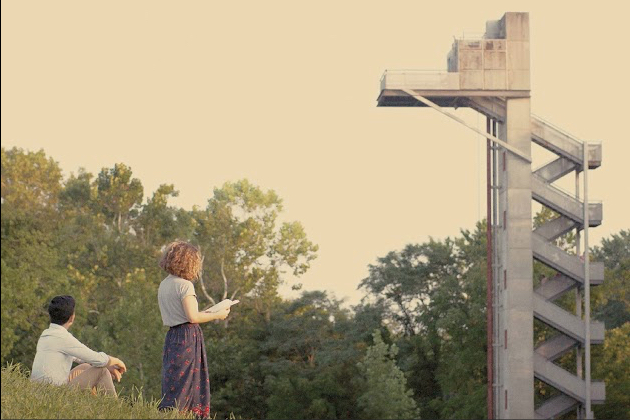 The title city, a leafy Midwestern exurb that is located in Indiana, not Ohio, is an interesting choice for a place where the two main characters find themselves stuck. The town’s main attraction is its full line of modernist architecture, much of it designed by the Finnish master Eero Saarinen, and first-time feature director Kogonada apparently built his whole script around this feature. The fact that it works so well in illustrating the difficulties of two people overcoming their circumstances is a tribute not only to the Korean-American director’s imagination, but to his acute insight into the way we project onto our surroundings.
 It was only a matter of time before Kenneth Branagh, the still-living film actor most popularly identified with Shakespeare, portrayed the Bard himself on screen, and for what it’s worth and despite the stupid schnozz, there’s something heartening and even a bit surprising in his impersonation, namely an effort to confound any sort of expectations. Branagh’s Shakespeare, caught at the end of his life, after he’s retired from writing and managing his theater company, is a man who not only knows his worth, but likely understands his place in history, and Branagh plays this aspect without the kind of hindsight navel-gazing one usually gets in the biopics of “great men in their twilight,” but rather with a wistfully sad acknowledgment that it means very little if you’re not around to enjoy it. And that’s something we all have to address, even if we aren’t famous and world-changing. On the other hand, the movie itself feels like a greatest hits collection of rumored moments that never quite deliver the pleasures promised.
 Here’s
  Usually, I don’t comment on acting when I review a film, mainly because I expect professionalism from everyone involved and good acting should be a given. Normally the acting is good, so there’s no point in talking about it unless it’s extraordinary in some way. With this movie about Judy Garland, however, I feel it’s necessary to discuss Renee Zellweger’s performance, and not just because it earned her an Oscar, but rather because of what it says about imitation and how we tend to judge quality by measuring verisimilitude. Zellweger doesn’t look much like Garland and she makes up for this shortfall by focusing on physical and vocal tics. She’s not entirely successful on this front, but, inadvertenly perhaps, a compelling character comes through, and whether or not it’s Garland isn’t really important, though I imagine to some people it is. In any case, the movie, which isn’t particularly well made, could be much worse if this character were done differently.
 Critics have at long last realized that the development of Chinese art house cinema over the last decade has been deeply influenced by American and European film noir. The influence probably goes back further, and, for what it’s worth, film noir as an aesthetic idea is so deeply imprinted on film theory that it seems hardly worth mentioning. Bi Gan’s Long Day’s Journey Into Night, which has nothing to do with the O’Neill play, is drenched in both the mood and the attitude prevalent in classic film noir, and thus comes across as a kind of primer for what Chinese art cinema has turned into. The fact that it was something of a hit in China shouldn’t really be surprising.
 As has already been pointed out, the title of Ladj Ly’s debut feature is a kind of piss-take on the classic Victor Hugo opus, a move that both provokes curiosity and confounds expectations. It is about “poor people” in the sense that a put-upon population is pitted against their so-called betters, but Hugo’s story was classist to the core, while Ly’s is more about conflict born of authoritarianism. The “betters” in his case are represented solely by the local police contingency in the Paris banlieu of Montfermeil, where immigrant cultures live in various states of near-destitution. Crime is not exactly rampant here, but it is a mode of survival and thus the tension between the residents and the cops is ever-present and prone to eruptions of emotional if not physical violence.
 Though it’s not vital to appreciating her achievement, Waad al-Kateab was not a trained filmmaker when she started recording her day-to-day existence in the besieged Syrian city of Aleppo in 2012. At the time she was studying for a business degree, and while protests against the regime of the dictator Bashar as-Assad were growing, the civil war that eventually overran the country and destroyed Aleppo had yet to reach its deadliest phase. The beginning of this remarkable documentary contains the kind of casual everyday videos you’d expect from a 26-year-old woman who is pursuing her dream of a better life. They are hopeful and even playful at times. Al-Kateab is clearly on the sides of the rebels, longing for the day when Assad is gone, but as the national army and its proxies start bombarding the town, first to destroy rebel forces and then the IS contingents that move in to take advantage of the chaos, loyalties fade from the picture because survival is the first priority.
 Tongue-in-cheek title aside, there’s not a whole lot in Jay Roach’s takedown of Fox News that’s farcical. If anything, the movie is earnest, even sincere in the way it unloads on male toxicity in the media, but Roger Ailes is dead and Megyn Kelly, though somewhat chastened by her failure at NBC, still willfully spouts ignorant horseshit. In a word, Bombshell is burdened with too much ongoing context.
 philipbrasor.com