
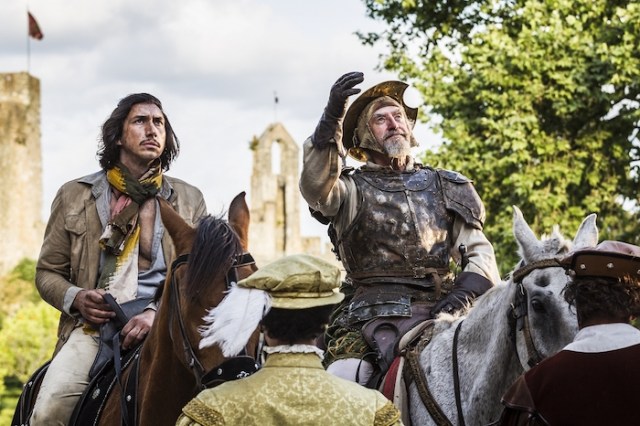
 It’s the slightest of serendipities to note that two days after the great Terry Jones died at the age of 77, another Terry who toiled in the same comedy group and, like Jones, a man who made a second career as a director of feature films, finally sees his 30-years-in-the-making epic open in Japan. Granted, Terry Gilliam is surely a more famous filmmaker than Terry Jones, though I would hesitate to call him a more successful one. Jones’ output was slight in comparison, but it was surely more consistent in tone and quality since it mostly had to do with bringing Monty Python’s Flying Circus to the big screen. Does that make Gilliam, a famous asshole with a streak of artistic idiosyncrasy a mile wide, more ambitious? Perhaps, but given that ambition, it will probably be some time before we’re able to properly judge his body of work.
The Man Who Killed Don Quixote won’t make the job any easier. Begun in 1989 and discontinued twice due to lack of funding, a situation that led to a kind of documentary about the failure of the project featuring footage of the abandoned film, this finally finished movie is credited to lead actor Adam Driver’s ability to use his name to attract money, a development that, in and of itself, is deserving of a deeper explanation since Driver has only been a box office draw for about 2 years now. In the film he plays Toby, a hotshot CM director working on location in Spain to film a vodka spot. Under pressure from his ad agency boss (Stellan Skarsgaard), who hopes to snag an open-ended contract with the liquor conglomerate, Toby is essentially returning to the scene of the crime, since his student film was made in this exact same stretch of Spain. It was about Cervantes’ immortal knight errant, and Gilliam implies that Toby has not done much else of aesthetic value since then. When a gypsy drops by the set and tries to sell pirate DVDs to the crew, Toby snatches up a copy of the student film, a move that inspires him to abandon the commercial in order to find out what has transpired in the town in the ten years since.
Quite a bit, as it turns out. The actor who played Sancho Panza drank himself to death. The female lead gave up her dreams of stardom to become an escort, and his Don Quixote, a cobbler named Javier (Jonathan Pryce), went mad and now is convinced he’s the real thing and, as such, is determined to right the wrongs of the world, if only he had the right Sancho to accompany him. Against his better judgement, Toby takes the role.
It’s easy to understand Gilliam’s stubbornness in pursuing this theme. His metier has always been fantasy shot through with a touch of madness, and the man of La Mancha was the original crazy dreamer. If Toby is Gilliam’s obvious stand-in, a creator who relies on many others to realize his vision, then it follows that in the end he has to feel responsible for those who suffered as a result of that vision. Though the storyline mirrors Cervantes’ in an episodic way, the overall plot is original and mostly revolves around Toby’s overcoming his sellout impulses, ending in a frenzy of cross-purposes that requires the participation of not only the ad agency boss, but the Russian liquor company that is presumably paying for all of this. One is tempted to see it as an elaborate raspberry aimed at all the backers who gave up on Gilliam over the years, but there’s not enough narrative meat to bite into much less chew on. Like Don Quixote’s crusades, everything feels amorphous and liable to disappear in a puff of smoke at any moment. Gilliam has fun with Don Quixote’s hallucinations, but for the most part the movie doesn’t display his usual sense of whimsy. Over-determined and stuffed with confusing detail it definitely looks like a movie that took 30 years to make.
In English and Spanish. Now playing in Tokyo at Toho Cinemas Chanter (050-6868-5001), Shinjuku Cinema Qualite (03-3352-5645).
The Man Who Killed Don Quixote home page in Japanese.
photo (c) 2017 Tornasol Films, Carisco Producciones AIE, Kinology, Entre Chien et Loup, Ukbar Filmes, El Hombre Que Mato a Don Quijote AIE, Tonasol SLU
 The unwieldy title of this feature film from Kazakhstan that was trotted out for film festivals is The Horse Thieves, The Road of Time, which is far too much information and points to a loss of clarity as to what the purpose of the movie is as a piece of art or entertainment. For sure, the basic narrative idea, which mixes romantic intrigue with action and danger, is dramatically absorbing, but the whole exotic component of the setting and the culture as emphasized by the cinematography and production design points to its promotion as some kind of precious artifact. Then there’s the subtext of having a Japanese actor play the romantic male lead opposite a Kazakh actor who won a Best Actress prize at Cannes, as well as the directing credit being shared by a young Japanese director, even though the story and overall aesthetic is obviously the product of the award-winning Kazakh director.
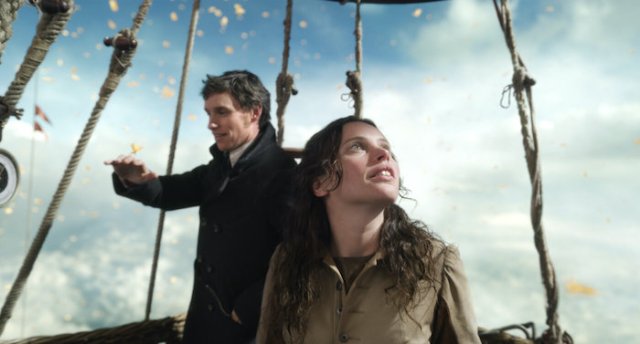 About the only way to approach Tom Harper’s two-handed adventure film is as a problem in search of a solution. Though based thinly on a true story (or, more exactly, elements from several true stories), the film’s adventure component is so limited in scope that in order to remain relevant for 100 minutes a number of hurdles must be overcome, the first of which is that there are only two characters, and the second of which is that the entire adventure takes place in the basket of a hot air balloon.
 Though Clint Eastwood’s oft-discussed tendency to inject his personal cultural prejudices into his movies seems to become more pronounced with age, he is more likely to get away with that proclivity in films where he also stars, probably because the director’s work as an actor, particularly in the Dirty Harry series, provided his entire public persona with an acceptable facade of conservative independence that comes with its own integrity. Whether you appreciate or abhor his politics, Eastwood is a known entity, and a comfortably familiar one, so wherein presentations such as American Sniper and 15:17 to Paris can come across as reactionary statements, equally skewed movies like The Mule and El Torino feel more like films thanks to Eastwood’s curmudgeonly lead characters. You take them at face value as entertainment rather than as veiled attempts at libertarian persuasion.
 Director Taika Waititi sincerely tries to hedge his bets with his Oscar-nominated Nazi comedy by labeling it right off the bat as an “anti-hate satire,” which, of course, gives the impression that the New Zealand director, not-so-fresh off the success of his MCU Thor blockbuster, has only the best intentions when he depicts Hitler as a goof-ball and anti-Semitic propaganda as akin to MAGA-inspired cultural laziness or immaturity or both. And for sure, the movie’s relentlessly inventive stream of jokes that tap directly into our collective sense of how ridiculous that whole regime was, with its uniform fetishes and obsession with whiteness for the sake of whiteness, works a certain magic until you catch yourself wondering what you should make of a group of people hanged in a town square after summary trials for anti-Nazi activities. You’re obviously supposed to be appalled, but then you’re also supposed to fall right back into laughing at the silliness of it all.
 Here’s
 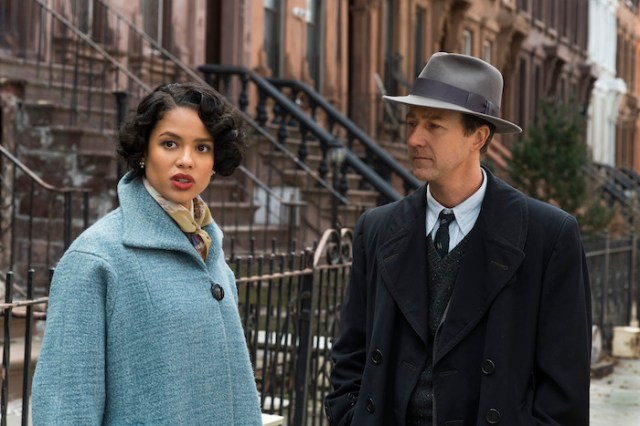 Edward Norton is arguably Hollywood’s most idiosyncratic movie star, a description that will find pushback in some circles for two reasons: Norton doesn’t present as a “star” and his idiosyncrasies aren’t apparent in all the work he’s done. Motherless Brooklyn, a kind of vanity project that Norton has been trying to launch for many years, makes good on this description for various reasons but also points up the problems that the actor-director-screenwriter has trouble seeing through the haze of his ambitions. Since I haven’t read Jonathan Lethem’s source novel I have no opinion about Norton’s decision to change the setting from 1999 to 1957, though given the central plot point of a grasping, corrupt New York city planner modeled after Robert Moses (Alec Baldwin), it at least makes logical sense. However, all the attendant noir elements feel a little too on-the-nose when they are located in an era when film noir was at its historical apex as a form of expression.
 The initial reflexive response to James Mangold’s wannabe epic about the Ford Motor Company’s ambitious entry into the world of auto racing is that it’s late to the 60s nostalgia orgy. As could be predicted with such a high budget Hollywood project the production design is immaculately retrograde, though as is also often the case with high budget Hollywood projects the verisimilitude is sometimes off-putting: the colors a bit too period-bright, the haircuts creepily perfect. What made Mad Men (and, to a lesser extent, Once Upon a Time in…Hollywood) transcend this aesthetic was the way the scripts buried beneath the surface gleam for something that felt real about the time, especially if you lived through it. Ford vs Ferrari, however, simply wants you to bathe in the promise of American exceptionalism, even if one of the main characters is a spiky Brit.
 After it opened last January, this crime-comedy became South Korea’s second biggest box office success in history, prompting all sorts of speculation as to what exactly it represented to the country’s very large movie-adoring population. Though a few of the actors have wide appeal, no one had ever been considered responsible for a comparable hit, so it mostly came down to a happy combination of factors, including central plot points focused on food, a fairly open-ended approach to violent slapstick, and the normal January doldrums, when studios, even in Korea, I suppose, mostly release detritus.
 philipbrasor.com