
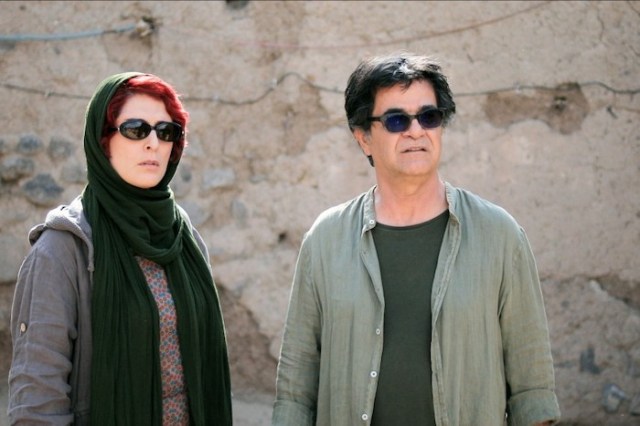
 In his last samizdat production, Taxi, Jafar Panahi spent almost the entire running time behind the wheel. He spends a good portion of his latest movie also in a car, thus in a way extending a cinematic style perfected to obsessive lengths by his late mentor Abbas Kiarostami, many of whose last films took place in moving vehicles. For Panahi, the device takes on an extra layer of meaning, since he is banned from making movies for 20 years by the Iranian government. His first two forbidden works were resolutely indoor affairs, but with Taxi and now 3 Faces he endeavors to get out of the house, and cars provide just enough cover for him to scratch his creative itch without being noticed (cameras are by necessity very small when filming in a car, and no crew). However, here he’s also incorporated a long automobile trip into a story that takes him far from Tehran, into the mountains bordering Turkey, where people are familiar with his celebrity but not close to any government organs that might risk his being exposed.
The story he has fashioned around this conceit is probably his most expansive and conventional since going underground. Playing himself, he is driving the well-known actress Behnaz Jafari to a remote mountain village to find out if a girl who purportedly hanged herself after failing to get in touch with Jafari actually died. The girl (Marziyeh Rezaei) records her last minutes with her iPhone, saying that she desperately wanted to talk to Jafari about her own discouraged desire to become an actress, and when the older woman never replied she saw no future for herself. Jafari tells Panahi that she has no knowledge of these attempts to contact her, and is frantic with guilt and worry, and so talks him into accompanying her into the mountains, a trip that requires riding over rough, winding roads for hours. Occasionally, they have to stop for an hour or two to let a herd of cows or a cart pass.
Structured as a kind of missing persons mystery, the film follows the cosmopolitan pair as they are recognized by villagers who fete them as lavishly as they can. They beg off unsuccessfully but in order to find out if the girl really did kill herself they have to be indirect and discreet with their questions, a strategy that leads to misundertandings both serious and humorous. In his other post-ban works, Panahi had to work around his limitations, but here he seems almost recklessly liberated by the resources at hand, allowing seemingly ad libbed conversations with locals to veer off on odd tangents. The overall feeling is of strangers stranded in a strange land—many of the pair’s interlocutors speak only Turkish and not Persian—and as Panahi and Jafari find it increasingly difficult to get at the truth, the death they hope is a hoax seems to permeate everything they encounter, because life in a hardscrabble environment like this one means always living in death’s immediate shadow.
But the film has its surprises, the most potent of which is how unexpectedly dramatic it is. The implication of the suicide, regardless or whether it was real or staged, is that freedom of thought is even more of an illusion the further you get from the relative open-mindedness of the city. Though the girl tried to contact Jafari, a worldly woman whose impatience with the villagers is striking, it is with Panahi that her story resonates. She deigned to kill herself out of frustration with being kept from pursuing her dreams, while Panahi has somehow overcome his own proscriptions. What can he tell this girl when he meets her? It’s the movie’s most compelling mystery.
In Persian and Turkish. Now playing in Tokyo at Human Trust Cinema Shibuya (03-5468-5551).
3 Faces home page in Japanese.
photo (c) Jafar Panahi Film Production

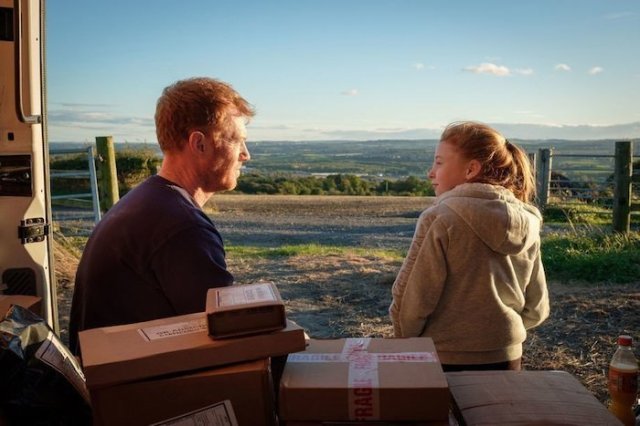 At this point in his career Ken Loach is neither anybody’s fool nor anything less than what he resolutely says he is in his films—a staunch socialist muckraker with no qualms about using rough sentimentality to drive home his political points. Consequently, he’s been more appreciated and honored at continental film festivals (Cannes, especially) than he has by international critics and his fellow Brits. His latest, in fact, may be his most scathing indictment of late stage capitalism, not to mention his harshest rant against what the UK has become socioeconomically in the 21st century. Though film purists will obviously see it as yet another over-the-top screed, in light of yesterday’s general election, it comes across as nothing less than a libertarian horror movie.
 Here’s
  What made the first Zombieland more interesting than it had any right to be was its attention to dweebish detail, in partcilar its lists of dos and donts when navigating a new American landscape where the undead were a daily danger, but a danger that could be reduced to a mere nuisance if the protocols devised by the film’s redneck hero, Tallahassee (Woody Harrelson), were followed to the letter. His opposite number, the bookish rube Columbus (Jesse Eisenberg), needed some time to absorb this wisdom, and while he managed to adjust a few tenets and add some corollaries of his own, the basic manual of chopping and shooting survived into this sequel, whose very title references one of the rules, which is to ensure that a zombie is really finished by zapping it twice with whatever weapon is at hand.
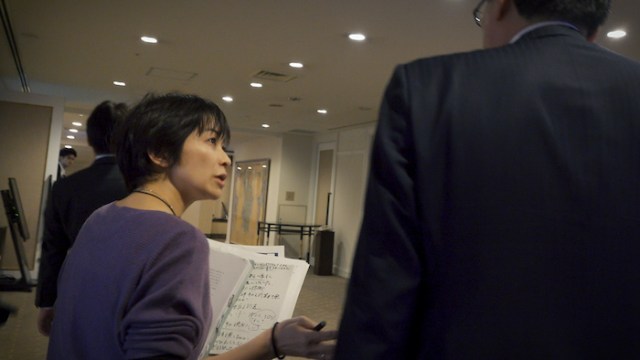 Writer and documentary filmmaker Tatsuya Mori obviously likes titles limited to one letter of the alphabet. The two movies that made him famous, the ones about the Aum Shinrikyo cult, were titled A and A2. The title of his latest, i is a bit of a mystery until it’s explained at the end, so someone, perhaps producer Mitsunobu Kawamura, suggested the secondary title that pointed out it was a film about journalism, or, actually, one journalist in particular, Isoko Mochizuki, who writes for Tokyo Shimbun. Though Mori teaches about media in Japan and is a common pundit on TV for media-related issues, i, apparently, was not his idea, but rather Kawamura’s. The producer also made that fiction film, Shimbun Kisha, that was released several months ago and which was also based on Mochizuki. It was a hit. This is a kind of companion piece and Kawamura thought Mori was just the guy to do it, and he is, except as with all his documentaries, i is more about him than it is about its nominal subject.
 This third exploration of the semi-fictional competition-friendship between the two British comedic actors, Steve Coogan and Rob Brydon, tries to get by on the pure momentum generated by the last installment, The Trip to Italy, which was and will probably remain the high point in the series about two insufferable entertainers tooling around the countryside on some publication’s dime sampling amazing food, accommodations, and scenery while bemoaning their respective personal and professional setbacks. Though Coogan and Brydon got much more mileage out of their considerable celebrity impersonation skills in Italy than they did in the original The Trip, where they simply traveled the English countryside and which was edited down from a TV mini-series, here the surrounding plot is so weak and gratuitous that you almost get the feeling the whole movie was built around these seemingly spontaneous attempts at one-upmanship in the mimicry arts, which peaks during a sequence in which Coogan, attempting to explain to two female acquaintances the importance of moor culture in Spain, is confounded by Brydon’s incessant impersonation of Roger Moore. The scene outdoes Ricky Gervais (also referenced at least twice in the movie, which is nothing if not incestuous about British comedy) in terms of wince-inducing faux hilarity, and you really just want it to stop as soon as possible.
 It could be argued that we don’t need another biopic of Vincent Van Gogh, certainly the most cinematized painter of all time. And on the surface, Julian Schnabel’s treatment of the tormented Dutchman covers much of the same ground that previous movies have, at least temporally. He limits the film to the last year of Van Gogh’s life, but rather than dwell on his state of mind or what might or might not have happened during those last fateful, disputed months, he looks squarely at the work, which makes sense since Schnabel is a respected painter himself.
 Ironically or not, the national film culture that has best represented post-millennial capitalist malaise has been China’s. Many, including me, will credit or blame Jia Zhangke with this development, but it’s really a function of the Peoples’ Republic’s almost schizophrenic approach to economic relativism, the idea that a fully communist regime can adapt market solutions to social policy. The latest piece of evidence proving how pointless this approach has been is Hu Bo’s An Elephant Sitting Still, a nearly four-hour exercise in raging against walls. The movie is set in a town in northeast China that was once an important mining center and which now seems desperate to find any use for itself. This desperation is mirrored in the lives of four characters looking for a way out their difficulties—and out of the town—and not having any success.
 philipbrasor.com