Kabuki actor Ichikawa Ennosuke in “Hanzawa Naoki 2”
Here’s this week’s Media Mix, which is about the popular TBS drama series, Hanzawa Naoki 2. As pointed out in the column, the dramatic elements of the production are purposely exaggerated, especially the acting, which is at least partially based on kabuki stylings. The fact that the production employs a number of well-known kabuki actors only points up this purposefulness, but as one of the experts I cite in the column, Kesako Matsui, told the Asahi Shimbun, kabuki actors often act in standard movies and TV dramas where they play standard characters without resorting to their particular gei (art). Here, as she notes, they are being asked to explicitly tap into their traditional skills as stage performers but for a visual medium that relies a great deal on intimacy. And as I stress, this aspect gives the whole project an air of ludicrousness. But I also think this ludicrousness is purposeful, because it plays up the artificiality of both the story and the production.
Artfulness is not exclusive to Japanese theater but in my experience it tends to have a higher value within the movie and TV industry owing to certain developments that have more to do with commerce than with art. I’ve always loved the classic Japanese films that every critic cites as fundamental to understanding the greatness of world cinema, but there are few Japanese movies, whether independent or studio-led, released after, say, the late 80s that give me as much pleasure, and for a long time I always thought it was a fault in my own stars, but now I think it may have something to do with this emphasis on artificiality. There are many great trained actors in Japan, but, as in Hollywood during its golden age, leading men and women are often cultivated as leading men and women, and thus scouted or selected due to attributes such as looks or charisma rather than their acting abilities. From the mid-90s almost all TV drama series in Japan employed pop music idols as stars for obvious reasons. (Not new; in the 60s and 70s many Japanese movie stars were also pop singers, but often they started out as movie stars) Given the logistical circumstances of TV productions in Japan—most series are put together and shot very quickly so as to keep costs down—preparation is not as important, and so actors have to do the best they can. Supporting actors in such productions tend to be professionals and they can be counted on to carry their weight, but the leads are often out of their depth, and they probably know it, so in order to come across as deserving of the responsibility thrust upon them by TV producers and their own talent agencies (which, in many cases, are collaborating with the producers directly on the shows) they overdo it. In other words, they act their asses off, and the effort shows.
Since this sort of thing is perhaps more acceptable in Japan because of the traditional dynamic between audience and performer as exemplified by kabuki, few people may find it as off-putting as I do. (There are idol-movie stars in Hollywood, too, best represented by Elvis Presley, but they tend to compensate for their lack of skills by going in the opposite direction, by assuming a kind of forced naturalism) Still, I think as an aesthetic it has come to permeate movies and TV dramas to the point where directors (or, at least, younger ones) expect it, and that generates a cycle of ever-more obvious artificiality. To put it bluntly, Japanese movies and TV dramas tend to focus on the kind of showmanship that is overly evident in Hanzawa Naoki 2 simply because it proves to the auidience that the actors, directors, and even the writers are working hard. It’s not enough to deliver a story that makes you think or appeals to your imagination, the production itself has to blow you away with the professionalism of it all. And you can’t show off your professionalism by holding back.
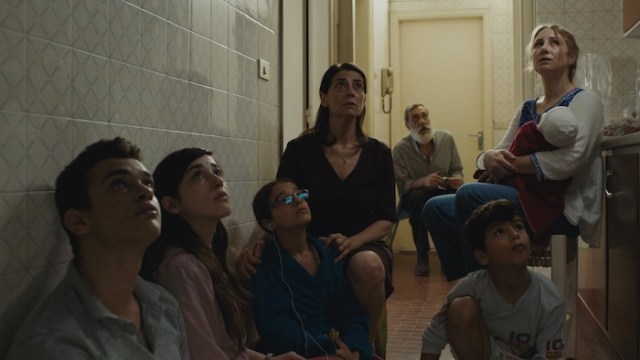 Narrative films that take as their subject current affairs face a dilemma in terms of execution. How much of the story will be irrelevant or even incorrect in years to come? What sort of viewpoint should the direction take, or should a viewpoint be taken at all? In Syria, also called Insyriated (a made up word?) in some markets, is set during the early days of the Syrian civil war, which was almost a decade ago, so in a sense the Belgian director, Philippe Van Leeuw, has some leeway with historical distance in making his decision as to how to approach the conflict, and he has chosen to generalize the circumstances as to lose any specific idea of how the war came about and how it is being fought. Essentially, this is a movie about “all war,” and while that approach doesn’t detract from the film’s dramatic power it does make it that much less convincing as a historical document.
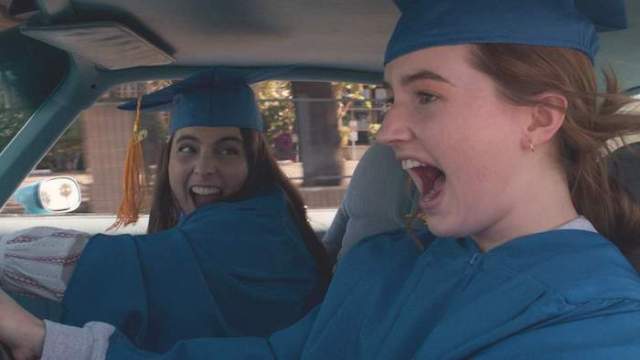 This American teen comedy, focusing almost exclusively on the girls’ experience, is blessed with one of the best titles of recent memory. “Booksmart” implies a brain full of stuff derived from reading materials and outside sources rather than from experience. It’s the opposite of “street smart.” Our two protagonists, Molly (Beanie Feldstein) and Amy (Kaitlyn Dever), are more than just the class nerds, students who get straight As and participate in the astronomy club and school band. They’re also the class snobs in that they put on a front of not caring about what the rest of their classmates do, i.e., popularity through being hip and a willingness to party under any circumstances. Molly and Amy aren’t hip except to their own vision of adult sophistication and responsibility (they proudly flaunt their Warren for President bumber stickers), and in that regard they see themselves as better than their peers because they’ve been accepted to top-flight universities. This self-affirmation, however, is deflated when, during the final weeks of their senior year, they discover that most of those peers are also going to top-flight universities — and without having busted their assses academically the way Molly and Amy did.
 Here’s
  Though Korean movies still find wider distribution in Japan than do movies from other countries outside of the U.S., some Korean movies have an easier time of it than others. The fact that this occult actioner features Park Seo-jun, who stars in the wildly popular Netflix drama Itaewon Class, is probably the main reason for its being picked up. On the surface, the high-concept premise—a mixed martial arts fighter moonlights as an exorcist—didn’t hurt, but all these elements don’t necessarily blend together in a satisfactory way. Park himself often looks as if he’s not entirely sure what he’s supposed to be doing when he isn’t throwing flame balls at Satan’s spawn.
 Like Joseph Heller and the Notorious B.I.G., Chinese director Wang Bing debuted with a work that was so overwhelming in its originality, scope, and message that anything he would produce subsequently was bound to be anticlimactic; but like those two seminal artists, Wang has pretty much nailed his subjects consistently. West of Tracks, his nine-hour documentary, released in 2002, about the decay of China’s biggest, most ambitious industrial complex, shot seemingly in real time, wasn’t just immersive. You left the theater so disoriented that it might take several days to readjust to reality.