Media Mix, Nov. 3, 2019

Shiroyama Dam

Here’s this week’s Media Mix about the government’s lack of preparation for the recent run of flood-related disasters. Though the conclusion I drew from all the information I gleaned in the media is that there’s really no ideal way to prepare for such disasters in the long run, it doesn’t mean the government is off the hook. The only genuinely effective solution would be to relocate people living in dangerous areas, but that’s hardly going to be a popular move in a free democracy. More palatable would be some policy that discouraged any new housing or development in at-risk locations, but nobody wants to tell someone else where they can and can’t live. Still, this kind of squeamishness seems to extend to existing water management policy. According to the land ministry only 51 dams in western Japan have formulated systems for pre-release of water when there is a threat of over-capacity from projected heavy rainfall, and only about half have ever carried out these plans. In eastern Japan, which, prior to the three storms that recently struck in rapid succession, had not suffered from major flooding in many years, there are almost no systems in place for pre-release. And one of the main reasons is that much of the water is conserved for waterworks. If a local water authority releases too much water in fear of flooding and the result is insufficient water capacity for households and agrucultural users, they might be subject to lawsuits. The land ministry also requires that local governments obtain permission from users to pre-release water in the case of possible heavy rainfall, but that’s easier said than done. In the end, many don’t even bother to make such plans.

That is one of the reasons why there was such confusion at Shiroyama Dam in Kanagawa Prefecture when Typhoon Hagibis was doing its worst. Water levels were approaching capacity, and the water authority kept announcing it would release water, possibly endangering households farther down the river, but they kept postponing the release. That’s because they were working without a plan. The dam was built 54 years ago and they’ve never been in this situation before. Eventually, they did release water, but almost five hours after they first announced they would. In those five hours certain residents didn’t know whether they should evacuate. Of course, they should anyway, considering the amount of rainfall, but it doesn’t instill confidence in the authorities if they don’t seem to know their own system and how to approach a critical situation that could have disastrous results. Managing water can be a perilous business, and if the public isn’t made aware of the real situation, then they have every right to be angry.

Posted in Media | Tagged | Leave a comment

Review: Climax

As the poster boy for post-millennial transgressive French cinema, Gaspar Noe has a reputation that precedes him by miles, and while his newest outrage does nothing to confound that estimation, its musical pedigree makes it somewhat less distasteful, at least on the surface. Ugly things happen as they do in all Noe films, but the glaze of manic terpsichorean energy lightens it up substantially, making Climax not only Noe’s most watchable film but perhaps his wittiest as well.

The premise is simple and straighforward: a dance troupe of some two dozen young people from various multi-cultural and pan-sexual backgrounds are assembled through audition in a cavernous abandoned school in the middle of nowhere on a cold winter night sometime in 1996. They rehearse an extraordinarily visceral dance routine to Cerrone’s “Supernature” that lasts 20 minutes, and when they are through the viewer is just as exhausted as they are and ready to party. The manager of the troupe has set out a bowl of sangria, and as the dancers partake Noe shifts fitfully from one conversation to another in order to give us an idea of the various personalities at large in the big, dimly lit room. The stories are cleverly spun to peg certain behaviors and sensibilities to individuals: some are aggressively sexual, some menacingly cerebral, one thinks she is pregnant, while another can hardly keep her libidinal urges in check. What binds them all is the physicality of their beings as crystallized in their one common desire, which is to dance.

As these conversations increase in intensity and self-absorption, it becomes clear that something is off, and eventually someone realizes that the sangria has been spiked, perhaps with LSD. Once this intelligence spreads, the behavior becomes both more aggressive and less controlled. The preternatural physicality of the dancer becomes a danger to both the possessed and those around them, and soon bodies are doing odd things in unpleasant ways, including causing violence to others and themselves. A child is locked in a storage room for his own protection only to freak out as well (never trust Noe with a kid); the pregnant woman miscarries; a knife is applied to skin; a miscreant is shoved out into the snow with no protection.

The joke, as Noe has himself admitted, is that none of these people are being punished for their egotism and arrogance, though they might very well deserve it. He is simply showing how a good time can descend into horror show in such a short span and for such a pedestrian reason. In the end, what he’s really after is an excuse to put his filmmaking imagination to full use, and his depiction of the drug-fueled hysteria that develops is both terrifying and hypnotic. The longest seemingly unbroken cut is almost 40 minutes and involves turning the camera in every direction until the viewer is walking on the ceiling observing the carnage below. All the while Noe miraculously follows the various interpersonal storylines without dropping a beat or losing a motivation. These possessed souls have bodies that can perform the hallucinatory contortions that Noe demands, so why not make a movie about a bad collective trip? For once, the director’s high concept approach to horror results in something unique and fascinating, but no less repugnant.

In French and English. Opens Nov. 1 in Tokyo at Human Trust Cinema Shibuya (03-5468-55519.

Climax home page in Japanese.

photo (c) 2018 Rectangle Productions-Wild Bunch-Les Cinemas de la Zone-Eskwad-KNM-Arte France Cinema-Artemis Productions

Posted in Movies | Tagged | Leave a comment

Review: Van Gogh, Of Wheat Fields and Clouded Skies

One surprising thing I learned while watching Julian Schnabel’s movie about the last year of Vincent Van Gogh’s life was just how many paintings he produced. Sometimes he would finish a dozen in a week. This sort of superhuman output clashes with our image of a great painter, who we tend to think hesitates over every brush stroke. Van Gogh, who admitted he was an “animated” painter, just couldn’t help himself.


This Italian documentary, directed by Giovanni Piscaglia and narrated by Valeria Bruni Tedeschi, focuses on the collection of Helene Kroller-Muller, who died in 1939. Kroller-Muller collected some 300 paintings by Van Gogh, most of which can be viewed at a dedicated museum bearing her name in the Netherlands. Piscaglia synced his film with a traveling show consisting of 40 paintings and 85 drawings from the collection that came to Italy, and his approach, like Schnabel’s, is to find something new to say about probably the most well-known and picked-over modern painter of our time. Put simply, Piscaglia downplayed Van Gogh’s personality and his storied psychological troubles and concentrated on the work, in particular Van Gogh’s draftsmanship, a prerequisite that no longer holds as much importance these days in the visual arts. We see how Van Gogh’s subject matter changed as he developed his unusual technique, from somewat mundane sketches of average people to landscapes filled with colors that are almost preternaturally vibrant. As the title suggests, his real subject was nature, and he found more life in a stalk of wheat or a cloud formation than he did in the human forms around him. He was, of course, a masterful portraitist, but the film makes it seem as if that was a side line he did in order to fit in, either to make money (which he didn’t really do because he couldn’t care less about it) or to please someone he liked or simply to keep up his skills.

The documentary interviews a number of Van Gogh experts, and what’s interesting about their comments is how each person has gained something important from Van Gogh’s work that is different from everyone else’s. One says that part of Van Gogh’s brilliance was that he didn’t know he was brilliant (apparently, during the height of impressionism, which he followed, all the big painters were quite full of themselves). Another speculated about his seeming rejection of male subjects. A few repeat the age-old chestnut that Van Gogh’s unique was of seeing was the result of some kind or organic dysfunction, but no one really takes that at face value, since it’s assumed that each person sees the world differently anyway. More interesting is the idea that he followed the standard process of becoming a painter, and it wasn’t until that last year, when he became obsessed with painting, that the work took on the qualities that have made him so beloved. His development was so accelerated that he overtook the conventional process, which is why, as one critic explained, collectors didn’t really “get” him until twenty years after his death, at which time his painting were still in general circulation but mostly among people who simple liked something nice on their wall; in other words, the common people Van Gogh appreciated because they were “closer to nature” than the city folk he was supposed to cultivate to make a living. In a sense, this is a perfect companion piece to Schnabel’s movie, which opens in Japan on November 8.

In Italian, French and English. Now playing in Tokyo at Shinjuku Musashinokan (03-3354-5670).

Van Gogh: Of Wheat Fields and Clouded Skies home page in Japanese.

photo (c) 2018-3D Produzioni and Nexo Digital

Posted in Movies | Tagged | Leave a comment

Review: Gemini Man

The term “high concept” normally refers to movies with memorable plot hooks specifically married to casting or directing decisions. Gemini Man is thus high concept in the most literal way. Ang Lee, a respected director of nuanced dramatic fare and a dedicated booster of cutting edge cinematic technology, helms a fairly standard spy action film whose hook is Will Smith playing two versions of his usual laid-back screen persona at two different ages. More significantly, the movie was shot in hyper-realistic 120-frames-per-second 3D format, giving it an unusual look that has already divided audiences. Some have found the format intriguing in the way it boosts the credibility of a genre that is incredible by definition, while others find it unwatchable.

I fell into the latter camp, owing mainly to dialogue and story development that was even worse than what you normally find in pumped-up spy thrillers. For sure, the rendering of the younger clone version of Will Smith, who plays a newly retired government hit man, is amazingly realistic. There are none of the usual motion or portraiture seams you get with the de-aging CGI or motion capture technology. The scenes that Smith plays against himself don’t look any different quality-wise than similar scenes where Smith would be reacting to a real actor, including the fights, of which there are many. But what all these considerations add up to is a viewing experience that is shot through with unavoidable distractions.

In a sense, that’s a blessing in disguise since the script is awful. Smith’s Henry Brogan comes to realize he’s losing his edge when instead of putting a bullet into the head of a passenger on a high speed train from the vantage point of a distant hill he hits the target’s neck, so he retires to his boat only to discover he’s still being surveilled by his old employers, specifically techno villain Clay Verris (Clive Owen), who is in charge of something called the Gemini project. When things get hairy and Henry attempts to shake Verris’s all-seeing eye with the agent (Mary Elizabeth Winstead) initially assigned to tail him, Verris decides Henry has to go and sicks a younger, cloned version of the hit man on him. Some interesting and nominally exciting action sequences ensue, but David Benioff’s story (the script is also credited to two other co-writers) adds some gratuitous daddy issues and other totally bonkers themes that turn the movie into a tangle of conflicting narrative vectors. That it’s all conceived in a visual atmosphere that looks, as one critic put it, like a cross between a telenovela and a video game, heightens the ludicrousness of the basic concept and, especially, the dialogue, which is almost mind-numbing in its obviousness. Gemini Man is only tolerable as an experiment, and a failed one at that.

Now playing Toho Cinemas Hibiya (050-6868-5068), Toho Cinemas Nihonbashi (050-6868-5060), Shinjuku Wald 9 (03-5369-4955), Shinjuku Picadilly (050-6861-3011), Toho Cinemas Shinjuku (050-6868-5063), Toho Cinemas Shibuya (050-6868-5002), Toho Cinemas Roppongi Hills (050-6868-5024).

Gemini Man home page in Japanese.

photo (c) 2019 Paramount Pictures

Posted in Movies | Tagged , | Leave a comment

Review: La verite

Hirokazu Kore-eda is Japan’s master of the middlebrow, and in that regard Shoplifters, the movie that cemented his international cred, is an outlier. Most of what has sustained his career in Japan is what can be safely called domestic potboilers—tales of family secrets that coast along on unchallenging ideas and solid craft. Kore-eda’s first non-Japanese film fits this pattern. It is a perfectly executed French middlebrow entertainment, though lighter on the sex than your average French middlebrow entertainment.

Kore-eda’s ordinary script is helped immensely by an extraordinary cast led by Catherine Deneuve as legendary actress Fabienne D’angeville, who has just published her memoir and is doing press with fawning, cowed reporters in her Paris mansion. The imperious Fabienne loves it. For the first time in many years, Fabienne’s daughter, Lumir (Juliette Binoche), comes to visit from New York with her American actor husband, Hank (Ethan Hawke), and their young bilingual daughter, Charlotte (Clementine Grenier). Lumir is nominally estranged from her mother, but makes the visit expressly to check the memoir to find whether it is, as the movie title tells us, “the truth.” Naturally, it isn’t, though most of what’s false about the book is what it leaves out, particularly Fabienne’s rivalry and relationship with another actress who was considered better but died young. Lumir, who called this woman her aunt, was essentially raised by her in the absence of her mother.

As with all of Kore-eda’s family secrets films, the truth in this case is malleable, and as much as Fabienne stretches and compacts certain events to fit her ideal narrative, Lumir has forgotten things herself—or, more essentially, misremembered them. Within this structure, Kore-eda provides some excellent jokes, such as screenwriter Lumir’s penchant for writing scenes for loved ones to play out in real life. But in the end, the movie’s mild melodrama doesn’t give us anything substantial to think about since the consequences of Fabienne’s subterfuge and Lumir’s resentments don’t really add up to much in the way of drama. Nevertheless, Binoche takes Kore-eda’s sketchy profile of Lumir and turns it into a tour de force of character revelation. At first you wonder what such an intelligent, insightful woman is doing with a mess like Hank—recovering alcoholic, eternal B actor—and Binoche shows you through the cracks in Lumir’s self-possession. Though the movie is mostly about Fabienne’s fear of aging, it says more about Lumir’s unsteady grip on her own identity, which is an obvious casualty of her mother’s neglect. And in that regard, the movie works well. Maybe a little sex might have given it the spark it needs.

In French and English. Now playing in Tokyo at Toho Cinemas Hibiya (050-6868-5068), Toho Cinemas Shinjuku (050-6868-5063), Shinjuku Wald 9 (03-5369-4955), Toho Cinemas Roppongi Hills (050-6868-5024), Toho Cinemas Nihonbashi (050-6868-5060).

La verite home page in Japanese.

photo (c) L. Champoussin/3B-Bunbuku-Mi Movies-FR3

Posted in Movies | Tagged , , , | Leave a comment

Review: Upgrade

Leigh Whannell’s seeming homage to David Cronenberg pits an analog holdover named Grey (Logan Marshall-Green), who likes to listen to blues music on vinyl and rebuild classic cars, against the already arrived cyborg technology that rules the rest of his life in this approximation of our immediate future. As it turns out, Grey is married to a woman (Melanie Vallejo) who is totally into tech, and, in fact, works for a company that has a huge stake in this brave new world of AI and total interconnectivity. Eventually, this clash of sensibilities comes to a head, and Grey is left paralyzed after an accident involving a self-driving car.

Though Grey had little affection and even less use for vanguard tech, he eagerly agrees to be a guinea pig for an experimental technology called Stem that promises to make his limbs once again respond to his brain’s command. As Grey learns to use this new technology he finds it has quirks of its own that add to the superhuman context. For one thing, the technology also seems to have a mind of its own, which is not necessarily a bad thing for Grey, since his main motivation for getting his motor functions back is revenge. The result is often comic and definitely unsettling, as Grey becomes a kind of perfect fighting machine, only one whose controller—himself—sort of sits back and marvels at what he can do. Whannell has a lot of fun with this aspect, but in the end, Upgrade doesn’t give us anything to chew on beyond the clever and very violent action set pieces. There’s the usual cop who thinks that Grey’s actions are suspicious as well as at least one evil genius whose own weird capabilities are not enough for him. Not much of an upgrade there.

Now playing in Tokyo at Shinjuku Cinema Qualite (03-3352-5645), Shibuya Cine Quinto (03-3477-5905).

Upgrade home page in Japanese.

photo (c) 2019 Universal Studios

Posted in Movies | Leave a comment

Media Mix, Oct. 13, 2019

Here’s this week’s Media Mix, which is about the development and marketing of 4K and 8K television sets. I say “set” in the traditional sense, meaning an appliance that incorporates both a display and a tuner, though many modern consumer TVs don’t include tuners owing to various factors, the most obvious one being the range of source signals available. You can now watch TV shows that originate via terrestrial radio waves, satellite feeds, cable input, and internet connections, and while there are TVs that are easily capable of handling all of these functions, they each require other devices to make them work, such as satellite dishes, wi-fi routers, cable boxes, as well as subscriptions with the various operators who provide these services. It can become quite complicated, and the area immediately surrounding your display can start to look like a snake pit of cables and connections. Also, most people now buy recorders, which have tuners built in.

I mention this because the main thrust of the column is that home electronics manufacturers are always looking for new things to sell, because replacing old devices was once a proven money-maker. You bought a TV and upgraded when new models promised better picture quality, and that is what 4K and 8K provide. However, as technology improves picture (and sound) reproduction, the opportunity to profit from upgrades also becomes more complicated. For sure, no one longs for the days of CRTs and video tapes. Even the picture quality on an iPhone is better than any you could get on the highest-grade, largest-screen TV set sold 20 years ago. The reason 4K and the theoretically four-times-better 8K went on the market almost simultaneously has more to do with technological development than economics. For sure, manufacturers and retailers seem to be in a fix trying to sell both, because logic says that they should be touting 8K as the best thing available, though from my own observation the quality advantages of both modes can only be fully appreciated on very large screens—at least 55 inches. Personally, I don’t have the room in my home for that big a display, so 2K is still just fine for me. Salespeople have their work cut out for them.

And as I said at the end of the piece, content and consumers’ relation to content will really determine what kinds of devices people buy. Young people don’t watch conventional television much any more, and TV companies have had to adjust to a certain extent. Until 20 years ago, content on TV was restricted by certain economic and technological realities, but no more. TV is the rival of cinema in terms of narrative content, and in many cases surpasses movies. But that doesn’t necessarily mean people stop going to movie theaters because they can watch the same films at home on large displays. It simply means there are so many choices that each mode of viewing has to share an audience with another mode of viewing, whether it be a movie screen, a TV display, or a smart phone. The development of technology both drives and confounds this diversity of choice, and those who want to profit off of it are still struggling with ways of making it work for them. It’s no longer a simple question of planned obsolescence. It’s niche marketing gone ballistic.

Posted in Media | Tagged | Leave a comment

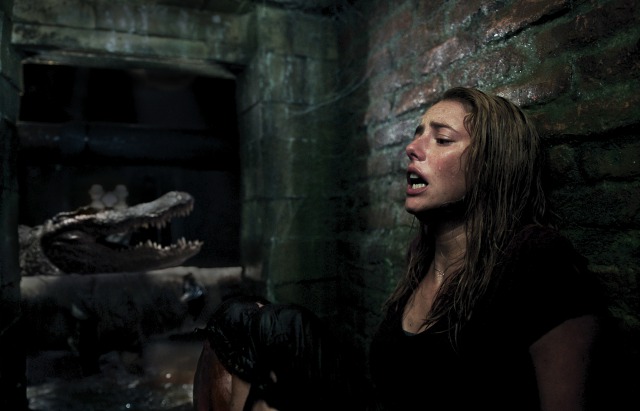
Review: Crawl

Damsel-in-distress movies still exist, but these days women in peril tend to be the heroes who defeat malevolent forces rather than their victims; though in many cases the deadly force is not malevolent, but merely hungry. In this vein, the gold standard was the 2016 shark movie, The Shallows, which traded in jolts and gore for a simmering suspense fueled by the intelligence of survival. Like that movie, Crawl has a hero who is good with water—she’s a champion university swimmer—but while horror master Alexandre Aja foregoes the usual tactics, he doesn’t quite find a proper rhythm, and the movie feels slack even at 87 minutes.

Part of the problem is that Haley (Kaya Scodelario), the aforementioned swimmer, is motivated by a problem that feels cooked up. When a huge hurricane threatens to pass over the Florida home she grew up in, she finds it difficult to contact her estranged father and former coach, Dave (Barry Pepper), and so endeavors to brave the elements to find out if he’s all right, talking her way past police who have ordered the area evacuated. The father-daughter impasse is touched on so lightly that you wonder why they even bothered, and it seems to have something to do with Dave, who divorced Haley’s mother a while ago, selling the house against his children’s will. None of that matters much, however, when Haley shows up to find Dave trapped in a crawl space in the flooded house, badly injured from the bite of an enormous alligator. It is thus Haley’s job to get him out as the waters keep rising and the alligator’s mischief is compounded by an equally large and ravenous pal.

All filmmaking efforts go into creating an impossible obstacle course for Haley and Dave to navigate and overcome. Aja keeps things lively by allowing the outside world to occasionally peek in, as in one scene where the gators decide to go out in the flooded streets for dumber (and less sympathetic) prey, but for the most part we’re dependent on Haley’s ingenuity and swimming skills for entertainment at the expense of credible dialogue and somewhat hokey emotional salve (there’s a dog, of course). It’s also pretty claustrophobic, but not in a way that makes us uncomfortable. It elicits something closer to annoyance with being stuck in the same place. There’s blood, but you actually wish there was more.

Now playing in Tokyo at Toho Cinemas Hibiya (050-6868-5068), Shinjuku Wald 9 (03-5369-4955), Toho Cinemas Shinjuku (050-6868-5063), Toho Cinemas Roppongi Hills (05-6868-5024).

Crawl home page in Japanese.

photo (c) 2019 Paramount Pictures

Posted in Movies | Leave a comment

Review: Yesterday

The most interesting thing about this pop star fantasy is that the Beatles estate agreed to license so many songs. McCartney I can understand, since he was always the band’s most fervent champion regardless of how his beloved “tunes” were used, but Yoko? In her dotage she seems to be slipping a little. Danny Boyle’s film, based on a script by the always annoying Richard Curtis, imagines a world without the Beatles, which, in fact, is pretty difficult to do considering how large the Fab Four figure in the history of the late 20th century—or in the 21st, for that matter. It’s a clever conceit as far as it goes, but Curtis and Boyle try to take it further with mixed results.

The movie’s playful mood is set right from the start, with struggling singer-songwriter Jack Malik (Himesh Patel) plugging his one decent pop song to mostly uninterested crowds in lazy dive bars and rural English festivals. His friends encourage him and his biggest fan is his manager, Ellie (Lily James), who, of course, doesn’t make any money off of him, but the script is rather clear that she and Jack are not an item at the moment, just good friends. Bicycling home from a gig one night he gets into an accident just as the entire world suffers an electrical blackout. He wakes up in the hospital and after he’s released his friends buy him a new acoustic guitar to replace the one wrecked in the accident. To try it out he plays “Yesterday.” Everybody is very impressed and asks Jack if he wrote it. Eventually, he comes to realize that he’s the only person who remembers the Beatles (later on we find out there are others with this strange infirmity), and after a brief struggle with his conscience he decides to make the most of it and, of course, is a smashing success.

The subtext is almost too obvious to take seriously: The Beatles’ music is indelible for reasons that transcend taste, so of course Jack, even in the 21st century, will be a star playing this stuff. But since he’s also a member of a minority in Britain, and takes the credit for music by not one, but three of the world’s greatest songwriters, the movie has to bear more thematic weight than Richard Curtis’s bland romantic comedy cliches can carry. At one point Ed Sheeran, playing himself with much less self-deprecation than he’s publicly known for, asks Jack to open for him, and, of course, immediately regrets it because he understands just how good Jack’s songs are. The best joke is when they compete at spontaneous songwriting chops, and Jack has all those great songs at his disposal—it’s the kind of gag that Sheeran’s legions of haters will absolutely adore, even if it is unspeakably cruel.

As Jack’s and Ellie’s romance blossoms, Jack’s conscience gets the best of him, and it’s typical of Curtis that he doesn’t really know how to credibly resolve the dilemma, so he aims for the schmaltz. Paul probably loves that aspect of the film, while Yoko obviously didn’t read that far into the script.

Now playing in Tokyo at Toho Cinemas Nihonbashi (050-6868-5060), Toho Cinemas Hibiya (050-6868-5068), Toho Cinemas Shinjuku (050-6868-5063), Toho Cinemas Shibuya (050-6868-5002), Toho Cinemas Roppongi Hills (050-6868-5024).

Yesterday home page in Japanese.

photo (c) 2019 Universal Studios

Posted in Movies | Tagged | Leave a comment

Review: Joker

Todd Phillips’ odd superhero gloss has a lot of distractions built into it, the most obvious one being its non-relationship to the Batman franchise (or franchises, depending on how doctrinnaire you are) as a feature that is only tangentially relevant to the Dark Knight. The other distraction is the way Phillips uses our collective movie memory of New York City in the 70s and 80s. It doesn’t matter if you weren’t there at the time or even if you weren’t born yet: if you’re a moviegoer you know the grungy production values that are de riguer for movies set in the pre-Clinton administration Big Apple. Here, of course, it’s called Gotham City, and Phillips’ main goal seems to be to ride us through analogues of all that era’s big crime stories, from Son of Sam to the infamous garbage strikes to the Bernhard Goetz shootings. His ability to connect it all to our current crisis of income inequality is a neat trick.

But a trick is all it is. The movie spends its entire time in the company of the colossal loser Arthur Fleck (Joaquin Phoenix), a seriously disturbed man of no determinate age with no discernible background except that represented by the single mother (France Convoy) who raised him and who now is slowly dissolving into senile dementia, a plot device that’s a bit of a cheat since there are hints that mom isn’t suffering from senior moments as much as full-on psychosis that has been passed on wholesale to her son. Fleck makes his living as a clown-for-rent, the kind of guy who frolics in front of store openings hoping to draw people inside. That Fleck is particularly bad at this is the first clue that Phillips is being less than sincere in his plotting. The second clue is that Fleck suffers from a named psychological condition that causes him to laugh uncrontrollably for no reason. Consequently, he is regularly beaten up by teen thugs and ridiculed by his colleagues, a particularly humiliating circumstance given that they’re literally clowns, too. One night on the subway, a group of drunk yuppie stockbroker types turn their lascivious attention away from a woman to Fleck’s grease-painted wreck and start taunting him, and he makes them sorry they ever did that. Naturally, this makes the news and the anonymous clown is suddenly a hero to the city’s down-and-out, unwashed, raring-to-riot lower classes.

Fleck’s dream is to become a standup comic and his one attempt ends in cringe-inducing failure, but in a kind of Andy Kaufman twist of meaning, a tape of the performance makes its way to the city’s big late night talk show host (Robert De Niro, upending the character he played in King of Comedy), who invites him to the show for reasons that can only be characterized as stupid.

Phillips does a good enough job of joining all these disparate plot elements into a credibly solid narrative, and the one point of entry into the Batman mythos is a kind of genius move that, unfortunately, would make more sense in a story that was truly going to lead to some sort of origin story, but according to reports there’s no plan to take this weird movie any further. And I think that’s just as well. Much will still be written about Phoenix’s incredibly broad performance, but in a movie that is as certifiably bonkers as this, it doesn’t make as much of an impression as you might think it should. The Joker’s on you.

Opens Oct. 4 in Tokyo at Toho Cinemas Nihonbashi (050-6868-5060), Toho Cinemas Hibiya (050-6868-5068), Marunouchi Picadilly (050-6875-0075), Shinjuku Wald 9 (03-5369-4955), Shinjuku Picadilly (050-6861-3011), Toho Cinemas Shinjuku (050-6868-5063), Toho Cinemas Shibuya (050-6868-5002), Toho Cinemas Roppongi Hills (050-6868-5024).

Joker home page in Japanese.

photo (c) 2019 Warner Bros. Ent. & (c) DC Comics

Posted in Movies | Tagged , | Leave a comment