Here is an interview I did with Peter Fonda in 2002 for the Japan Times on the occasion of the rerelease of a restored version of his directing debut, The Hired Hand. For the sake of context, I should mention that I’m pretty sure Fonda was stoned during our conversation. I can’t seem to find this on the JT website.
Peter Fonda is on the phone from his home in Montana. He says he just finished mowing the lawn and in a week or so will begin shooting a new movie in Canada called “Polly Yesterday.” According to the 63-year-old actor, the film’s storyline “begins with the death of [the Rolling Stones’] Brian Jones in 1969 and progresses all the way up to now.”
Since Fonda is considered at least half responsible for “Easy Rider,” the 1969 movie whose popularity revolutionized American commercial filmmaking and helped define the hippie counterculture, being pegged for something like “Polly Yesterday” sounds like typecasting. “Yeah, it should bring back some memories,” he says.
Fonda seems to be in the memory business right now. Having seen his artistic credibility reconfirmed with a best actor Oscar nomination for “Ulee’s Gold” in 1997, he was then tapped by Steven Soderbergh for “The Limey” to play what was essentially Captain America, his character in “Easy Rider,” had the pot-smoking biker survived those shotgun-toting rednecks and grown up to invest his cocaine money in a record production company.
For the past year or so, he’s been reliving 1970-71, restoring his directoral debut, “The Hired Hand,” a Western that almost no one saw when it came out. “It only played on 52 screens for two weeks,” he says, though he’s not completely sure why Universal Pictures made no effort to promote it. He suspects the studio “lumped it in with ‘The Last Movie,’ which came out about the same time.” “The Last Movie” was “Easy Rider” partner Dennis Hopper’s own infamous follow-up to that seminal film, and, according to Fonda, “a disaster.”
Despite being butchered by Universal while Fonda was out of the country, “The Hired Hand” has since garnered an admiring cult. “Martin Scorcese presented the restored version at the Tribeca Film Festival in New York. He loves it and was helpful in the restoration process.”
Fonda himself initiated the restoration. “There was a retrospective in San Francisco a few years ago, and they showed ‘The Hired Hand.’ The print was so bad and the music had been scraped off in some parts. I tried to find a decent print and couldn’t. So me and my editor snuck into the vault at Universal and everything was there: the camera negative, the interpositive, a semi-releasable version, and the NBC television cut which had us puking with laughter it was so bad.”
Fonda made a deal with Universal’s Ron Meyer and raised the money for the restoration. “Now they’re thinking of buying it back,” he says with a chuckle. “I think that’s very funny.”
The changes weren’t that difficult. “I actually made most of them when I first took the film to Europe with [co-star] Warren Oates. I brought along a hot splicer and would go to each print just before it was screened and take out the things Universal had put in that shouldn’t have been there. I had long hair and a beard, and they had no idea who I was, just a freaked-out hippie attacking the film. But I knew which reels to go for. I was able to lift these two pieces out, hot splice them together, and not lose sync. That means there were only six or seven prints in the world that were close to my ideal.”
Finally, it’s payback time. “I think Universal feels foolish, because the press is making a lot of noise about this being a lost treasure. If they want to distribute the film in the U.S., they have the means. And they can make DVDs, which will be marvelous because then I can include different things that people have heard about over the years. We’ll get to show some of the cool shit I had to cut out. It was [Oscar-winning cinematographer] Vilmos Szigmond’s first film, and we can have him talk about it. Historically, it’s very cool.”
He might even talk about how he came upon the script. “I was in London in 1969. The British censors had finally allowed ‘Easy Rider’ to open, and my associate producer, Bill Hayward, and I went there for the opening. I got a call from a woman I knew, who said she promised a friend, Alan Sharp, that she would show me his script. I went from there to the continent where we dubbed ‘Easy Rider,’ and between Paris and Rome, I read the script. I turned to Bill Hayward and said, this’ll be our next movie. It was so well done–the language, the feeling for the American West–and this by a Scotsman who had never even been there.”
Perhaps because it was not written by a Hollywood hack, the script favored character development and atmospheric detail over the usual horse opera cliches. Fonda picked up on this aspect and fashioned what could be called the first impressionistic Western. He says he deliberately teased out the Biblical and mythical elements inherent in the story of a man who abandons his family and then, after seven years of roaming, tries to insinuate himself back in their lives. “When we scouted locations in New Mexico we were looking for a real ghost town. Because Del Norte, as it’s called in the movie, represents Hell. The Rio Grande is the Styx.”
Some critics see “The Hired Hand” as the missing link between the more traditional Western and the “revisionist” movies of Sergio Leone and Clint Eastwood. “What was different for me is that a woman is at the center. Me and Warren Oates are in the movie more, but it’s Verna Bloom as Hannah who’s the true center of the movie. She is the axle. The rest of us just turn around her.”
In this regard, the movie was revisionist in more ways than one. Hannah’s sexual candor may seem tame by today’s standards, but it caused problems in 1971. “NBC said, we can’t have her say that kind of stuff. But the movie loses all meaning without that beautiful scene between Verna Bloom and Warren Oates on the porch. That was cut out of the TV version. They couldn’t handle a woman saying, ‘It doesn’t matter much if it’s you or him. Just down in the dirt sometimes, or in the hay.’
Another reason Fonda would like to see a DVD version is that it will finally offer the public a chance to own the spare, guitar-based film score, which has never been released. “One man, Bruce Langhorne, did all that. Universal was mad. ‘Peter, you can’t just hire your friends. What’s he done?’ But he’s a virtuoso on 52 stringed instruments. He could play all the parts in a symphony. His picking hand has a thumb stump and two fingers end at the joint. I want people to hear that. I invited Alan Sharp to a special screening of the restored version in L.A., but he couldn’t come. He said his main regret was that he couldn’t hear that music one more time. I mean, I want the CD, too. And you know what [Langhorne] is doing now? He makes hot sauce.”
Fonda made a Western because he thought it would help him break out of the image straitjacket of “Easy Rider,” though he admits that the two films contain themes that are strikingly similar. “Both movies are journeys; people trying to find things, themselves. In both I find myself dead, but at least in ‘The Hired Hand’ my partner survives to clean up the mess I made. In the beginning of the movie, Robert Pratt falls on his ass, and it’s just another way of saying ‘we blew it’ [a signature line from “Easy Rider”]. We’re not as civilized as we think we are.”
He even admits that there’s a lot of himself in Harry, the character he plays. “My own marriage was falling apart. I was away a lot making movies.” In the end, it’s obvious that if he had to be remembered for one thing, he’d prefer it be for the Western rather than the hippie biker flick. “Everybody thinks, ‘I wanna see him on a motorcycle smoking marijuana.’ But instead you get me on a horse, without pot, moving slowly. And there’s no rock and roll [laughs]. But Verna Bloom rocks. Warren Oates rocks. And Bruce Langhorne definitely rocks.”

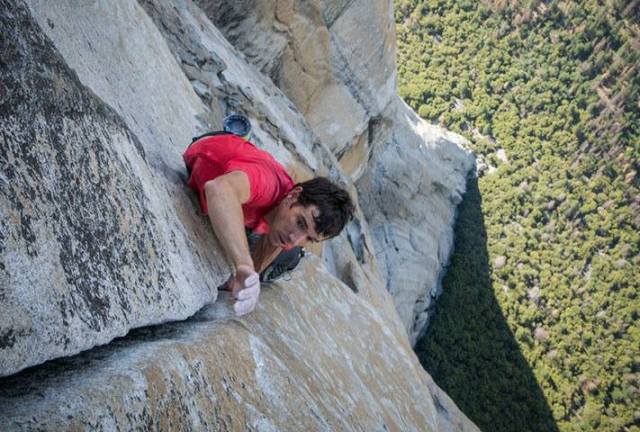 Though Elizabeth Chai Vasarhelyi’s and Jimmy Chin’s Oscar-winning documentary is ostensibly about world-famous rock climber Alex Honnold, it’s really about how we define heroes nowadays, especially in the context of movies. Honnold in many ways embodies the classic traits of the cinematic hero: reticent, private, obsessed with detail (at one point in the movie it’s suggested he has Asperger’s), indifferent to his effect on others. But as a post-millennial public figure, his most interesting trait is that he performs his heroics without much exposure. After all, he climbs sheer mountain faces away from the nervous gaze of the general public, which is where Vasarhelyi and Chin come in. In their own heroic ambition they decided to film Honnold scaling El Capitan in Yosemite National Park, one of the most forbidding climbs in the world, with multiple cameras operated by trained climbers who would record the feat up close and personally.
 Though it’s tempting to call his latest film a return to form, Jia Zhangke’s output since his last critically acknowledged masterpiece, Still Life (2006), mainly shows an artist grappling with his place in his own world, meaning China. For the most part, Jia’s features operated on the edge of China’s cultural mainstream, hailed by international movie lovers and mostly tolerated by his compatriots who have more control over the industry he works in. The fact that they looked down on his socioeconomically critical stories was not necessarily expressed through action, though for years his countrymen could only see his films on bootlegged DVDs. That changed with A Touch of Sin (2013), a movie that maintained the critical stance but couched it in more populist terms, which the authorities could tolerate because the criticism seemed aimed at society in general rather than policy. Nobody was fooled, but it’s obvious the authorities wanted to claim Jia as their own given his international acclaim and, for that matter, his love for his country. For what it’s worth, Touch was a pretty great movie, but not for the reasons his previous films were great. Always a fan of old gangster films, Jia proved he could handle genre fare, but when he tried to apply this skill to his next movie, Mountains May Depart, with its dystopian plot, the results were confused and, probably due to the fact that he was partly working in a foreign language, thematically incomprehensible.
 Jordan Peele’s Get Out was so on point about its sociopolitical subtext that many critics gave it a pass on its plotting, which, especially toward the end, became stiff and formulaic. It’s clear that Peele has a talent for horror forms, but it’s also clear that these skills have mainly been acquired through osmosis, which makes sense for someone who was making his first horror movie. But what everyone, including myself, took away from the groundbreaking feature was the way Peele incorporated the everyday discomfort that black people feel in a world ruled by white people into a conventional horror story by inflating that discomfort into pure terror. Given how skillfully and convincingly he accomplished this feat, the screenplay’s pitfalls seemed less blatant. In fact, it won Peele an Oscar.
 Here’s
 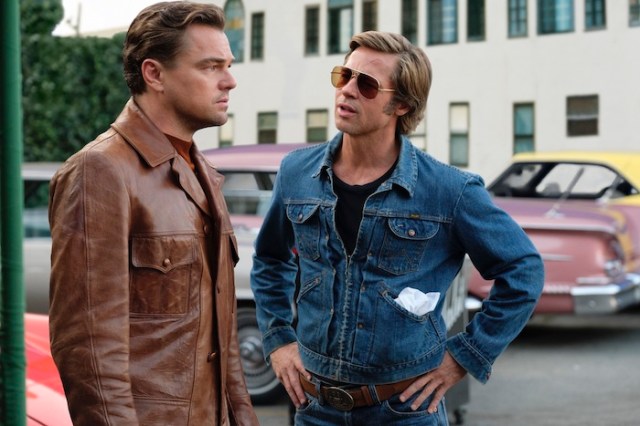 Technically speaking, Quentin Tarantino’s ninth feature is a historical movie, and he’s said it follows in that genre concept the same as his other so-called “revisionist” movies, Django Unchained and Inglourious Basterds, did. The main and vital difference is that Tarantino was alive during the period that Once Upon a Time…in Hollywood takes place, 1969, and while he was only six at the time, it’s obvious from his take on the setting and the milieu—in particular, the soundtrack, which is filled with AM radio hits of the era—that he remembers something of the texture of those times. For sure, Hollywood is deeply informed by the movies and TV shows of that era, but if feels a lot more relevant to Tarantino’s sensibility than the other two films of this ilk.
 This is the second big budget biopic of a major flamboyant 1970s male rock musician who eventually came out as gay to be released within the last year, and while the differences between Bohemian Rhapsody and Rocketman are notable, the overall impressions are so similar that the differences will be neglible over time. In that regard, the Freddy movie wins because it came out first and made a ton of money, thus partly exhausting the market for this kind of movie. The gap in box office receipts may also have something to do with the fact that Mercury died 20 years ago and Elton John, played here by Taron Egerton, is still very much with us—in fact, the release of the film, which his husband produced and he oversaw, coincides with his big final world tour.
 There are few capitalist recreactions as confounding and uninteresting to the hoi polloi as investing in art. Though everyone understands the concept and can perhaps appreciate the economic dynamic at work, most people find the effort involved, not to mention the enormous amount of money needed, to be beyond the pale. Nathaniel Kahn has thus managed to make a documentary for those of us who don’t see the point, if only to clarify that the point is not as esoteric as we think it is. Art is money and always has been. It’s just that in our post-modern world the artists have figured out a way to make it pay for themselves now rather than others in the future.
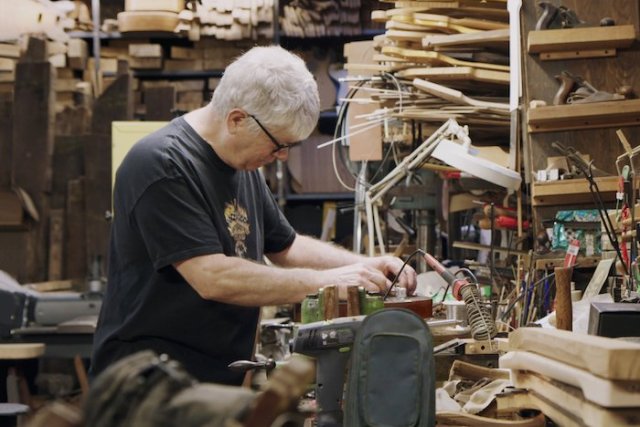 As fly-on-the-wall documentaries go, Ron Mann’s small-scaled portrait of a venerable Greenwich Village guitar shop should make even Frederick Wiseman green with envy. Due to its location and hard won reputation, Carmine Street Guitars can expect quite a few celebrity guitar aficionados to drop in on a regular basis, which means all Mann had to do for the five days he shot the film was just hang out. There’s not a lot of explication in the movie—no voiceover or text cards—but Mann knows what the audience wants to know and is able to extract this information with as little prompting as possible.
