 Rebellious teens come in all shapes, sizes, and modes of seriousness, and thus are reliably timeless as cinematic characters. The hook for this debut feature by Crystal Moselle is that it’s based on a popular Instagram account and uses the subjects of that account as actors mostly playing themselves, though the plot is contrived and even a bit elaborate. The world depicted is that of female skateboarders in Manhattan, most of whom enjoy very little in the way of family life or educational opportunities. Camille (Rachelle Vinberg), a dedicated skater living out on Long Island, falls into this milieu after injuring herself while skating and receiving a command from her worried Spanish-speaking mother (Elizabeth Rodriguez) that she can no longer partake of the pastime, so in order to avoid her mother’s gaze she takes the train into the city to do her thing.
The title of the film is taken from the Instagram account, but its ironical gender-identified overtones help sell a story that’s pointedly centered on female solidarity. Moselle sets up a clear divide between the group of girl skaters that Camille hangs out with and the boys who often invade their space. At this young age, the girls have learned not to trust the boys too much, even though some of them are dating and even shacking up. Since Camille is for the most part reserved, it takes her some time to open up to this crew, whose New York attitude is played for all its worth. Camille’s skills are unimpeachable, but her lack of ballsy boldness initially means she has to hang back and let her new acquaintances steer her toward self-actualization, which some will interpret as borderline delinquency and others as maturity through the back door, so to speak. In any event, Camille’s new secret life becomes full blown in that she moves in with a new friend, Janay (Dede Lovelace) and her family, making the fateful break from her own.
Intrigued viewers should understand that, while there are drugs and sex involved, this isn’t a Larry Clark movie. In fact, dramatically it tends more toward an after-school soap opera than a gritty urban cautionary tale. Consequently, it’s often difficult to tell what these kids really want, a situation that may have more to do with their undeveloped acting chops than Moselle’s undeveloped narrative skills. Nevertheless, as a depiction of a closed-off culture it works surprisingly well, and the skating sequences are thrillingly executed. Moreover, anyone who wants to know about the spiritual boundaries that separate Long Island from the city will learn a lot from this movie, which gets the mood just right.
Now playing in Tokyo at Cine Quinto Shibuya (03-3477-5905).
Skate Kitchen home page in Japanese.
photo (c) 2017 Skate Girl Film LLC
 Having seen Mimi Leder’s On the Basis of Sex, I approached this documentary about the life of Supreme Court justice Ruth Bader Ginsburg equipped with a certain store of images and facts that I assumed would aid me in understanding the iconic legal hero, and was somewhat taken aback when I left with more questions than when I went in. It’s not often that a dramatic narrative feature tells you more about a subject than a documentary, and the only answer I can come up with is that the filmmakers of RBG, Julie Cohen and Betsy West, are so enamored of their subject they assumed that devotional regard would satisfy anyone who viewed it, including the members of the Academy of Motion Picture Arts and Sciences, who nominated it for an Oscar.
 Gus Van Sant manages to recover from recent poor choices (Sea of Trees, Promised Land) with the help of Joaquin Phoenix and an inspired cast of A-listers in supporting roles. The vehicle is perhaps less impressive than any of its component parts, but the somewhat tired theme of personal redemption is at least given a new lease on life with a totally bonkers take on addiction porn. Basically a biopic of the parapalegic cartoonist John Callahan (Phoenix), who died in 2010 at the age of 59, Don’t Worry trades mainly in black comedy undercut by some rather nasty truths about human nature. Set in the 1970s and 80s, the script moves liberally back-and-forth in time with little regard for narrative coherence, which actually saves the film from having to justify Callahan’s actions or even make sense of them.
 Here’s
  When Rikiya Imaizumi’s latest movie premiered last year at the Tokyo International Film Festival, the official English title, Just Only Love, sounded a bit like nails on a chalkboard. The IMDb lists the movie’s English title as What Is Love?, which is a direct translation of the Japanese title, Ai ga Nan da. Some months later, I’ve actually come to the conclusion that the TIFF-designated title more accurately reflects the movie—not so much its story or theme, but rather its somewhat incoherent take on infatuation.
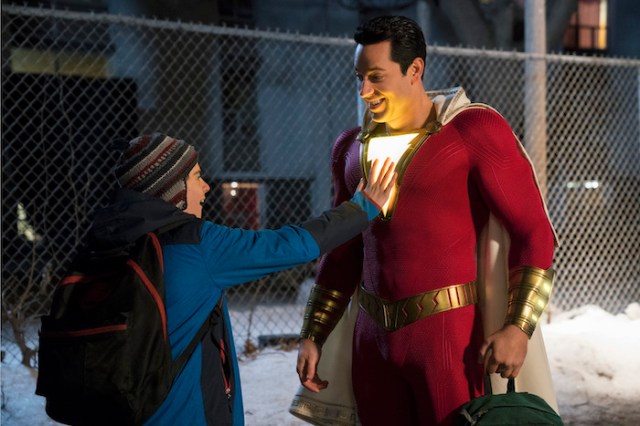 Boosted as a welcome light touch for the DC Comics movie universe, this rambunctious, somewhat unfocused comedy doesn’t really pass muster as a proper superhero feature, and it’s difficult to tell whether that’s the point. If you broke it down as you would a normal story you’d find two trains of thought: a touching tale of a foster child finding a family that’s more supportive of his needs than he could ever expect, and a hackneyed fairy tale about the same boy being gifted with super powers he has a hard time dealing with. As far as the latter thread goes, the recent Into the Spider-verse already nailed that particular theme, and the former thread is never really given a chance to make its case since it’s always being interrupted by the superhero stuff. What’s left is mostly confusion, though quite entertaining as such.
 Jon S. Baird’s loving tribute to the legacy of Stan Laurel and Oliver Hardy falls into a trap common to biopics of performers. The film focuses on an episode in the comedians’ career that occurred late in life, thus allowing the filmmakers simultaneously to provide an overview of that career and a comment on how it turned out. It’s the early 1950s, and Laurel and Hardy are obviously past their prime. They are touring music hall theaters throughout England, staging famous slapstick bits from their movies. Their fans are their age or older. Younger people, who don’t have widespread access to TV yet, barely know them and so aren’t interested in the show, which means the performances are lightly attended except in the larger cities. This background provides the narrative with its requisite bittersweet tone, and while Baird doesn’t force the point, he doesn’t seem to feel obliged to make any other case for their situation at the moment, which is made even more melancholy by the fact that the purpose of the tour is to drum up industry interest in a new movie, which Stan (Steve Coogan) is constantly working on by pitching new sketch proposals to his partner (John C. Reilly), who doesn’t seem particularly interested. Due to health problems and his relatively new wife (third? fourth?), Ollie has already assumed the attitude of a retired man.
 In the press synopsis for his documentary, American director Miki Dezaki calls the comfort women issue “perhaps Japan’s most contentious present-day diplomatic quandary,” which is true to an extent but misleading in terms of scale. The issue of the comfort women, the euphemism used by the Japanese military to describe women who sexually serviced soldiers at officially sanctioned brothels during World War II, needs to be approached from the standpoint of overall responsibility for the Pacific War, which remains to this day unsettled in Japan while it has been mostly decided elsewhere. Though Japan was not alone in committing atrocities against civilian populations during that conflict, its acknowledgement of Japan’s primary role in instigating the war for purposes of territorial expansion has shifted over the years. The comfort women issue is simply one part of this problem.
 Kudos to director Felix Van Groeningen for managing to fuse two different memoirs about the same topic into a movie that doesn’t become a mine field of conflicting points-of-view. The true story of Nic Sheff’s decade-plus battle with drug addiction was the subject of two books, Sheff’s own and another written by his father, David Sheff, a veteran journalist. Both were published in 2008 and recall events that started in the early 1990s. It’s both chronologically apt and a bit worrying that Nirvana plays such a prominent role in the beginning of the movie.