
 It’s tempting to imagine that the British director Andrew Haigh is encountering the milieu of his latest film with the same kind of fresh awareness that the audience encounters it as it watches his movie. There’s something about this depiction of the seedier parts of Portland, Oregon, that feels almost shocking in its unexpectedness. Based on a novel by the songwriter Willy Vlautin, whose band the Delines covers much the same kind of rustic waywardness as that put forth in the film, Haigh’s script always seems to be in the process of unfolding truths that don’t come easy. It keeps you off balance, and slightly on edge.
Fifteen-year-old Charley (Charlie Plummer) seems to be permanently stuck in limbo. Living precariously with a deadbeat dad (Travis Fimmel), who knows he should take better care of his son but can’t seem to summon the wherewithal to even look him in the eye, Charley is very much on his own both economically and spiritually. He hardly goes to school and his father doesn’t make him, instead giving him errands and paying him for them, as if that were the bare minimum expected of a parent. Charley, in fact, has more fellow feeling for his father’s current girlfriend, who feels at least sorry for Charley, though not necessarily in a maternal kind of way.
Eventually, he falls into a job at the local racetrack, where a horse trainer named Del (Steve Buscemi) desperately needs someone to take care of the animals. Charley, who lies his way into the position, is forced to be a quick study, especially since Del doesn’t suffer fools lightly. But in that odd kind of working class way, Del and Charley take to each other despite the lack of real honesty between them, and that feeling transfers to Del’s jockey, Bonnie (Chloe Sevigny), and to the unfortunate quarter horse that gives the movie its title. Given his impressionable age, Charley can’t help but identify with this horse, which isn’t good enough for anything more than pickup races. Del and Bonnie are careful to remind him that Pete “isn’t a pet.” He’s a commodity, and only worth something to the world as long as he wins. When he doesn’t, then he’ll be gone. Given that Del dopes and overrides the animal, that end comes sooner than Charley can handle.
It says something about Charley that the violent loss of his father, which should result in Charley’s being sent to an institution, is less traumatic for the boy than the possible loss of Pete through normal economic exigency, and while Charley’s way of handling this possible loss is extreme and foolish, it has the effect of leading the viewer into a world that’s more beautiful, albeit much more dangerous. The second half of the film—basically a road movie on horseback—is weird and discomfiting, but also fascinating. Charley is desperate for a new home, though the audience realizes right away that even if he reaches his destination, it will never be what he envisions. There are few teenage tragedies as heartbreaking as dashed hopes, and Haigh knows exactly what that’s worth.
Now playing in Tokyo at Human Trust Cinema Shibuya (03-5468-5551), Human Trust Cinema Yurakucho (03-6259-8608).
Lean On Pete home page in Japanese.
photo (c) The Bureau Film Company Limited, Channel Four Television Corporation and the British Film Institute 2017
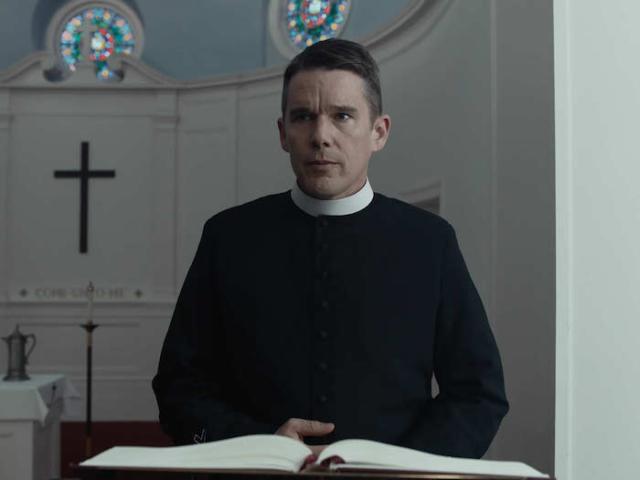 Though I rarely acknowledge such matters, Paul Schrader was royally screwed last February when he failed to receive the Best Original Screenplay Oscar for his latest film. It was bad enough that Ethan Hawke, who won all sorts of awards from critics’ groups for his performance in the lead role, wasn’t even nominated, but Schrader was a screenwriter before he was a director, and First Reformed may be the most cogent realization of his distinct world view and approach to cinematic storytelling. In fact, the most brilliant detail in his screenplay is the provenance of the First Reformed Church that provides the setting for the story. Its main appeal in the 21st century is not its status as a sanctuary from material suffering or the lucid world view of its sympathetic pastor, Reverend Toller (Hawke), but its historical relevance as a main stop in upstate New York on the Underground Railroad during the days of slavery. It’s a tourist attraction, which pretty much sums up the way Schrader has come to rationalize his fundamentalist upbringing and the state of his own faith.
 The comic challenge for Adam McKay, who made his name with Will Ferrell vehicles, in depicting the life of former Vice President Dick Cheney is not that no amount of satire could make the George W. Bush administration seem more ridiculous than it was, but that we already have a near perfect lampoon of the venality of Washington D.C. as represented by the second-in-command: Veep. Granted, McKay, as he did with The Big Short, is attempting to graft semi-serious real life matters onto frat boy stock situations, and there certainly wasn’t a bigger mess of frat boy toxicity than the Bush II White House. The real problem with this kind of approach is that the actors seem to be having much more fun than the audience is.
 The time frame of Paul McGuigan’s slice-of-life biopic of actress Gloria Grahame isn’t specifically stated, though the first scene takes place in a rundown dressing room in Liverpool in 1981 as Grahame (Annette Bening), long washed-up as a film actress, prepares to take the stage for yet another performance of The Glass Menagerie. She has already met and fallen in love with a local aspiring actor, Peter Turner (Jamie Bell), who is much younger than she is, and McGuigan hints throughout the movie that Grahame had a penchant for much younger men, even for boys. However, the film focuses on her relationship with Turner, which is limiting in terms of what it tells us of Grahame’s life as an artist and a human being. It’s also dramatically lazy, since the plot is a series of flashbacks and flash-forwards that seem to cover a long period of time but actually only cover a few years, and the development is just one drunken fight after another, many in Liverpool, where Turner was raised, but also in New York and Los Angeles, all followed by desperate reconciliations and punctuated by the recurrence of the breast cancer that eventually killed her at the age of 57.
 Here’s
 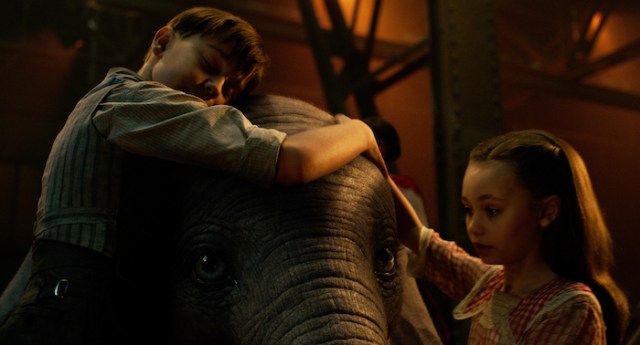 At this writing, the new CGI live-action Dumbo is being slated as a likely box office smash, thus justifying Disney’s faith in director Tim Burton as the kind of edgy filmmaker they can trust with their family fare. Inherent in this proposition is the idea that, of course, there is no intention of supplanting the original animated version of the story, but rather to simply give it more relevance for an audience whose tastes in technology are presumably more sophisticated than they were in 1941, but that’s a load of bull. Disney owns the story and the images and thus controls how those elements are reconfigured for a new generation. The real idea is to exploit a property, and nobody expects Burton, regardless of his reputation for the weird and the wondrous, to make anything other than what Disney approves of. And if you hold Alice in Wonderland up as an example of what Burton can do in the face of corporate control, remember that it was probably the worst reviewed film of his career. Neither Burton nor Disney seems willing to test each other in the same way this time.
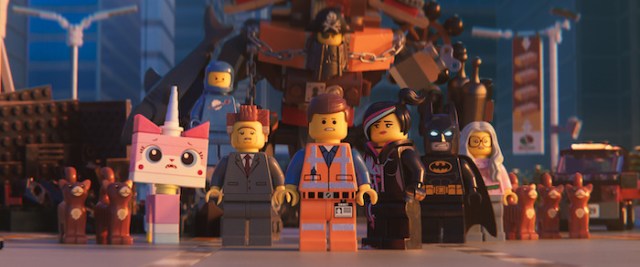 The big reveal at the end of the first LEGO Movie was one of the most brilliant in the history of animated films, since it capped a fairly hilarious mock-dystopian story with a credibly affecting framing device that not only put the mock-dystopian story into proper perspective, but gave it an emotional force that you couldn’t have expected given the overall comic thrust of the movie. Obviously, the sequel isn’t going to be able to deliver the same kind of thrill. As they used to joke in the old Looney Tunes shorts when the guy blows himself up to impress a vaudeville talent agent, yeah, it’s great, but you can only do it once.
 In the wake of the recent Mueller report and the disappointment felt by those who hoped it would hasten the end of Donald Trump’s presidency, Rob Reiner’s earnest paean to the old-fashioned virtues of hard-hitting newspaper journalism may, in fact, only serve to rub salt in those wounds being nursed by liberals like Reiner himself. Shock and Awe chronicles the painstaking research that the Knight Ridder newspaper group carried out to prove that the weapons of mass destruction Bush II posited as the reason for invadeing Iraq in 2003 were essentially made up. Almost every other media outlet in America bought the administration story, so Knight Ridder should have come to represent what’s left of responsible journalism, but for the most part journalism didn’t survive the Bush years, as we can easily tell by the shrill tone used to cover both the Obama and Trump administrations. The lesson the Trump folks want us to take away from Mueller is that the mainstream press can’t be trusted, which is also what Shock and Awe tries to tell us.
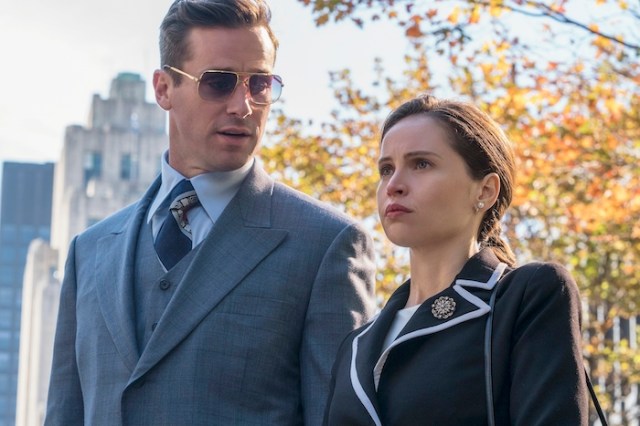 Given her current role in keeping the U.S. Constitution on an even keel during these politically stormy times, it’s not surprising that there are two feature-length films about Supreme Court Justice Ruth Bader Ginsburg, and by most lights the Oscar-nominated RBG is the more rigorous of the two simply because it’s a documentary. But that doesn’t necessarily mean it’s a better movie. RBG is mostly a tribute to Ginsburg as a guiding personality for the 21st century, and while it explains her accomplishments and their effect on not only the legal landscape of America but the status of women, it does so in a manner that highlights her qualities as a woman rather than her mind. On the Basis of Sex is a dramatic recounting of Ginsburg’s early career centered on the case that brought her attention as the leading gender rights advocate of the 20th century, and while it tends toward easily processed characterizations in the mode of Hollywood biopics, it gets into the nitty-gritty of legal procedures more deeply than RBG does. When the phrase “radical social change” comes up—more than once—it has genuine meaning.
 Spike Lee’s most obvious touchpoint as a major film director is his obsession with the African-American experience, which he translates to the screen in the most uncompromising terms. For that reason, he often oversteps his subjects when it comes to form and style. The manic qualities that made critics notice him early on have never receded, and are often at odds with what seems to be his purpose in making a particular film. Certainly, Do the Right Thing is the clearest example of this mode of presentation when it works sucessfully. Malcolm X proves that he can also pretty much address his obsession in more conventional ways and produce something worthwhile, but it feels more like an exception rather than the rule.
