
 At first blush, this fairly modest horror movie by upstart Trey Edward Shults feels like a pale reflection of A Quiet Place, which is probably this year’s most successful horror movie. Both films are about families hiding out in the woods from unseen menaces. In the case of It Comes at Night, it’s a kind of plague, while in A Quiet Place it’s some sort of invading species of predator, but the main theme is survival against very bad odds. What eventually gives Shults’ film the edge in this regard is that the central family—Paul (Joel Edgerton), Sarah (Carmen Ejogo), and their 17-year-old son Travis (Kelvin Harrison Jr.)—can’t see the menace clearly, since it can only be transferred via another living being. Their paranoia is practical but not empirically based. In the haunting opening scene, they literally cart Sarah’s father (David Pendleton), covered in lesions and mumbling incoherently, to a ditch where they shoot him and set his body on fire.
The father, somewhat cruelly named Bud, is an obvious threat. But when a straggler tries to break into their remote house, thinking that it’s abandoned, the family has no choice but to handle him roughly and tie him to a tree overnight. Paul, a preternaturally nervous but stoical head of household, has to make sure this younger man, named Will (Christopher Abbott), is not carrying the disease, and it takes a lot of convincing. Once it’s established he’s not infected, he pleads with Paul to help him, since he has a wife and son at an abandoned house some miles away. They have food, but almost no drinking water. Eventually, a deal is made, and Will and his wife, Kim (Riley Keough), and son, Andrew (Griffin Robert Faulkner), move into Paul’s spacious but decidedly creepy house.
Conventional horror films tend to trade in concrete terrors, but despite the pronoun in the title, It Comes at Night rarely delivers a material threat. The few times that something rudely intrudes on the space so covetously protected by the protagonists, the danger is never confirmed. While driving through the woods, Paul’s truck is shot at and he responds by savagely killing the shooter and the shooter’s companion without bothering to find out why they shot at him and if they’re infected. The movie’s title mainly describes Travis’s awful dreams. Constitutionally an insomniac, Travis has terrible visions when he does manage some shut-eye and Shults cleverly alternates these nightmares with the boy’s midnight ramblings through the hallways with only an oil lamp to guide his way. By refusing to name or even show the menace all around the house, Shults makes terror more realistic and thus more unsettling.
The movie’s structure is clearly bifurcated between setup and delivery, and though these purposes are brilliantly carried out, they may feel a little too on-the-nose given how much Shults thinks he has to withhold. In the end, the movie’s horror component is invested in the characters’ capacity for mistrust and how that mistrust can blossom into deadly intent, especially where there’s lots of guns on hand. But horror movies in particular require some sort of resolution to make their point, and It Comes at Night doesn’t really have any. It’s bleakness is almost immoral.
Opens Nov. 23 in Tokyo at Cinema Qualite Shinjuku (03-3352-5645).
It Comes at Night home page in Japanese.
photo (c) 2017 A24 Distribution, LLC
 Though not a Hollywood film in the least, David Lowery’s A Ghost Story plays with ideas about the paranormal that are fashionable among the bean counters of tinsel town, except that they’re in service to a story about loss and the persistence of love. And in that regard it’s compelling up to a point. What fails to get through is any real reason for caring about the people on screen.
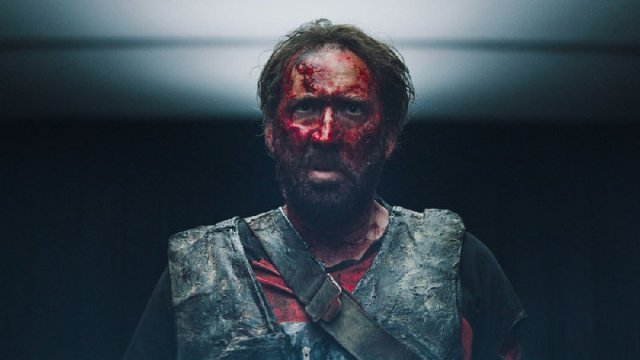 Panos Cosmatos’s violent revenge thriller is like every other violent revenge thriller and yet unique, owing mainly to its stubborn insistence on describing a specific place and time that has no discernible purpose. Set somewhere in the California wilderness in 1983, Mandy could have been set in a suburb of Indianapolis in 2010 with no change in theme or plot, and yet Cosmatos keeps throwing signifiers at us, as if he expects the viewer to pick up allusions that might explain the protagonist’s disturbing behavior. In that regard, the only thing that makes sense is the casting: Nicolas Cage may not have been born to play the grieving lumberjack, Red, but given his recent tendency to take every part offered to him, including terrible ones, he seems preternaturally suited to play this sympathetic monster.
 In it’s own limited way, the biopic of the British band Queen is as narratively compromised as the group’s creative output was musically compromised. Leader Freddie Mercury was always open about how his approach to rock was not doctrinnaire; that while he loved rock music and what it had undergone in the post-Beatles world of English pop, he loved theatricality even more, and so many of Queen’s best-loved songs combine prog-rock technique with Broadway glitz, and the movie honors this legacy by avoiding anything that smacks of subtlety or even verisimilitude. When people say that Rami Malek’s impersonation of Mercury is the best thing about the movie, what they’re saying is that the actor falls for Mercury’s preternatural need to show off. Even in the expository passages, showing how Mercury overcame his immigrant insecurities, his self- esteem problems, and, eventually, his hesitancy to acknowledge his homosexuality, you almost expect him to break into song in a bid to make these scenes even more emotionally fraught. Queen fans will love it, and Queen skeptics still won’t get it for the same reason.
 The “Ten Years” series started in Hong Kong in 2015 with an omnibus of shorts depicting the former British territory ten years into the future, and was notably dystopian in tone, which is to be expected, and not just because of the city’s special circumstances of being stuck halfway between a Western-influenced conclave in Asia and the point-of-the-spear for China in the international economic order. Any movie that attempts to specifically predict what’s going to happen in the future is probably going to have cautionary aspects. In any case, Beijing was quite alarmed at the film, and it may have been that aspect which sparked similar productions using the concept in Taiwan, Thailand, and Japan.
 The pleasures and edifications of Michael Moore’s latest broadside attack on the power elite comprise more of a mixed bag than any of his previous polemics, which tended to focus on a specific, albeit broadly characterized, subject matter. Though Donald Trump is the ostensible target, Moore ranges far and wide to explain the forces that he thinks conspired to get Trump elected, taking in everything from establishment Democrats to the mass media and even Gwen Stefani. And while Moore’s explications don’t always stand up to rigorous scrutiny as journalism, there’s less of his patented working-guy-confrontation shtick, which had been getting old more than a decade ago, and it makes all the difference in the world.
 There’s an over-familiar quality to this movie about an elderly man coming to terms with his mortality that is both exacerbated and dismissed by its Indian setting. The story’s particulars—a man’s reckoning with the inevitable, his son’s reactionary intransigence, the comic second act that attempts to soften the blow of death before giving in to its terrifying inevitability—don’t differ substantially from other films of this sort, but by placing it all in the context of the holy city of Varnasi on the sacred Ganges River, it becomes more edifying, even, presumably, to Hindus.
 Norman Oppenheimer (Richard Gere) is a freelance political fixer, and in popular fiction terms such a description conjures up visions of slick men in three-piece suits juggling cell phones and commanding transactions of millions of dollars in fees and payoffs. Norman is anything but. We first see him badgering his nephew, a lawyer named Philip Cohen (Michael Sheen), for the contact information of one of his clients. Though Norman talks as if he’s experienced in the world of political connections, Cohen’s reaction is caution veering toward alarm. There’s something between the two men that’s unexplained but points to general mistrust on Cohen’s part of not only Norman’s motives, but his effectiveness. Norman is a hustler, but unlike the stereotype, he’s not a particularly good one.
