
 I’m probably not the first person to think that Ralph Wrecks the Internet would have been a better title for this sequel to the Disney hit Wreck-It Ralph, since it would have taken better advantage of familiarity with the original. However, these days people know more about a Disney-related film before it’s released than after, and having enjoyed Wreck-It Ralph without necessarily being invested in it—the digital video games it referenced had no traction on my life back in the day—the possibility that the main characters—the lamebrained, sentimental, muscle-bound title character (John C. Reilly) and the sweet-voiced, diminutive, super competitive race car driver Vanellope (Sarah Silverman)—would be moving out of the circumscribed universe of arcade games into the infinite possibilities of the Internet—a world, for better or worse, that I am invested it—was immediately intriguing.
As with the Toy Story franchise and other contemporary fictional animated milieus, Ralph Breaks the Internet uses our proximity to actual pop culture in its favor. It’s not just the real games in the arcade, many of which are known to me only in passing, but the huge tech companies represented in the Internet world that Ralph and Vanellope pass into in their decidedly analog quest for a discontinued steering column for the game that is Vanellope’s whole reason for being. Both characters have no real concept of what the Internet entails, thus allowing the filmmakers to make of it what they want, and the analogies go beyond the clever and convenient into the realm of the sublime. Though at first the Internet’s landscape resembles a vintage version of a World’s Fair Futureworld on steroids, the way the various apps interact is brilliantly realized, and though people with little practical experience with Internet protocols might be lost, do such people still exist? (Or, more precisely, are people unfamiliar with Internet protocols going to see this movie?) Unschooled in the ways of capitalism, Ralph and Vanellope innocently bid up the price of the coveted steering wheel at an eBay auction, thus pricing themselves way out of their league and necessitating a visit to a YouTube high priestess (Taraji P. Henson) who will help them raise the needed credits to buy the part through meme-generating videos starring the clumsy Ralph. Meanwhile, Vanellope has become enamored of another racer (Gal Gadot) who exists in a Grand Theft Auto type game where the stakes are higher and more dangerous, thus opening her up to greater possibilities for honing—and showing off—her native skills.
There’s more, including a hilarious takeoff on Disney’s own princess legacy brand where Vanellope, a kind of princess herself, turns Snow White, Cinderella, and other royal denizens of a Disney website on to the joys of loose clothes and not having to pin your hopes on Princes. But as with the Toy Story movies, Ralph Breaks the Internet uses its clevel cultural references to make a larger point about connections that transcend the everyday needs of commerce. It’s a story about friendship and what friendship entails. Though cartoonishly simple at the outset, Ralph and Vanellope develop into complex beings whose emotional needs veer off in different directions, the result being the catastrophe indicated in the title. In that regard, Ralph Breaks the Internet comes the closest that a purely Disney animated film has to a Pixar movie, and joins Toy Story and Wall-E (but not Cars) as an effective vehicle for using non-sentient entities to reveal in a moving way the limits of our hold on humanity in an attempt to make us more human. It succeeds.
Opens in Tokyo on Dec. 21 in subtitled and dubbed versions at Toho Cinemas Hibiya (050-6868-5068), Toho Cinemas Nihonbashi (050-6868-5060), Toho Cinemas Roppongi Hills (050-6868-5024), Toho Cinemas Ueno (050-6868-5066), Toho Cinemas Shinjuku (050-6868-5063), Shinjuku Wald 9 (03-5369-4955), Shinjuku Picadilly (03-5367-1144), Toho Cinemas Shibuya (050-6868-5002).
Ralph Breaks the Internet home page in Japanese.
photo (c) 2018 Disney
 It seems, well, almost Grinch-like to complain about a new Christmas movie while we’re smack dab in the middle of the Christmas season, but, then again, The Grinch isn’t new. This is the third film iteration of the beloved Dr. Suess holiday story and people my age who grew up with the half-hour TV special will probably tell you that was good enough for them, especially when compared to the 2000 live-action feature film version starring Jim Carrey at his most scene-chewing obnoxiousness. Both that version and the latest one, a CGI animated creation by Illumination Studios, require a lot of padding to make a feature and Theodore Geisel had nothing to do with the script, so you sort of get what you might expect when Hollywood takes a classically idiosyncratic piece of art and tries to stretch it out.
 Here’s
  As a Canadian film acquaintance put it, Our Departures is a classic Shochiku release: sentimental, not too dramatic, and warmly funny in spots. It’s also about the importance of family, even if the family in question is unconventional, but, then, that seems to be the point. Jun Kunimura plays Setsuo, a veteran train driver in rural Kagoshima who is set to retire, much to the chagrin of his superiors, who, due to depopulation, don’t think they can find a replacement soon enough. Setsuo, a widower, lives alone in that kind of stoical self-sufficiency real men in Japanese films tend to manifest. One day, a young woman, Akira (Kasumi Arimura) and an elementary school-age boy, Shunya, show up on Setsuo’s doorstep. They turn out to be his estranged son’s second wife and son, who have come from Tokyo to inform Setsuo that his son died suddenly. Apparently, Akira tried to call many times but Setsuo has a habit of not listening to his old-fashioned message machine.
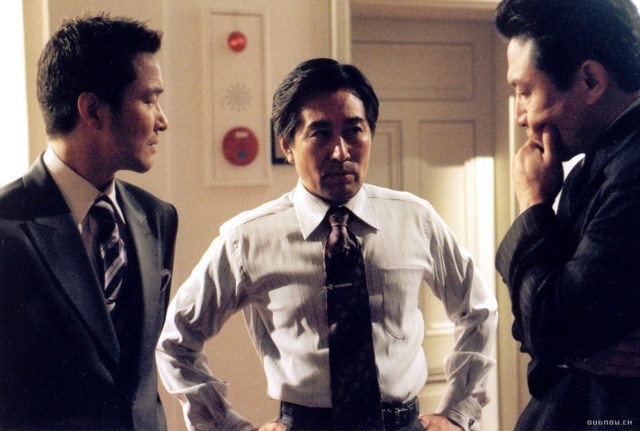 The following interview was conducted at the Pusan International Film Festival in October 2006. It originally appeared in The Japan Times.
 Israeli director Ofir Raul Graizer’s debut feature is a deceptively wicked take on romantic transference in that his strikingly unusual plot devices don’t seem that striking when they happen since they are so seamessly woven into the fabric of the story. Put bluntly, The Cakemaker is a love story between a young German man and not one, but two Israelis, a man and a woman, and while Germany as a country has done its best to reconcile with the Jewish people over its genocidal actions during World War II and is now a staunch supporter of Israel, the scenes where the German character interacts with Israelis on the latter’s home turf show how the relationship is still fraught with uneasiness. But it’s the second plot device, which connects directly to the first, that makes this movie more than a cross-cultural study. For those of us who know about Israel only through the news, it’s an eye-opening revelation, though to Israelis it’s everyday life.
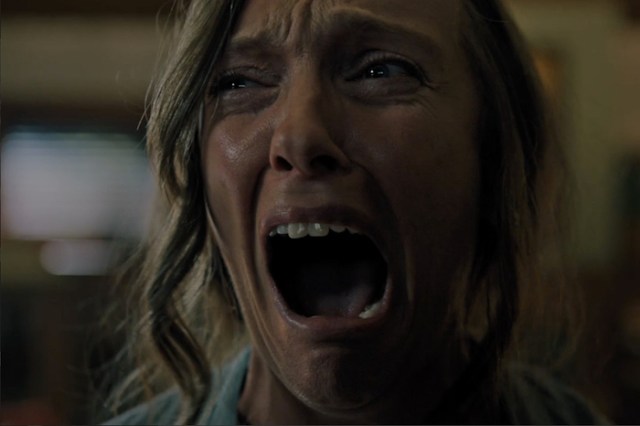 By far the most effective element in Ari Aster’s debut horror movie is Toni Collette’s face. Hereditary veers wildly and often incomprehensibly between domestic psychological drama and occult mystery, and the only thing holding it together is Collette’s command of her character’s mixture of incredulity and base terror. She plays Annie, a diorama artist grieving over her recently deceased mother, whom she never really liked but nonetheless felt connected to in a primal way she never understood. Her family—ineffectual psychiatrist husband Steve (Gabriel Byrne), 16-year-old pothead son Peter (Alex Wolff), slightly developmentally disabled 13-year-old daughter Charlie (Milly Shapiro)—empathize with her but mostly stay out of her way through the fitful funeral and its aftermath. When the mother’s grave is subsequently vandalized, Annie’s torment intensifies, and she joins a grief counseling group, where she meets Joan (Ann Dowd), who has a lot of peculiarly apt advice.
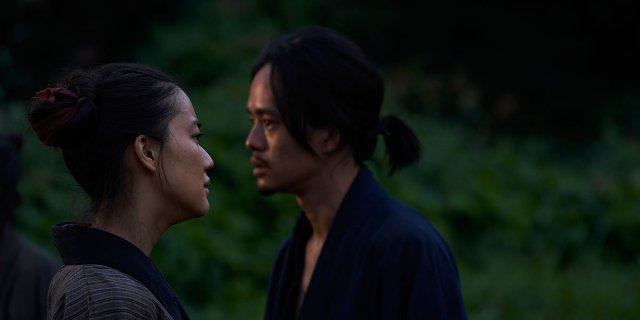 Director Shinya Tsukamoto wants people to come to his latest feature prepared for something different, which may sound like quasi-spoiler fodder given that it’s Tsukamoto’s first genuine genre film, namely a jidaigeki or, more familiarly, a samurai flick. But anyone familiar with Tsukamoto’s previous work will likely expect more than the usual gore, given the filmmaker’s penchant for grotesquerie. And, to a certain extent, there is a lot of blood, though not as much as there was in his World War II churner, Fires on the Plain. What’s different is his protagonist, Mokunoshin (Sosuke Ikematsu), a ronin who has decided he will have nothing to do with killing. Modern viewers will think of him as a pacifist, but the impulse is deeper, less philosophical. Mokunoshin is physically sickened by violence.
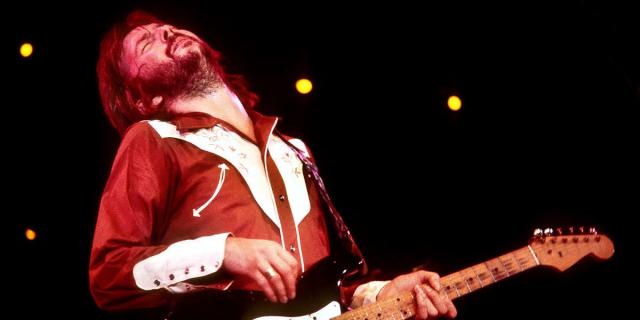 Artist biodocs would seem to be easier to pull off than artist biopics, as long as there’s enough available footage. Eric Clapton has been more or less a star since he emerged in mid-60s England as a blues guitar prodigy and purist, and this career review makes ample use of film and photography, not to mention audio recordings of friends and family who offer insight into Clapton’s mindset at specific junctures in his life. There’s a lot to chew on, and in the end we get a very good idea of the kind of person Clapton is but are not much closer to understanding his sensibility as an artist than we were before we watched the movie.
