Best CDs 2010

Before compiling the best-CD list for EL Magazine, which this year will be published on Christmas Day, I usually shut myself in for a weekend in late November and bathe in those albums that have intrigued me over the past eleven months. With each year it becomes a little more difficult. Sometime after my 22nd birthday I lost the ability to absorb music with all my being; and since I started writing about music and, more significantly, getting paid to do so (not very much, mind you) the professional obligation to hear as much of it as possible made it hard to give the appropriate level of attention to even stuff I really liked. Time, of course, is the main constraint, but distractions are everywhere, especially in a media environment where everyone has an opinion and those opinions are almost impossible to ignore. When I was in college, there were only a handful of music writers whose ideas I turned to on a regular basis for guidance, not just in terms of what I might enjoy but also in terms of how to refine my critical faculties. Nowadays the static is unavoidable, and often precedes the arrival of the music itself in my home. The critical faculties are thus overwhelmed, and tend to break down as a result.

I’ve always maintained that the only criterion for judging music is how much you like it and how often you want to listen to it. That’s a good, simple means of assessment as far as it goes (and, in truth, has little to do with “judging”), but it doesn’t always help when you get to the problem of describing why you like a particular song or album; because once you start doing that the cognitive dissonance becomes deafening. Tokenism is the great bugbear of list-making, and so during that lost weekend in November I listened to an inordinate amount of hip-hop, not because I liked the albums I listened to so much, but rather because I didn’t like them that much. A certain prominent critic declared in 2009 that hip-hop was dead, and though I hardly agree there was little this year that brought me out of myself. Due to the delayed release schedules that major labels in Japan often follow, I have yet to hear what is shaping up as the year’s best album according to Western critical consensus, the Kanye West thing; but I was underwhelmed by the Drake album, the Rick Ross album, even The Roots, which I count as one of the three or four best groups in the world, regardless of genre. The closest I got was Big Boi’s solo turn, mainly because it mirrored the qualities I appreciated most on my album of the year: craft in the service of spontaneity. And while I rarely cite punk or metal on my lists due to their self-imposed stylistic conventions, I felt that I should find some hard rock to put on the list, some representation of the popular will that was close to my own middle-class American white-boy sensibility. The closest I got was a pop album by a female Colombian superstar. (Some will find it suspect that I have no Japanese artists on the list since I live in Japan and make part of my living writing about Japanese pop; it’s a valid accusation and one that I feel more comfortable addressing in my Best Movies list next week.) Continue reading

Posted in Music | Tagged , , , , , , , , , , , | Leave a comment

Media Mix, Dec. 12, 2010

Here’s this week’s Media Mix, which is about the Ichikawa Ebizo scandal. As often happens with such stories, the column was outdated the moment it was published. Two days previously, the police arrested the man who allegedly beat up Ebizo. He gave himself up and has already admitted to the charge, though he insists that the kabuki star initiated the brawl, if not with actual violence then with the promise of same and insultingly surly behavior. Also, Aera magazine confirmed something I hinted at in the column, that Ebizo’s injuries weren’t half as serious as they were made out to be when the scandal first came to light.

One of my analyses was also nullified the night before the column ran in the Japan Times. I implied that Takeshi seemed skittish about taking on Ebizo as fodder for his lowly brand of satire, but on last Saturday’s edition of “Newscaster” he did perform a short sketch in which he addressed the scandal, though, in keeping with his methodology, it didn’t make fun of Ebizo so much, but rather made fun of kabuki fans in general. Also, I think Takeshi was waiting for someone else to do it first. Matsuko Deluxe, the “big-scale” talent whose bitchy transvestite TV persona gives him license to be more irreverent than most conventional comedians, had been razzing Ebizo continually for the past week; or, more precisely, razzing the media’s obsession with Ebizo. And on that note, I’ll shut up.

Posted in Media | Tagged , , , | 3 Comments

Great moments in iconicness: Christina Aguilera and the “Burlesque” crew hit Tokyo

Blonde ambition: Xtina meets "masukomi"

The purposes of a movie press conference are crystal clear but not always easy to accomplish. Journalists want witty and revealing quotes while the cast and staff want to convey what’s appealing about the film without pointing to themselves as the reason since that would turn people off. Inevitably, they point to one another and tell the journalists how great they are, and in doing so usually put a damper on witty and revealing quotes.

As an illustration of this phenomenon, the press conference for the new backstage musical Burlesque was both vivid and bizarre. Vivid because the cross-compliments were fast and furious; bizarre because the movie itself was engineered as an exercise in campy extravagance and the p.c. was anything but. Christina Aguilera plays the proverbial girl from the American Midwest–an orphan, no less–who leaves the sticks for the bright lights of Los Angeles–the Sunset Strip, no less–to seek her fame and fortune as a singer, and there runs up against a backbiting prima donna, a handsome bartender who’s engaged to someone far away, and a flinty but ultimately understanding older entertainer who becomes her benefactor and mentor. Trashy fun should be guaranteed for all, and if the movie doesn’t deliver it’s because all of the principals except Cher and Stanley Tucci–i.e., the ones who are old enough to comprehend camp–took the project a bit too seriously. At the very least the press conference should have been smarmy and self-effacing; in other words, fun. Continue reading

Posted in Media, Movies | Tagged , , , , , , | 1 Comment

Media Mix, Dec. 5, 2010

Here’s this week’s Media Mix, which is about NHK’s decision to cancel its popular Sunday morning series “Shukan Kodomo no News,” or, more precisely, change it into a news show for the “whole family” rather than one aimed specifically at kids.

Posted in Media | Tagged , , | Leave a comment

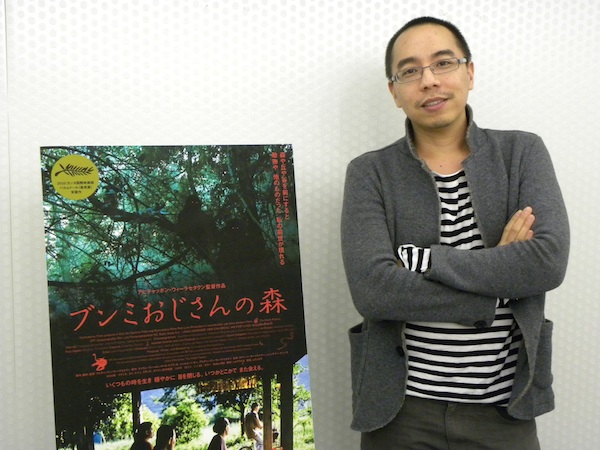
Seriousness and innocence: A chat with Apichatpong Weerasethakul

It’s easy to understand why Apichatpong Weerasethakul‘s latest film, Uncle Boonmee Who Can Recall His Past Lives, was chosen as the opening movie for the latest Tokyo Filmex. It was the Palme D’or winner at Cannes in May, which shouldn’t have been as surprising as many people made it out to be. Given Thailand’s reputation as one of the most dynamic movie-producing countries in Asia, a Thai film was going to triumph sooner or later at a major Western festival, and Weerasethakul’s have already attracted a great deal of attention in Europe. Moreover, the 40-year-old director belongs to that club whose films always get shown at Filmex, which this year he was attending as a member of the competition jury.

As Weerasethakul is the first to admit, his films are an acquired taste. “I’m so grateful that so many people came today,” he said during his remarks prior to the screening at Tokyo International Forum. “I’m just afraid that when the movie opens here commercially in March, there won’t be anyone left who wants to see it.” Boonmee will in fact be his first feature ever distributed in Japan, owing undoubtedly to the Cannes win, but as he implied wryly it’s not necessarily more accessible than his previous films. Like Hou Hsiao-hsien and Jia Zhangke, Weerasethakul has his a unique narrative style. Uncle Boonmee is ostensibly about a middle aged man dying from a kidney ailment who makes peace with his fate. Along the way he has conversations with his dead wife and a son who went missing years ago and has returned as a kind of hairy beast. Weerasethakul also inserts seemingly unconnected sequences that may or may not represent Uncle Boonmee’s past lives as a princess and a water buffalo, and there are other digressions that have even less to do with the protagonist. As the director also said during his opening remarks, it’s better if the audience simply allows the film to “flow through you.” It’s an immersive experience, both visually and aurally.

I talked to Weerasethakul in the tiny offices of Cinema Rise, the Shibuya movie theater company that specializes in hip indie cinema. Though he was as subdued and gracious as his films, he was also impish. He understood the irony of a filmmaker like him winning at Cannes and he was not going to not take advantage of it.

Interview after the jump. Continue reading

Posted in Movies | Tagged , , , , | Leave a comment

Media Mix, Nov. 28, 2010

Here’s yesterday’s Media Mix, which is about one television reporter’s dogged pursuit of the truth behind the Ashikaga murder case, which remains unsolved since the man originally convicted in 1992 was found innocent last year. In the article, I mention how some politicians have questioned the justice ministry’s claim that there’s nothing it can do about reopening the case since the statute of limitations has run out. On the Nihon TV program cited in the column, we see a representative of the justice ministry deflecting questions in this vein with obfuscatory answers that mirror almost exactly the ones that former justice minister Minoru Yanagida joked about in that famous “gaffe” which became his downfall. It’s difficult to decide which is more disturbing: that Yanagida thought this kind of tactic was funny, or that he didn’t have the wherewithal to admit that it’s how the justice ministry operates.

Posted in Media | Tagged , , | Leave a comment

December 2010 CDs

Here are the CD reviews I wrote for the December 2010 issue of EL Magazine, which came out November 25. All the albums were released by local labels in Japan during the month of November 2010.

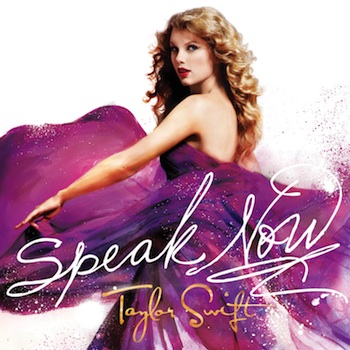
Speak Now
-Taylor Swift (Big Machine/Universal)
Libra Scale
-Ne-Yo (Def Jam/Universal)
The week it was released Taylor Swift’s Speak Now was the biggest selling album on the planet. It’s her third LP and her best. It’s also the first one where she wrote all the songs herself. Normally, a singer-songwriter of Swift’s commercial caliber starts out writing hits that gain a following and by the time she’s big has song doctors and producers coming out her ass. Speak Now is slick, but relative to most product coming out of Nashville these days it’s uncluttered and focused on its subject, who does a good job of cluing us in on what it’s like to be Taylor Swift, a middle class white girl who spent her teenage years studying herself under a microscope and letting anyone take a peek. Having transcended any country music stereotype, Swift speaks to a lot of people with her deceptively simple take on adolescent longing. Compositionally, there’s little here that Lady Antebellum or Sugarland can’t do better, and the melodic thrust of her tunes can get redundant when you strip them to their essence. But the narratives have such imaginative drive that you find yourself hitching a ride despite their appeal to the youngest common denominator. On the one hand you have “Mine,” an ecstatic description of first love leading to a rocky but otherwise perfect marriage, and on the other hand, “Mean,” a stiff-upper-lip, sticks-and-stones put-down of a recognizable type of cynic. Both songs are corny and calculated and contain lines that can break your heart, meaning corny and calculated works both ways. “Don’t make her drop you off around the block,” she sings to a girl of 14 on “Never Grow Up,” a girl whose purview shifts from second to first person and back again with such facility that the gimmick is immediately negated. Even more than “Mean,” this song confronts those critics who feel she’s selling a manufactured lie when all she’s doing it trying to make sense of an unusual existence. What is so terrible about being well-adjusted? It’s a question Ne-Yo, another singer-songwriter who first gained attention as a teen and has since topped the charts continually, has obviously pondered. Despite a franker approach to sex than Swift’s, Ne-Yo still presents a self-consciously moral persona on all of his songs. His last album, remember, was titled Year of the Gentleman, and his latest takes that idea almost to the point of self-parody. As Jerome, a member of a triumvirate of superheroes called the Gentlemen, Ne-Yo struggles between the need for love and the desire for fame-money-power, all of which adds up to easy sex. “I’m turned on but scared of you,” he sings on “Beautiful Monster” to a temptress The-Dream would have been in bed with an hour ago. The song is a detour from Ne-Yo’s standard benign grind into faux techno. The attempt at conceptual significance doesn’t compromise Ne-Yo’s melodic gifts, but it also doesn’t rock as tough as Gentlemen. Good manners has its limits.

More reviews after the jump. Continue reading

Posted in Music | Tagged , , , , , , , , , , , , , , , | Leave a comment

December 2010 movies

Here are the movie reviews I wrote for the December issue of EL Magazine, which came out yesterday. They cover films released in Tokyo between late November and mid-December. Titles without opening dates have already been released.

Twentieth Century Fox

Amelia Mira Nair’s biopic of pioneering woman pilot Amelia Earhart wants to be so many things to so many viewers that it ends up being not very much of anything to anybody. As a historical re-creation, the film invests a great deal in fashion, props, and accents that attempt to capture the clipped cadences of mid-century movie stars. Hilary Swank, whose career is more about impersonation than acting, provides a stiff heroine whose aw-shucks approach to everything fails to reveal much about her inner life. And that’s OK, except that Nair and her screenwriters, Ron Bass and Anna Hamilton Phelan, concentrate on her marriage to publisher George Putnam (Richard Gere), a relationship that doesn’t make much sense without more information about what makes the aviatrix tick. Her extramarital fling with Gene Vidal (Ewan McGregor), father of Gore (here seen as a timid, impressionable child), is explained as the decision of a liberated woman and is unconvincing. Maybe the material is beyond Nair’s capabilities. The structure renders the chronology incoherent, and the depiction of Earhart’s last flight is dramatically flat. (111 min.)

More reviews after the jump. Continue reading

Posted in Movies | Tagged , , , , , , , , , , , , , | 2 Comments

Needs more blue: Russell Crowe in Tokyo

Fascinatee and fascinater: Kanda & Crowe

The last time Russell Crowe came to Japan, eight years ago to promote A Beautiful Mind, he was dressed like a slumming indie rocker (he was still fronting that band, Thirty Odd Foot Of Grunts) and chain-smoking on the dais. Though he was cordial, he seemed more interested in establishing his average guy bona fides and talking about the upcoming World Cup (“Who do you think will win?” Audience response: blinking silence) than promoting the movie; and, with the local distributor exercising Gestapo tactics on behalf of the studio (blunt instructions to not ask personal questions on threat of the evil eye; required release forms pledging that photographs and quotes would not be reproduced on the Internet), the whole affair lent Crowe the air of a prima donna working his mojo.

What a difference a marriage and middle-aged fatherhood makes. At a Nov. 24 Tokyo press conference to promote Robin Hood, his fifth joint with director Ridley Scott, Crowe looked stout and comfortable in his sober dark suit, a neatly trimmed beard, and a hairstyle that would have found its perfect milieu on an episode of Starsky and Hutch. He didn’t smoke a puff and answered all the questions–even the boilerplate ones, even the personal ones–thoughtfully if somewhat blandly, and when it was time to trot out the requisite Japanese celebrity at the end for the photo op, he was not only game, but added some welcome chattiness to a p.c. convention that’s usually awkward for foreign guests since they have no idea who this bubbly person is (it’s always a cute starlet or a comedian) and how they should react to her/him. “That’s a really amazing outfit,” he said in reference to veteran “celeb” talento Uno Kanda and her self-designed leather getup. “In Australia we call that kind of hat a fascinater.” Continue reading

Posted in Media, Movies | Tagged , , , , , | 1 Comment

Media Mix, Nov. 21, 2010

Here’s a link to this week’s Media Mix, which is about the Fuji TV drama “Freeter, Ie wo Kau” (A Freeter Buys a House). For those who aren’t familiar with the term, a “freeter” is a “free arbeiter,” meaning a part-time worker who goes from one job to another. The show is more or less a domestic soap opera, but I mainly talk about what the story says about the income gap. I don’t really go into the quality of the drama itself, which is, like most serial dramas, not very good. My main complaint is the character of the mother, played by Atsuko Asano. She’s supposed to be suffering from depression, but she acts more like a borderline schizophrenic: paranoid, delusional. It makes a difference because one of the premises of the story is that she was driven into depression by neighbors who have bullied her; meaning, she could be “cured” by a change in environment. What she really seems to need is a bit of institutionalization.

Posted in Media | Tagged , , | 1 Comment