
Here are the articles about the movies and events I covered for the 33rd Tokyo International Film Festival home page.
“TiTi“
Asia Lounge with Tsai Ming-liang
“Alaya“
Here are the articles about the movies and events I covered for the 33rd Tokyo International Film Festival home page.
“TiTi“
Asia Lounge with Tsai Ming-liang
“Alaya“

Here’s this week’s Media Mix, which is about the controversy over the six rejected nominees for the Science Council of Japan. As pointed out in the column, it was Akahata, the press organ of the Japanese Communist Party, that broke the story, which naturally gives rise to the suspicion that had they not reported on it, it may not have been reported by anyone. In the Aera article cited, Honorary Prof. Tatsuru Uchida of Kobe College made the claim that the media and the public in general are probably not surprised that the Liberal Democratic Party would reject pro forma appointments to a government-related group for political reasons. He says that ranking politicians, bureaucrats, and journalists according to their loyalty to the ruling party became normalized during the administration of Shinzo Abe, and the public has absorbed this truth, not to mention the press. It goes without saying that they would do the same thing with academia, and no one in academia might have protested if the JCP hadn’t raised its own voice. After all, the six rejected scholars didn’t call up any reporters and tell them that the LDP may have broken the law by not appointing them. They probably accepted it as well. However, once the JCP did make a big deal out of it, the rest of the media fell in line and so members of the Council were solicited for their views, and they then said that what the Cabinet did was wrong. This docility may be a function of how universities are structured and promotions are administered. No one wants to risk their careers protesting against what they probably see as a lost cause. After all, when the government took away professors’ right to govern themselves in 2014, they didn’t rise up and complain. According to Uchida, most universities now are essentially limited corporations, which means instructors and professors are treated as salarymen, and the government knows how to control people who see themselves as employees of a company rather than members of an institution.

The 25th Busan International Film Festival ended today and, as usual, the press office sent me a final report. Total attendance at offline screenings came to 20,135, or 92 percent of capacity, which is surprising given that there was only one screening per film and each screening was limited to 50 persons. I thought it would have reached 100 percent. Online “views” of related events (forums, awards, master classes) totaled 30,204. Community BIFF, an “audience participation” gambit held in the Nampo-dong area of Busan for the first time, was declared a success. It targeted young people and 37 of the 46 screenings were sold out. The idea seems to be to create some sort of year-long connection between BIFF administration and young people in Busan, though, by now, I would have thought it hardly necessary. Usually, the festival is swarming with young people, though I haven’t been to Nampo-dong in a few years.
Of the various awards that interested me, one of the Kim Ji-seok Awards, named after the late founder-programmer, which are given to worthy Asian films from all the sections of the festival save New Currents, went to the Iranian film The Slaughterhouse, which I thought was good but not quite as accomplished as 200 Meters, if we’re going to talk about Middle Eastern movies with socially relevant themes. My own choice for Best Actor at the festival, Lim Seong-mi, actually won one of the acting awards for her startling turn in Fighter, which also won the NETPAC Award, given by foreign critics to the best Korean film. Good Person won two awards, both given out by industry associations, which makes sense since it had the strongest conventional narrative of any film I saw this year.
The two awards for the New Currents section, which showcases new directors (first or second feature), went to Three from Kazakhstan, and the Japanese film A Balance, which I caught this morning. Certainly one of the most original Japanese movies I’ve seen in recent years, the film’s parallel storylines reflect on each other in often stunning ways. Essentially a story about media justice and how we weigh moral obligations against our personal requirements, A Balance can come across as overly cynical if you think too much about it, but Yujiro Harumoto’s direction is so steady and lead actor Kumi Takiuchi’s performance so compact that it holds your attention in a vice. Takiuchi plays Yuko, a serious documentary filmmaker tackling a two-year-old scandal involving two suicides and two families left in ruins, thanks to the resulting media attention. Conscientious to a fault, Yuko is painfully honest with all the “victims” of the scandal and against all odds gains their trust, all the while trying to convince a TV network to run the finished doc, a task that becomes frustrating for all the wrong reasons. Meanwhile, she has to deal with a personal matter that threatens to turn into its own media scandal and uses her peculiar talents to make it go away without getting anyone hurt.
As someone who writes about the Japanese media, I would have preferred Harumoto had stuck exclusively with the TV doc story, which is canny and frank about the journalistic priorities exercised by mass communications outfits in Japan. At one point, Yuko’s partner, who is handling the negotiations with the network, asks her to tweak a significant portion of the doc, and when she says she can’t change the “truth,” he responds, “Whatever we put together is the truth.” In comparison, the parallel, more personal scandal, which ends up consuming most of the film’s dramatic oxygen, seems designed to make a point about Yuko’s methods and attitudes, and comes off as being contrived, at least in hindsight. While it’s happening it’s pretty intense.

I watched the much-anticipated debut feature by Lee Chung-ryoul, Cicada, because it’s about the traditional Korean performing art form Dasiraegi, and yesterday I had enjoyed The Disciple, also about an indigenous art form, so thoroughly that I thought it might make an apt complement. No such luck. Whereas The Disciple used its traditional arts theme to say something about integrity and purity of intention in a digital world, Cicada mostly used its traditional art as decoration, a colorful means of making its protagonist an unruly outsider. Duk-bae (Lee Yang-hee) is a master of Dasiraegi on Jindo, the island where it developed and the only place where it is practiced. Dasiraegi is a kind of burlesque performance that is staged before a funeral as a means of helping the spirit leave this world while another is entering it. It is bawdy, scatological, and indifferent to the feelings of the mourners, who nevertheless donate more money if they appreciate the show. Duk-bae is determined to become a Living National Treasure after his female mentor, who is not long for this world, leaves it, though he has a rival. Out of nowhere, his estranged daughter, Su-nam (Ju Bobi), shows up with her young daughter in tow, asking for money and seemingly determined to leave her child in the hands of her irresponsible father and then disappear into the ether. Though the motivations of all involved are crystal clear, the story development is a mess of contradictions, or perhaps the ways of Jindo Island are just too site-specific for outsiders to understand. For me, the movie’s attitude toward suicide is shockingly casual and its view of redemption so dark as to be opaque. The Dasiraegi scenes were quite convincingly staged, however.
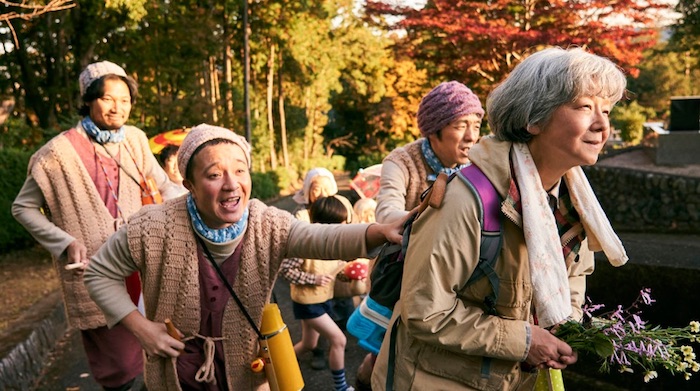
I didn’t intend to watch the Japanese contribution to Window On Asian Cinema, Ora, Ora Be Goin’ Alone, a World Premiere, because I was asked to write about it for the English web page of the Tokyo International Film Festival next week and had a reserved seat for the Tokyo public screening. But due to a sudden last minute schedule change at TIFF another assigned screening was switched to the same time as Ora. Fortunately, it was available on the BIFF press screening platform.
The awkward title is meant to be an English language approximation of what the Tohoku dialect sounds like in contrast to conventional Japanese. I’m not a subtitler, but I would have advised against such an approach. Still, it’s easy to understand why the producers went this route. The award-winning novel on which the movie is based is written in tohoku-ben. It’s what made it a best-seller and, from what I understand, gives it its unique charm, so the producers obviously think that charm has to be impressed on foreign audiences, as well. It isn’t, and it doesn’t really need to be. The theme of a lonely old woman looking back on her life with some regret is pretty universal, and the specifics of her experience as expressed through her speech patterns can be conveyed by other means. And yet, while the director, Shuichi Okita, manages to drive home the drama without getting too sentimental, he can’t recreate the intimacy of the book, which is only hinted at on screen.
Then there’s Yuko Tanaka, who is 10 years younger than 75-year-old widow Momoko Hidaka, the character she plays in almost every scene of the movie. Tanaka still has a flawless, almost wrinkle-free complexion that tends to distract from her capable performance as a woman whose mind may be playing tricks on her while her body is slowly deteriorating. More to the point, in a number of flashbacks, her character is played by Yu Aoi, probably the most accomplished Japanese actor of her generation, and there’s a certain disconnect enhanced by their respective notorieties, both as actors and public figures. Of course, foreign viewers won’t pick up on these distractions, but the thespian firepower on display seems overwhelming considering the slightness of the material. Momoko ran away from her home in Iwate in 1964 to escape an arranged marriage, only to fall in love with and marry a man in Tokyo with whom she raised two children and pretty much did nothing else. With her husband now dead and her children uninvolved in her life, Momoko wonders what the difference really is between marrying a stranger selected by her parents and being a lifelong housewife. The beauty of Chisako Wakatake’s story is how compelling she makes this question, but, in the end, it’s a personal one that requires a very personal mode of explanation, and this movie, despite its earnest attempt at fantasy—Momoko is pestered by three mischievous hallucinations representing three renditions of herself—isn’t that. It’s basically a nostalgic two-hour visit with a nice old lady who is actually quite healthy in both mind and body. Don’t let the grey hair fool you.

The Disciple, an Indian film that won a Best Screenplay award at Venice, also centers on a protagonist who ponders if he has pursued as meaningful a life as he hoped. In Sharad’s (Aditya Modak) case, however, he thinks this not at the end of a life, but at several junctures along the way. Sharad is the titular student of a Guruji (Dr. Arun Dravid) who follows a more ascetic style of classical Indian music, Raag, that demands total devotion to the point of denying money, career, family, even ego. As in a good Hou Hsiao Hsien movie, The Disciple dips into Sharad’s life seemingly at whim, sometimes catching him at the foot of his father, also a devotee of Raag who didn’t have the talent to get anywhere with it but became a kind of hopeless apologist for the genre. During his early 20s, Sharad sits at the foot of his Guruji, and finds himself coming up short in terms of discipline (his sexual frustrations lend the film a tragicomic cast) and inspiration. In early middle age, he’s gained weight, as well as the frustration that comes trying to make a life out of an art that demands he forsake everything else.
Director Chaitanya Tamhane structures the story in conventional dramatic style, but not chronologically. Sharad’s pursuit of “the truth” in his music may be linear, but his success in reaching some kind of understanding is intermittent, and Tamhane builds tension through an accumulation of non-chronological incidents that become more dramatically fraught as the movie progresses, climaxing in an oddly affecting scene in an outdoor restaurant where a noted music critic bursts the young man’s idealistic bubble by telling him the truth about his artistic idols. It’s not that his heroes were fools or hypocrites, but rather that what he admires about them others find ridiculous and impractical. Adding a parallel side plot about an amateur classical vocalist who makes it as a pop singer, Tamhane also shows how technology both enhances and undermines the artistic purity of a musical form that’s been around for thousands of years. He greatly admires the kind of devotion that goes into it, but his movie finds its own truth in showing how devotion can’t stand up to the demands of modern life.

This year, the Asian Film Awards were presented at BIFF for the first time. Of course, the organizers hoped to have a real ceremony with a real audience, so transferring the awards to Asia’s biggest film festival made sense, since there is already a built-in audience on hand and, from what I understand, the Asian Film Awards need all the publicity they can get. But this year they had to settle for a YouTube presentation and shoutouts on the Asian Contents & Film Market website. Not many surprises here. Parasite, of course, won Best Picture, as well as Best Screenplay and two technical awards, well after its sell-by date. The Chinese Best Director is someone I’m not familiar with, and while I know the Best New Director, Japanese filmmaker Hikari, I haven’t seen her film, 37 Seconds. Lee Byung-hun predictably won Best Actor for The Man Standing Next, which, I hear, is also South Korea’s official submission for the next Best Foreign Film Oscar, so I’m doubly discouraged that the print they’re showing on the BIFF screening platform doesn’t have English subtitles. I also don’t know the Chinese Best Actress winner, though I’m very familiar with Ryo Kase, who won the Best Supporting Actor prize for To the Ends of the Earth, which feels as if it came out a decade ago, so much has happened since it was first released in Japan in the summer of 2019.
At the Inzai branch of BIFF, I watched the world premiere of the South Korean drama Fighter, another example of a very plain, descriptive English title. One thing you can say about South Korean movies: You know what you’re getting with the title. The fighter in this instance is a North Korean defector named Ree Jina (Lim Seong-mi), a bitter, frustrated young woman who would prefer being left to herself in Seoul but has to make a living, not only for herself, but also to save money to get her father out of China, where he’s presumably at the mercy of brokers who helped him get out. Jina’s “fights” are against South Korean prejudice and government functionaries who demand special kinds of thanks for their assistance. It’s all very predictable, though director Yun Jero, who’s made a bunch of documentaries and a debut feature, Beautiful Days, that was selected as the opening film at BIFF in 2018, keeps things real with a low-key style that allows the characters to come through fully. As Jina, Lim is a real find. Her sudden vocal tonal shifts and the way she conveys rage and frustration through only her eyes justifies Yun’s preference for tight closeups.
Jina channels her frustrations into boxing, a sport she takes up at the insistence of the owner and head trainer of the gym where she works as a janitor. Though they’re initially intrigued by her military training in hand-to-hand combat (“Why do South Koreans think North Koreans are all commandos,” she snarls), they also sense that her fighting spirit isn’t the same as that of the rich women who patronize their establishment to look cool. As a “North Korean refugee” Jina attracts some low-level media attention, and so she’s able to gain traction on a possible pro career, but the movie mostly hovers just above ground level and never falls into the usual sport movie cliches. It’s a character study that just happens to be about boxing, and while I wish Yun has been a bit bolder with the story, he lets his lead actor tell it, and she carries it off admirably.

If Fighter feels slightly empty of substance, the China-Germany documentary Hong Kong Moments seems stretched beyond its capabilities. An attempt to get at the gist of the riots that gripped the city in the fall of last year during the campaign for city council elections in November, the movie does a good job of showing the native qualities that make Hong Kong such a unique metropolis, but fails to explain the basis of the conflict. Having resulted from Beijing’s unilateral insistence on forcing an extradition law on the territory, the battle is over self-determination, but very little mention is made about the form this particular government has taken. There’s a lot of talk about democracy, with several people who support Beijing asserting that Hong Kong, even now, is, as one taxi driver puts it, the “most democratic place in the world.”
Director Zhou Bing isolates half a dozen people, including a pro-Beijing teahouse owner, a pro-demonstrator EMS nurse, an incognito hardcore demonstrator who condones violence because he knows the communist regime is implacable, a young police officer, and two council candidates representing the two sides of the conflict. The fact that Zhou has more success explaining the sense of place that all these Hongkongers have in common than he does forming a coherent narrative of what went on during the three months covered is probably a function of the chaotic circumstances themselves. There’s some truly stunning footage of the violence as perpetrated by both the demonstrators and the police, as well as breathtaking drone shots from above the action. Typical of Zhou’s approach is a scene on the night of the election when the pro-democracy side gets shut out of the counting station, followed by a scuffle that makes you wonder if the pro-Beijing side is up to no good; but the brouhaha quickly calms and things go smoothly. Alongside horrific shots of the effects of rubber bullets and police losing their shit for no reason there are scenes showing couples playing badminton and workers getting boisterously drunk, as if to show that life goes on amidst all this turmoil, but that really tells us nothing about the conflict itself. Zhou is an impressive technician but he has a shaky grasp of the journalism part.
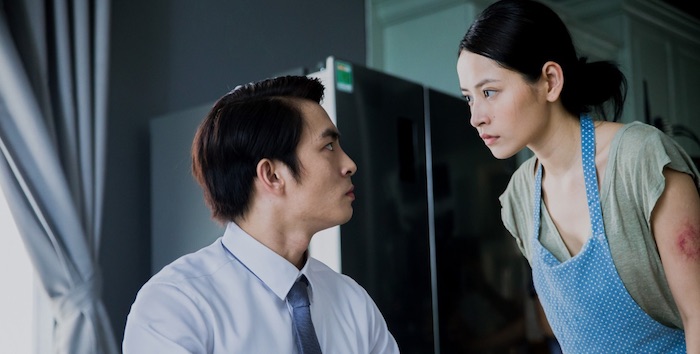
I haven’t seen that many Vietnamese movies, but all the ones I’ve seen I’ve seen at BIFF, and I’m pretty sure all of them were about people of limited means, which I interpreted to represent the bulk of the population. Sister Sister, reportedly the biggest box office hit in Vietnam in 2019, is a decidedly different species of movie. It’s about the rich, or, perhaps I should say the new rich, since we are talking about a country whose communist government still has authoritarian powers over most of the population’s lives. At first, I found the story quaint in a way that perhaps revealed my prejudices about entertainment in developing countries, even those who already have created a 1% upper layer. Kim (Thanh Hang), the daughter of a wealthy real estate developer, hosts a popular radio talk show where she listens to callers discuss their family problems. One, a young woman having an affair with a married man who dumps her after he finds she’s pregnant, is a frequent caller to the show and has forged a kind of spiritual bond with Kim. When the woman, Nhi (Chi Pu), indicates she’s been a victim of sexual violence from her boss at the restaurant where she works, Kim meets her in private and invites her to stay temporarily at the mansion she shares with her husband, Huy (Lanh Thanh), an up-and-coming architect at her father’s company. Huy, as well as the couple’s maid, resent this interloper and are suspicious of her intentions, but Kim becomes more attached to the young woman, and it seems to have something to do with the fact that Kim recently lost her own baby.
It’s a pretty standard TV soap, but about halfway through it becomes something that could have been conceived by James Cain, and things turn pretty wild. It’s a fun movie that has some obvious structural and continuity problems, and in a sense it has the kind of glittery sheen that makes you wonder how much of it is supposed to be a joke. Certainly, the sex scenes are not supposed to be taken seriously, but it’s difficult to discern how much of director Kathy Uyen’s depiction of “traditional family values” are supposed to be critical. Initially, Kim’s peculiar brand of broadcast therapy is meant to seem progressive in that a soon-to-be single mother like Nhi is normally ostracized by good society, and Kim gets grief for it (but not by her employer, since she gets high ratings). But as the twisty, sordid plot reaches the home stretch, the cynicism toward not only acquired bourgeois attitudes but also the attendant soft-hearted Western liberalism feels like a feint. As it happens, Uyen is Vietnamese-American, born in San Jose, so she has a foot in both traditions. Her debut is canny and, for me at least, a bit too calculating in its effort to have its moral cake and eat it too.

The family depicted in the Palestinian film 200 Meters is more conventionally “happy” in that their love for one another is solid. However, the social milieu they have to navigate is much more complicated, even absurd. The head of the household, Mustafa (Ali Suleiman), lives in the West Bank at his family home, while his wife and three children live in a house in Israel, on the other side of the wall, but only 200 meters away, meaning close enough so that when he goes to sleep at night he can signal to them his “good night” with a light on the roof. The director, Ameen Nayfeh, never fully explains why the family is separated, though one gets the feeling that Mustafa is not comfortable living in Israel. In any event, he has to work there, and thus must endure the grueling checkpoint process on an almost daily basis.
This process becomes the movie’s leitmotif, a gauntlet of humiliation and potential danger that is stretched out almost interminably during the movie’s second half, when Mustafa, cut off in the West Bank over the weekend due to an expired permit, has to hire a smuggler to get him into Israel after his son is injured in a traffic accident. That 200 meters turns into a taut day-long journey involving switching cars, enduring the annoying peccadillos of strangers, and being stuffed in a trunk for hours as a life-and-death drama he doesn’t even know about is taking place only feet away. Though there are several implausibilities in Nayfeh’s script, he keeps the politicizing to a minimum and trains his dramatic firepower on Mustafa’s anxiety, which is all the more visceral because he is a good man, albeit an often impatient one. Even the ringer in the story, a young German filmmaker who tags along on the smuggling expedition to get some good footage, doesn’t feel gratuitous, even if some of the English dialogue sounds forced. And if the ending seems too faintly happy, the context gives it poignance. Mustafa is just going to have to get up the next day and do it all again.
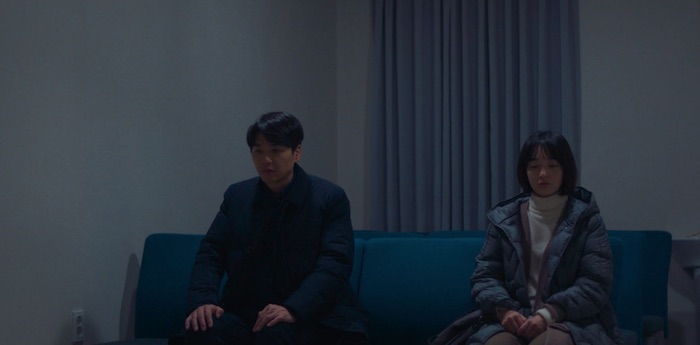
Debut features, especially by university trained directors, are a crap shoot, since they often replicate graduation projects. That isn’t usually the case, however, in South Korea, where film students with real ambition and talent are put through the ringer, and that tends to describe a large number of them, so I try to take in as many Korean debuts as I can at BIFF, time willing. Good Person, a World Premiere mystery by Jung Wook, born in 1987, was produced by the Korean Academy of Film Arts, which automatically recommends it as a fine-tuned commercial offering by an excellent student, and it delivered, even though I watched it in the morning with a lot of interruptions.
The interruptions, in fact, were often welcome since at times I found the movie almost too painful to watch. Popular actor Kim Tae-hun plays Choi Kyung-seok, who teaches at an all-male high school. Tae-hun obviously thinks of himself as a good person, a conscientious teacher who seems to be respected by his charges, though sometimes grudgingly so. When a student’s wallet is stolen, he gives the culprit a chance to turn himself in without being exposed as such to the other students, but, of course, no one steps forward, and when one student quietly indicates it may have been the class’s black sheep, Se-ik, Tae-hun gives the sullen suspect, who denies the theft, the benefit of the doubt, but not before lecturing him in such a patronizing way as to let himself off the hook should things go south, which they do in very short order.
The script is almost granular in its attention to plot detail and credible motivations, though the accumulation of left turns may leave your head spinning. Tae-hun’s virtue signaling, as it turns out, is mostly compensation for a failed marriage and a drinking problem that he believes he’s overcome. But as one bad decision leads to another, the personality pluses turn into minuses, guaranteeing that Tae-hun’s spiral to the bottom is fast and relentless. Though not particularly original, Good Person is technically and narratively irreproachable, with a theme that resonates through its supreme downer tone. And like a lot of South Korean debuts that are this accomplished, it will leave you either cold (because it is cold) or desiring of a long shower. It may sound like a cliche to predict that Jung has a bright future, but, yeah, I can’t wait to see what he does next.
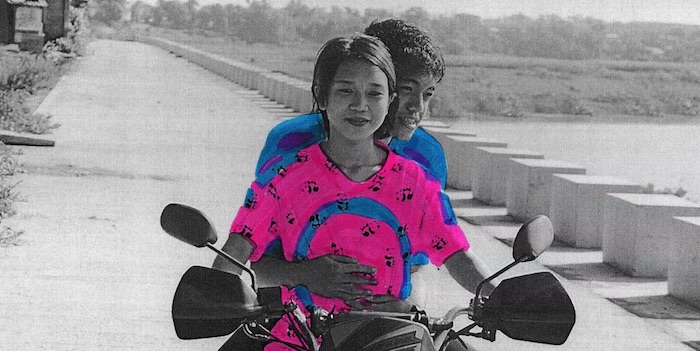
High school is also the setting for the Philippine movie Cleaners, which takes a conventional film genre, the gross-out school comedy, and jigs it up visually and aurally. Divided into six sections, each of which addresses a cliche of Catholic high school life, the film is almost painfully amateurish, but director Glenn Barit processes it all through a stop-motion filter and then adds hand-painted day-glo colors to the black-and-white cells (or, at least, that’s what it’s supposed to look like; it’s probably all done digitally), giving the whole production a surreal cast. And while the situations are trite enough—loser courting pregnant popular girl, a bunch of skater-emo kids entering a dance contest and turning it on its head, the rich boy upending his privilege—Barit adds some fairly shocking scatology and self-mutilation just for fun. Though it’s easy to laugh at the corners cut and the rawness of the acting, there’s emotional grit mixed in with the sentimentality that’s leavened by Barit’s clever and catchy indie music score. Humor-wise, it’s not my cup of tea, but it did give me a pretty good idea what it might have been like growing up in a middle class suburb in the Philippines in 2007.

I spent all day on Kazuo Hara’s latest epic, Minamata Mandala, which is six hours and 12 minutes, thus making it almost twice as long as his last epic, Sennan Asbestos Disaster. The two documentaries are very similar in both subject matter and theme, but I would hardly call them redundant. Both address the grievances of people who have suffered medically for the neglect of the state and attempt to gain redress only to spend many years in an agonizing tug-of-war with the bureaucracy, which is invariably implacable.
Minamata is, of course, synonymous with structural neglect. Lawsuits to gain some measure of relief for the tens of thousands of people injured by the organic mercury pollution let loose by the Chisso Corporation in the middle of the 20th century in the seas off Kumamoto Prefecture have been going on for almost 60 years, and are still going on for some people. Minamata has been seared in the mind of the world through the photos of W. Eugene Smith, whose own biopic with Johnny Depp playing the late photographer who made those iconic B&W prints of Minamata Disease victims will open theatrically pretty soon, and likely upstage the message this movie is trying to convey. As with Sennan, here Hara is not so much interested in the original crime, which is pretty cut-and-dry, but rather the process of wearing-down that those in power put in motion in order to make an inconvenient problem go away. And while it doesn’t go away, it may not reach the ears of the general public in a way that will make much difference. Hara’s job is to place the viewer right in the middle of the controversy, and while he doesn’t bother to ask for the other side’s view of the matter at hand, you can tell from the action he does put on film that the other side doesn’t give two shits about what the public might think. To them, silence is golden, since it is the most absolute way of asserting power, especially in Japan, where those who are not directly affected are not likely to profess more than token sympathy.
Hara breaks the film, which was was shot over a period of some 20 years, into three parts. The first establishes the science behind the plaintiffs’ claim, which finds the government’s various remedies to be self-serving and insufficient. The criteria for providing compensation and medical treatment established in 1977 was based on medical findings that said Minamata Disease was all about damaged nerves, a decision that excluded many patients who, when tested, presented no nerve damage. Two doctors from Kumamoto, however, theorized quite early on that Minamata Disease was about losing brain function, or, more precisely, it was a disease of “sensory disturbance.” People’s sense of taste and smell were diminished, they lost peripheral vision and some feeling in their extremities, and had trouble communicating, but none of these symptoms presented as damaged nerves because the problem was in the brain and its ability to send the proper signals to the body. It wasn’t until 2006 and the Supreme Court case handling the suit brought by a group of Minamata victims who were living in the Kansai region that the sensory disturbance explanation was taken seriously.
The rest of the film presents how this inconvenient ruling was ignored by both the Environmental Ministry and Kumamoto Prefecture, which stalled in its duty to rectify its certification processes for Minamata victims. It’s a maddening journey, filled with court victories that prove to be empty, either because the authorities appeal them again, drawing out the agony for sick people who are at death’s door, or because they simply interpret the court ruling in a way that allows them not to admit they ever did anything wrong. As with Sennan, the movie’s climax is a showdown in the halls of Kasumigaseki with a bunch of youthful civil servants, who know very little about the history of the problem, being dispatched to receive the withering anger of people who have nothing left to lose. But this is even more intense, climaxing in a bit of showy violence when one plaintiff rips the notes out of the hand of a bureaucrat to find out if his “apology” is sincere or not. To make matters worse, these people essentially reenact this farce several days later in the Kumamoto Prefecture offices, where the governor says he will get down on his knees and apologize “if you want me to.”
Interspersed throughout this drama are interludes with various victims of the disease, which offer the requisite human side of the tragedy but, thanks to Hara’s immersive approach, give us a world beyond the hospitals and care homes. I was particularly moved by a certain Mr. Ikoma, who contracted Minamata Disease as a teenager and, despite the widespread prejudice against patients, wed a woman through an arranged marriage. When Hara finds out that the woman is Korean, his investigative antennae go up and he asks the couple and their matchmaker (another Minamata victim—one of the strongest suits of the film is the way it conveys a sense of community among patients) if anti-Korean prejudices had anything to do with the arrangement and the couple says it did not. Hara seems deflated, and, probably the audience is as well, and the mystery endures. Maybe that’s as it should be. Some things just can’t be explained so neatly.
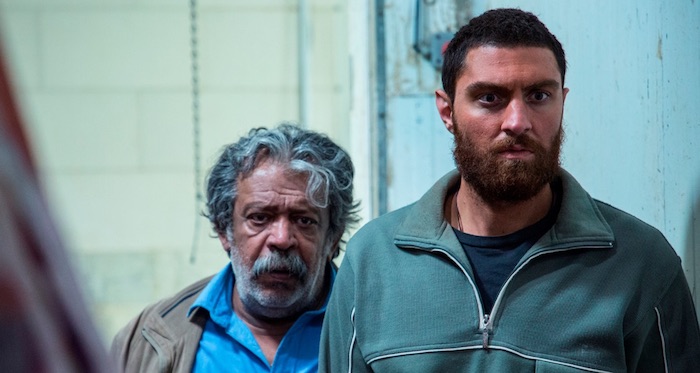
This is the first time in recent memory that there hasn’t been an Iranian film directed by someone I’m familiar with; or maybe I should say it’s the first time there hasn’t been an available Iranian film directed by someone I’m familiar with. As with South Korea, Iranian cinema exists, to me at least, on a slightly higher plane than other national cinemas, meaning that besides the pleasures of art house features that are unique to Iran, the country’s mainstream films are technically, stylistically, and narratively more sophisticated across the board. Which isn’t to say there isn’t the occasional dud, but even when an Iranian movie falls into trite sentimentality or over-earnestness, there’s still something refreshingly original about it, and, again, as with South Korean films, I think it has something to do with the enormous amount of competition among the country’s established film professionals.
So I felt rather confident in choosing to watch The Slaughterhouse at random. It’s the third feature by Abbas Amini, who initially made his name with socially minded documentaries, and there’s a studied quality to the story that shows how a great deal of research went into the theme. It’s basically a thriller, but one whose central mystery becomes almost incidental to the larger picture, even though it spurs the action right up until the end. Abed, an excitable middle aged man who once worked for the government but now makes a living as a security guard at a slaughterhouse, finds three dead men locked in the facility’s large refrigerator. He calls the owner as well as his own son, Amir, who has recently been released from prison, where he spent two years for assaulting a policeman in France. The owner blames Abed for the deaths, saying that the men must have wandered into the refrigerator and the door shut behind them. Faced with an obvious police interrogation and probably punishment for death by neglect, Abed begs his son to help him get rid of the bodies, and the three men bury them in a shallow grave near a wall of the abattoir.
It’s hardly an original idea, and the viewer automatically perceives that the worst is bound to happen to one if not all three of the men involved, but then Amini’s skills with social investigation kicks in and we find that the slaughterhouse is mainly a front business. The owner mostly makes a living by smuggling dollars into Iran and exchanging them on the black market. Abed seems to know something about this occupation, since he once partook of it himself (it may be the reason he lost his government job), but Amir, the protagonist and the person with the most to lose, given his ex-con status, is sucked in as well, not only because he desperately needs money to get out of his father’s house, but also in order to put the ugly incident of the secret burial behind him, which is easier said than done. Needless to say, the deeper he dives into the illegal black market in dollars, the closer he gets to finding out the truth about the three dead men.
Besides having a close understanding of this world, Amini knows how to use that knowledge to create tension, and along the way he shows, through implication and indirection, how the isolation of Iran by both its own government and the rest of the world (it’s particularly ironic that dollars are so valuable, given that the U.S. is Iran’s chief nemesis) has crippled its economy so completely. The requisite scenes of animals being made into meat in the slaughterhouse fit nicely alongside those with men crowded in a dark plaza trading their dollars for the best prices, as if they were brokers on the floor of the New York Stock Exchange. Someone is being skinned.

In that light, the movie I chose next, mainly because of its brevity, was perfect in contrast. As I said, South Korean films are a cut above, regardless where they start from. Vestige, a 70-minute curiosity made up of two short films commissioned for a film festival in the mountain town of Muju, was hardly a promotional or vanity project. I have no idea if the two directors, Kim Jong-kwan or Jang Kun-jae, are from Muju, but they seem to have a deep empathy for small town lives.
Kim’s offering presents a scraggly woman who gets off a bus in Muju and proceeds to walk a long distance into a forest, where she digs up a metal container. She takes the container, along with some candles she buys at a convenience store, to an abandoned house, where she performs a kind of exorcising ritual. In a brief flashback, we learn that she once lived in this house with her teenage daughter, and that she made some kind of living as a shaman. The film is nearly wordless, highly evocative of the location, and spooky in a Lynchian way. And while it isn’t scary, its particular breed of melancholy gets under your skin.
Jang’s half elaborates on this theme by focusing on two civil servants who are cohabitating in a house that looks suspiciously similar to the one in Kim’s film. They discuss the friends who went away and those who never will. As a precis of small town life it’s both familiar and haunting. Just from their conversations, one gets an intimate feeling of what it’s like to grow up here, and the movie mirrors the first one with a tribute to all those inhabitants who are no longer around to defend their corner of the world. I don’t know if this is what Muju had in mind when they asked these two filmmakers to honor their town, but what they got was extraordinarily poignant and evocative. What’s particularly striking is that this movie, made so exactly to specifications, will probably never be seen by anyone other than its target viewership, and yet it deserves so much more attention.

“High-concept” is a term used to describe Hollywood projects that are based on extremely easy-to-grasp ideas that have little to do with story or production values. They’re more like riffs on traditional genre tropes: zombies on Mars, say, or Shakespeare in Mumbai. Destroyer fits the high-concept bill, but in the past decade or so, the idea of “A-list movie star uglying up to play a degenerate” has already become a commonplace. Here, Nicole Kidman is an alcoholic, clearly psychologically damaged L.A. detective with looks to match. Nailing accents is something she perfected decades ago, but this appearance is something new, and it would have been nice if that high-concept had included a script that justified it.
First off, Destroyer uses one of those “start at the end” plot devices that require an incredible sensitivity to narrative development in order to pull off credibly, and from the get-go director Karyn Kusama seems uninterested in untangling the inconsistencies in Phil Hay’s and Matt Manfredi’s script, if, in fact, she even notices them. Through a series of flashbacks embedded a little too deep in the story, we learn that L.A. officer Erin Bell (Kidman) once infiltrated a gang of particularly skilled bank robbers with her lover-mentor (Sebastian Stan), and that they were eventually found out due to a mistake on her part, and that the mentor was killed as a result. She blames the mastermind for that death, but he runs underground. Seventeen years later, evidence from that last fateful bank robbery surfaces mysteriously, indicating that the mastermind is back in business, and Erin goes all lone wolf rogue to exact revenge.
Of course, a lot has happened in the intervening 17 years, most of it to Erin’s face, which is dried-out, pock-marked, and dreary to beat the band. She’s got a disaffected daughter (Jad Pettyjohn), the product of her dalliance with the mentor, who tends to trust more in one of Erin’s subsequent boyfriends than she does in her mother, who isn’t around for her. The mother-daughter thing is a distraction, though, from the ongoing self-debasement that Erin undergoes in order to catch her prey, a process that entails not only lying to her colleagues and pulling patently illegal stunts, but also pissing off other gangland types to the point where they think nothing of beating the shit out of her and leaving her for dead. The point seems to be to allow the transformation that Kidman’s normally pristine features undergo to stand in for what we would usually expect of “screen acting,” but without the support of a story that makes sense or develops a dramatic arc. The scene where Erin gives a handjob in exchange for information doesn’t elicit anything but disgust, and if that’s the point then Kusama has really misunderstood the potential audience for this movie. One of the definitions of high-concept is that it’s also high-risk.
Now playing in Tokyo at Toho Cinemas Chanter Hibiya (050-6868-5001).
Destroyer home page in Japanese
photo (c) 2018 30West Destroyer, LLC
 philipbrasor.com