BIFF 2020: Oct. 23

Everyday Is a Lullaby

Though I’m not writing for a paying media outlet this year, I was still hoping to “attend” a few press conferences. There aren’t that many except for the Opening and Closing films and the features in the Gala Section. Last month, the press office asked me if I was interested in participating and I said, yes, but yesterday I learned that they were only making the PCs available to Korean journalists because not enough foreign reporters expressed interest, which makes sense since the Opening/Closing/Gala films are not available on the online press screening platform. My guess is that it’s because it’s something of a pain to provide English interpreting for Zoom conferences—I know because I had a lot of trouble with the English channel for the BIFF announcement PC in September—but the two PCs I wanted to see were for Naomi Kawase’s True Mothers and Kiyoshi Kurosawa’s Wife of a Spy, so I didn’t need English interpreting, but apparently once these decisions are made they’re difficult to reverse. Interestingly, I was invited to the PC for the American movie Minari, which is about a Korean family moving to a farm in Arkansas, probably because most of it would be in English anyway, but while they did send me the email invitation ten minutes before the PC was to start this afternoon, they forgot to attach the link, and by the time they realized this and sent me the link the PC was over.

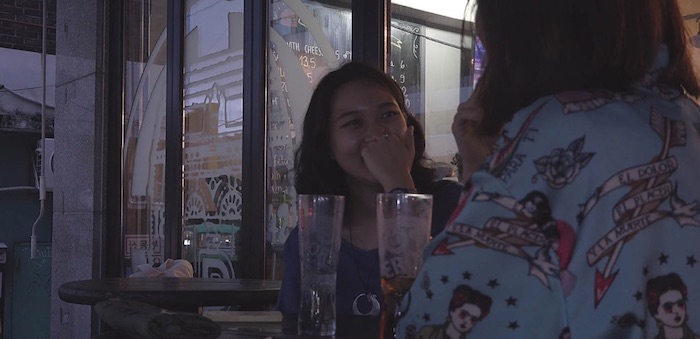
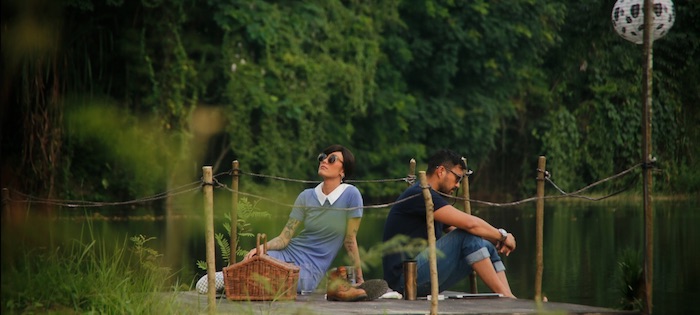
Well, more time to watch movies. However, based on the first one I chose, Everyday Is a Lullaby, from Indonesia, I’m getting the feeling that every Asian filmmaker in the last year has binged on Charlie Kaufman. Directed by Putrama Tuta, Everyday is one of those films about films, with a debauched screenwriter protagonist desperate to get out of his successful rut writing ghost stories. From the outside, Rektra (Anjasmara Prasetya) seems to have it made: fame, money, a gorgeous actress girlfriend. But he’s seriously depressed, and though his only three activities are writing, sex, and smoking weed, he partakes of the last two only to provide “inspiration” for the first. Needless to say, it doesn’t really get him anywhere, and it doesn’t really get the viewer anywhere, either. The narrative weaves in and out of rambling conversations and expressionistic tableaux with no fixed destination. In one early scene, a hard-assed producer who refuses to take on Rektra’s new “indie crap” illustrates the limitations of artistic wankery by pointing to the cheap quality of the sets she’s building for yet another horror movie. “This is Indonesia,” she points out. Unfortunately, from that point on you can’t help but notice that every scene seems to take place on a cheap set, and while this aspect gives the film a dreamlike quality, it also draws attention to Tuta’s unsubstantial theme and desperation to make an impression, manifested by car crashes and an odd interlude featuring a glory hole. 
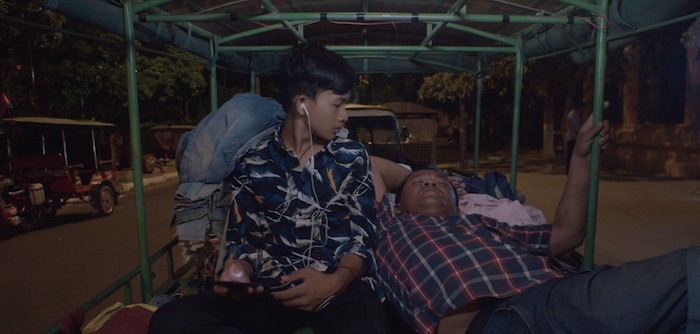
Coalesce

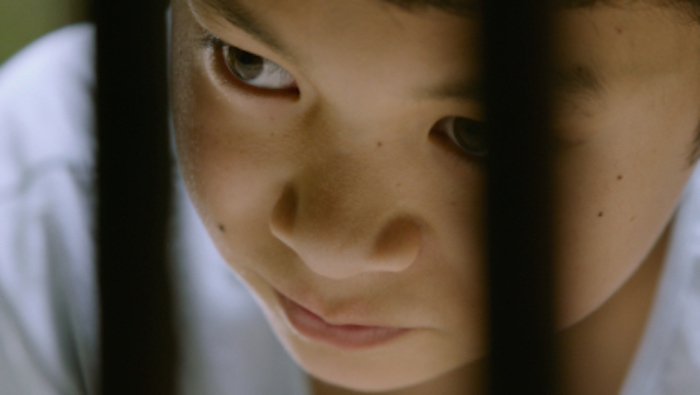
By this point I was desperate for a movie about something real, and turned to the Cambodian-French co-production Coalesce, directed by Parisian Jesse Miceli. Coalesce is the kind of Asian indie that BIFF has always championed: socially relevant, shot on a shoestring, and realistic. All the actors are local amateurs and look it, but the real star of the film is the urbanization of Phnom Penh, which, as is often the case in Southeast Asia, seems to be moving ahead faster than its people can handle. The story has three threads, each pulled by a young man. Songsa is a reticent rural teen who is sent to the city to sell clothes out of a neighbor’s jitney and ends up overwhelmed by the pace and depravity of it all. Thy, who has just turned 20, gets a job in a gay bar as a dancer-cum-hustler for foreign men and is saving his money for a motorcycle. Married Phearum drives an off-grid taxi in order to feed his extended family and buy land for an auto sales business someday. As the title suggests, these three storylines will merge in some way, but Miceli isn’t obsessed with the process. He’s more interested in the milieu and some well-observed incidentals, including a backroom abortion, a foreign element, both Chinese and Western, that sees Cambodia as a chicken ready to pluck, and a casual native attitude toward violence that is shocking, but mainly in retrospect. Best of all, it really does feel up-to-the-minute.

Posted in Uncategorized | Leave a comment

Review: Once Were Brothers: Robbie Robertson and the Band

The title tells you right off the bat what you’re getting into with this supposedly definitive documentary about The Band: Robbie’s version, which has been contentious for years owing to how much drummer/singer/nominal frontman Levon Helm resented his post-breakup stewardship, which translated into taking the lion’s share of the group’s royalties and, for the most part, deciding that the organization was finished. Levon’s dead, of course, as are both Richard Manuel and Rick Danko, so there is hardly anyone left to be contentious. (Survivor Garth Hudson always seemed the neutral-man-out, so I wouldn’t expect him to be contentious about anything) That said, the movie does make a case that drugs were their downfall, and only Robertson and Hudson (who probably didn’t do drugs) managed to get out with their lives, so in hindsight there’s much to be said for Robbie’s pulling himself together and at least making sure the legacy has reach.

Still, Robbie is as much of an asshole as he is a mensch, and his narration has the over-excited tenor of a pitchman, which is perhaps appropriate because, as he points out so convincingly, The Band started out as a bunch of teenagers who were essentially hawking their wares—they were even dubbed the Hawks by their first real mentor, rockabilly star Ronnie Hawkins, who is still feisty enough to repeat for the millionth time that line about how he got the Canadians (Helm, the sole American, was already working for him) on board: you won’t make any money, but you’ll get more pussy than Sinatra. And the doc’s real worth is how it plays up this pre-Dylan period in the ensemble’s career, which consisted of countless nights in dives playing R&B staples and Hawkins’ narrow cross-section of regional “hits.” 

The Dylan era is given less focus, which probably has something to do with copyrights (even if Bob himself shows up to offer up his own unique effusions), but that somehow feels right given that they were definitely in his shadow; that is, until they did the Basement Tapes in Saugerties, New York, at Big Pink, an event that is rightly mythologized here. Director Daniel Roher is careful to make all these elements coalesce into a satisfying hypothesis of what made these five musicians worthy of the bold moniker The Band. And that’s another reason why Robertson’s pushy personal take on the story, cribbed from his autobiography, grates a little. Roher is up to the task, but that task is to burnish Robbie’s reputation, which may explain why he didn’t get any on-film comments from Hudson. In fact, the one person who makes Robbie’s dominance acceptable is his wife, Dominique, who provides witness to the horrors of the group’s drug-taking days, including those in which her husband participated. None of this biographical material overshadows the musical import of the documentary, but The Band’s stature as perhaps the greatest, most organic North American group of the rock era is already carved in stone. The movie simply gives a few more examples of their musical greatness. What we come to Once Were Brothers for is the truth behind the myth, and Robbie is still sort of blocking the view. 

Now playing in Tokyo at Kadokawa Cinema Yurakucho (03-6268-0015), White Cine Quinto Shibuya (03-6712-7225).

Once Were Brothers home page in Japanese

photo (c) Robbie Documentary Productions Inc. 2019

Posted in Movies | Leave a comment

BIFF 2020: Oct. 22

GV for Peninsula (credit: BIFF)

In-person events are the bread and butter of the Busan International Film Festival, which, despite its global reputation as the most important international film festival in Asia and the significance of its concurrent Asian Content Film Market, is by and large a fan-centered event, with dozens of opportunities for Korean movie freaks to meet and talk to actors and filmmakers. Their post-screening Q&As are legendary, and often spill out of the theaters and into the lobbies of wherever the screenings are taking place. Obviously, all in-person events are cancelled this year, which is a bigger blow for BIFF than it probably is for other major world fests, but, apparently, they’ve found some small ways to make up for the loss. According to a press release, there were two screenings today that linked up simultaneously with screenings in the countries where the movies were made, and afterwards, the two sets of audiences were able to interact online. One was the documentary School Town King from Thailand and the other, the hit Vietnamese film Sister Sister, directed by a Vietnamese-American actor-director. In addition, a local screening of the zombie epic Peninsula, which is already in wide release in South Korea, included a “hybrid guest visit” afterwards, at which the producer and main actor showed up in the theater while the director “attended” online, wearing a mask, of course.

Back here in the BIFF annex at chez Brasor, I had a slight problem with a movie I had been looking forward to, The Man Standing Next, a fictionalized rendering of the activities of KCIA director Kim Gyu-pyeong (Lee Byung-hun) during the 40-day period prior to his assassination of President Park Chung-hee in 1979. Ever since seeing the farcical but supposedly entirely factual (according to its director, anyway) The President’s Last Bang, I’ve always been fascinated by the murder of the great dictator, but, unfortunately, the version that was uploaded to the press screening platform does not have English subtitles. Should I send a message or let it slide?

Me and Me

So instead I watched another movie from the Panorama section, Me and Me, the debut feature by veteran actor Jung Jin-young. A fantasy with elements of a stalled police procedural, the movie is difficult to describe. A young couple have moved from Seoul to a remote village where the husband takes a teaching job. The couple has a secret that eventually leaks to the surrounding community, which becomes concerned about their well-being and tries to create an environment wherein everyone feels safe, but the plan leads to disaster. As a local police detective, investigating the disaster, starts getting closer to the bizarre truth of the matter he finds himself literally changed into someone else, though his mind still clings to his former life. At first I found the continuing shifts in tone and logical development annoying and the idea of completely replacing one set of protagonists for another halfway through confounding, but eventually the film sort of won me over with its idea that we are all different people from time to time; it’s just that some of us adjust better to these displacements than others do. Jung and his main actor, Cho Jin-woong, conveyed the complete helplessness of a man caught up in a nightmare with a visceral power that was difficult to shake, and I can’t say that the nominally semi-happy ending made be feel any better. It’s hard to recommend, but it’s certainly original. 

Also original was the short documentary essay from the Wide Angle section, When a Hen Crows, an obvious student project by a young woman named Dabin. Mostly a contemplation of her coming out, so to speak, as a feminist in South Korea in 2020 (she says she became a feminist three years earlier), the movie has a tentative mood that reflects it’s narrator-maker’s lack of confidence in both her storytelling skills and her credentials as an “enlightened” woman. Though 25 when she made the film, she was still struggling with whether or not she could leave her apartment sans makeup. She scours public toilet stalls for hidden spycams and attends the recent street demonstrations celebrating the lifting of the abortion ban. On trips to her family home in some unidentified town, she reverts to old habits that were the product of being a plain girl in a household where her older brother had precedent. Of frail health most of her life—chronic hypothyroidism made her the envy of her classmates because it prevented her from getting fat—she equates illness with just being a woman. 

When the Hen Crows (c) Bean Film

By telling her story in the third person, Dabin makes the case for all women, though the personal touches are what really make the pronouncement universal, like when she overhears a neighbor complaining about domestic abuse at the hands of a family member and feels relief that it’s someone else who’s the statistic. The writing is more impressionistic than the images, and sometimes you can’t quite figure out what she’s getting at, but that would seem to be the purpose of the film in the first place. She knows she’ll never understand how to make her way in this environment as a woman without interrogating her present life out loud, and wielding a camera, to boot. As much as I admired how she made the personal compelling, I feared for her choices, especially the one guy identified as her boyfriend, who sits silently, nodding and grunting as she tries to explain how all men and women, especially those in relationships, can’t help but play the roles their upbringing has assigned to them. I’m hoping she took her own words to heart and dumped the guy shortly thereafter.

Posted in Uncategorized | Leave a comment

Review: Madre

The news that Spanish director Rodrigo Sorogoyen was going to expand his Oscar-nominated 2017 short film to feature length was met with both excitement and dread. The premise of the short was high-concept to the point of gimmickry, and yet Sorogoyen pulled it off impressively, thanks mainly to his lead actress, Marta Nieto, playing a woman in Madrid who receives a phone call from her six-year-old son, Ivan, who is visiting his father in France. Ivan is on a beach he doesn’t know, alone, and as his mother, Elena, attempts to get him oriented and in touch with either his father or a person of authority, she slowly starts to lose her grip. Over a period of 15 minutes the situation escalates into something truly terrifying. 

Though some would say Sorogoyen was being manipulative, his idea of expansion is completely the opposite. In fact, anyone expecting the usual searching-for-the-missing child thriller will be deeply disappointed. Following the opening sequence, which is exactly the same short film that was nominated for the Academy Award, Sorogoyen moves the narrative forward ten years, with Elena now working at a beach in France, presumably the one from which Ivan called her and, as we soon discern, disappeared from completely. Though we assume Elena is there to look for him, nothing she does indicates as much. She works as a manager of a seaside restaurant and goes about her chores as if everything were normal, because, after ten years, everything is as normal as it’s going to get. She goes home at night to her boyfriend, Joseba (Alex Brandemuhl), who we figure out almost immediately is not Ivan’s father, and they have dinner. The only thing that seems slightly off is that Elena doesn’t have much energy.

And then she sees a teenage boy on the beach one day, a refugee from Paris, there with his family on vacation. Elena’s intent gaze implies she thinks he at least looks like what Ivan would look like now, and she starts to stalk him. Eventually, they meet by accident, and enter into conversation that leads to a budding friendship. By this point, the viewer is becoming increasingly uncomfortable, not because we necessarily believe the boy, Jean (Jules Porier), really is Ivan, but because the relationship feels fraught with emotional if not downright physical danger. Inevitably, Elena meets the parents (Anne Consigny, Frederic Pierrot), who see nothing wrong with a fortyish woman hanging out with their 16-year-old son, but those feelings are bound to change as well.

The sexual frisson is unmistakable, at least from Jean’s point of view. Elena’s is more difficult to gauge, but in a sense Jean as an individual who’s completely separate from Ivan starts to provoke Elena’s sympathies, and while I wouldn’t want to call it something as trite as “maternal instinct,” she empathizes with Jean’s normal adolescent anxieties in ways that are particularly charged given her background. There seems to be something actually healthy in her regard for Jean’s well-being, even if you dread what will come of it. It’s a test of Sorogoyen’s mettle as a storyteller that he can take such perfect grist for a conventional thriller and turn it into a stomach-churner of a completely different sort.

In French and Spanish. Opens Oct. 23 in Tokyo at Cine Switch Ginza (03-3561-0707), Yebish Garden Cinema (0570-783-715).

Madre home page in Japanese

photo (c) Manolo Pavon

Posted in Uncategorized | Leave a comment

BIFF 2020: Oct. 21

Swimming Out Till the Sea Turns Blue

I was finally given the tools I needed to register for online press screenings for the Busan International Film Festival. Obviously, I’m not there in person, but the organizers were kind enough to invite me to “attend” remotely, the benefit of which is that I get to see this year’s selections at home without having to hustle to a ticket booth and wait in line for something that everyone else usually wants to see. The disadvantage, at least this year, is that the online selection is limited, as it usually is in the video room where you can call up those films that don’t fit into your schedule—but only if the distributors or producers deign to make them available. This year, only about half the 200+ films being screened are available online, and most of the major ones, including the this-year-only “Cannes” section, are not on the list. These are films that were supposed to premier at the cancelled 2020 Cannes International Film Festival. Also, many of the big Japanese films, like Kiyoshi Kurosawa’s Wife of a Spy, are not available, which is not as big a deal as it seems since many have already opened in Japan or will shortly, but it would have been nice to see them here since I missed the domestic press screenings due to pandemic protocols. I’ve been informed that there was not enough foreign press interest expressed for the Gala films, so we won’t have access to the films or the press conferences save one, the American film Minari. Also, no Hong Sang-soo online, which already feels like a big hole for me; but, then again, I’ve become spoiled watching Hong movies with Korean audiences, who tend to laugh their asses off, so I’m sure it wouldn’t be the same watching The Woman Who Ran on my iMac. 

That still leaves a lot of movies that I can see, though. Choosing which ones might be a chore this time, since I don’t have ready, physical access to fellow press people who can recommend which ones are worth seeing and which ones to avoid. 

But there are a few no-brainers, one of which is Jia Zhangke’s Swimming Out Till the Sea Turns Blue, which I just finished watching. This is Jia’s third in a series of documentaries about the arts in China, and while I prefer Jia’s narrative films, the movie was engrossing in ways that the previous two installments weren’t, probably due to the subject matter. The first two films were about visual arts and fashion design, and mostly dealt with professionals who came of age during or after the 1990s. Swimming is about literature, and focuses on four writers who cover the entirety of the communist era. The impetus for the film was a literary festival that Jia attended in his home province of Shanxi. There he met three of China’s most celebrated poets/novelists, as well as the daughter of another, Ma Feng, a controversial figure who was central to the heroic style that the Party insisted on during its early years. 

All these artists are from Shanxi or nearby, and the common theme that runs through their ruminations is that you are nothing without the place that produced you. Even Ma had to return to his roots in order to produce works that people wanted to read. Jia juxtaposes static interviews with illustrative everyday scenes from Shanxi comprising 18 “chapters” that are supposed to “play like a symphony,” a metaphor made somewhat trite by the liberal use of classical music on the soundtrack, especially Shostakovich. Still, the witnesses prove their literary worth with stories that are both entertaining and enlightening about their respective artistic developments. Jia Pingwa explains how his father was purged during the Cultural Revolution, which means he grew up on a reeducation farm. But because he grew up on a reeducation farm he was urged by the authorities to attend university since they wanted more peasants to earn a higher education. There he was exposed to Western art and literature, which helped him hone his craft, even though he had to publish work that was acceptable to the Party. It wasn’t until after he moved back to the countryside that he found his real voice.

The most colorful figure is Yu Hua, who came of age in the late 70s. Though obsessed with literature, he couldn’t pass the university exam and so went to vocational school to become a dentist. Assigned to a hospital in a big city he noticed that people who worked for the Cultural Bureau just walked around town all day. “That’s for me,” he said, and started writing fiction. After years of rejection letters a Beijing publisher finally took him on and he was able to secure a position in the Cultural Bureau, but by then he was a real writer, and, like Jia, moved back to the countryside, where he became a bestselling novelist. The third writer, Liang Hong, did attend university in Beijing, where she majored in literature, but it was her impoverished upbringing and the unusual circumstances of her family life that informed her work, which is personal and tragic (“my family was the village soap opera”). The interview with her 14-year-old son is priceless, as he represents the next generation, and Jia is canny enough to leave any speculation to himself. The son says he wants to be a physicist, but his sly way with words definitely pegs him as his mother’s son.

Empty Body

A very different mother-son combination is explored in Kim Ui-seok’s Empty Body, part of the Korean Cinema Today-Panorama section. The Korean selections are mostly grouped into two categories: Panorama, which are generally movies by established directors, and Vision, which showcases new Korean filmmakers. Empty Body doesn’t come across as either, really. It’s Kim’s second film, following his well-regarded debut, After My Death. Empty Body is obtuse speculative fiction. Moon So-ri plays a rich, seemingly single woman whose 23-year-old son dies in a car wreck and the police can’t determine if it was accidental or deliberate. The mother opts to transplant the son’s brain into a made-to-order android that eventually “deletes” the son’s consciousness. There’s a weird court trial to decide if the android effectively “murdered” its “owner,” and the android repeatedly assures the mother that her son wanted to die and resented that she forced him “back to life.” There’s a lot of existential heavy lifting going on, and the mood is depressingly, relentlessly bleak. Supposedly, the 90-minute film was expanded from a 50-minute TV broadcast, and the padding shows, mostly in the over-use of long takes filled with uncomfortable silences. It doesn’t have a lot going for it in terms of entertainment or thematic originality. It’s essentially high-concept art house cinema that runs off the rails. 

Posted in Uncategorized | Leave a comment

Media Mix, Oct. 18, 2020

Eisaku Ide

Here’s this week’s Media Mix about universal basic income. As pointed out in the column, Heizo Takenaka, who is counterintuitively promoting a basic income plan for Japan, is one of the country’s staunchest neoliberals, and, in a sense, his ¥70,000 monthly payout for every man, woman, and child in Japan is basically another baramaki (helicopter money) scheme. Baramaki is one of the least imaginative moves in the neoliberal playbook, a quick means of stimulating consumption that, in Japan at least, tends to backfire because people whose income is above a certain lever simply sock the money away, thus effectively removing it from circulation. In his own scheme for fortifying basic services, rival economist Eisaku Ide proposes adjusting various tax rates to pay for these services, essentially by raising corporate taxes and income taxes for higher earners, and boosting the consumption tax, which may be the most controversial part of his plan.

Actually, increasing the consumption tax shouldn’t be that controversial. After all, in Europe, where basic services are more available, sales taxes and VATs hover around the 20 percent range. Ide says if you tax income and corporate profits more reasonably, you could pay for free basic services with a consumption tax rate of “only” 16 percent. But raising the consumption tax any further than it is now is anathema politically. In fact, some of the opposition parties are keen on reducing the consumption tax, and all in the name of countering neoliberalism. Yukio Edano, head of the Constitutional Democratic Party of Japan, has announced that he is, essentially, Japan’s main nemesis of neoliberal dogma, but as de facto leader of the opposition he somehow also has to be the standard bearer for reducing the consumption tax, a stance that Ide finds self-defeating. The opposition holds that the consumption tax is broadly discriminatory toward lower income people, since they have to spend money on essential goods and services and are thus taxed accordingly. But if basic services such as health care, old age pensions, education, and childcare are free, much of that burden is already removed from the backs of the poor, and rich people, who spend more money by definition, will contribute more through the consumption tax. Consequently, tax revenues are more evenly redistributed. In Ide’s eyes, Edano should not be advocating for lower consumption tax, and he knows his stance contradicts his rejection of neoliberalism, but he sees that stance as central to his political survival. Partly, this is the media’s fault, which has never bothered to explain to the public what neoliberalism really means and how the consumption tax works. The real problem with Japan’s so-called welfare system is that welfare is grossly mismanaged. In accordance with Prime Minister Yoshihide Suga’s determination to bolster “self-reliance,” social services will become even more stigmatized. As it is, only 20 percent of people eligible for unemployment benefits apply for them, not because they don’t need them, but because it’s too much trouble and/or they feel guilty about it. The same goes for government assistance, which is given out so grudgingly that some people would seem to rather starve than ask for help. For sure, universal basic income could solve these two problems immediately, but as envisioned by Takenaka, it would also force people to take any job they could in order to cover the basic services they might lose as a result. Ide’s means-based approach only sounds difficult. Compared to what we have now, it would probably be a piece of cake. 

Posted in Uncategorized | Leave a comment

Review: Ainu Mosir

As with most groups referred to as “indigenous,” Japan’s Ainu, who tend to be associated with the northern island of Hokkaido, are greatly misunderstood and mostly marginalized by their non-indigenous fellow citizens. The tricky part of this dynamic is that, more often than not, the indigenous people are relatively ambivalent about being understood, because if being understood means a constant attention that trivializes the cultural aspects of one’s everyday life, then it might be better to just be left alone, but, of course, that tends to be impossible everywhere. In the case of the Ainu, the government of Japan has restricted their activities in such a way that traditional hunting and fishing practices are significantly curtailed, and since those practices are central to their culture, the culture struggles to survive. 

But even if reduced, the culture endures and people adapt the best they can. Filmmaker Takeshi Fukunaga, who is not Ainu, made the bold move to try to tell a story about an adolescent who has grown up in an Ainu community and what that might be like. Unsurprisingly, the boy, named Kanto (Kanto Shimokura), isn’t completely happy with his circumstances, but much of that dissatisfaction has to do with normal teenage angst. His father having recently died, he is being raised by his suddenly single mother, who works at a tourist gift shop in the Ainu enclave of Akan Kotan, a UNESCO World Heritage site that sometimes seems more like a theme park than a village with its own heritage and history. Since the film doesn’t range outside this village very much, there’s little opportunity to sample the kind of discrimination that the Ainu are famously subjected to, but you get the idea that their existence is, at the very least, a curiosity to the rest of Japan. At one point, a tourist marvels that Kanto’s mother  actually speaks Japanese.

Kanto himself seems to find more fulfillment playing Western rock’n’roll in his middle school combo than he does learning about his own heritage and traditions, and the stifling situation of always being reminded that one belongs to a “tribe” becomes too much. He tells his school counselor he wants to get out as soon as possible, another common reaction to small town living that you’ll find among adolescents the world over, but one Fukunaga presents with special poignance; and for a while during this economical film, you get the feeeling that the director’s purpose is to say, “Look, growing up in an indigenous culture is really no different,” though he knows enough to make what is different bittersweet in the grander scheme of things.

But matters change when Kanto is mentored by a man named Debo (Debo Akibe), who comes across as a middle aged hippie in that he is fully invested in Ainu lore and culture—i.e., a friend of the earth before being a friend of man. At first, Debo is the father figure Kanto desires, but as he learns more intimately about his heritage and what it actually means, he starts to grow up, at least mentally. The connection to Ainu culture gives him his first experience with a living philosophy, one that connects his life not only with the world around him, but with those who came before him. His trust is rewarded with a task, which is to take care of a bear cub that Debo is raising for a specific reason. However, when Kanto finds out what the reason is, he is thrust back into doubt, and having had a taste of belonging to something larger than himself, he struggles with the seeming contradictions.

Though I’m not completely sure I buy the equivocation implicit in Kanto’s moral dilemma, Fukunaga handles it with a clear understanding of its dramatic imperative. Those of us who live outside the Ainu community cannot rightly judge this dilemma, but we can see what it means to those who do live inside at this particular moment in time. It’s no small accomplishment. 

In Japanese. Now playing in Tokyo at Euro Space Shibuya (03-3461-0211).

Ainu Mosir home page in Japanese

photo (c) Ainu Mosir LLC/Booster Project

Posted in Uncategorized | Leave a comment

Review: Kim Ji-young, Born 1982

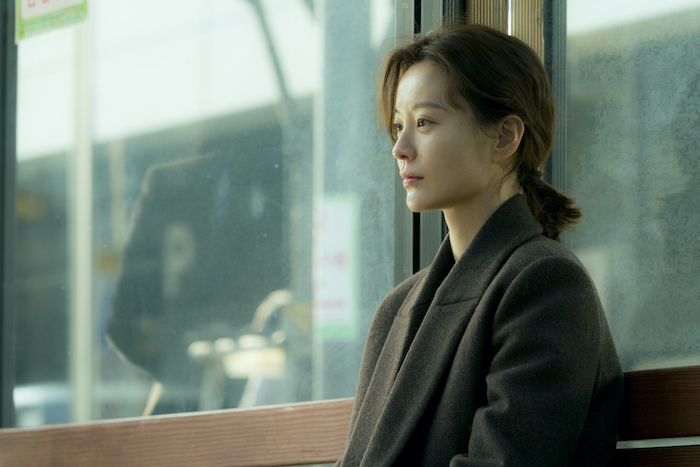
Though I haven’t read Cho Nam-joo’s international bestseller, Kim Do-young’s film adaptation of Kim Ji-young, Born 1982 apparently differs in several significant ways. For one thing, much of the novel is presented as a case study of a patient, and the psychiatrist writing the study and treating the patient is a man. Here, the therapist is a woman, and she doesn’t figure that much into the story, at least in terms of screen time. I’m assuming that the director, who is a woman, decided that the audience would be more comfortable with a woman treating another woman, since the psychological problem at hand springs from a sense of desperation born of the patient’s status as a woman in Korean society. Kim Ji-young (Jung Yu-mi) is a full-time mother/homemaker when she is introduced in the movie, standing in a park with her 2-year-old daughter eavesdropping on a conversation among a group of office workers on their lunch break complaining about “roaches,” a derisive term for stay-at-home moms who have lots of free time and disposable money to lay around. It sets Ji-young’s neuroses off, since she did have a full-time job and career goals but circumstances eventually conspired to place her in her current situation, which is causing her confusion and frustration. 

Ji-young’s husband, Dae-hyon (Gong Yoo), is not a sexist creep. He’s fully supportive of his wife and despairs that he may not be doing enough to help her around the house and raise their child. But it’s difficult for him to break out of his self-image as a breadwinner and head-of-household, since it’s one that was constantly instilled in him growing up. He is the one who first notices that Ji-young occasionally falls into dissociative episodes where she suddenly becomes someone else (usually from her past), and he tries to get her to see a therapist. At one point he breaks down in front of her, feeling guilty that he may have been the cause of his wife’s problems, and says he will do more to “help” her. She looks at him and asks why he thinks he needs to “help” her? This is his home, too. That toddler is his daughter, too. They are in this together.

Ji-young’s problem is easy to diagnose. She belonged to the first generation of South Korean women who entered university and later the work force ostensibly on an equal footing with men. Unfortunately, the social environment didn’t keep up with this progressive ideal. The story contrasts Ji-young’s situation with that of her mother (Kim Me-kyung), who gave up her own dream of becoming a school teacher because she had to work full-time as a teenager in order to make money to help her two older brothers go to college. When Ji-young gets a job with a prestigious ad agency after graduating, her mother cheers the loudest. But when Ji-young marries she becomes the daughter-in-law to a woman with more conventional views of family like. Initially, Ji-young and Dae-hyon decide not to have children, but pressure from their parents eventually turns that around, and once the baby is born Ji-young finds that the pressure to conform only gets stronger. She’s the victim of countless micro-aggressions from everyone around her to put her child above her career, and after trying to balance the two she quits her job.

But while the story hits all the proper notes (sexual harassment, pay gap, male defensiveness) with great care and thoughtfulness, the movie itself never fully commits to the darkness in Ji-young’s soul, which, again, seems to have been one of the reasons for the novel being such a powerful indictment of Korean (and, by extension, world) society. The scenes are like a parade of passive-aggressive demonstrations occasionally punctuated by rays of sunshine so as not to get too bleak and hopeless. And I wonder if Ji-young’s eventual turn to writing herself, first as a form of self-therapy and then as a financial gambit, was in the novel. From what I understand, Cho wrote the book in a period of several weeks out of a sense of frustration, so it makes a certain amount of sense, but as it’s presented it seems more like a convenient way to tie up loose plot ends. 

In Korean. Now playing in Tokyo at Marunouchi Piccadilly (050-6875-0075), Shinjuku Piccadilly (050-6861-3011), Shibuya White Cine Quinto (03-6712-7225).

Kim Ji-young, Born 1982 home page in Japanese

photo (c) 2019 Lotte Entertainment

Posted in Uncategorized | Leave a comment

Media Mix, Oct. 4, 2020

Here’s this week’s Media Mix about the media’s role in helping Yoshihide Suga attain the premiership. As implied in the column, the press didn’t actively boost Suga but rather stood aside and just let the Liberal Democratic Party propaganda machine do its thing. Their laissez faire attitude sprung from both familiarity with Suga and a feeling of intimidation cultivated over his long stint as Shinzo Abe’s spokesperson, and from all indications that style of spin will continue unchanged during Suga’s own term as prime minister. What will be interesting—not to mention frustrating—is Suga’s penchant for reticence, which he developed quickly as chief cabinet secretary. When he first assumed the post he reportedly was more sincere in trying to answer reporters’ questions, but then found he wasn’t cut out for the kind of spontaneous expansiveness that is necessary for a public figure who is asked to explain policy and other niceties of government. As with many Japanese politicians (and journalists, for that matter), he is lost without a script, and soon succumbed to this reality by becoming tight-lipped and pugnacious. During a discussion of the matter on the web program Democracy Times, several reporters related Suga’s favorite two rejoinders during press conferences: “I don’t have to answer your question” and “I already talked about that.” Since these interactions mostly took place out of the public’s sight, they didn’t cause problems and Suga got away with them. It remains to be seen if he can maintain such behavior out in the open as prime minister.

It seems as if he at least is going to try. He avoided debating Shigeru Ishiba, a skilled talker, during the campaign for LDP president because he knew he would look bad in comparison. Reportedly, NHK was quite angry when he pulled out of a TV debate at the last minute, saying that he had to be on standby because of an approaching typhoon. Reporters invariably describe him as even more authoritarian than Abe is, a function of his discomfort with delegating responsibilities. He doesn’t have much of an imagination and has trouble thinking of the big picture in terms of policy, but once the party reaches some kind of conclusion about a matter he knows exactly how to make things work in their favor. That’s why he’s cultivated the media so diligently over the past 8 years and why he’s so shameless in bending the bureaucracy to his will. (He’s set up a system in which he can unilaterally have a civil servant transferred out of a powerful post if he does something to displease Suga) Shigeaki Koga, the former METI official who is now a full-time government critic, has said that it was Suga who got him let go from his regular pundit position at TV Asahi’s “Hodo Station.” Supposedly, he also was instrumental in getting Hiroko Kuniya, the long-time host of NHK’s popular news show “Closeup Gendai,” removed after she asked him questions on air that he wasn’t prepared for. That, of course, is the thing that Suga hates the most, and he will continue avoiding any confrontations that require him to speak off the top of his head. That may sound difficult to pull off, but Abe successfully created an environment where the prime minister was shielded from potentially embarrassing encounters, unlike Junichiro Koizumi who, as prime minister, was happy to chat with reporters and show off his limited but nevertheless pointed erudition. Now that Suga has both the bureaucracy and the media in his pocket, he knows he doesn’t have to answer directly to anyone, which is why he was so bold in his rejection of those 6 scholars who were nominated to the Science Council of Japan because they opposed certain government policies in the past. It’s also why he can appoint a journalist who has been critical of the administration to his inner circle. Keep your friends close but your (potential) enemies even closer. 

Posted in Uncategorized | Leave a comment

Review: The Asadas

The true story of photographer Masashi Asada and his Mie Prefecture family, who were and presumably still are the main subject of his award-winning pictures, provides such a smooth dramatic arc for a movie that early on you begin to wonder how much was elided. As played by Kazunari Ninomiya, Asada is an amiable iconoclast, someone who is passionate about his art but not particularly intent on the work involved. His success is more or less accidental since he doesn’t actively apply himself to getting his photographs out there, and the viewer develops the feeling that he relies on his family for subject matter simply because it’s easier. Director Ryota Nakano depicts Masashi’s progress as a creative soul with the kind of comic aloofness you’d expect from someone like Robert Zemeckis, if we were to use a Hollywood cognate. If that seems like a cheap reductionist rhetorical gambit, it’s important to note that the aforementioned dramatic arc was something that Hollywood perfected in its heyday, if not outright invented. 

So Masashi’s mildly antisocial bona fides are conveyed by his tattoos and, reactively, by his brother Yukihiro’s (Satoshi Tsumabuki) relentlessly disapproving comments. Yukihiro is the killjoy, the scold who walks the straight and narrow and had little confidence in Masashi’s ability to make a living from his art. Which isn’t to say he doesn’t love him. His parents (Jun Fubuki, Mitsuru Hirata), on the other hand, couldn’t care less about his putaro attitude, and love getting dressed up as gangsters and firefighters and sick people for his staged tableaux. Predictably, publishers of photo books — a rarefied but seemingly active subsection of the Tokyo publishing business — aren’t interested in “family photos” and it falls to an equally iconoclastic small press to finally bring out his book, which is simply called “Asadake” (The Asada Family). It sells next to nothing, but it does win a prestigious award, so you could say that Masashi is on his way, even if he relies on his girlfriend, Wakana (Haru Kuroki), for financial support.

But if his book isn’t exactly flying off shelves, it does give him a certain rep, and he starts a niche business taking photographs of other families at their request. This activity takes him all over Japan and eventually to Fukushima, where he makes friends. When the quake and tsunami strike, he rushes back to see how he can help, and eventually gets caught up in a project to reunite families with the photos and albums they lost in the flood.

The completion of Masashi’s journey not only as a photographer but also as a character worthy of cinematic recognition is so airtight that the movie as a whole is stifling. While there are a few well-staged scenes in Fukushima involving victims and loss that are emotionally affecting, overall the story feels as safe as milk. It’s an extremely comforting two hours in that you never once sense that, as a viewer, you will be confronted with anything that could be described as disturbing. Families are wonderful things, of course, but they make better movie subjects when there’s a bit of friction. 

In Japanese. Now playing in Tokyo at Toho Cinemas Hibiya (050-6868-5068), Toho Cinemas Nihonbashi (050-6868-5060), Toho Cinemas Roppongi Hills (050-6868-5024), Toho Cinemas Shibuya (050-6868-5002), Toho Cinemas Shinjuku (050-6868-5063), Shinjuku Wald 9 (03-5369-4955), Shinjuku Piccadilly (050-6861-3011).

The Asadas home page in Japanese

photo (c) 2020 “Asadake”Seisaku Iinkai

Posted in Uncategorized | Leave a comment