
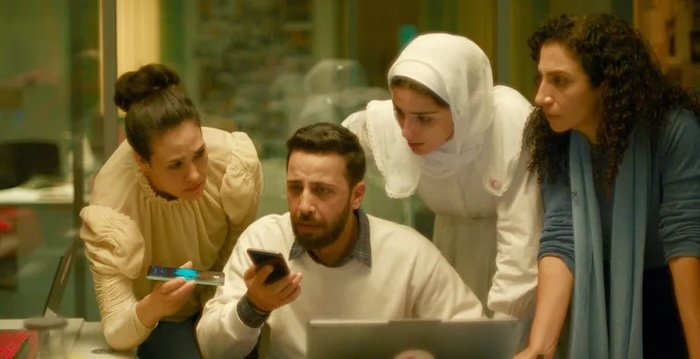
Tunisian director Kaouther Ben Hania has already proven herself to be an imaginative creator of documentaries with Four Daughters, a film in which she showed the real-life subjects of her story coaching actors who would play them in recreations of their experiences. The Voice of Hind Rajab takes this conceit to its next natural level. It is a wrenching dramatization of the events of January 29, 2024, as they unfolded in the offices of the Palestinian Red Crescent Society (PRCS) where workers tried to help the titular six-year-old girl via cellphone survive an Israeli attack in Gaza. Though what we see on screen is a minute-by-minute acting out of the story, much of the dialogue is the actual recording of the cellphone conversations.
The PRCS’s job in this case is “coordination,” meaning they receive calls for help from people inside the occupied territory and then assist them, but they are required to do this by working with the Israeli authorities, and through the Red Cross, no less, thus adding several layers of bureaucracy. Consequently, much of their mission is tangled up in red tape, which in this case proves deadly because the girl is the only survivor in a car full of relatives that has been hit by Israeli fire. The aid workers on duty must contend with a little girl using a phone with dodgy reception and surrounded by the corpses of her loved ones. Then they have to direct an ambulance to the site of the carnage to save the girl, but not before gaining permission from the Israeli Defense Forces to let the ambulance through. These various challenges cause extreme friction among the aid workers, including the front line operatives Rana (Saja Kilani) and Omar (Motaz Malhees), who talk directly to the little girl and pressure their harried supervisor, Mahdi (Amer Hlehel), to work around the IDF to get help to the girl as soon as possible. Ironically—or not, depending on your perspective—their task is complicated by the IDF’s tendency to jam signals from within Gaza.
Predictably, the film is unbearably tense, and not just because the voice we hear is that of a real, frightened child. Ben Hania keeps the action tightly focused on her main core of aid workers, so viewers have no chance to catch their breath; and her actors treat the whole endeavor accordingly, as a chamber piece where every character’s attention is fixed on one thing and one thing only. In addition, Ben Hania has to master her own tricky coordination, making sure the various non-recreated elements, like the real-time audio and video of the incident, are incorporated into the dramatization in a way that doesn’t make them a distraction. She does this mainly by occasionally cutting away from the artifice and giving us the actual footage of aid workers doing their job. It is aggressively present-in-the-moment, demanding you not forget what happened on that day.
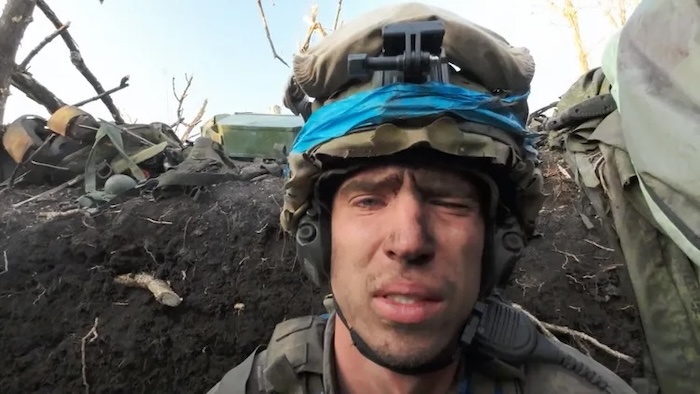
Presence in the moment is also the leitmotif of 2000 Meters to Andriivka, the latest documentary about the Russian invasion of Ukraine by AP reporter Mstyslav Chernov, which chronicles up close and personally a grueling inch-by-inch retaking of the titular village by a Ukrainian battalion in 2023. Chernov is embedded in the batallion and speaks to the audience in post-dubbed English voiceover, explaining much of what’s going on and even providing context about individual soldiers and the general tenor of the Ukrainian “counteroffensive” that the Andriivka mission is a part of. He has also fitted some of the soldiers with GoPro cameras to capture the action from their point-of-view. Unlike his narration of the Oscar-winning 20 Days of Mariupol, his tone here is distinctively muted, less optimistic about Ukraine’s chances as he watches the destruction firsthand from within the chaos of battle.
And “chaos” is the operative word. The terrain is unusually limited: a thin stretch of forest about 40 meters wide set between two huge mine fields that leads directly to the village. The forest already looks like the moon, with burnt trees and crater-like foxholes sometimes occupied by Russians who have to be removed one-by-one. The Ukrainian soldiers are uniformly profane and understandably terrified of their mission, and while they often talk about what they will do after Andriivka is secured (“I will sleep for two days”; “I am going to take the longest shower in history”) there’s that unmistakable quality in their voice that no actor could possibly mimic of talking through their terror.
2000 Meters to Andriivka is essentially the opposite of The Voice of Rind Hajab in that not only is nothing recreated, but the realness of the images and the sound become overwhelming. Bullets whizz by, clumps of dirt fly up into the camera lens, grenades go off a short distance away, and men scream. They scream a lot. More significantly, the exhaustion of being always afraid, contained rather obviously in Chernov’s voiceover, is a constant that can’t be erased by anything. Is it all worth it? Chernov implies that these soldiers are here because they feel they have no choice (“I came to fight, not to serve,” says one), because whatever their leaders in Kyiv and their enemy in Moscow decide, they will not rest until all Russians are out of Ukraine. The movie thus adds another layer of exhaustion to an inexhaustible war.
The Voice of Rind Hajab, in Arabic and English, now playing in Tokyo at Shinjuku Musashinokan (03-3354-5670), Bunkamura Le Cinema Shibuya Miyashita (050-6875-5280), Cine Switch Ginza (03-3561-0707).
2000 Meters to Andriivka, in English, Ukrainian and Russian, now playing in Tokyo at Toho Cinemas Chanter Hibiya (050-6868-5001), Shinjuku Musashinokan (03-3354-5670).
The Voice of Hind Rajab home page in Japanese
2000 Meters to Andriivka home page in Japanese
The Voice of Hind Rajab photo (c) Mime Films-Tanit Films
2000 Meters to Andriivka photo (c) 2024 Dogwoof

