
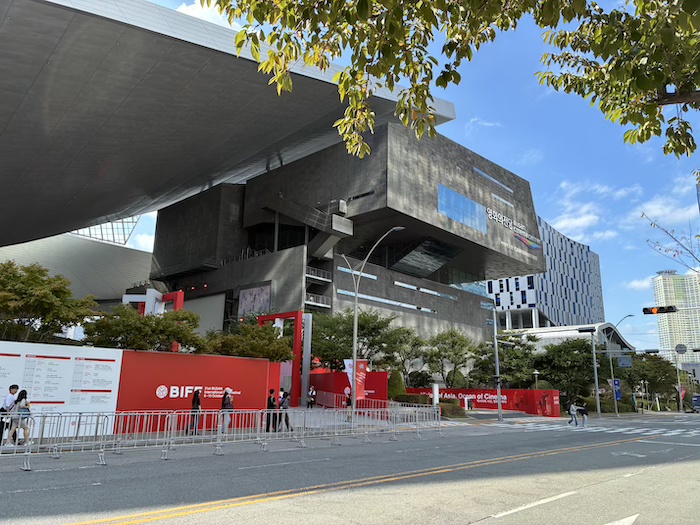
I was finally able to see Ryusuke Hamaguchi’s All of a Sudden yesterday at the only screening that would be taking place while I’m in Busan. I had missed it when it opened in Japan and, since it is mostly in French, decided it would be better to see it with English rather than Japanese subtitles. Of course, I was unable to get tickets through the guest ticket system, so I arrived early to wait in line for any empty seats. And it’s a good thing I got there early. More than 20 people ended up in line. I was #3, and when they finally counted the empty seats 15 minutes after the film started there were only 5, so I made it.
Fifteen minutes is a fairly big chunk, but All of a Sudden is three hours and 15 minutes, so not as big a chunk, relatively speaking, as it would be for a shorter film. It’s easy to get into, especially in the beginning, which takes place at a for-profit nursing home in Paris, where the manager has implemented a care system that privileges the elderly person’s “humanity” by treating their dementia seriously and adjusting the care to make sure they are not only comfortable but also engaged. The conflict arises when money comes into it, not to mention human resources, because the caregiving staff have to be trained to carry out this system and that takes time and money that the owners don’t want to spend.
However, that’s just the starting point. The manager, Marie-Lou, is understandably frustrated by the pushback she gets when trying to make the system work and by accident meets a Japanese director, Mari, who is staging a theater piece in Paris. The theater piece deals with the idea that the so-called insane are not really that different from so-called normal people, and it speaks directly to Marie-Lou’s predicament. She corners Mari and they have a long discussion into the night that takes in everything from late stage capitalism (complete with white board presentation) to the behavioral changes that accompany aging. As it turns out, Mari is at the end of her own life because she has stage 4 cancer and could die at any time (thus the title). Some of the movie’s narrative premises are, on the surface, outlandish (both principals are fluent in each other’s language), but Hamaguchi makes them work through the strength of his convictions. In the end, it is simply a moving story about the bonds of friendship, and how they can actually transcend life itself.
I also saw two Iranian films. The first, Majid Majidi’s Midday Meal, is in the Competition Section and seems to have a good chance of winning, given the buzz around it. There aren’t that many Iranian fiction features at this year’s festival, and some of them were made outside of Iran because of either their subject matter or the director’s status vis-a-vis the government. Majidi’s movie seems relatively safe in that regard, and harkens back to the classic pre-millennial Iranian cinema, which addressed social problems by subsuming them in children’s stories. Midday Meal is about a village teacher who struggles to keep his school open after the regional “benefactor” cancels their support for school meals. Most of the kids, it turns out, are mainly coming to class for food, and once it is not longer available, they drop out, thus threatening the school’s existence, because the education ministry won’t fund a school if the classroom size falls below a certain number.
The teacher desperately tries to raise money so that he and his mother can feed the children themselves, and the movie credibly sets up one barrier after another to make these projects more and more difficult. In the end, the teacher resorts to subterfuge that feels almost immoral, and Majidi keeps the stakes high. It’s a great script, one that never feels strained for credibility despite its desperate reach for melodrama.
The other Iranian film was completely different. Head to Head was made by a woman director, and the film’s protagonist is also a woman director, who is making a samizdat film at a relative’s residential compound featuring men wearing women’s clothing. The plot of even concept of her film is never explained, but she insists that the male actors stay in costume even while off camera, a directive that eventually makes them annoyed since the scarves on their heads are so stifling. That, in fact, seems to be the director’s point, and she becomes dictatorial in her insistence that they never remove their scarves. At first, this dynamic is played for all its comic potential, but about halfway through, after a police raid (mainly to arrest the female crew, who go about their jobs without any headwear; and not the men in hijabs, who, as it turns out, aren’t breaking any laws), the story turns serious and even scary. Though I’m pretty sure the movie was made in Iran, it would have had to have been made in secret, like the film-within-the-film. And it is pretty provocative.
The last film I saw was Revolving Lanterns, a Japanese documentary about a man who returns to his home town in Fukushima Prefecture after many years living in Tokyo. The earthquake and tsunami convinced him that he needed to reclaim his roots, but his town is in the mountains, and only contains 500 people, 70% of whom are over 65. I was expecting a fairly stylized, even abstract treatment of the area’s natural beauty, but it’s mostly the director hanging around old folks and getting their opinions on life in Fukushima and life in general. It’s very well made but has little value beyond its ability to capture a very small community’s vibe, which turns out to be not that special. It could easily be shown on NHK, though I’m sure NHK would insist on more voiceover narration.

