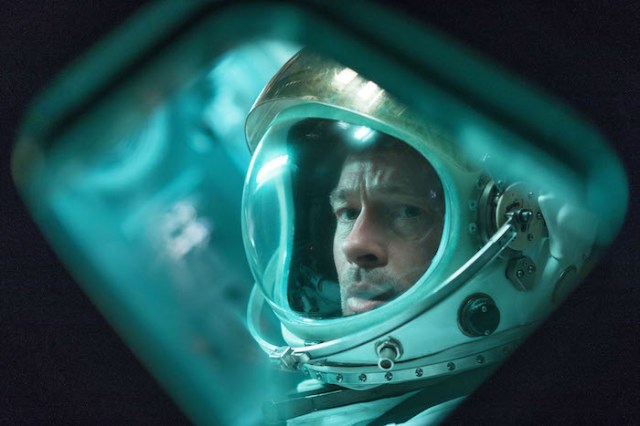
 The points of narrative and thematic convergence between James Gray’s last film, the old-school world explorer epic, The Lost City of Z, and his latest film, the old-school sci-fi potboiler, Ad Astra, are too numerous to ignore, but the main point of divergence—the respective stories’ grounding in objective truth—clearly demarcate them in terms of relatability. Lost City was, in part, based on a true story that has developed a patina of legend over the years, and Gray obviously felt some responsibility in keeping the known facts about the legend central to his storytelling. Being set in the future, Ad Astra demands no such adherence to known truths, rather only the kind of verisimilitude we’ve come to expect from sophisticated science fiction movies, and while Gray does an admirable job in this regard, he can’t quite build a story that justifies it all.
As with all such projects, Ad Astra owes a great deal to 2001, both in its focus on how technology springs from capitalist impulses and its use of a journey into vast space to plumb the human condition. Brad Pitt plays an almost impossibly capable astronaut, Roy McBride, whose failed marriage seems to belie a compromising, even-keeled temperament. In a harrowing opening scene, McBride is externally repairing an elevator that reaches from the earth to the ISS above the atomosphere when a “power surge” hits the elevator and throws McBride into freefall. Though he manages to survive, it is his preternatural cool that saves him, and we soon come to learn that his pulse rate rarely climbs into discomfort mode, regardless of the situation. It what makes him, despite his age, the ideal choice of his superiors to travel to Neptune to find the source of the power surge, which has killed thousands of people on earth. The fact that Neptune was also the place where McBride’s own father, Clifford (Tommy Lee Jones), disappeared years earlier on a mission to seek out extraterrestrial life complicates the matter, which is why McBride has to undergo psychological testing every few days as he makes his way from earth to the moon to Mars, where he finally fails the test owing to the possibility that he may encounter his father after having believed him dead for years.
There’s a lot to consider here, and Gray, whose best works are deep character studies of flawed men (his breakthrough, The Immigrant, centered on a woman, though it was the men around her who seemed more receiving of Gray’s attention), reinforces the script’s philosophical bent with distracting voiceovers from McBride that throw into question his outwardly chilly demeanor. Like the protagonist in Lost City, who obsessed over a mythical place that others didn’t believe existed, McBride is being changed by what he learns not only about his father, but the rationalization of humans’ need to journey out into the universe. As it stands, the problems of earth are simply extended out into the solar system. The movie’s numerous action scenes are tied to the idea that for-profit purposes still dictate our actions as we venture beyond our planet: McBride’s transport on the surface of the moon is attacked by “pirates” whose own aims are never really explained, and while exploring an abandoned ship on his way to Neptune McBride encounters a strange group of primates.
By the time he reaches his destination, he no longer possesses the presence of mind to withstand the truth he encounters, but Gray’s penchant for keeping key motivations unclear defeats the ultimate purpose of this odyssey. He wants to say that the kind of human bond represented by the relationship between a father and a son transcends such worldly concerns as maintaining socioeconomic systems or even safeguarding humanity, but he never quite gets the point over because, in the end, the human mystery remains. Why some people do terrible things can’t be explained with such a trite acknowledgement of the dangers of ambition. They say the journey is the thing, which is why, on the whole, Ad Astra works. But you’ve eventually got to get to where you’re going.
Now playing in Tokyo at Toho Cinemas Hibiya (050-6868-5068), Toho Cinemas Nihonbashi (050-6868-5060), Toho Cinemas Shinjuku (050-6868-5063), Toho Cinemas Roppongi Hills (050-6868-5024), Toho Cinemas Shibuya (050-6868-5002), Shinjuku Wald 9 (03-5369-4955), Shinjuku Picadilly (050-6861-3011).
Ad Astra home page in Japanese.
photo (c) 2019 Twentieth Century Fox

 Leigh Whannell’s seeming homage to David Cronenberg pits an analog holdover named Grey (Logan Marshall-Green), who likes to listen to blues music on vinyl and rebuild classic cars, against the already arrived cyborg technology that rules the rest of his life in this approximation of our immediate future. As it turns out, Grey is married to a woman (Melanie Vallejo) who is totally into tech, and, in fact, works for a company that has a huge stake in this brave new world of AI and total interconnectivity. Eventually, this clash of sensibilities comes to a head, and Grey is left paralyzed after an accident involving a self-driving car.
 Here’s
  Damsel-in-distress movies still exist, but these days women in peril tend to be the heroes who defeat malevolent forces rather than their victims; though in many cases the deadly force is not malevolent, but merely hungry. In this vein, the gold standard was the 2016 shark movie, The Shallows, which traded in jolts and gore for a simmering suspense fueled by the intelligence of survival. Like that movie, Crawl has a hero who is good with water—she’s a champion university swimmer—but while horror master Alexandre Aja foregoes the usual tactics, he doesn’t quite find a proper rhythm, and the movie feels slack even at 87 minutes.
 The most interesting thing about this pop star fantasy is that the Beatles estate agreed to license so many songs. McCartney I can understand, since he was always the band’s most fervent champion regardless of how his beloved “tunes” were used, but Yoko? In her dotage she seems to be slipping a little. Danny Boyle’s film, based on a script by the always annoying Richard Curtis, imagines a world without the Beatles, which, in fact, is pretty difficult to do considering how large the Fab Four figure in the history of the late 20th century—or in the 21st, for that matter. It’s a clever conceit as far as it goes, but Curtis and Boyle try to take it further with mixed results.
 Todd Phillips’ odd superhero gloss has a lot of distractions built into it, the most obvious one being its non-relationship to the Batman franchise (or franchises, depending on how doctrinnaire you are) as a feature that is only tangentially relevant to the Dark Knight. The other distraction is the way Phillips uses our collective movie memory of New York City in the 70s and 80s. It doesn’t matter if you weren’t there at the time or even if you weren’t born yet: if you’re a moviegoer you know the grungy production values that are de riguer for movies set in the pre-Clinton administration Big Apple. Here, of course, it’s called Gotham City, and Phillips’ main goal seems to be to ride us through analogues of all that era’s big crime stories, from Son of Sam to the infamous garbage strikes to the Bernhard Goetz shootings. His ability to connect it all to our current crisis of income inequality is a neat trick.
 It says a lot about this reboot that its focus on an origin story that seems quite different from the one put forward in the previous movies is barely coherent; or that it mostly does away with whatever it was Guillermo del Toro brought of himself to a beloved comic book to make it peculiarly cinematic. It’s essentially a faithful rendering of the grossest appeals of the source material beneath a coating of self-mocking humor applied with the broadest of paint brushes. Ron Perlman was no Brando, but his cagey, wisecracking style was perfectly suited to a superhero who is the actual spawn of Satan and understood the irony in the fact that he was working for the so-called powers of good. David Harbour gamely takes over under Neil Marshall’s direction and the only thing that makes an impression besides his razor-sharp cynicism is that, really, anyone could be underneath all that makeup and body latex.
 There are few segments in movies of recent memory that so starkly delineate the gulf between the director’s sensibility and that of their protagonist as the one that opens Eighth Grade. I don’t know how old Bo Burnham is, but it’s obvious that the technology ruling the life of his adolescent hero, Kayla (Elsie Fisher), is something he’s not comfortable with. Kayla, an awkward, shy, but also distressingly aware girl who is now in the eighth grade at a public middle school in a well-to-do California suburb, makes YouTube videos in her spare time that attempt to give advice to others her age on how to “put yourself out there” and “be yourself.” Her media skills will be impressive to anyone who came of age before the iPhone was a fixture of teen culture, though they come across as second nature for Kayla. In other aspects of social interaction, however, she’s seriously lacking, which is the point of Burnham’s movie.
 Here’s
  The person played by Rosamund Pike in this harrowing biopic is supposed to be American war correspondent Marie Colvin, who died in 2012 covering the civil war in Syria. However, early on there’s a sense that Matthew Heineman’s film intends to be the last word on battle-hardened journalists and the woman Pike plays could really be any battle-hardened journalist. With her alcoholism, inability to keep loved ones close, and obsession with being as close to danger as possible, she doesn’t even have to be a woman; which is to say, A Private War never really makes a case for Colvin’s storied cynicism and self-destructiveness because it’s all presented as a generic given.
 philipbrasor.com