
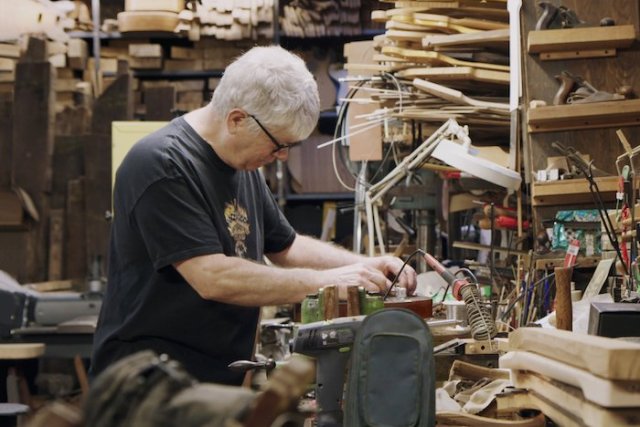
 As fly-on-the-wall documentaries go, Ron Mann’s small-scaled portrait of a venerable Greenwich Village guitar shop should make even Frederick Wiseman green with envy. Due to its location and hard won reputation, Carmine Street Guitars can expect quite a few celebrity guitar aficionados to drop in on a regular basis, which means all Mann had to do for the five days he shot the film was just hang out. There’s not a lot of explication in the movie—no voiceover or text cards—but Mann knows what the audience wants to know and is able to extract this information with as little prompting as possible.
And what Mann is after is not so much the “placeness” of the store and the prestige of its clientele, but the pursuit of craft for its own ends. There are only two employees, owner Rick Kelly and his apprentice Cindy Hulej, who describe how they custom make guitars for special players. What makes Kelly unique as a guitar maker is his attention to materials. He regularly patrols Manhattan looking for dumpsters with discarded wood from demolished buildings (“the bones of New York”), some with very long histories. He turns this wood into guitars, thus making a Carmine Street guitar more than an instrument; it’s a piece of local history, just like Kelly’s enterprise, which he’s been working at since the 1970s. Oh, there is a third employee: Kelly’s octogenarian mother, who answers the phones. She as much a part of this institution as Kelly is.
And while Mann wisely allows the detail of the craft to come through—how to improve resonance through resins, how burning improves resilience—he seems more interested in the idea of the shop, a commercial endeavor that still runs on its own steam and represents a calling that is as responsible for great art as the great art itself. When Nils Cline comes in to buy a guitar for his Wilco boss, Jeff Tweedy, he and Kelly bond over something inexplicable to the viewer but no less poignant, a flaw that makes one guitar tantalizing in its unexplored potential. The famous musicians who chat with Kelly are envious: they may have the glamorous life, but they don’t know themselves through their work as thoroughly as this master builder does. Carmine Street Guitars, both the movie and the store, represent heaven on earth.
Now playing in Tokyo at Cinema Qualite Shinjuku (03-3352-5645), Image Forum Aoyama (03-5766-0114).
Carmine Street Guitars home page in Japanese.
photo (c) MMXVIII Sphinx Productions
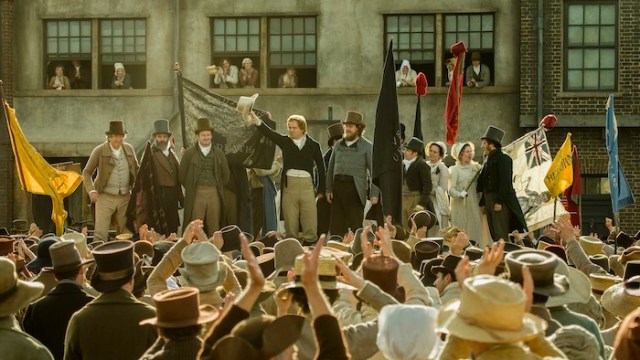 As he approaches the twilight of his career, Mike Leigh, perhaps the best and certainly the most idiosyncratic of British filmmakers, has increasingly turned to history to explore his feelings about what it means to be English. His two most prominent historical films, Topsy-Turvy and Mr. Turner, dwelled on the world of the arts, offering Leigh a means of looking at his position on the vector of creativity. His latest, however, is bitingly political, even polemical. It addresses an incident that happened on August 16, 1819, in the city of Manchester. A peaceful pro-democracy demonstration was attacked by British soldiers dispatched by local leaders. Dozens were killed and hundreds injured. Dubbed “Peterloo” because of its temporal proximity to the fateful battle that defeated Napoleon and the fact that it took place on St. Peter’s Field, the event, according to Leigh, should be taught to every British school child, but it’s mostly been lost to time. With his usual scrupulousness, he shows how the massacre came about and what it means for today’s world.
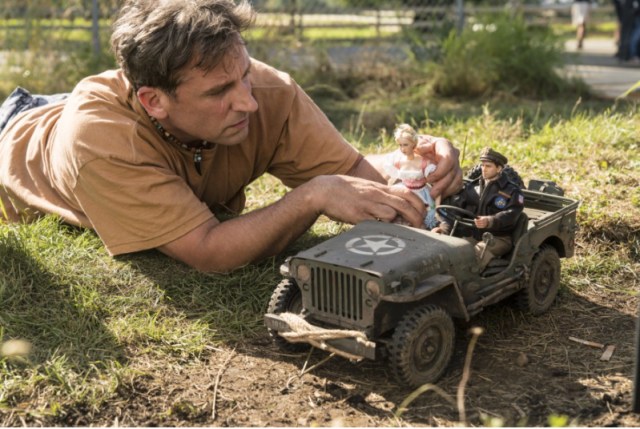 It’s easy to see why Robert Zemeckis was attracted to the true-life story of Mark Hogancamp. Zemeckis’s brief since the Back to the Future series has been fantasy that comments on who we are right now, “we” being invariably Americans. Hogancamp, an illustrator who lives in upstate New York, was assaulted by a group of neo-Nazis who objected to his cross-dressing habits and left him with scars, brain damage, and severe PTSD, all of which ended his career and deprived him of much of his memory. In order to cope, he turned to dolls, and interpolated his struggle into a World War II action tale about him and a group of multi-cultural female commandos taking on German soldiers. He would set up tableaux with the dolls and then photograph them. These photos were recognized as pieces of art and Hogancamp became famous, though the fame only worked to exacerbate his psychological problems—or so Zemeckis’s movie would have you believe.
 Here’s
  David Lowery’s career so far has produced one of the weirdest bodies of work of any young director: the 70s pastiche Ain’t Them Bodies Saints, the surprisingly affecting family-friendly fantasy Pete’s Dragon, and the ambitious occult-psychological study A Ghost Story. His latest, clearly a vehicle for Robert Redford to leave the acting profession on his own terms, has almost nothing in common with those three previous films except casting: Redford appeared in Pete, and Casey Affleck, who plays a police detective here, was in both Saints and Ghost (the latter, however, mostly under a sheet).
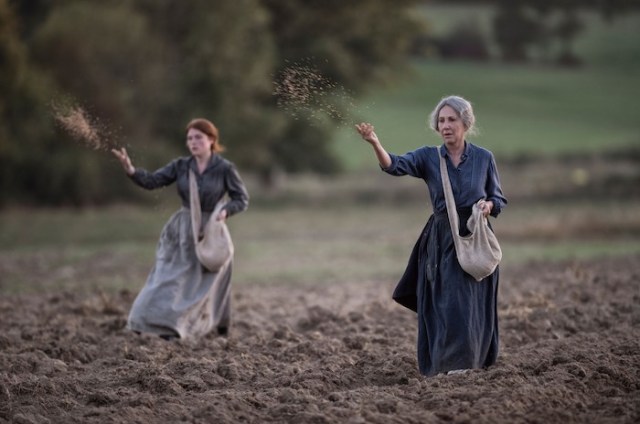 Xavier Beauvois takes an unusual approach to a war movie. Though he opens on a battlefield strewn with corpses during World War I, his film very rarely addresses the brute terror of warfare. Like Satyajit Ray’s memorable Distant Thunder, it mostly looks at the effect war has on those who are not at war, in this case the French farmers who continued to till the land during and after World War I. Not surprisingly, these farmers tended to be women, since the men were either fighting or already killed, and the special attention that women bring to agriculture is emphasized through action, word, and sensibility.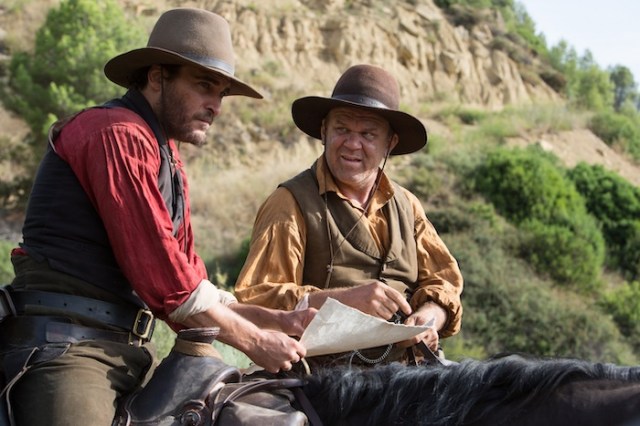
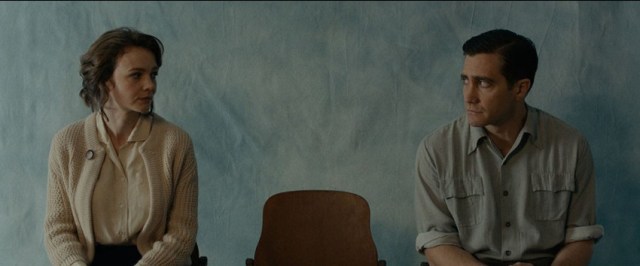 Actor Paul Dano took on a lot when he decided to adapt Richard Ford’s 1990 novel as his directorial debut. Dano does not appear in the movie, and neither does his significant other and co-scenarist Zoe Kazan, but there’s something of the pair’s storied flair for the quirky and unexpected in both the story and the way they pull it off. Ford’s book takes place in the 1960s, in a backward backwater in Montana, where a family of three has relocated. The father, Jerry (Jake Gyllenhaal), is a golf pro who has given up competition to take a job at a local country club. The town is overshadowed by a mountain that seems to be constantly on fire, a situation that’s the source of a lot of local black humor. The mother, Jeanette (Carey Mulligan), is a housewife who, at first, seems resigned to her fate of constant motion for the sake of her husband’s ambitions, which only go as far as his pride. The teenage son, Joe (Ed Oxenbould), is, according to Jerry, destined to be a distinguished football player, though Joe is so unassuming that you can’t imagine him giving or receiving a tackle.
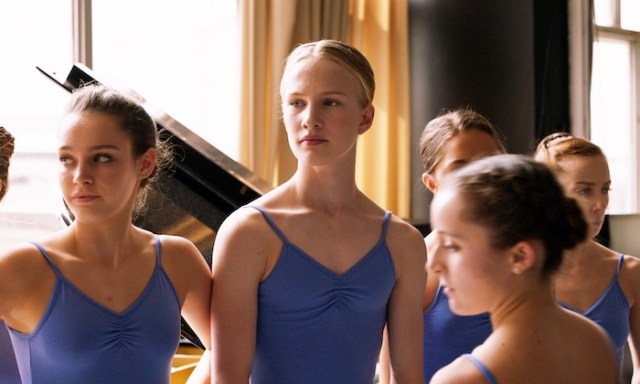 The movies are still conflicted when it comes to portraying LGBTQ individuals, not because the portraits are necessarily difficult to convey with sensitivity and honesty, but because the very act of representation is fraught. Heterosexual cisgender actors and actresses still mostly play the parts of gay, bi, and transgender individuals, and gay, bi, and transgender actors are justifiably upset, to say the least. The titular character in Lukas Dhont’s Girl, a young transgender woman trying to make it as a ballerina, is played by Victor Polster, a cisgender male, and while it’s not central to our appreciation of the movie’s merits to wonder if it might not have been better to have hired a nonbinary actor for the role, it’s difficult these days to dismiss the notion as you’re watching the movie, and that’s an unwanted and, for all intents and purposes, avoidable distraction.
 philipbrasor.com