
 According to Thomas Wolfe, you can’t go home again, but that doesn’t mean you can’t learn something in the attempt. I don’t know which country the 62-year-old Polish director Pawel Pawlikowski currently calls home—he left his native land for England when he was 14—but since returning to Poland to make films earlier this decade he has come into his own as a filmmaker with a cinematic style and narrative voice that are so distinctive he will soon have graduate seminars dedicated to his output. The movies he directed in the UK were accomplished and unremarkable, and it’s likely he started making movies in Poland—black-and-white “art films” in the old boxy aspect ratio—to rejigger his mojo in late middle age. Ida (2013), his first genuinely Polish film, won the Academy Award for Best Foreign Language Film, and Cold War, his second, was nominated for the same award and probably would have won if Roma hadn’t been released the same year. Though Poland has produced some great directors and inspiring films, this pair by Pawlikowski already feel like the last word on the postwar cultural situation in Eastern Europe.
It’s not just hindsight. Films like Ashes and Diamonds, produced temporally closer to the events they depict, have an immediacy that actually obscures the filmmakers’ message. Both Ida and Cold War are partly inspired by Pawlikowski’s family history, so there is an emotional connection that is real but measured. In Ida, the director struggled with the tension between his Catholic upbringing and his Jewish heritage, and Cold War equally struggles with his parents’ separation when he was young, a separation set in motion by the political circumstances of the time. If it’s less dramatically fraught than Ida, it may be because Pawlikowski doesn’t have the psychological wherewithal to confront directly the horrible choices his parents had to make.
Wiktor (Tomasz Kot) is an accomplished musician who, in 1949, travels the countryside with his professional partner, an older woman named Irena (Agata Kulesza), and a kind of government-certified impresario named Kaczmarek (Borys Szyc), in search of Poland’s folk music heritage. They record songs and singers and then form a choral group called Mazurek to teach them the songs and dances they have recorded. The auditions bring forth a cheeky young woman named Zula (Joanna Kulig), who after performing a duet with a friend of an old folk song is asked by Wiktor to sing something solo. She belts out a brassy show tune she once saw in a Soviet musical. Wiktor is smitten.
Cold War is their love story, and it’s a stormy one. Though Wiktor seems almost resigned when it’s revealed that Mazurek will mainly be a propaganda vehicle for the Soviet-controlled Polish Communist party apparatus (Irena, disgusted, quickly disappears from the movie), Zula, who is clearly the ensemble’s most vibrant member, becomes increasingly annoyed at the strictures placed on her artistry, if not her personality. It is she who suggests they escape to the West while the group is performing in East Berlin (1952, the wall won’t be built for at least 8 years), and while Wiktor agrees in a seeming half-hearted manner, he shows up for the rendezvous and ends up leaving on his own, because the mercurial Zula gets cold feet at the last minute.
The story jumps to 1954, Paris, where Wiktor plays jazz piano in a nightclub and lives in bohemian splendor with his free-loving French paramour. Zula visits him when Mazurek comes to town, and though it’s as if they were never apart, they don’t stay together. Zula cannot quite make the break, even if her dismay with the kind of kitsch she has to perform is palpable.
The movie continues in this elliptical manner, jumping years and locations—Yugoslavia, back to Paris, back to Poland—and Wiktor and Zula’s love for each other never tempers. If anything, the vicissitudes of holding on to your values, not to mention sanity, in the face of such nationalist self-annihilation, forces them to admit that they only have each other in this world. Their journey is not a happy one, even during an unusually prolonged period when both seem to be achieving the professional success they always wanted. What they don’t have is a place to call their own, because it’s been highjacked by brutes.
Much has been said of Cold War‘s look, its pristine monochrome textures and uncanny ability to isolate individuals in crowded settings (the change in expression on Zula’s face when she notices Wiktor sitting in the audience while she performs with Mazurek is one of the most startling things you will ever see in a movie), but these aspects are mostly gravy. It’s Wiktor and Zula, as both characters and physical objects, who hold you spellbound, and if the movie feels as if it needs to go deeper to do justice to their story, it may simply be that Pawlikowski couldn’t go that far. Some stories are just too painful to tell.
In Polish and French. Now playing in Tokyo at Human Trust Cinema Yurakucho (03-6259-8608), Humann Trust Cinema Shibuya (03-5468-5551).
Cold War home page in Japanese.
photo (c) Opus Films Sp. z o.o./Apocalypso Pictures Cold War Ltd./MK Productions/Arte France Cinema/The British Film Institute/Channel Four Television Corp./Canal+ Poland/EC1 Lodz/MazoweickiInstytutKultury/InstytucjaFilmowaSilesia Film/Kino Swiat/Wojewodzki Dom Kultury w Rzeszowie

 The flaw in the X-Men saga that outsiders can’t quite get past is the mutant pretense that is its whole reason for being. Though the idea of mutants being social outcasts despite their super powers and tendency to use them for good is a powerful one, the kind of poetic license exerted in describing those powers becomes strictly arbitrary after you sample a few characters. It’s as if the creators simply make up an ability that fits whatever story they wanted to tell, and after a while you have so many super powers that there seems little point in extrapolating on them.
 Here’s
  Young people in Japanese and Korean indies often evince a distinct cognitive dissonance, purposely rubbing against the stereotype of the good son or daughter in the Confucian tradition. Those of us who are not Japanese or Korean may feel cut off: Adolescent disaffection is universal and perhaps more acute in a social milieu that distinctly places greater value on family cohesion, but there’s usually the feeling that the filmmaker is trying to make their point by exaggerating certain attributes. Hikari, the narrator of Makoto Nagahisa’s debut feature, is a 13-year old video game addict who has just lost both parents in a bus accident and feels nothing. Actually, scratch that. He betrays some relief, because he obviously didn’t love his parents, and the sentiment may have been mutual—to call Hikari an unreliable narrator would be an understatement.
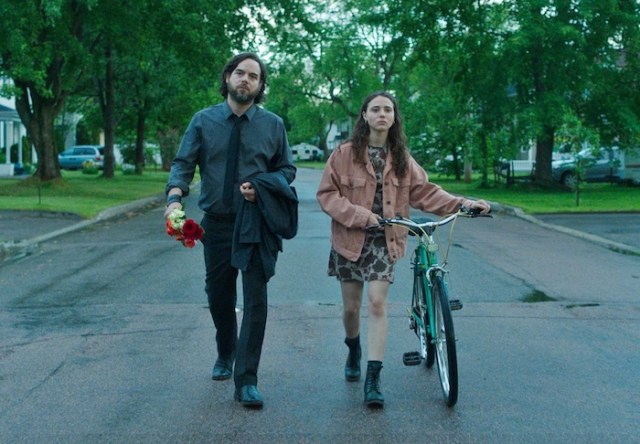 Disaffected youth is a currency that filmmakers never tire of trying to exchange in hopes of finding a theme that suits their world view. Everybody was young once, and if experience counts for a lot when telling a story, the coming-of-age tale has built-in advantages. In this small Canadian film, the director is a man and the protagonist an 18-year-old girl living through that magic hour of adolescence, from the last month of high school through to the end of the subsequent summer. Leonie (Karelle Tremblay) is typically skeptical about everything in the ways of cinematic teen heroines. She bristles whenever an adult confronts her with her future. “I’m only 18,” she spits back. “I have plenty of time to decide.” Her bad attitude is manifest right off the bat when she bails on a restaurant meal in her honor hosted by her mother (Marie-France Marcotte) and stepfather (Francois Papineau). She pretends to use the rest room and then walks out the door and catches a bus.
 Disney’s latest live action—or, more precisely, CGI-assisted—remake of a beloved animated classic hits perhaps too close to home in my case. The original Aladdin was the first movie I reviewed for a print publication, albeit in capsule form, and the memory of seeing it at my first-ever press screening is indelible, though that movie was so overwhelmed by Robin Williams’ participation that, other than the simple, crowd-pleasing plot, little of the film itself made much of an impression. Seeing the new version, I now attribute this perceptive gap less to the passage of time than to Disney’s generic storytelling style. Suddenly, all the things I liked and disliked about the original but had forgotten about came flooding back, but it was a weird kind of nostalgia. Except for Williams, have things changed so little since 1992?
 There’s something refreshingly irreverent about Hiroshi Okuyama’s debut feature, but it’s not in the Japanese title, which translates directly as “I hate Jesus.” Appropriately small-scale in both production values and ideas, the movie posits Christianity as an object of curiosity. People of faith will find it quaint at best, while the rest of us may think it’s grandly pulling a leg or two, though in spots it reveals a disarming seriousness. If, in the end, it doesn’t say much about organized religion, it does say something interesting about the cult of Christ.
 At one point at the beginning of Frederick Wiseman’s monumental documentary about the New York Public Library, someone basically calls it a holy place for secular people. That’s a fair description of any library, but New York’s is special in that it not only provides the largest research resource collection of almost any institution in the world, it actively involves its users in the life of the city’s vast culture. Entering the huge, beautiful main branch at 5th Avenue and 42nd Street, with its famous marble lions and elegant wood paneling, is like entering the city’s soul—the good ecumenical soul that should be at the heart of every great city’s endeavor.
 philipbrasor.com