

Sorry we’re such wusses
Here’s this week’s Media Mix about the recent tabloid coverage of Becky and SMAP. The headline chosen by JT is perhaps misleading in that it conflates the two “scandals” along the same lines, but if you read the column you can see that while both “acts” have the same provenance within the Japanese show business world, their respective problems have nothing to do with each other. Becky’s is a typical sex scandal, while SMAP’s is mainly existential—Should I stay or should I go?
But they are similar in the sense that, regardless of how deeply the problems affect Becky and the members of SMAP personally, it all comes down to money. Becky’s value to her management company is dependent on maintaining her pure image, so if that image is damaged in any way her value is diminished, and various media reports are now saying the scandal could cost Sun Music upwards of ¥500 million in lost revenues for TV commercials and penalties paid to the companies who use that image. With SMAP the money trail is a bit more circuitous but the numbers are nevertheless impressive. Shukan Bunshun, always a thorn in Johnny Kitagawa’s side, reports that SMAP’s fan club, which has close to 1 million members, brought in ¥4 billion in 2014 in membership fees alone. Tickets sales for concerts amounted to ¥9.5 billion; CDs and DVDs ¥2.3 billion. And then, of course, there’s the TV appearances, which grossed ¥6 billion. As a distinct business enterprise, SMAP made Johnny’s & Associates ¥22 billion in 2014, and that doesn’t even include licensing for SMAP-related merchandise, which is probably another ¥3 billion. Though Arashi is currently the most in-demand group in the Johnny’s stable, in 2014, at least, SMAP was the most profitable, accounting for one-fourth of the company’s revenues. Continue reading
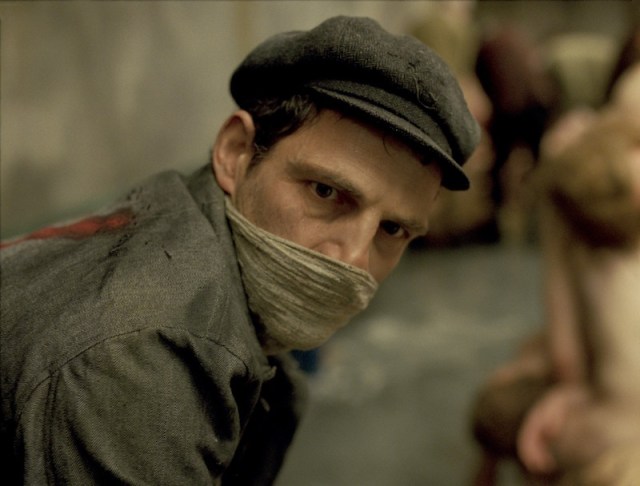 A winner at Cannes and favored contender for the best foreign language film Oscar this year, Laszlo Nemes’s debut feature is both formally audacious and thematically provocative, so much so on both counts that it’s difficult to absorb all the implications while sitting through the movie. Movies about the death camps start from a position of high tension, and making good on that tension is central to the value of the film. Nemes gears up our anxiety by throwing us directly into the horror. His protagonist, Saul Auslander (Geza Rohrig), is a Hungarian Jew assigned to be a Sonderkommando, an inmate who essentially carries out the labor at the Nazi death camps, in this case Auschwitz-Birkenau. Saul moves new arrivals into the gas chambers, clears out the bodies afterwards, and separates clothing and other valuables. Perhaps understanding that showing these atrocities would be overwhelming, Nemes chooses to keep his camera close to Saul, so that the horrors mostly occur on the periphery of the frame, but there is still the voices and other sounds—of barked orders, panicked victims, and various mechanical noises, all of which are sufficiently overwhelming in their suggestiveness. After fifteen minutes you want the projectionist to call a time out so you can collect your wits.
  Here’s
  In a word, this was a great year for hip-hop, as evidenced by the worldwide acclaim for To Pimp a Butterfly, a record I listened to a lot, and the only reason it didn’t land on this list was probably because in the last few months so many other albums pushed it out of my consciousness. That doesn’t detract from its value, but it does make it less of a presence in my world, which is what these lists are all about. It’s impossible to be objective about music, though it’s nice if you have the time to be able to try to be objective, but of all the albums on this list only the Future joint didn’t immediately grab me the first time I listened. In contrast, there were a few country albums I liked right off the bat–Alan Jackson, Maddie & Tae, Ashley Monroe, Jason Isbell–but they didn’t sustain themselves for as long as it took to make it to the end of the year, which isn’t to suggest I’ll never listen to them again. I didn’t really like the Kacey Musgraves album much when I first heard it and I still think the themes are too conventional, but her craft eventually got to me, just not enough to make me forget Brian Henneman’s. And, yes, I did splurge for the Dylan opus, but not the 18-CD version. What do you take me for?
  I don’t know if I saw fewer movies this year than last or more, and I don’t feel like counting to find out. For sure, there were a few I wanted to see that I didn’t, like Phoenix, which made quite a few critics’ lists, but as for Hollywood and bigger budget entertainments, I found that if I did miss press screenings I could usually count on them being shown at my local multiplex, which is ten minutes from my house by bicycle. They have late shows for only ¥1,300, and Thursday is “Men’s Day.” Tomorrow, I’ll turn 60, which means…well, no need to get anal about it. It’s been so long since I’ve regularly seen movies in a theater rather than in a screening room that the occasions when I do have become special. What’s weird is that whenever I go to the multiplex, I’m usually the only person in the theater, which makes me wonder how they can possibly stay in business. Of the movies on the following list, only one was watched in a movie theater. I almost included Mad Max: Fury Road, another movie I saw in a theater, but since I never wrote about it I hadn’t really considered why I enjoyed it. In a sense, its appeal was centered on how resistant it was to analysis. I get the stuff about female power and George Miller’s talent for comic violence, but those points seem tangential to the movie’s effect, which is purely visceral. It would be like saying, I loved the movie because I got to see it on a huge screen with kickass sound in a theater I had to myself. It has nothing to do with the movie and everything to do with “the movies.”
 Product
 About Ray
 Here’s
 Purpose
 Art and Craft
 philipbrasor.com