
 Here’s this week’s Media Mix, which concerns that anonymous blog post about the daycare shortage. An interesting footnote about Shiori Yamao that I didn’t learn until after I wrote the piece is that she once played Little Orphan Annie in a local version of the Broadway musical when she was much younger. I’m not sure if the experience gave her any special insight into the problems covered by the column–orphans and at-risk children are less of an issue here than over-burdened parents–but it certainly must have honed her public speaking skills, which are always in evidence whenever she stands up in the Diet.
As pointed out in the last section, the main difficulty to overcome with regard to the daycare shortage is the attendant shortage of human resources, caused mainly by the low pay involved. (As some have pointed out, the reason nursery school teachers get paid so poorly is that it is considered women’s work, but that’s an issue that deserves its own distinct discussion.) Whatever solutions the government comes up with in the short run to give it some traction before this summer’s elections, none of them will make much of a difference if they can’t get more daycare workers on board. And the only solution that I can see to that problem is for the government to make all workers government employees. After all, we’re talking here almost exclusively about public daycare services, which are run bureaucratically. For the most part, public daycare is set up and funded by local governments, who have limited budgets, so if the LDP wants to take a stand for working mothers they have to do something on the national level. There has been some talk about giving subsidies to public daycare centers that will go directly to workers, but they’re only talking about an extra ¥10,000 a month or so. Since public nursery school teachers are civil servants, governments should pay them civil servant wages, which tend to be better than those earned by private sector employees. Local governments are not going to be able to cover this outlay, so it’s up to the central government. Though it would be a huge amount of money, it would solve the problem. The fact that no one on either side of the ideological divide has suggested it probably means it’s a political non-starter, but isn’t that always the situation?
 Here’s
 The Catastrophist
 The Big Short
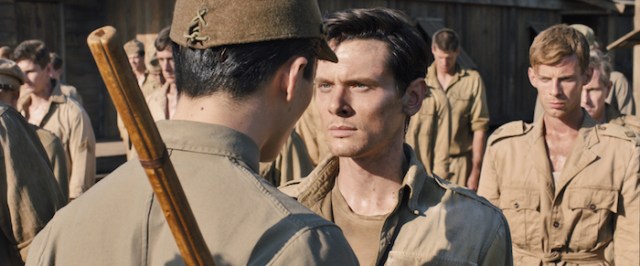 As has been well documented, at least by the non-Japanese press, Angelina Jolie’s epic Hollywood retelling of the life of Olympic runner Louie Zamperini was not picked up by the usual Japanese distributor for Universal Studios product due to fears that right wing elements would make a stink about the film’s purported “anti-Japanese” slant. If the negative light this story shed on the Japanese movie industry was dimmed somewhat, it probably had more to do with the fact that foreign critics, not to mention American audiences, were cool about the movie. To a certain extent, the publicity stems from Jolie’s celebrity status and its somewhat paradoxical relationship with her intentions as a director. Her first film, after all, was set during the Bosnian conflict and featured unknown actors speaking in languages other than English. Unbroken isn’t quite as pure-of-purpose. It’s very much a big budget production, and while there are no famous faces on the screen, it has the melodramatic heft of a Tinseltown biopic. In that regard, and given Jolie’s popularity in Japan, it could have been a moderate money maker here, though I’m not sure if that explains why a distributor normally associated with European and Japanese art films took the risk of releasing it.
  Ben Cotner and Ryan White’s documentary, produced for HBO, immediately sets its priorities and its outlook. As the title forcefully suggests, the movie is a polemic against Proposition 8, the California state initiative to repeal legal same sex marriages, and which won in a 2008 referendum. That was the same election, the film notes, that brought Barack Obama to the highest office in the land. As journalism, the movie’s steadfast position in opposition to the particulars of the proposition would seem to make it less than objective, but Cotner and White gave themselves the luxury of covering the lawsuit that eventually annulled the election results, and which took five years. In that regard, the film is an invaluable investigation into how the American consensus on same sex marriages changed over time.
 In Japan, real estate agents are by law required to inform potential renters or buyers of murders or suicides that occurred in properties under consideration, though if someone died there of natural causes no one has to say anything. In any event, if you look at an apartment that seems unusually cheap, it might mean the last tenant threw himself out the window—or worse.
 It must be contractually mandated that every movie in which Morgan Freeman appears he has to provide folksy voiceover narration. He does it in this bittersweet domestic drama, though there isn’t a whole lot of need for it. The situation is easy to grasp and hardly requires elaboration. Freeman and Diane Keaton play Alex and Ruth, an elderly couple who have spent their whole married life in a 2-bedroom Brooklyn apartment. Since it’s a walkup and they live on the fifth floor, they decide, at the urging of their realtor niece, Lily (Cynthia Nixon), to sell and move somewhere closer to the ground or, at least, to a building that has an elevator because they won’t be able to handle stairs forever.
  As the Oscar nominations for The Big Short testify, the 2008 economic collapse continues to provide raw meat for heavy-duty dramas, as well as comedies of the blackest sort. 99 Homes gets down to the bone of the matter, since it’s concerned with the housing bubble that started the whole disaster. Set in Orange County, Florida, where rampant building in the late 90s and early 00s created a surplus of mini-mansions and put the notion in every existing homeowner’s head that his property was a bottomless gold mine to borrow against, Ramin Bahrani’s tale isn’t subdued enough to qualify as a cautionary tale. Though the losers who find themselves at the mercy of ruthless real estate agent Rick Carver (Michael Shannon) might provide lessons in reckless American financing, Carver’s unabashed opportunist does not, as some have analyzed, represent the 1%. What he actually represents is that element which sees through the sorrow and the pity of any economic disaster and finds a way of making money out of it. And for what it’s worth, Shannon is the perfect actor to play this land shark. His mush mouth delivery and rough features telegraph the man’s callous disregard for anyone stupid enough to have been caught in the racket the banks perpetrated on the public. He shows up at foreclosed homes with his paid cop pals and throws people out, along with their furniture and whatever shred of dignity they have left, without the slightest twinge of remorse. If anything, he implies they deserve it, not for being deadbeats but for being dumb.
  philipbrasor.com