Media Mix, Sept. 25, 2011

Here’s this week’s Media Mix, which is about welfare rolls swelling with large numbers of unemployed men who seem to have no will to work. One of the implications of the NHK special from which much of the column was derived is that there are jobs out there but that these men are either unqualified for them or not motivated enough to make whatever adjustments are necessary to secure them. When I first came to Japan and taught English to company employees on a contract basis, most of my students were university graduates, but except for the engineers they had learned practically everything they needed to know for their work on-the-job. At the time, this practice seemed wasteful. Why spend all that money and intellectual effort striving for and then earning a college degree when, in the end, your company was going to supersede it all with its own training and “corporate culture”? Eventually, I came to understand that the university experience had two purposes in the larger scheme of Japanese corporate business. It provided recruiters with a filtering system, a means of pre-evaluating potential employees based on which university they attended, since they all knew what it took to get into certain schools. And it also prepared these so-called corporate warriors for the life of a salaryman, which had as much to do with loyalty (to one’s school, to one’s company) and comeraderie as it did with being a productive worker. Being an American raised on the sanctity of self-determination, I didn’t find this model of employment appealing, but I quickly grasped its value in the larger scheme of Japan’s industrial mission, which was a direct reaction to the postwar trauma of trying to rebuild from literally nothing.

Once the mission was accomplished by the mid 1980s, this model became economically cumbersome, and in any event was seriously undermined when the bubble burst in 1990. Since then, corporate culture has gradually taken the more widely held laissez faire approach to employment, meaning, in the crude American parlance, “Show me what you got.” Experience, by implication a resource based on proactive involvement, is now more important than a willingness to give oneself over to a circumscribed group. It is still a notion that many Japanese workers, even younger ones who entered the job market well after the storied “lifetime employment” system had already become moribund, can’t quite get their heads around. The problem is, even the authorities don’t seem to grasp the full scope of the problem. Retraining is one obvious solution, but education in Japan has always been a young person’s game. Once you’ve “entered society”–i.e., secured your first full-time job–it’s almost unseemly to go back to school, any school. That may explain why retraining programs in Japan seem like torture to the people who take them (or, at least, that’s my impression based on what I’ve seen on TV). But maybe I’m generalizing. I recently read that there are one million jobs in America unfilled because there are no qualified people for those positions. If that’s true, maybe it means Americans, whether they represent the public or the private sector, aren’t sufficiently behind retraining either. So the problem may have more to do with being old than with being Japanese.

Posted in Media | Tagged , , , | 1 Comment

Media Mix, Sept. 18, 2011

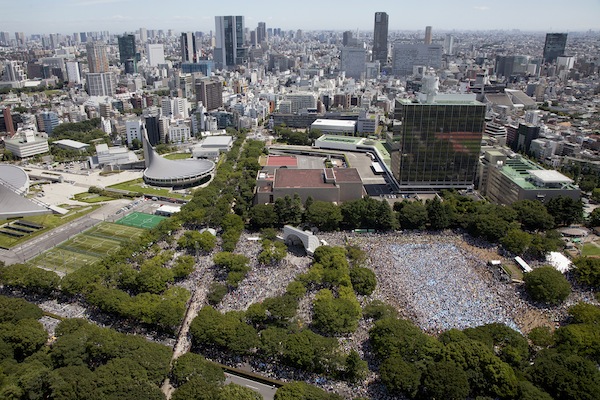
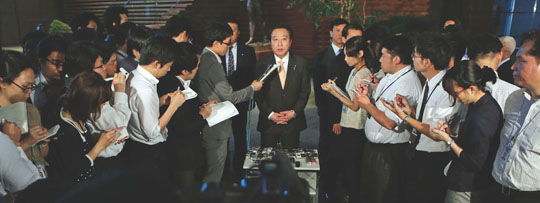
Here’s this week’s Media Mix, which is about Yoshio Hachiro’s resignation as Minister of Trade, Economy and Industry, though it’s mainly about the enduring dominance of “elites” in all aspects of Japanese life. As I implied in the column, elites more or less run the world, so there’s no particular reason to think they wouldn’t run Japan. If there’s a difference, and I admit it’s a relatively slim one, it’s that the Japanese media take this situation so much for granted that they basically accept it as the natural order; so while there isn’t any concrete proof that Hachiro’s ouster was engineered by some cabal headquartered deep within a bunker under Hibiya Park, the fact that so many media advanced the idea that his gaffes caused “public outrage” (a term used by almost every English language publication that covered the matter) proves at the very least that they thought he deserved to lose his job. As I told my editor, who was reluctant to run the line “we’ll have to take their word for it,” I could find nothing in the available media, in either English or Japanese, that offered proof of this “public outrage.” NHK went out on the street and interviewed a few passers-by who expressed dismay at Hachiro’s remarks, but is that representative of the “public” and does it qualify as “outrage”? In fact, if we use the NHK interviews as a standard, there were just as many comments in letters-to-editor columns agreeing with the “town of death” remark. The only disparaging comments I could find were to the effect that since Hachiro was representing METI, which had a hand in the nuclear accident that created the town of death situation, there was something disingenuous about him saying it, even if he wasn’t in the ministry when the disaster took place. This sentiment goes back to the theory I posited earlier this year in this column about that BBC program joking about the gentleman who suffered both the Hiroshima and Nagasaki atomic bombings. The victims and their relatives own the narrative to that tragedy, so nobody else gets to comment on it, much less joke about it. Hachiro, as a representative of the government that made it possible for the Fukushima No. 1 reactor accident to happen, had no right to identify with the victims, so the town of death comment was inappropriate. But that’s not “outrage” to me.

As for Hachiro’s remark about passing radiation onto reporters, it was a pretty adolescent joke, and thus smacked of desperation. For people to find proof in that joke of Hachiro’s air of superiority betrays a lack of understanding of human nature. It doesn’t excuse him of being childish and needy, but resignation? All he has to do is apologize for acting like a dumb kid and that should be it, but the idea that he has to leave over such a faux pas was obviously pushed by more than public sentiment. Though I didn’t mention it in the column, rumor has it that Fuji TV first reported the joke, and thus every other outlet, not wanting to be seen as having missed the boat, had to report it as well. But the race to put that quote out there was so fast and furious it was difficult to tell who did it first. That’s why all the quotes were unique: every reporter who was there heard something different, meaning they weren’t taking notes when he said it. Did one or more media outlet have it in for Hachiro? I’d say it’s a definite possibility, but in any case, as distasteful as many people found the joke, it didn’t warrant resignation. All it proves is that the media and those who really make a difference don’t care who is doing what in the government. It’s all an elaborate show, because nothing gets done.

Posted in Media | Tagged , , , | 1 Comment

Media Mix, Sept. 11, 2011

Here’s this week’s Media Mix about the death of 3-year-old Miyuki Watanabe in August 2010 while she was in the foster care of voice actress Shizuka Suzuike, who was arrested a few weeks ago for causing the injuries that led to Miyuki’s death. On Friday, Suzuike was indicted. As I point out in the column, the tabloid media has already tried and convicted Suzuike, which is their usual m.o. in such cases, but it’s difficult to discuss the matter of foster care and abuse without at least suggesting that it happened in this particular case. That’s what makes it difficult for the mainstream press to cover it, since the circumstances of Miyuki’s death require an investigation into the system of foster care in Japan. The point I make at the end is that because the idea of raising a child not related to the foster parent by blood is something those involved don’t want to discuss (or, perhaps more relevantly, are assumed to not want to discuss), the problems related to the foster care system–and child welfare programs in general–don’t get a proper airing until something terrible happens. Consequently, such coverage perpetuates a cycle that reinforces the belief that orphans and children who for whatever reason no longer live with their parents are permanently damaged. There’s no denying the evidence that suggests such children are more likely than children from whole families to suffer from psychological problems, but we’re not talking about statistics. We’re talking about a cultural stereotype, a phenomenon that is self-perpetuating.

In that regard, you have to go outside the standard media coverage for perspective. One blogger read Suzuike’s own blog and formed a different take on what she wrote. The tabloids simply found things that supported their thesis, which is that Suzuike was driven to distraction by Miyuki’s intractable nature. But this one blogger had heard that Miyuki may have had a disability, and that Suzuike took her into her home knowing this. If that’s the case, then many of the things Suzuike said in her blog take on a different cast. The “dark side” comment, for instance, could be seen not as a description of some capacity for evil, which is how the tabloids interpreted it, but rather as an acknowledgement of Miyuki’s incapacity for certain things. This, of course, is just as speculative as the tabloids’ coverage, but it does indicate that there are often aspects of a tragedy that don’t see the light of day. Unless someone in a position of authority actually came out and said that Miyuki had a disability, no one else will. It would be considered in bad form. In any case, it’s easier to turn Suzuike into a deluded over-achiever.

Posted in Media | Tagged , , | 1 Comment

Media Mix, Sept. 4, 2011

Here’s this week’s Media Mix, about actress Hisako Manda’s inheritance problems following the death of her common-law husband in June. The piece is a rehash of all the different elements of the story that have come out in the weeklies and on the TV wide shows. At the end I mention something about the anti-progressive nature of Japan’s Civil Code and family law in general. For readers who may want more detail about this aspect of the story, here are several past columns that addressed illegitimacy, inheritance, and associated matters. The thing to remember is that discrimination is built into the law.
Sept. 20, 2009
June 15, 2008
Sept. 24, 2006
Mar. 6, 2011
Sept. 5, 2010
Mar. 14, 2004

Posted in Media | Tagged , , , | 1 Comment

September 2011 movies

Here are the movie reviews I wrote for the September issue of EL Magazine, which was distributed in Tokyo last week. The movies open in Tokyo from late August through mid-September.

Battle: Los Angeles
It would be easy to blame this cacophonous war movie on Cloverfield: the same woozy, handheld photography (only without the conceit of amateur vidographers); an invasion of monsters (who are just as indistinct); and more cliches than you can shake a clapper at. One thing you have to say for it: It doesn’t mess around with formula. It dives right into action before pulling back to give us the dull particulars about the squadron of marines who we’ll follow into battle: a head case, a medical student from Nigeria, a virgin rookie, and a cat whose brother just died in combat. The adversary is an invading army of extraterrestrials who are after our water. Some will see all sorts of parallels with oil and the situations in Iraq and Afghanistan, but the movie has no interest in reality. The whole culture of the U.S. Marines has become so cinematized that I’m sure most real marines don’t know how to act until they’re shown Jarhead. Aaron Eckhart plays Staff Sgt. Nantz, a career soldier who has decided to call it quits after leading a group to their slaughter in some Middle East hellhole. He has to put all that off when the beasties from outer space start zapping the surfers at Santa Monica, but he’s second-in-command to a newbie lieutenant (Ramon Rodriguez) whose lack of decisiveness becomes a problem when the mushroom-headed, stick-legged, weapon-fused-to-arm universal soldiers start jumping out of the woodwork. Nantz has to take control of the mission, which is to secure a police station where civilians have taken shelter and lead them to safety before all of downtown is bombed back to Bedrock. His main problem is that the men don’t trust him, having heard about his disastrous mission over there. Chris Bertolini’s script gives everybody a chance to be a hero, even the Mexican dad (Michael Pena) who despairs that he always made “the wrong choices” for his little boy. “Choice” is the last word you’d associate with Battle: Los Angeles, which is so machine-driven you can recite the war-weary lines right along with the actors. “That’s some real John Wayne shit,” one marine comments approvingly after Nantz lures an alien drone to a gas pump, which he then blows up. No, actually, that’s some real Bruce Willis shit, except Nantz doesn’t whoop it up afterwards. The invaders are the perfect war movie enemy: literally pieces of meat with no souls. There’s even one scene where Nantz and a pretty veterinarian (Bridget Moynahan) butcher a wounded alien in order to find his “vital spot” so that his men know where to shoot more effectively “and thus save ammunition.” It turns out to be “just to the right of the heart.” Good stuff to know the next time you’re in an alien invasion. Continue reading

Posted in Movies | Tagged , , , , , , , , , | Leave a comment

Media Mix, Aug. 28, 2011

Here’s this week’s Media Mix, which is about the retirement of comedian Shinsuke Shimada. The story continues to develop, and while nothing particular has been added to the case that I didn’t already outline in the column, some of the suppositions may require adjustment. At the end, I weakly venture that the scandal may change TV. (I do not, as the Mainichi Shimbun editorialized, hold out any hope that it leads to weakening ties between organized crime and show business; it may scare some people into being more careful and discreet, but from what I understand the yakuza’s hold on the entertainment industry is practically elemental) But since I wrote the column several broadcasters have announced that they may continue some of Shimada’s variety shows, only without him. It sounds desperate to me, and exactly the sort of imagination-free solution that has made TV dull and redundant, which I talked about in more detail in last week’s column. It seems the TV industry will learn nothing from this incident except that if someone talks like a yakuza and acts like a yakuza, it probably means he’s a yakuza.

But the nagging question that the Japanese media hasn’t answered yet is: Why is Shimada considered popular? Or, more to the point: Is he popular? The whole rationale behind his ubiquity was that he guaranteed high ratings, but as AERA points out in the issue that hits newsstands tomorrow, at least two of his shows have been gradually losing ground in terms of audience share for the past two years. More significantly, the whole concept of audience share is being challenged by advertisers who know that this audience is shrinking. Young people now are not watching as much TV as young people in the past did, thanks to other, newer distractions; plus, the population is decreasing. Shimada’s worth as a TV personality is mainly tied to his functionality. Because TV producers have staked their survival on the variety show format, which is cheap and easy, uniformity of effect is more desirable than originality (which takes too much work) or novelty. The only consideration that means anything is assembling talent who are “topical” (i.e., possess names that are recognizable for any reason at all) and can talk on the air. The reason emcees like Shimada and Sanma and Monta Mino (whose star has dipped noticeably in the past two years) are used so relentlessly is that they can think on their feet and are just bold enough in their opinions to seem edgy, though in the grand tradition of TV comedy, “edginess” simply means a capacity for humiliating others. Shimada, especially, knows how to bring out those latent qualities in comedians and idols that are the most provocative; which is why his most characteristic “accomplishment” is the quiz show Hexagon, on which he cultivated a whole new sub-genre of “dumb” talent. The AERA article states, somewhat admiringly, that Shimada’s real worth to the TV industry is the way he has helped develop an entire new generation of TV talent. In other words, Shimada did the TV producers’ work for them, though, in truth, most of these baka tarento are, like all TV talent eventually, on their way down.

So when the chief cabinet secretary mentions during a press conference Shimada’s “genius” as a talk show host, it requires some qualification. What distinguished Shimada from Sanma, his only real rival as an emcee, is Shimada’s autodidactic worldliness. Outside of his own experience, Sanma is incapable of discussing anything except soccer; while Shimada has made a point of becoming knowledgeable about politics, the law, and, especially, finances. But even when he holds forth on these topics on TV, it’s still about him, about what he’s learned and how he learned it. On one of his regular shows, Gyoretsu no Dekiru Horitsu Sodanjo, he shared the studio with real lawyers, but they rarely got to say anything since it was Shimada’s show, and he has a lot to say. It’s easy to understand why he believes he can get away with anything, because everybody lets him do exactly as he pleases. It lets them off the hook.

Posted in Media | Tagged , , , | 1 Comment

September 2011 albums

Here are the album reviews I wrote for the September issue of EL Magazine, which was distributed in Tokyo on Thursday.

Goblin
-Tyler, the Creator (XL/Hostess)
Blackenedwhite
-MellowHype (Fat Possum/Hostess)
Though they are American and their rap-rhetoric is tonally reminiscent of gangsta stuff from the early 90s, the teenage hip-hop collective from Los Angeles known as Odd Future Wolf Gang Kill Them All provides a kind of chilling context to the mayhem that gripped London and other English cities last month. Probably the most common adjective attached to the perpetrators of the riots was “nihilistic,” which has also been used to describe OFWGKTA’s music, in particular that of its most visible member Tyler, the Creator. Goblin is his second album, and though it arrives surrounded by the kind of hype that signals commercial success down the road, it’s an even darker, more cynical record than his first one. Some believe this is a calculated move, instigated so that Tyler can maintain a certain measure of street cred in the face of fame, but there’s so much going on in the album that it’s probably safer to say Tyler is still working out who he is as an artist. And he definitely sees himself as an artist rather than a guy who thinks there’s money in this rap game. In the title cut, he even aims his diatribe at a virtual psychoanalyst, proving less that Tyler is into Freud than that his view of mental instability is informed by TV sitcoms. Wisely, Tyler steers clear of politics–if, in fact, he has any interest–though it would be easy to interpret his profusion of profane put-downs in a political way. In this regard he’s closer to the original English punks than to gangbangers like NWA; meaning someone whose aim is to negate everything the listener takes for granted. And because he’s still a kid, his passions are simple and direct: He likes porn and his grandmother (not together, of course); hates school and collared greens. The confusion of the lyrics is mirrored by the beats, which are dissonant and challenging. But that doesn’t make Goblin a challenging album, only a difficult one to like. Easier on the ears is BlackenedWhite, the debut from another OFWGKTA rap entity called MellowHype. The album was originally released online last October by the OFWGKTA collective, but, hype being anything but mellow, it now reappears as a legit release care of Fat Possum, remastered and rearranged. As a storyteller, Hodgy Beats is every bit as nihilistic as Tyler–guns are the main leitmotif, along with “mobbing”–but he brings some humor to the proceedings. He’s more of a shit-talker than a confessionalist; which makes him less distinctive than Tyler but also more appealing on a purely musical level, owing to the record’s relatively commercial sound. BlackenedWhite is more like what you would expect from a teen artist: derivative and looking to provoke through laughter. That isn’t to say you won’t cringe when Hoagy kills a cop in cold blood, only that you might also chuckle in spite of yourself. Continue reading

Posted in Music | Tagged , , , , , , , , , , , , , , , | Leave a comment

Media Mix, Aug. 21, 2011

Nothing never looked better

Here’s this week’s Media Mix, which is about the controversy over remarks that actor Sosuke Takaoka made several weeks ago regarding South Korean TV dramas. A good deal of the column refers to an article in Shukan Post that outlines the decline of quality in TV programming and attempts to explain the reasons. Many of the article’s points have been discussed in Media Mix in the past, but as a distillation of what’s wrong with Japanese TV, it’s quite thorough and convincing. The only part I found less than convincing, and which I didn’t mention in the article, is the implication that the recent changeover from analog to digital broadcasts was somehow engineered by the television industry to protect their interests. The change to digital was inevitable from a purely evolutionary standpoint, and considering that most other developed countries are making the switch in some form it seems a worldwide trend separate from any circumscribed interests of one industry. In fact, if any one industry does benefit from digitization it’s home electronics manufacturers, who enjoyed increased sales, at least for a while, of high-definition TVs and related hardware. The broadcast industry, on the other hand, had to pay a huge amount of money to change over; money they didn’t necessarily have any more because of the decline in advertising sales.

Moreover, as mentioned prominently in the Post article, the changeover to digital freed a huge amount of bandwidth. And while the Post claims that the commercial TV networks have managed to somehow protect this resource from falling into the hands of potential competitors, it seems by that token that they would have been better off not changing over to digital, since remaining with an analog system would have made it easier for them to maintain their monopoly of the airwaves. Perhaps there’s something in the article I missed that better explains their theory, but in the end I think digital was going to happen regardless of what the industry thought or tried to do. The real question from now on is what the government will do with that resource, which, theoretically, belongs to all the people of Japan.

Correction: I describe Takaoka’s most famous role, in the movie Pacchigi, as being “Korean-Japanese.” Though it’s been years since I saw the movie, it occurred to me this morning that the label isn’t correct. Though the character has lived his whole life in Japan, as with all zainichi (resident in Japan) Koreans, his nationality is Korean, though I don’t remember if it’s North or South in his case.

Posted in Uncategorized | Tagged , , | 3 Comments

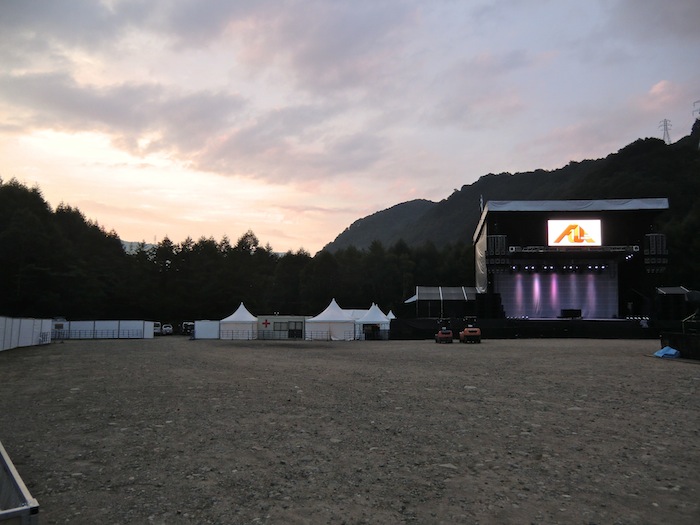
Notes on Summer Sonic 2011


Whalin'

While inching my way into the bottleneck that always forms on the platform of Kaihin Makuhari Station Saturday morning as Summer Sonic ticketholders make for the exit, I heard two Japanese guys in back of me trading voiceless labiodental fricatives. Since the “f” consonant doesn’t properly exist in Japanese, practice was, apparently, in order, and they cracked each other up with the attempt. Preparing their “fuck” cheers for the festival?

***

“Fuck” was practically the only word I understood during the first performance I saw on Saturday, Odd Future Wolf Gang Kill Them All, the famous teen hip-hop collective from Southern California. Summer Sonic is consistent about these sorts of booking coups. I remember a few years ago they snagged one of those next-big-thing bands in England before the group had even released a record–and after Fuji Rock had turned them down because of the band’s demand for $80,000. The thing is, I forget the name of the band because after their appearance they quickly vanished.

That’s not likely to happen to Odd Future, mainly because there are too many talents in the collective, if “talent” is the right word. On stage they demonstrated exactly what it is that made them instant stars: a capacity for unhinged adolescent clowning. As on their various records, the music was more difficult to appreciate, much less penetrate, and not just because the beats are harsh and atonal. With up to five rappers trading lines willy-nilly while dashing about shirtless and reckless, crashing into each other, mooning the audience, and making private jokes they knew would go over the heads of everyone (“How many of you niggas like chips?”), the 30-minute showcase bordered on performance art; which is to say, it was entertaining in its own, wholly peculiar way. These are boys who have no intention of ever growing up, and probably haven’t even contemplated the possibility. Tyler, the Creator, the most talked-about member of the group, was actually the most subdued and least concerned with projecting the sort of menacing vibe the collective owns as a style constant. The smile plastered to his kisser the entire show was a kid grin: irrepressible and, as a result, irresistible. The other rappers, Hodgy Beats and Mike G, in particular, stalked the stage as if marking out territory, and Tyler let them take it, happy to fade into the background when he wasn’t rhyming. “Konnichi fuckin’ wa” was his personalized greeting, followed, as if an afterthought, with, “You guys are awesome.” He wasn’t talking to his mates, but to the audience, who were game if uncomprehending. Hodgy offered totally pointless mock provocation, prodding the crowd into an acknowledgement of his skills and then came back with, “You lie. You can cheat on me but don’t lie.” One wonders what the folks in the audience thought of Mike G’s T-shirt, whose large Chinese characters said, “Nihonjin Kanojo Boshuchu,” which could be translated as “Now Soliticing Japanese Girlfriends.” Some might be alarmed, considering how violent the sexual component of Odd Future’s raps are, but one thing that came through clearly is that it’s all an act. And a pretty good one. Of the Odd Future albums I’ve listened to, the only one I get is Frank Ocean’s, probably because he’s an R&B singer and not a rapper (he didn’t seem to be in the group that came to Japan). I should try harder, I know, but I’m sure Odd Future wouldn’t give a flying fuck if I did. In fact, I think they said that. Continue reading

Posted in Music | Tagged , , , , , , , , , , , , , , , , , | 6 Comments

Media Mix, Aug. 7, 2011

Beyond belief (Kyodo)

Here’s this week’s Media Mix, which is about the various schemes to influence public opinion with regard to Japan’s nuclear energy policy. As I pointed out at the end, the press is mainly using the word “manipulate” to describe what the authorities are doing, but I think “manufacture” is a better verb. It has been well-documented in recent months how carefully planned the public relations component of Japan’s nuclear policy has been, extending back to the mid-50s when the Americans recruited a number of high-profile Japanese individuals in government and industry to support the peaceful use of nuclear technology as a means of making the Japanese public more accepting of America’s nuclear deterrence policy. It’s correct to say that people who remembered the war and the atomic bombings had to have their perceptions manipulated in order to accept nuclear energy, but every generation since then has started with a clean slate. Regardless of how you feel about the safety of nuclear energy, the relevant bureaucratic organs and their industry partners felt it necessary to nip debate in the bud as early as possible; which is why the bulk of the money budgeted for the Nuclear and Industrial Safety Agency goes to “education.” It’s basically a PR organ.

This is just how things are, and for the media to treat it as a “conspiracy” is ingenuous. For sure, the real intent behind the email scheme outlined in the column is hidden, but every few years the press uncovers a similar scheme and reports it as a scoop. Officials are left with red faces and promise an investigation, but nothing really changes because the sensibility behind the yarase (fakery) is one of confrontation. They know that the only people who will make their opinions known in the pertinent public forum are those who are against them, so they feel justified is providing counter-arguments, even if they’re for the most part manufactured. The various mainstream media outlets who breathlessly reported the chicanery going on in Saga neglected to say that, for the most part, the citizens don’t know what to think. As one journalist told Tokyo Shimbun, “The people have a responsibility, too.” In other words, they have a responsibility not to be manipulated; because, in truth, anyone who watched the local TV show in question, the one where Kyushu Electric employees sent in questions, had to wonder why there were almost no counter-arguments. Skepticism is an integral component of democratic involvement, but mostly what the Japanese public exhibits is cynicism: They don’t trust the government, anyway, so why get involved? There is a difference. As Prof. Kawakami also told Tokyo Shimbun, “If the silent majority remains silent, there’s no way you can prevent fakery.”

Posted in Media | Tagged , , , | 1 Comment