August 2011 movies

Here are the movie reviews I wrote for the Aug. issue of EL Magazine, which was distributed in Tokyo last week. The movies are opening here between late July and mid-August.

Edge of Darkness
Mel Gibson’s first lead role in eight years is a Boston cop whose grown daughter is murdered outside his home. At first, it’s assumed the shotgun blast was meant for him, but as he starts looking into his daughter’s recent history he learns she may have been involved with a radical group trying to expose illegal research at the top secret facility where she worked. Though everything in Gibson’s bulldog performance and Martin Campbell’s direction indicates a vigilante revenge fantasy, the movie doesn’t go full-tilt gonzo until the very end. The script, based on a British TV miniseries, has pretensions to sociopolitical seriousness that are undermined by the presence of a shadowy fixer (Ray Winstone) whose loyalties waver right from the start. Assigned by the government to keep an eye on Gibson’s investigation, he makes friends with the ornery detective for no other reason than to provide the movie with macho banter (“Who am I? I’m the guy with nothing to lose”). It’s a waste of time and distracts from Gibson’s effective demonstration of star power. (photo: GK Films LLC) Continue reading

Posted in Movies | Tagged , , , , , , , | 1 Comment

August 2011 albums

Here are the album reviews I wrote for the August issue of EL Magazine, which was distributed in Tokyo yesterday.

James Blake
(A&M/Universal)
Bon Iver
(Jagjaguwar/Hostess)
The pendulum swings eternal in pop, bringing old styles back into fashion and replacing certain aural trends with their polar opposites. The preference now among the musical cognoscenti is for quiet and contemplative, after almost two decades of continually loud product. James Blake, a young producer from England, is a nominally bedroom artist whose m.o. is to take soul-inflected melodies and process/reduce them to within an inch of their digital lives, sometimes adding sampled voices on top, more often adding his own heavily processed vocals, which, under the circumstances, sound a lot like Antony Hegarty’s. As far as new things under the sun go, Blake is the real deal. As derivative as his methodology is, the end results are like nothing that which usually emerges from bedrooms these days, English or otherwise. What’s surprising is how resiliently popular his minimalist tracks are, since they contain no insistent rhythms, much less a groove. On the relatively expansive “I Never Learnt to Share,” the synth loops are tightened to the point where they resemble a beat but Blake prefers keeping the listener slightly off-balance, and the tension of “no release” creates its own sort of compulsion. The low volumes focus attention on textures that are all the more synthetic in contrast to the surrounding silence. As if to prove he can do it straight, there’s a cover of Feist’s “Limit to Your Love” that opens with Blake’s voice and piano, but is quickly augmented by a stuttering bass pattern. As a statement of artistic purpose it’s simple and direct and original, but since the song itself isn’t original it begs the question of where Blake goes from here. As beautifully realized as James Blake is it feels necessarily unsubstantial, the work of an artist who is still formulating what he wants to do. It’s an odd position to be in for someone who’s attracted this much attention; almost as much as Justin Vernon attracted with his debut solo album as Bon Iver, For Emma, Forever Ago. The record was made in a remote, snowbound cabin where he played all the instruments. Vernon fashioned the perfect breakup record that topped more Best-of-year lists than any other album in 2007. His stylistic markers are conventional: Singer-songwriter sentiments of the 1970s, with music to match. The eagerly awaited followup is, like James Blake, a self-titled affair, thus indicating some sort of recalibration, in particular the voice, which, while it isn’t as processed as Blake’s, also mimics Antony’s in its equating of feeling with vibrato and falsetto. With a budget comes more complex sonics and arrangements but less in the way of memorable melodies. Though composed of 10 songs, seven of which have place names for titles, the album works best as one long swoon, a tribute to Vernon’s attention to detail but indicative of his limited breadth. Like Blake, he’s the creator of a quiet, beautiful sound that he’s still figuring out what to do with. Continue reading

Posted in Music | Leave a comment

Media Mix, July 24, 2011

Does crap look better in 3D?

Here’s this week’s Media Mix, about the end of analog TV broadcasts, which takes place today at noon. In the column I touch on satellite broadcasting as an example of a standard system that might have made more sense than terrestrial digital broadcasting, but, of course, BS broadcasts are available in Japan and NHK makes money from them. In fact, many of the same people who seemed reluctant about making the changeover to digital terrestrial have the same reservations about having BS forced on them. That’s because if you buy a digital tuner or new TV, you automatically get a feature to receive BS broadcasts. Recently, a Tokyo Shimbun reader wrote to the paper saying he had just bought a new TV and wondered if it meant he now had to pay NHK the extra fee for BS. He had never watched NHK’s BS broadcasts before and had no intention of watching them in the future, but apparently NHK expects you to pay if you have a BS tuner or TV that receives BS signals.

The guy has a point and one that the media hasn’t talked about at all in the runup to the digital changeover. We recently moved into a new apartment complex that does not have a digital antenna. If we want to receive normal digital broadcasts we either have to put up our own antenna or subscribe to the apartment complex’s cable TV service, which comes with BS channels. As soon as we subscribed a guy from NHK was at our door asking for the BS fee in addition to the regular NHK fee for terrestrial broadcasts. We’ve always paid for both and had to go through a complex song-and-dance about direct bank transfers that hadn’t been registered yet by NHK because of the move. But what impressed me was that NHK obviously receives subscriber info from the cable TV company. The bill collector didn’t ask us whether or not we watched BS, he simply said we had to pay for it. And that’s apparently also true of people who buy new TVs. Because of the B-CAS card, which comes with every new TV sold since 2002, NHK knows who has a TV or a recorder with a BS tuner, since the card automatically sends this data digitally to a foundation (obviously another amakudari concern) that monitors digital TV usage. In the old days, the NHK bill collector simply looked to see if a house or apartment had an antenna and then knocked on the door, demanding that the resident pay his NHK fee. The B-CAS system makes this shakedown process more sophisticated, but the end result is the same: NHK can demand you pay even if you say you don’t watch NHK.

The sensible thing to do would be to implement a scramble system similar to the one used by pay satellite content providers like WOWOW and Star Channel. Thanks to the B-CAS card, broadcasters can “turn on” certain channels for specific TV sets whose registered owners have paid their subscriptions. Everybody else just gets a blank screen. NHK could do the same thing for people who say they don’t intend to watch their BS channels. Instead they allow anyone to watch and then demand they pay for it. At ¥950 more a month, it’s a considerable expense for many households, especially considering what you get. A good portion of the content on the two BS channels is eventually broadcast on NHK’s terrestrial channels. All you have to do is wait a month or two.

Posted in Media | Tagged , , , , | 1 Comment

Media Mix, July 17, 2011

Here’s this week’s Media Mix, which is about a comment made by comedian Sanma Akashiya that he may stop appearing on TV after he turns 60. My feelings about Sanma as a comic are mixed. I can appreciate his quick wit, but often I think that appreciation is relative. Much of this ambivalence, I know, is cultural. I’m not a big fan of puns, and the ijirigei (making fun of the weak) style, as I mention, is limited. In the past two decades, most Japanese humor, at least the kind that makes its way to TV, is fundamentally derived from shtick: a specific comic hits on a pose or phrase that strikes a chord with the public, but as proven by the increasingly high turnover rate for TV comedians, this sort of humor is even more limited than ijirigei. Nevertheless, while I will concede I’m not the ideal audience for this kind of humor, I wonder if the majority of Japanese are. Most of my Japanese acquaintances say they don’t really think most comedians are very funny and agree that sketch humor is really lacking. When I point out the cultural significance and influence of the old Drifters comedy revue show, Hachijidayo, Zeninshogo, forty years after it was first aired, what people usually say is that the show’s popularity is mostly nostalgic. The boomers who still buy the DVDs of that show were children at the time, and the humor’s slightly risque tenor (at the time it was on, PTAs throughout Japan complained bitterly about it) was seen as stimulating. But most people seem to agree that it wasn’t that funny. The same goes for Oretachi Hyokinzoku and the other ijirigei shows it spawned: People were drawn more by what the comedians were getting away with than with the actual jokes and routines. So when I read the interview that Edan Corkill did with comedian Koji Imada in the Japan Times a few weeks ago about the new Saturday Night Live Japan and Imada remarked that the show would mostly avoid topical humor because it’s obvious and “easy,” I wondered what he meant. For sure, a lot of the topical humor on SNL in the U.S. is pretty obvious and, at least since the mid-80s, has lost much of its bite because everyone in the media, including non-comedians, are into topical humor. But easy? In the sketches I watched on the second installment of SNL-Japan, laughs were derived not from the sketches themselves or from the lines, but from the way the players stepped out of character. This sort of thing brings the audience in on the joke, makes them feel like a part of the routine. That’s pretty much the hallmark of all Japanese sketch comedy, and, I would think, a lot easier to pull off than coming up with routines that are themselves truly funny.

Posted in Media | Tagged , , , | 2 Comments

Media Mix, July 10, 2011

Yamato does some heavy lifting

Here’s this week’s Media Mix, which is about how express delivery companies now represent the spirit of Japanese service as well as the virility of Japanese men. Though the column dwells mainly on the role that Yamato and Sagawa have played in promoting these images, in many ways they were self-perpetuating. Though Sagawa no longer uses the cartoon symbol of a hikyaku—the traditional couriers who was famous for running the length of the old post roads—it’s that sort of hustle that today’s drivers are supposed to embody. However, what was more interesting to me is how such a job came to mean more than just a paycheck to the workers themselves, and instinct tells me that no one sticks with delivery work because of the image boost. I know, because I was a delivery person in San Francisco for a number of years after university. I actually enjoyed the work because it got me out on the streets, but pay was based on how many packages you handled, which means you had to not only hustle but cultivate the dispatcher and cheat a bit on routes. One aspect of the job that isn’t really covered in reporting about delivery services is commissions, which tend to be downplayed in Japan. There isn’t even a good word for it in Japanese. Dekidaka-barai is the closest I’ve heard, though it’s usually used to describe piece work. In the West, commissions are usually associated with sales work, which implies that the salesperson is working more for himself than for his company. I don’t know if that’s the reason salespeople in Japan don’t work for commissions, but it might explain why “sales” (eigyo) is usually a more group-oriented endeavor in Japanese companies. For delivery people, however, commissions are a more direct indication of their effort and efficiency, and apparently wages in the industry are pegged to how many customers a driver can cultivate on his route. My partner used to work in the shipping department of a famous fashion designer, and the Sagawa guy stopped in every hour or so checking if there were any packages and constantly berating her to “send out more,” as if it were her decision. When we recently moved, we used Yamato, who gave us a deal that was better than ones offered by dedicated moving companies, and they did a great job. Labor standards don’t seem to apply to drivers, who often work more than ten hours a day and six days a week with no overtime. Really good drivers can make in excess of ¥5 million a year, which doesn’t sound like much considering how many hours they work but in today’s job environment that probably sounds good to a lot of people stuck in contract or part-time jobs. And if you can get sex on the side, it’s gravy.

Posted in Media | Tagged , , | 2 Comments

July 2011 movies

Here are the reviews I wrote for the July issue of EL Magazine of movies that are being released in Tokyo from late June to mid-July.

The American
Back in the day, smart European directors paid tribute to American noir by not trying to copy it slavishly. Antonioni with The Passenger and Wenders with The American Friend downplayed the more sensational qualities of the genre and dialed up the existential angst. The American attempts something similar. George Clooney plays a shadowy assassin-for-hire who bolts his Swedish hideout when an attempt is made on his life and holes up in rural Italy, where his taciturn contact (Johan Leysen) finds him a job fashioning a special weapon for a fellow assassin (Thekla Reuten). Clooney’s man of few words who is good at his job fits the stereotype of the lonely hit man, but the plot device of having him fall in love with a hooker (Violante Placido) smacks of desperation. Anton Corbjin, directing his second feature film, understands the moody undercurrents that Rowan Joffe’s screenplay emphasizes, but the movie wears its European pedigree like a hair shirt and Martin Booth, who wrote the novel on which it’s based, is no Le Carre. (photo: Focus Features LLC) Continue reading

Posted in Movies | Tagged , , , , , , , , , , | Leave a comment

July 2011 albums

Here are the album reviews from the July 2011 issue of EL Magazine, which was published in Tokyo today.

Born This Way
-Lady Gaga (Interscope/Universal)
Stone Rollin’
-Raphael Saadiq (Sony)
It’s encouraging to note that the biggest artist of this young decade is primarily a songwriter. Whatever her credentials as drama queen, outsider spokesperson, or fashion disaster, Lady Gaga paid her way into the pantheon of pulchritude by penning instantly likable disco-rock singles. Not for nothing is the name of her boutique label Streamline: Efficiency is Gaga’s watchword, not so much in the economy of instrumentation or instantly recognizable sentiments, but rather in the way her variations-on-a-riff style focuses the hooks where they count. That’s actually a better description of good rock than it is of good disco, but the beauty of Gaga’s approach is that she doesn’t distinguish between the two, since they are the pop genres closest to the common folk, and if she seems over-identified with queers and club kids, they’re the kinds of queers and club kids who work for a living. It’s easy to make too much of Gaga’s message, especially when it’s delivered with such theatrical flair, but the real message is in the beats, the slamming sloppiness of “Judas” or the precision lockstep of the title cut, which slices the word “born” into four sixteenth notes. Her vocal agility won’t make Annie Lennox lose any sleep, but she’s learned how to channel her operatic tendencies more effectively. What she owes Madonna isn’t the idea that packaging can make up for technical shortcomings but that spectacle need not be outwardly spectacular. “Americano,” with its faux Mexican accent and faux Spanish musical phrasing is both ridiculous and sublime. Madonna wouldn’t have dared get this camp, but Gaga always acts (and sings) as if she has nothing to lose. Of course, there’s calculation in the hyperbole, but the zeitgeist seems to demand an extravagance of expression. Indie just doesn’t cut it any more when all you want to do is dance, a credo that Raphael Saadiq has come to by the long route. Saadiq led the neo-soul group Tony Toni Tone for years before striking out on his own with an anti-commercial sound that won him little more than a high-minded cult. On his last album, however, he embraced his forebears at Motown with a collection of originals that sounded like an undiscovered cache of Holland-Dozier-Holland tunes. More than being mere mimickry, The Way I See It absorbed the Motown sensibility as being at once sophisticated and fun, and it held up as a unique work of pop. Saadiq sticks to the formula on Stone Rollin’ but gets bluesier in the singing, rockier in the rhythms, which declare their dominance on the opening cut, “Heart Attack.” And if the background vocals still owe too much to the Four Tops and the Jacksons, the touches of synth and the impressionistic drumming bring Saadiq’s aesthetic fully into the 21st century. In interviews, the former Ray Wiggins has complained that Motown comparisons are made by people who “don’t know music.” Maybe, but they’re definitely made by people who know what they like. Continue reading

Posted in Music | Tagged , , , , , , , , , , , , , , | Leave a comment

Media Mix, June 19, 2011

Daishin Kashimoto

Here’s this week’s Media Mix, which is about Yutaka Sado’s conducting debut with the Berlin Philharmonic. Originally, I was going to write a review of the programs themselves but changed my mind when I found that certain prejudices related to the “inferiority complex” point started creeping into my analysis. The coverage seemed to emphasize the difficulties that Sado faced when he confronted the orchestra during rehearsals, and I read too much into it. Though there was obviously some problems in terms of communication, Sado’s German sounds perfectly adequate to get his points across. Many conductors work with orchestras whose mother tongue isn’t their own and they get by through the so-called universal language of music. My partner once worked as a kind of freelance road manager for visiting classical musicians (her input into this particular column was invaluable), and she says that a lot of conductors don’t even bother talking to the orchestras. A few words that everybody knows, a lot of gestures, and mostly mimicking of the kind of sounds/phrasing/accents/etc. that the conductor wants are enough. From what she’ told me, too much is made of a conductor’s control over an orchestra. Usually, it’s a matter of both sides reaching a happy medium, finding a compromise, and the orchestra in the end usually has more to do with the overall interpretation.

One thing I didn’t mention in the column was that the Berlin Philharmonic’s concert master is actually Japanese, which in its own way is more remarkable than Sado’s being asked to guest conduct. Guest conductors, even of subscription concerts, are as much about PR as they are about extending the orchestra’s creative reach. If a conductor isn’t up to the task, he simply isn’t asked back, and in the Aera article Sado said as much: That being asked to conduct once means less to him than being asked to conduct a second or third time, since that would mean he passed the audition, as it were. Daishin Kashimoto, however, is a permanent member of the orchestra; and not just a permanent member, but the concert master, the first violin, first chair, who is the second most important person on stage. Obviously, he passed a much more rigorous audition, and in an interview in the NHK special he revealed something most insiders know but rarely talk about: When an orchestra doesn’t understand what a conductor wants or disagrees with his interpretation, they block him out and play what they want. It was apparent that this didn’t happen with Sado–the orchestra members seemed quite engaged with his directions, and he managed a breakthrough when he asked during the Shostakovich that a cello solo be “red” while the rest of the ensemble stick to “black-and-white”–but Kashimoto’s statement indicated that to a certain degree the Berlin Philharmonic does what it pleases. I’ve heard the same about the NHK Symphony, whose veteran players tend to opt out of performances with guest conductors they feel are beneath them. The fact is, you don’t have to be Japanese to suffer an inferiority complex in the world of professional classical music.

Posted in Media, Music | Tagged , , , , , , | Leave a comment

June 2011 movies

Here are the movie reviews I wrote for the June 2011 issue of EL Magazine, which came out yesterday in Tokyo. These films are being released in Japan from late May to mid-June.

127 Hours
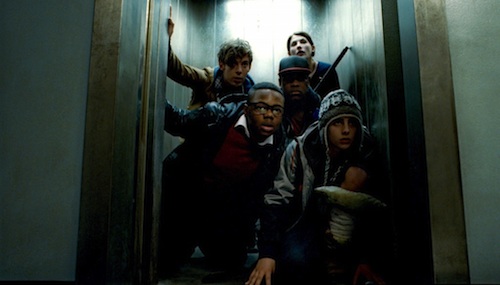
The story of Aron Ralston, the American rock climber who cut off his arm after he was pinned by a boulder in a Colorado canyon, doesn’t sound like the sort of thing that would interest Danny Boyle, a director whose signature kinetic style made Trainspotting and Slumdog Millionaire rock like a Jay-Z video. This is basically a movie about one man who is trapped at the bottom of a crevice for the titular length of time while pondering his life and the universe. Nevertheless, Boyle gives it all he’s got, opening the film with a split-screen montage showing, on the one hand, the rat race of the world at large (stock exchanges, urban commuters), and on the other, Ralston’s hyperactive preparations for his solitary hike, all scored to A.R. Rahman’s pounding dance music. We get the point, though it isn’t hard to form the idea that Boyle is simply thinking up some way to jazz up the material, and inadvertently shortchanges James Franco’s contribution, which is as central to the film’s effectiveness as Boyle’s direction. This is, after all, essentially a one-man show, and by the evidence on the screen Franco could have carried it by himself if Boyle hadn’t felt the need to open up the drama with all this manic visual business. Obviously, it’s vital to understand Ralston’s peculiar personality in order to also understand how he could have done what he did, and the director and the actor compete with each other to convey what’s going on in the young man’s head. Prior to the accident, he’s leaping and running over gorgeous, sun-drenched rocky terrain and meets up with a pair of female hikers whom he talks into exploring an underground lake. This sequence sets up Ralston as a carefree loner who picks up on the girls’ natural attraction to him but seems too locked up in his own head to care; a trait that’s transmitted better by Franco’s silly smiles than Boyle’s careful camera angles. Later, after Ralston falls down the crevice and the rock pins his arm against the wall, he realizes that it’s this self-absorption–he didn’t tell anyone where he was going this weekend–that may spell his doom; but Doyle’s impressionistic flashbacks are less convincing than Franco’s blackly comic asides and sudden eruptions of despair. “Don’t lose it,” he keeps saying, and once we comprehend that Ralston has a background in engineering, his choices make more sense. If Boyle’s own choices seem more distracting than enlightening some may find that welcome. As Ralston runs out of water and starts drinking his own urine, and then almost impulsively decides he can do without the arm, the impressionistic stuff becomes so graphic–like the drug-taking scenes in Trainspotting–that it almost makes you laugh. Almost. (photo: Twentieth Century Fox) Continue reading

Posted in Movies | Tagged , , , , , , , , , , , , , | Leave a comment

June 2011 albums

Here are the album reviews from the June 2011 issue of EL Magazine, which went on sale in Tokyo today.
So Beautiful or So What
-Paul Simon (Hear/Universal)
Helplessness Blues
-Fleet Foxes (Sub Pop/P-Vine)
This year Bob Dylan and Paul Simon turn 70, and if the two former folkies had little in common during their heyday they now share a view of the abyss. Dylan remains mercurial in his outlook on life; if anything old age has proven to be a legitimation of his contrary sensibility. Simon, on the other hand, has always acted his age, and on his best album in two decades he contemplates the end with the resignation you’d expect from a man who appreciates religion for all the things it’s done for music. The infectious gospel shuffle of “Getting Ready for Christmas Day” sells the idea of everybody’s favorite holiday as being something you can’t wait for; and if the high-life cooker “The Afterlife” makes fun of the myths that surround death (“you gotta fill out a form first, and then wait in the line”) it doesn’t deny that it leads to something else, maybe something better. But So Beautiful is less about mortality than eternity, and while God has a role to play (he shows up in several songs), Simon is adamant that one’s place in the universe is a personal matter. It explains the title of the album and the album’s best song, a bluesy rocker that parses the difference between savoring the moment and suffering the future; which isn’t to say you should foul your nest, only that “life is what you make of it.” Simon has made more of his than many of us could ever hope to make of ours, which makes his pronouncement sound haughty until you listen carefully to “Love and Hard Times,” a return to the simple craftsmanship of his early solo albums, and you realize the ability to forge acute insight from careful observation is not an accident of birth. It’s something you work at. No one would accuse Fleet Foxes of not working hard. Younger and more earnest than Paul Simon, Robin Pecknold shares with the august singer-songwriter a fondness for the impressionistic phrase, though stylistically he has more in common with Brian Wilson. Apropos its title, his group’s second album, Helplessness Blues, is less sunny than the debut, the rich harmonies recalling choirs rather than beach boys. If anything, the album sounds more like Simon’s original gig, especially the title cut, a passionate pledge to change ways, set to a fiercely strummed acoustic guitar. The echoey ambience that suffuses the album betrays nostalgia for an era Pecknold mostly knows through his parents’ record collection, but he now understands that music more for what it said that what it represented. There’s still too much showcasing of the group’s debt to the post-hippie era, especially in the long instrumental passages, but Pecknold has incorporated his love for that music into a worldview he can now call his own. For those of us who lived through it firsthand, it makes for music that’s more moving than it has a right to be. Continue reading

Posted in Music | Tagged , , , , , , , , , , , | Leave a comment