
 Given the enormous output of the South Korean film industry, even during its occasionally fallow times, it’s not surprising that certain genres and subjects get covered to death. One is the storied Joseon Dynasty, when a good deal of what we know now as Korean culture developed. It was also a fraught time both politically and socially, as the class system that ruled the kingdom resulted in mass starvation and the tribute the court paid to their Ming overlords in China exacted a heavy price, especially in retrospect. In that regard, Hur Jin-ho’s Forbidden Dream is enormously ambitious. It attempts to be the last word not only on the Joseon Dynasty, but on movies about the Joseon Dynasty, even if it focuses on the relationship between two men.
These two men are formidable figures, however. King Sejong (Han Suk-kyu) is a man who seems to think too much about his responsibility as well as his place in history. He came to the throne after a blood bath that killed his father and practically destroyed his kingdom. His fealty to the Ming Dynasty is grudging at best, and, per the title, his own ambition is to make of his country an independent entity. His partner in this endeavor is presented as an impossible confederate. The slave Jang Yeong-sil (Choi Min-sik) has demonstrated a self-taught talent in engineering, and his submission of a plan for a Rube Goldberg-style water clock through the auspices of the royal maintenance division intrigues the king, who orders it be realized in physical form. The result is revolutionary in that the kingdom now has a means of telling time at night and when the sun is not out. Sejong elevates Jang out of slave status and makes him a bureaucrat, much to the chagrin of other bureaucrats, who subsequently try to undermine Yang’s creative ambitions but to no avail, since the king recognizes these ambitions as dovetailing perfectly with his dreams. He quickly commissions his newest “inventor” to build a device for charting the heavens, an order that violates the dictates of the Chinese, whose explicit rule of heaven and earth is inviolable. The king’s purpose is at first practical — farmers of Joseon must follow the Chinese almanac and are thus unprepared for drought and other natural phenomenon — but ultimately ideological. Jang’s armillary proves that Joseon “time” is different from that authorized by Nanking, the capital of Ming. The king finally has something he and his subjects can call their own.
When it sticks to this historical vein, Forbidden Dream is compelling and enlightening, even though it’s obvious that much is speculation. Imagination gets the best of the production when it relies too much on the central relationship of Sejong and Jang, which gets practically matrimonial in its bromantic effusiveness. In a scene that will elicit either tears of empathy or howls of derision, Jang recreates the heavens for the king in his bedchamber by painting the paper doors black and poking holes in strategic spots to represent stars. Polaris is the king, and the bright star next to it, says the monarch with a tearful smile, is Jang. This relationship, naturally, must be tested to the extreme, and the script ties itself into knots temporally using a flashback-within-a-flashback structure that posits a near fatal accident involving a palanquin as the lever with which Jang’s fate is decided in the greater scheme of history. As often happens with Asian historical epics, the attendant court intrigue assumes the viewer has some understanding of the way ministers and their opposites think, and without such understanding the motivations feel weak. The biggest opportunity lost during this part of the film is the idea that the Korean writing system, Hangul, was invented by the king as inspired by Jang’s example. A syllabary exclusive to the Korean language was both revolutionary and heretical since it allowed all people, and not just the educated upper classes, to pursue literacy, and it distinguished Joseon from all other civilizations, including China’s.
In the end, it’s the movie’s emotional sincerity that fall flat, especially when considered in light of the care that Hur and his writers have put into the story, which shows dramatic verve and a lot of intelligence. There is too much time given over to Jang and Sejong making moony eyes at each other or squaring off in jealous rage. It’s great that these class distinctions can be so readily transcended, but a little of this goes a long way, and it’s a long movie to begin with.
In Korean and Chinese. Now playing in Tokyo at Cinemart Shinjuku (03-5369-2831).
Forbidden Dream home page in Japanese.
photo (c) 2020 Lotte Entertainment

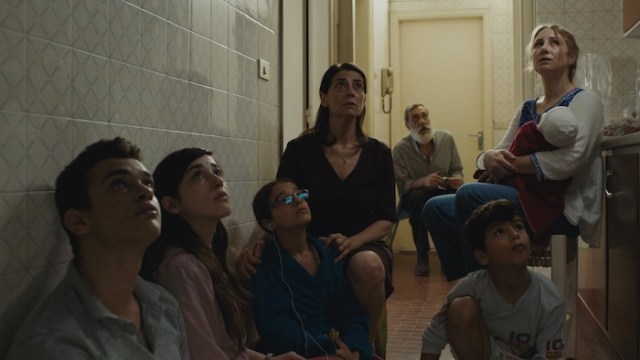 Narrative films that take as their subject current affairs face a dilemma in terms of execution. How much of the story will be irrelevant or even incorrect in years to come? What sort of viewpoint should the direction take, or should a viewpoint be taken at all? In Syria, also called Insyriated (a made up word?) in some markets, is set during the early days of the Syrian civil war, which was almost a decade ago, so in a sense the Belgian director, Philippe Van Leeuw, has some leeway with historical distance in making his decision as to how to approach the conflict, and he has chosen to generalize the circumstances as to lose any specific idea of how the war came about and how it is being fought. Essentially, this is a movie about “all war,” and while that approach doesn’t detract from the film’s dramatic power it does make it that much less convincing as a historical document.
 This American teen comedy, focusing almost exclusively on the girls’ experience, is blessed with one of the best titles of recent memory. “Booksmart” implies a brain full of stuff derived from reading materials and outside sources rather than from experience. It’s the opposite of “street smart.” Our two protagonists, Molly (Beanie Feldstein) and Amy (Kaitlyn Dever), are more than just the class nerds, students who get straight As and participate in the astronomy club and school band. They’re also the class snobs in that they put on a front of not caring about what the rest of their classmates do, i.e., popularity through being hip and a willingness to party under any circumstances. Molly and Amy aren’t hip except to their own vision of adult sophistication and responsibility (they proudly flaunt their Warren for President bumber stickers), and in that regard they see themselves as better than their peers because they’ve been accepted to top-flight universities. This self-affirmation, however, is deflated when, during the final weeks of their senior year, they discover that most of those peers are also going to top-flight universities — and without having busted their assses academically the way Molly and Amy did.
 Here’s
  Though Korean movies still find wider distribution in Japan than do movies from other countries outside of the U.S., some Korean movies have an easier time of it than others. The fact that this occult actioner features Park Seo-jun, who stars in the wildly popular Netflix drama Itaewon Class, is probably the main reason for its being picked up. On the surface, the high-concept premise—a mixed martial arts fighter moonlights as an exorcist—didn’t hurt, but all these elements don’t necessarily blend together in a satisfactory way. Park himself often looks as if he’s not entirely sure what he’s supposed to be doing when he isn’t throwing flame balls at Satan’s spawn.
 Like Joseph Heller and the Notorious B.I.G., Chinese director Wang Bing debuted with a work that was so overwhelming in its originality, scope, and message that anything he would produce subsequently was bound to be anticlimactic; but like those two seminal artists, Wang has pretty much nailed his subjects consistently. West of Tracks, his nine-hour documentary, released in 2002, about the decay of China’s biggest, most ambitious industrial complex, shot seemingly in real time, wasn’t just immersive. You left the theater so disoriented that it might take several days to readjust to reality.
 philipbrasor.com