Media Mix, Aug. 30, 2020

Kabuki actor Ichikawa Ennosuke in “Hanzawa Naoki 2”

Here’s this week’s Media Mix, which is about the popular TBS drama series, Hanzawa Naoki 2. As pointed out in the column, the dramatic elements of the production are purposely exaggerated, especially the acting, which is at least partially based on kabuki stylings. The fact that the production employs a number of well-known kabuki actors only points up this purposefulness, but as one of the experts I cite in the column, Kesako Matsui, told the Asahi Shimbun, kabuki actors often act in standard movies and TV dramas where they play standard characters without resorting to their particular gei (art). Here, as she notes, they are being asked to explicitly tap into their traditional skills as stage performers but for a visual medium that relies a great deal on intimacy. And as I stress, this aspect gives the whole project an air of ludicrousness. But I also think this ludicrousness is purposeful, because it plays up the artificiality of both the story and the production.

Artfulness is not exclusive to Japanese theater but in my experience it tends to have a higher value within the movie and TV industry owing to certain developments that have more to do with commerce than with art. I’ve always loved the classic Japanese films that every critic cites as fundamental to understanding the greatness of world cinema, but there are few Japanese movies, whether independent or studio-led, released after, say, the late 80s that give me as much pleasure, and for a long time I always thought it was a fault in my own stars, but now I think it may have something to do with this emphasis on artificiality. There are many great trained actors in Japan, but, as in Hollywood during its golden age, leading men and women are often cultivated as leading men and women, and thus scouted or selected due to attributes such as looks or charisma rather than their acting abilities. From the mid-90s almost all TV drama series in Japan employed pop music idols as stars for obvious reasons. (Not new; in the 60s and 70s many Japanese movie stars were also pop singers, but often they started out as movie stars) Given the logistical circumstances of TV productions in Japan—most series are put together and shot very quickly so as to keep costs down—preparation is not as important, and so actors have to do the best they can. Supporting actors in such productions tend to be professionals and they can be counted on to carry their weight, but the leads are often out of their depth, and they probably know it, so in order to come across as deserving of the responsibility thrust upon them by TV producers and their own talent agencies (which, in many cases, are collaborating with the producers directly on the shows) they overdo it. In other words, they act their asses off, and the effort shows.

Since this sort of thing is perhaps more acceptable in Japan because of the traditional dynamic between audience and performer as exemplified by kabuki, few people may find it as off-putting as I do. (There are idol-movie stars in Hollywood, too, best represented by Elvis Presley, but they tend to compensate for their lack of skills by going in the opposite direction, by assuming a kind of forced naturalism) Still, I think as an aesthetic it has come to permeate movies and TV dramas to the point where directors (or, at least, younger ones) expect it, and that generates a cycle of ever-more obvious artificiality. To put it bluntly, Japanese movies and TV dramas tend to focus on the kind of showmanship that is overly evident in Hanzawa Naoki 2 simply because it proves to the auidience that the actors, directors, and even the writers are working hard. It’s not enough to deliver a story that makes you think or appeals to your imagination, the production itself has to blow you away with the professionalism of it all. And you can’t show off your professionalism by holding back.
Posted in Media | Tagged | Leave a comment

Review: In Syria

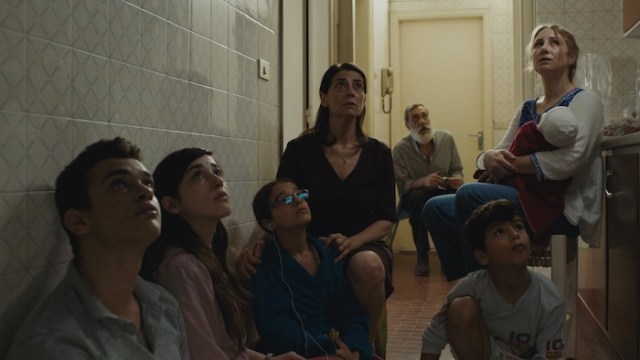
Narrative films that take as their subject current affairs face a dilemma in terms of execution. How much of the story will be irrelevant or even incorrect in years to come? What sort of viewpoint should the direction take, or should a viewpoint be taken at all? In Syria, also called Insyriated (a made up word?) in some markets, is set during the early days of the Syrian civil war, which was almost a decade ago, so in a sense the Belgian director, Philippe Van Leeuw, has some leeway with historical distance in making his decision as to how to approach the conflict, and he has chosen to generalize the circumstances as to lose any specific idea of how the war came about and how it is being fought. Essentially, this is a movie about “all war,” and while that approach doesn’t detract from the film’s dramatic power it does make it that much less convincing as a historical document.

The entire film is set within a Damascus apartment that is under siege by default due to the presence in the neighborhood of snipers. The apartment belongs to Oum Yazan (Hiam Abbass), who has been left alone with her elderly father-in-law and three children by a husband whose purpose at being away is never clearly explained, though it obviously has something to do with the war. Oum has barricaded the front door, and in the process of shutting out the world has taken in her housekeeper, Delhani (Juliette Navis), her teenage daughter’s boyfriend, and a young neighbor couple with an infant. The couple, Samir (Moustapha Al Kar) and Halima (Diamond Abou Abboud), have access to egress to Beirut through a journalist friend of Samir’s, but he has to leave the apartment to retrieve papers that will get them over the border. This act becomes the focal point of the plot, since its outcome forces Oum to consider several different unpleasant scenarios. The one she chooses is ostensibly a no-brainer: she will do anything to protect her family. However, the decision that Van Leeuw makes in order to bring home this point is brutal in the extreme, exposing the savagery that attends warfare but without the kind of context that makes it meaningful in this particular situation. All we derive from the terrible middle section is that men (specifically Arab men) are capable of the most atrocious behavior when left to their own devices.

Perhaps Syrians who watch the film will understand enough of what’s going on to know why these events unfold as they do, but for the rest of us there’s a gaping hole that just grows wider as the story reaches its conclusion. Van Leeuw understands that too much exposition ruins the flow of a movie like this, which depends on the niceties of everyday existence within a larger crisis to maintain tension and interest. But all we really come away with is the old cliche about war being hell, especially for women.

In Arabic. Now playing in Tokyo at Iwanami Hall Suidobashi (03-3262-5252).

In Syria home page in Japanese.

photo (c) Altitude100-Liaison Cinematographique-Minds Meet-Ne a Beyrouth Films

Posted in Movies | Tagged | Leave a comment

Review: Booksmart

This American teen comedy, focusing almost exclusively on the girls’ experience, is blessed with one of the best titles of recent memory. “Booksmart” implies a brain full of stuff derived from reading materials and outside sources rather than from experience. It’s the opposite of “street smart.” Our two protagonists, Molly (Beanie Feldstein) and Amy (Kaitlyn Dever), are more than just the class nerds, students who get straight As and participate in the astronomy club and school band. They’re also the class snobs in that they put on a front of not caring about what the rest of their classmates do, i.e., popularity through being hip and a willingness to party under any circumstances. Molly and Amy aren’t hip except to their own vision of adult sophistication and responsibility (they proudly flaunt their Warren for President bumber stickers), and in that regard they see themselves as better than their peers because they’ve been accepted to top-flight universities. This self-affirmation, however, is deflated when, during the final weeks of their senior year, they discover that most of those peers are also going to top-flight universities — and without having busted their assses academically the way Molly and Amy did.

To say this realization takes the wind out of their sails is an understatement. It basically negates their entire adolescence, which means they have only a weekend or two to make up for it, and they decide to debauch to their heart’s content; except, of course, they have no idea of how to debauch. The script, by director Olivia Wilde and four other women, distinguishes the two girls, BFFs if there ever were any, by temperament. Molly is an extrovert, the class president who is still asserting her prerogatives on the last day of school, while Amy suffers from a latent case of same sex attraction (not to Molly, who seems straight) that keeps her introverted when it comes to social interactions, though she’s woke enough to put down racists and dweebs when the situation calls for it. In a sense, Booksmart occasionally suffers from an abundance of riches: the dialogue is sharp and rapid-fire, the incidental music is punchy and appropriate, and the surfeit of weird high school types provides humor that doesn’t get old right away.

Booksmart is what used to be called a picaresque, only that our two rogues are essentially learning their bad manners as they go along. By that token, the humor can get pretty gross (the vomit scene and copious references to female masturbation are quite ripe), which may be why some critics have unimaginately called it the girls equivalent of Superbad (also, that movie starred Feldstein’s older brother, Jonah Hill), but it’s probably the movie’s sensitive, empirically true take on teen sex that makes Booksmart the superior movie, not to mention its generally optimistic take on the lives of young people who spend too much time in high school smoking pot and playing video games. Wilde doesn’t look down on anyone here, but rather endeavors to show that high school shouldn’t be the best or worst time of a person’s life. It simply is what it is, as one very un-booksmart person recently said.

Now playing in Tokyo at Human Trust Cinema Yurakucho (03-6259-8608), Shinjuku Musashinokan (03-3354-5670), Shibuya Cine Quinto (03-3477-5905), Toho Cinemas Roppongi Hills (050-6868-5024).

Booksmart home page in Japanese.

photo (c) 2019 Annapurna Pictures LLC

Posted in Movies | Tagged | Leave a comment

Media Mix, Aug. 16, 2020

Here’s this week’s Media Mix about recent cases of child molestation by school teachers and childcare professionals. As pointed out in the column, the crime of sexual abuse generally becomes more difficult to prove and prosecute when the victim is a child because of the way children process that abuse. In many instances it isn’t until years later that the child realizes they were abused, though they had probably been carrying around the resulting pain and confusion in the intervening years. The Japanese government amended its sexual crimes law in 2017, making it stricter, but a relatively short statute of limitations remains and this year they are supposed to review the law again. Advocates for stricter laws are hoping to lengthen the statute of limitations for sex crimes or even get rid of it altogether, especially when it comes to sex crimes against minors.

Without a doubt, the more cases of sex crimes that are prosecuted the greater the awareness of child sexual abuse in the general population. This has already happened with child abuse in the past. Laws were made more strict and penalties were increased, and as a result more child abuse incidents are reported. It’s not so much that the incidence of child abuse has increased, but that cases of child abuse that may have been overlooked in the past are now being noticed more readily and reported to authorities. The same will happen with child sexual abuse, which is often more difficult to determine because the scars are psychological rather than physical and the perpetrators are usually adults in positions of authority whom the children are taught to respect, in particular teachers. According to the Sankei report I cited, in 2018, 282 school teachers in Japan were “punished” for improper touching of students, a record high. The number rose above 200 for the first time in 2013. Obviously, awareneness of child molestation in schools has grown in recent years, and a countermeasure I found interesting was one suggested by a lawyer, who said that sex education for elementary school children should be reinforced with lessons that explain what molestation is and how children can recognize and report it. What I find interesting is that teachers will be handling these classes, and while the number who are active pedophiles is very low (0.02-0.03% of all teachers in Japan receive punishment for touching students improperly), even those teachers will be confronted with their own actions during these lessons. In a sense, such lessons could have a multiplying effect of preventing sexual abuse, though, unfortunately, sex education, at least in public elementary schools, is frowned upon by many bureaucrats and politicians. They just feel uncomfortable having children listen to anything that has to do with sex, which, of course, is why there’s a problem in the first place.

Posted in Media | Tagged , | Leave a comment

Review: The Divine Fury

Though Korean movies still find wider distribution in Japan than do movies from other countries outside of the U.S., some Korean movies have an easier time of it than others. The fact that this occult actioner features Park Seo-jun, who stars in the wildly popular Netflix drama Itaewon Class, is probably the main reason for its being picked up. On the surface, the high-concept premise—a mixed martial arts fighter moonlights as an exorcist—didn’t hurt, but all these elements don’t necessarily blend together in a satisfactory way. Park himself often looks as if he’s not entirely sure what he’s supposed to be doing when he isn’t throwing flame balls at Satan’s spawn.

Like all good Korean action films, and quite a few non-action films, The Divine Fury is premised on revenge. As a child, Yong-hu loses his widowed policeman father after the latter is savagely attacked during a routine traffic stop, and denounces his father’s Catholicism when he realizes that this faith did nothing to alleviate the pain of losing a wife and didn’t protect him from the evil in the world. He becomes a professional fighter whose m.o. is beating his opponents within an inch of their lives in the first round, fired up by a hatred for humanity. Fortunately for him the world loves to watch this kind of thing and rewards him handsomely. He lives in a luxury condo in central Seoul and has fans the world over, but, of course, he’s never happy, and one day he develops a painful wound on the palm of his hand that he eventually come to learn is stigmata. He swallows his pride and consults Father Ahn (Ahn Sung-ki), a have-holy-water-will-travel exorcist for hire, who tells him that due to his denunciation of his father’s faith, evil spirits are battling for his soul.

As it happens, a smarmy, ageless nightclub owner (Wu Do-hwan), contains the evil spirit that killed Yong-hu’s father, and now seems bent on taking over Yong-hu, but the movie never quite calms down long enough to make sense of the whole evil possession thing. Those familiar with The Exorcist will appreciate the script’s fidelity to the lore of demon possession—the naming of names, the transmigration of evil from one body to another, and the various tools at the disposal of the exorcist—but we never get a clear idea of how or why the nightclub guy is doing what he’s doing except that it looks like he’s having fun; and it could be a lot more fun if the first element in the high-concept theme, that of the martial arts fighter, were exploited more elaborately. As it stands, Yong-hu does more soul-searching and demon-denouncing than he does ass-kicking. It’s a muddled though nonetheless handsomely staged thriller that also lacks much in the way of campy horror, relying too much on cheesy special effects and uninspired body makeup (though the lizard-man thing at the end is pretty good). Park Seo-jun stans may be satisfied because they get a few scenes of him without his shirt on, but when plot integrity requires the donning of a priest’s collar, even that kind of fan service is compromised.

In Korean. Now playing in Tokyo at Cinemart Shinjuku (03-5369-2831).

The Divine Fury home page in Japanese

photo (c) 2020 Lotte Entertainment

Posted in Movies | Tagged | Leave a comment

Media Mix, Aug. 2, 2020

The new Uniqlo outlet in Harajuku

Here’s this week’s Media Mix about the fall of the Japanese apparel industry as a result of the coronavirus crisis. As I mentioned, the industry was already failing even before the pandemic. The Big Three—Renown, Onward, and Sanyo Shokai—were struggling mightily and relying on foreign investment funds or partners to keep them afloat. And it wasn’t just competition from fast fashion that was eating into their revenue. Perhaps the most representative change was when Sanyo lost its license to sell Burberry, a hugely popular brand in Japan, back in 2015. The company’s fortunes tumbled and have never climbed back. Sanyo has gone through three CEOs in the meantime.

The main problem is that the culture of fashion has changed a lot since Japanese apparel’s heyday in the 70s-80s, when television and magazines were at the apex of their influence. There were so many publications—not just fashion magazines, but lifestyle publications centered on clothing—that everybody regardless of income was up on the latest trends. The rise of the internet eroded this advantage in two ways. Firstly, it diluted the power of print, and secondly, it made shopping in person unnecessary, two factors that were essential to the prominence of clothing fads in the public’s imagination. Of all the emerging post-bubble Japanese clothing brands, Uniqlo is thought to be the greatest success, but even Fast Retailing, the company that owns Uniqlo, is going through hard times right now, and was suffering even before CV-19 arrived on these shores. Though Uniqlo bucked fashion trends by selling what is essentially generic-albeit-high-quality clothing, its success still relied on people visiting actual stores, and the brand’s rise was in direct proportion to the number of outlets it opened, and not just in Japan. Fast Retailing has closed a lot of stores in recent years, mainly overseas (in China, Uniqlo’s products are still considered status items), but it did recently open a new shop in Harajuku that points to its future sales strategy, allowing customers to browse apparel on screens, “coordinate outfits,” and then “process” their purchases via their smart phones. I’m not really sure why people have to go to a store to do all this, but that’s probably why the store is in Harajuku, where window shopping is still a thing. If the concept is successful, then Fast Retailing may expand it to other outlets. Rumor has it that Amazon is coming out with its own clothing line, so Fast Retailing is obviously worried they’ll be left behind in the digitization wave.

It’s hard to imagine that more hardcore fashion lines can survive in this kind of environment, though they seem to be adapting the best they can. Another evolutionary aspect covered by the Asahi Shimbun is very small fashion houses that could be called super-niche suppliers. One that the newspaper profiled is owned and run by a 25-year-old Japanese woman who grew up in Shanghai. She once worked as a sales clerk at Shibuya 109, the mecca for young fashionistas. Her concept is simple: she wants to make the kind of clothing she wants to wear, and so carries out everything herself, from design to marketing to sales. She even does her own modeling, and it’s all digitized, not just sales (via Instagram). Most importantly, she is sensitive to trends and tastes, and only produces as much product as she can sell. Unlike conventional fashion houses she isn’t afraid of running out of inventory. If she sells out a line, that’s great, since she doesn’t have to worry about clearance sales and stocking issues. And she charges what the market will pay, which, in the case of her T-shirts, is about ¥7,000. High fashion isn’t dead, it’s just crawled into a cubby hole.

Posted in Media | Tagged | Leave a comment

Review: Dead Souls

Like Joseph Heller and the Notorious B.I.G., Chinese director Wang Bing debuted with a work that was so overwhelming in its originality, scope, and message that anything he would produce subsequently was bound to be anticlimactic; but like those two seminal artists, Wang has pretty much nailed his subjects consistently. West of Tracks, his nine-hour documentary, released in 2002, about the decay of China’s biggest, most ambitious industrial complex, shot seemingly in real time, wasn’t just immersive. You left the theater so disoriented that it might take several days to readjust to reality.
His newest film is equally monumental in terms of covering his chosen topic, except that the topic is more of an idea than a physical place. Dead Souls is a 495-minute deep dive into the anti-rightist campaign of the 1950s and 1960s carried out by the Chinese Communist Party, told by its survivors in their own voices. In 1956, the party launched the Hundred Flowers Movement, which encouraged members and non-members alike to frankly express their opinion on how Mao was doing. A year later, those who were against the movement—or, more likely, those whose feelings were hurt by it—gained power and reversed course. In the process they came down hard on anyone who had used the movement to criticize the party, branding them capitalist running dogs, rounding them up, and sending them off to re-education camps in the hinterlands to start life anew by essentially creating an agricultural community from scratch in an environment that was not suited for cultivation. Naturally, the vast majority starved to death, which seems to have been the point all along. How many? No one knows, not even those who survived, but despite their advanced age they all seem to remember vividly the atrocities committed against them, and their stories are riveting for both the intensity of the cruelty described and the matter-of-fact manner in which they’re described.

Wang focuses on two camps located in the Gobi Desert, a place he already knows well from his only narrative film so far, The Ditch, which dramatized a few of the stories related here. As good as The Ditch was in depicting the horror of life in those camps, it couldn’t possibly convey the enormity of the social displacement these people experienced. The movie is long because the stories are long, starting from how and why the subject was targeted by the authorities, to their “trial” (which often incorporated torture), and then to their exile. Wang sets everything in the present, careful in his insistence that he is referring to a past that would likely be forgotten if not for his herculean effort, taken at great risk to his own well-being, to make sure these stories are preserved for all time. He even interviews current residents of the area (yes, they did somehow create something of a community in this wasteland) who give an idea of where the bodies are buried, so to speak.

The movie is repetitive by necessity if not design. The camera is placed before the subject, who talks until they have nothing left to say. Though static and sometimes muddled, these interviews are punctuated by everyday activities—a wife drifting into the frame to deliver a snack, a relative dropping by and adding some clarity to a particular story—that make the movie seem more alive than if the stories had been recorded, edited, and used as voiceover. There is also an extraordinarily dramatic scene of a funeral for one of the survivors whose remains are carried up a treacherous hill in the former compound, capped by a moving elegy given by his son, whose own telling of his father’s tragic but eventful life deserves a film of its own. Taken together, these tales, and Wang’s unobtrusive way of getting them on film, has their own immersive, subversive power.

In Mandarin. Opens Aug. 1 in Tokyo at Theater Image Forum in Aoyama (03-5766-0114).

Dead Souls home page in Japanese.

photo (c) Les Films d’ICI-CS Productions-Arte France Cinema-Adok Films-Wang Bing 2018

Posted in Movies | Tagged | Leave a comment

Media Mix, July 26, 2020

Taro Yamamoto

Here’s this week’s Media Mix, which is about the Tokyo gubernatorial election earlier this month. Near the end, I mention a discussion between activist-writer Yasumichi Noma and journalist Koichi Yasuda on the web channel No Hate TV. The title of their discussion was Liberal Racism, which may sound to some people like an oxymoron, but Noma was quite clear in his belief that racism underlies the entire political and ideological spectrum in Japan. His essential point, I think, is that racism, or, at least, a blinkered view of people and institutions that are not “pure” Japanese, is built into a lot of Japanese social structures, just as prejudice towards people of color and their institutions is built into so-called white culture in the U.S. The difference between Japan and the U.S. in this regard is that people who identify as liberal in the latter are self-conscious about these structures, while in Japan they only pay attention to them if someone else points it out. The far left in Japan, for instance, has always been to a certain extent anti-semitic, Noma says, trading in Jewish conspiracy theory with regards to world finance, etc. Taro Yamamoto, the leader of the left-identified Reiwa Shinsengumi party, is an avowed Emperor-worshipper, and while that in and of itself doesn’t make him a racist, there are facets of his ideology that point to an inherent mistrust of China and South Korea. Noma says that almost all the political parties in Japan “attach certain meanings to certain ethnic groups,” but since they don’t talk about it explicitly, it doesn’t register publicly. The press reinforces these prejudices by not checking them, which means they probably share those prejudices. The tabloid media tend to wear their racism on their sleeves because they think that’s how the average person feels. The mass media is simply more careful with their language. Noma characterizes this phenomenon as being “populism,” thus lumping it together with other right-wing movements in the world that work to exploit the public’s worst instincts about “others.” As Thomas Frank pointed out in Harper’s magazine several issues ago, “populism” tends to get a bad rep for that reason even though its origin in the reformist movement of late 1890s U.S. politics was a direct reaction to the intolerance and greed of the ownership class. Somehow the term has become twisted over the years. Noma’s use of the English word may be slightly misleading, since it implies that populism is a foreign concept. What he wants to say is that all the candidates for Tokyo governor were racist in some way and signal as much to their supporters and to those undecided voters they hope to sway.

Posted in Media | Leave a comment

Eric Clapton, Budokan, Oct. 1997

Almost all of the music reviews I wrote for the Japan Times in the 90s and the movie reviews I wrote for the Asahi Shimbun during the same decade are not available on the Internet, so I will remedy that by slowly, methodically posting them here on my blog. I have not edited these, so all the prejudices and dumb assessments remain. Enjoy. Continue reading

Posted in Music | Leave a comment

Media Mix, July 19, 2020

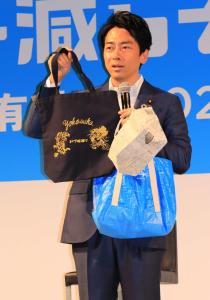
Shinjiro Koizumi and eco bags

Here’s this week’s Media Mix about the new rules for plastic shopping bags. As I say in the column, the rules aren’t going to make a big practical difference since shopping bags only account for about 2 percent of all plastic waste, which is now increasing due to the pandemic. The government has acknowledged this, saying that the main purpose of the rule is to heighten awareness, and in that regard, the highly visible, highly recognizable environment minister, Shinjiro Koizumi, is perfectly suited for the job of publicizing the rules. The Shincho article I cite in the column is actually mainly about Koizumi’s PR moves regarding the launch of the new bag rules, and it was typically unflattering about his efforts.

The title, for one thing, said something to the effect that minister’s “eco bag is empty.” The article begins by saying that the famously photogenic Koizumi hasn’t been much in the news lately since he became a father late last year, and seemed to need something to remind people that he was still around, so the shopping bag rule promotion was an easy and seemingly fool-proof way to get his face in front of cameras again, especially since, as Shincho put it, he has yet to register any kind of “achievement” as environment minister. It should be noted that he had little to do with the legislation for the bag restrictions.

From what I could gather in the main media, his PR activities came down to a public press event where he appeared with the helium-voiced TV talent and ichthyologist Sakana-kun where they rewrote a children’s song with lyrics having to do with plastic bags. He also patronized a convenience store in Nagatacho with the media in tow to show off his own eco bag, a blue plastic number recycled from tarp that had been used for cleanup purposes following the 2016 Kumamoto earthquake. To give credit where credit is due, Koizumi has been using this bag since the end of last year when he carried out a similar PR stunt to drive home the idea of refusing plastic shopping bags. However, this time Shincho made careful note of what he purchased at the CS: among his purchases were several beverages in PET bottles, a plastic waste scourge that has yet to receive its own legal sanction. Doesn’t Koizumi have his own reusable water bottle or coffee cup? Where’s the ministry spin doctors when you need them?

Posted in Media | Tagged | Leave a comment